
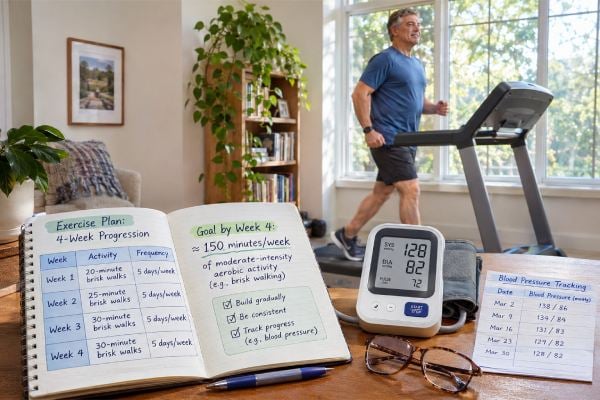
Regular exercise can lower blood pressure by an amount that is clinically meaningful, especially if your starting pressure is high. Across large research reviews, aerobic, resistance, combined, and isometric training commonly reduce resting systolic blood pressure by roughly 4 to 8 mmHg on average, with smaller but important drops in diastolic pressure. Some people improve more, while others improve less.
You may see a temporary blood pressure drop after a single workout, but lasting changes usually require several weeks of consistent training. A practical target is at least 75 to 150 minutes of aerobic activity per week, plus resistance training when appropriate. For many people with hypertension, about 150 minutes of moderate aerobic exercise per week is a strong goal and may produce substantial benefit within 8 to 12 weeks.
Exercise is not a replacement for prescribed blood pressure medication when medication is indicated. It is one of the most effective lifestyle tools to use alongside nutrition, weight management, sleep, and medical care.
Table of Contents
- How Much Blood Pressure Can Exercise Lower?
- How Fast Exercise Starts Working
- Weekly Exercise Targets That Make Sense
- Which Types of Exercise Lower Blood Pressure?
- How to Track Whether Exercise Is Working
- Common Mistakes That Reduce the Benefit
- When to Get Medical Guidance Before Exercising
How Much Blood Pressure Can Exercise Lower?
A realistic expectation is a several-point reduction in both systolic and diastolic blood pressure, not an instant 20- or 30-point drop. The exact effect depends on your starting blood pressure, exercise type, training dose, medication use, age, fitness level, and other health factors.
Large analyses help put the numbers in context:
- Aerobic exercise often lowers systolic pressure by about 4 to 7 mmHg and diastolic pressure by about 2 to 5 mmHg.
- Dynamic resistance training commonly lowers systolic pressure by around 4 to 8 mmHg in people with hypertension.
- Combined aerobic and resistance training can produce similar or sometimes larger average improvements.
- Isometric training, such as structured wall-sit or handgrip programs, has produced average systolic reductions of roughly 6 to 8 mmHg in several reviews, although protocols vary and this should not be treated as a guarantee.
These averages matter. A reduction of only a few mmHg across a population can translate into fewer strokes and cardiovascular events. At the individual level, a 6 mmHg fall can be the difference between remaining clearly hypertensive and moving much closer to a treatment goal.
People with higher starting pressure generally have more room to improve. If your average home pressure is 148/92 mmHg, a 6/4 mmHg improvement might bring it to about 142/88 mmHg. That is worthwhile, but it may still be above target. Exercise can be effective without being sufficient by itself.
If you are unsure how your readings are classified, review normal and high blood pressure ranges before judging your response.
How Fast Exercise Starts Working
Blood pressure responds to exercise on two different timelines: the hours after one session and the weeks after repeated training.
After one workout: hours of lower pressure are possible
After aerobic exercise, blood vessels often remain more relaxed for several hours. This is called post-exercise hypotension. The effect varies, but it can lower blood pressure for part of the day after a workout. That is one reason spreading activity across the week is useful instead of doing all your exercise on one day.
A single session does not mean hypertension is cured. The benefit fades, and your resting baseline does not permanently reset after one walk or bike ride.
After 2–4 weeks: early training effects may appear
Some people begin seeing lower resting readings within a few weeks, particularly if they were inactive before. Early improvements may come from better blood-vessel function, lower sympathetic nervous system activity, improved insulin sensitivity, and better handling of sodium and fluid.
Do not judge the program from two or three random readings. Blood pressure naturally varies from day to day. A consistent home-monitoring average is much more useful.
After 8–12 weeks: the effect is easier to judge
Most exercise trials that demonstrate meaningful reductions run for weeks to months. By around 8 to 12 weeks, you usually have enough training exposure to assess whether your routine is making a measurable difference.
This does not mean benefits stop at 12 weeks. Continued exercise helps preserve the improvement and supports weight control, fitness, blood sugar, sleep, and stress management. If you stop training, some of the blood pressure benefit may gradually fade.
Weekly Exercise Targets That Make Sense
The 2025 high blood pressure guideline emphasizes regular physical activity as a core lifestyle treatment and recommends about 75 to 150 minutes per week of aerobic and/or resistance exercise. General heart-health guidance also supports at least 150 minutes of moderate aerobic activity per week, with muscle strengthening on at least two days.
For blood pressure specifically, a strong practical target is:
| Goal | Practical target | Example |
|---|---|---|
| Aerobic activity | About 150 minutes/week moderate intensity | 30 minutes of brisk walking, 5 days/week |
| Strength training | 2–3 days/week | Full-body lifting with controlled breathing |
| Movement frequency | Most days if practical | Walks, cycling, swimming, active commuting |
| Progression | Build gradually | Add 5–10 minutes or small workload increases |
A 2024 dose-response meta-analysis in adults with hypertension found progressively larger blood pressure reductions as weekly aerobic exercise increased, with the greatest average decrease around 150 minutes per week. That does not mean 149 minutes is ineffective or that everyone needs exactly 150. It means the classic 150-minute target is supported by both general cardiovascular guidance and blood pressure-specific evidence.
If 150 minutes sounds unrealistic right now, start lower. Ten- or 15-minute walks still count. A person doing no planned activity may gain more from consistently reaching 60 to 90 minutes per week than from attempting a perfect schedule for one week and quitting.
A simple progression might look like this:
- Weeks 1–2: 15–20 minutes of moderate walking on 4 days.
- Weeks 3–4: 20–25 minutes on 5 days, plus one light strength session.
- Weeks 5–8: Build toward 30 minutes on 5 days, plus two strength sessions.
- After week 8: Keep the routine steady or add small amounts of time, hills, cycling, swimming, or other activities you enjoy.
The point of progression is not to delay benefits. It is to create a dose you can tolerate. Blood pressure responds to accumulated training, so a program that reaches 150 minutes gradually and then continues is usually more useful than an aggressive first week followed by inactivity.
Intensity matters, but it does not need to be complicated. For moderate aerobic work, the “talk test” is often enough: you should be able to speak in sentences, but singing would be difficult. For vigorous activity, speaking more than a few words at a time becomes harder. Heart-rate targets can be useful, but medications such as beta blockers can change heart-rate response, making perceived effort and clinician guidance more reliable.
For a gradual starting approach, use a beginner exercise plan for high blood pressure rather than jumping into hard intervals immediately.
Which Types of Exercise Lower Blood Pressure?
There is no single “best” exercise for everyone. The strongest program is one you can perform safely and repeat for months. Research supports several approaches.
Aerobic exercise
Brisk walking, cycling, swimming, jogging, dancing, and similar continuous activities have the largest evidence base. Moderate intensity is often described as a pace where you are breathing faster but can still speak in short sentences.
Walking is especially practical because it requires little equipment and can be split into shorter sessions. A detailed walking plan for heart health can help you turn casual steps into a more consistent training dose.
Aerobic exercise improves arterial function and cardiorespiratory fitness while helping with body weight and stress. In people with hypertension, about 150 minutes per week can produce a notable average blood pressure reduction, though individual responses vary.
Dynamic resistance training
Strength training can also lower resting blood pressure. Exercises may include squats, rows, presses, hinges, step-ups, resistance bands, and weight machines. The goal is not maximal lifting. Most people with hypertension benefit from controlled repetitions, good technique, and steady breathing.
Avoid holding your breath through difficult repetitions because the Valsalva maneuver can cause large temporary blood pressure spikes. Exhale through the hardest part of a lift and stop sets before technique breaks down.
Research increasingly supports combining resistance work with aerobic training rather than treating them as competitors. You can learn more about strength training for blood pressure and heart health if you want to build a balanced plan.
A practical strength session does not have to be long. Six to eight exercises covering the major muscle groups can be enough. Many beginners can start with one or two sets of about 8 to 15 controlled repetitions, using a load that feels challenging but leaves several repetitions in reserve. Rest between sets, breathe continuously, and increase resistance gradually rather than testing maximum strength.
Strength training also helps preserve muscle during weight loss and makes daily activities easier. Those benefits matter because better mobility and strength can make it easier to stay active throughout the rest of the week, indirectly increasing the total amount of movement that supports blood pressure control.
Isometric exercise
Isometric exercise means contracting muscles without much joint movement. Examples include wall sits and handgrip holds. Meta-analyses have reported meaningful reductions in resting blood pressure from structured isometric programs, often performed several times per week for at least 8 weeks.
The results are promising, but protocols are specific. A hard wall sit is not automatically safe for every person with severe or uncontrolled hypertension. If you want to use this method, follow a structured isometric exercise plan for blood pressure and use an intensity appropriate to your health status.
Intervals and vigorous exercise
High-intensity interval training can reduce blood pressure and improve fitness, but it is not necessary to receive a benefit. Moderate exercise works well and may be easier to sustain, especially for beginners, older adults, or people with cardiovascular disease.
If you enjoy vigorous training and have no medical reason to avoid it, it can be part of your program. If you are starting with uncontrolled hypertension, chest symptoms, or significant heart disease, get individualized guidance first.
How to Track Whether Exercise Is Working
Blood pressure should be judged from averages, not from the lowest reading you can produce after exercise.
A good tracking method is to measure at consistent times when you are rested, not immediately after a workout. Sit quietly for about five minutes, support your back and arm, keep your feet flat, and use a validated upper-arm cuff that fits correctly.
For a short monitoring period, you might take two readings one minute apart in the morning and two in the evening for several days. Average the readings according to your clinician’s instructions. A consistent routine is more informative than checking repeatedly throughout the day.
See a home blood pressure monitoring schedule if you need a repeatable method.
When assessing exercise progress, track three things:
- Training dose. Record minutes, days per week, and general intensity.
- Blood pressure average. Compare multi-day averages, not isolated readings.
- Medication and weight changes. These can affect blood pressure independently and should be noted.
For example, suppose your seven-day home average is 138/86 mmHg before starting exercise. After 10 weeks of consistent walking and strength training, it averages 131/82 mmHg. That 7/4 mmHg improvement is meaningful. If you also lost weight or changed medication, however, the change cannot be credited to exercise alone.
Do not reduce or stop blood pressure medication because your exercise readings improve unless your prescriber tells you to. Better blood pressure is the goal; needing less medication is not the only measure of success.
Common Mistakes That Reduce the Benefit
Exercise lowers blood pressure best when the routine is consistent, progressive, and paired with accurate measurement. Common problems include:
- Doing one very long weekend workout. Blood pressure benefits are easier to sustain when movement is spread through the week.
- Starting too hard. Excessive soreness and fatigue can make a new program collapse within days.
- Ignoring resistance training. Aerobic activity is excellent, but strength work adds fitness and metabolic benefits and can also lower pressure.
- Holding your breath while lifting. This can cause large temporary pressure spikes.
- Assuming sweat equals effectiveness. Hot weather or a sauna-like gym increases sweating without necessarily improving the training stimulus.
- Measuring immediately after exercise. Post-workout readings do not represent your resting baseline.
- Compensating with excess food or alcohol. Exercise cannot fully offset a high-sodium diet, frequent heavy drinking, or large calorie excess.
- Stopping after the first improvement. Blood pressure benefits generally require ongoing activity.
A program also works better when paired with sleep, sodium reduction, a DASH-style eating pattern, stress management, and weight loss if appropriate. Exercise is powerful, but hypertension is often influenced by several factors at once.
It is also possible to improve fitness while the scale barely changes. Do not assume exercise “failed” just because weight loss is slow. A lower home blood pressure average, easier walking pace, lower resting heart rate, improved strength, and better exercise tolerance are all useful signs that your cardiovascular system is adapting.
If your blood pressure does not change after 8 to 12 weeks despite consistent exercise, review the whole picture. Confirm that your home measurement technique is accurate, estimate your true weekly exercise minutes, look at sodium and alcohol intake, and discuss medication or secondary causes of hypertension with your clinician. A nonresponse to exercise does not mean exercise lacks value; it means blood pressure may need additional treatment.
When to Get Medical Guidance Before Exercising
Most people can become more active safely, but some situations call for medical guidance before increasing intensity.
Talk with a healthcare professional if you have known cardiovascular disease, unexplained chest pressure, fainting, severe shortness of breath, a significant heart rhythm problem, or major kidney disease. Guidance is also important if your blood pressure is persistently very high despite treatment.
The 2025 high blood pressure guideline defines severe hypertension in nonpregnant adults as pressure above 180/120 mmHg. A reading in that range should not be treated as a signal to “exercise it down.” Follow medical advice promptly, and seek urgent care if very high pressure occurs with symptoms suggesting acute organ injury, such as chest pain, severe shortness of breath, neurological symptoms, or confusion.
For people who are stable but deconditioned, the safest strategy is usually simple: start with low-to-moderate intensity, increase duration before intensity, use controlled breathing during strength work, and build consistency over several weeks.
The bottom line is that you do not need extreme training to lower blood pressure. A repeatable combination of brisk walking or similar aerobic activity, strength work, and regular movement can produce a several-point reduction within a few months. Choose a weekly target you can actually maintain, measure your blood pressure correctly, and adjust the plan based on your real average rather than a single number. Consistency over months matters more than chasing the hardest possible workout or the fastest short-term drop. A durable routine is the result that matters most clinically.
References
- 2025 High Blood Pressure Guideline 2025 (Guideline)
- Effects of aerobic exercise on blood pressure in patients with hypertension: a systematic review and dose-response meta-analysis of randomized trials 2024 (Systematic Review)
- Exercise training and resting blood pressure: a large-scale pairwise and network meta-analysis of randomised controlled trials 2023 (Systematic Review)
- The efficacy of resistance training for the management of hypertension: a systematic review and meta-analysis 2025 (Systematic Review)
- Effects of different exercise training modalities on 24-hour ambulatory blood pressure in adults with hypertension: a network meta-analysis of randomised controlled trials 2026 (Systematic Review)
Disclaimer
This article provides general education and does not replace individualized medical care. Blood pressure exercise recommendations may need modification for people with cardiovascular disease, severe or uncontrolled hypertension, pregnancy, kidney disease, or other medical conditions. Do not stop or reduce prescribed blood pressure medication without guidance from the clinician managing it.





