Heart rate recovery is the drop in your heart rate after you stop exercising. The most common version, one-minute heart rate recovery, compares your heart rate at the end of exercise with your heart rate one minute later. A faster drop often reflects stronger parasympathetic “braking” from the autonomic nervous system and is generally associated with better cardiovascular fitness and lower long-term risk. But it is not a stand-alone fitness score, and one reading should not be treated as a diagnosis.
The number is heavily influenced by how hard you exercised, whether you stopped completely or kept walking, your age, medications, temperature, hydration, and the device you used. That is why a value that looks “good” or “low” can be misleading when the testing conditions change. Heart rate recovery is most useful when you measure it consistently and interpret it alongside exercise capacity, symptoms, resting heart rate, and overall health. Used that way, it can become a simple trend marker for how your cardiovascular system is responding to training and recovery.
Table of Contents
- What Heart Rate Recovery Measures
- How to Calculate Your 1-Minute Drop
- What Is a Good Heart Rate Recovery?
- What Can Change Your Result
- How Fitness Training Affects Recovery
- When a Low Number Deserves Attention
- How to Track Heart Rate Recovery Usefully
What Heart Rate Recovery Measures
Heart rate recovery, often shortened to HRR, measures how quickly your pulse slows after exercise. During exercise, your sympathetic nervous system helps raise heart rate and cardiac output so working muscles receive more oxygen. When exercise ends, parasympathetic activity returns and sympathetic drive falls. The heart begins to slow, often quite rapidly in the first minute.
That first-minute drop is useful because it captures part of the transition from exertion back toward rest. In the earliest phase, parasympathetic reactivation is especially important, while sympathetic activity gradually withdraws over a somewhat longer period. Breathing, blood pressure regulation, body position, and the muscle pump all contribute as well. This is one reason HRR should not be described as a pure measure of “vagal tone.” It is a practical composite signal from several systems adapting to the sudden change in workload.
In clinical exercise testing, a blunted recovery has been associated with higher risk of future cardiovascular events and death. The relationship does not mean a slow recovery directly causes those outcomes. Rather, HRR reflects several features of cardiovascular and autonomic function that overlap with health, fitness, disease burden, and medication effects.
Heart rate recovery is related to fitness, but it is not the same as fitness. Cardiorespiratory fitness is better represented by how much work or oxygen uptake you can achieve during exercise. A person can improve endurance performance without showing a dramatic change in one-minute HRR, and two equally fit people may have different recovery values. Research has specifically cautioned against using HRR as a single predictor of physical fitness.
This distinction matters because wearables often turn physiological data into simple scores. A recovery number can be informative without being definitive. If you want a broader marker of aerobic capacity, VO2 max and cardiovascular fitness provide a different and more direct view of exercise capacity.
How to Calculate Your 1-Minute Drop
The calculation is simple:
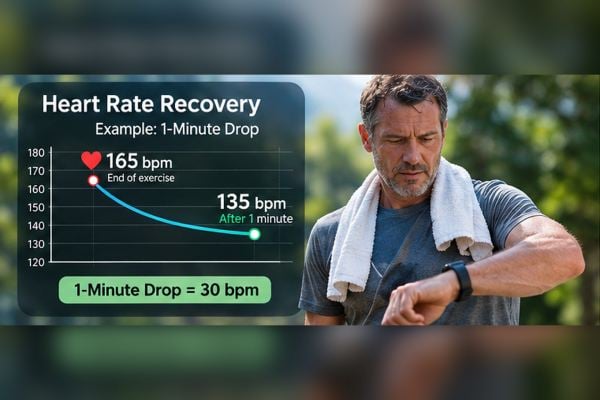
1-minute heart rate recovery = peak or end-exercise heart rate − heart rate 1 minute later
For example, if your heart rate is 165 beats per minute (bpm) at the end of a hard effort and 135 bpm one minute later, your one-minute HRR is 30 bpm.
The difficult part is not the subtraction. It is making sure the two measurements were taken under comparable conditions.
Use a consistent recovery protocol
Clinical studies use different recovery methods. Some have people stop and sit or lie down. Others use active recovery, such as slow walking. Heart rate usually falls faster with complete rest than with continued movement, so values from those two protocols should not be compared as if they were identical.
For home tracking, choose one repeatable method. Testing after a steady, familiar effort is usually more informative than testing after an all-out session because the effort is easier to reproduce. If you want to compare monthly trends, try to use the same time of day, similar room or outdoor conditions, and similar hydration status. One practical approach is:
- Use the same exercise mode, such as treadmill walking, cycling, or a familiar run.
- Finish at a similar effort level each time.
- Record the heart rate immediately at the end of the effort.
- Recover in the same way each time—either stand still, sit, or keep walking slowly.
- Record heart rate exactly 60 seconds later.
- Subtract the one-minute value from the end-exercise value.
If the exercise session itself varies greatly, the recovery result becomes harder to interpret. A 30-minute easy walk and a maximal hill repeat create different physiological stress, so their HRR values should not be treated as interchangeable.
Peak heart rate versus end-exercise heart rate
A wearable may show a “peak” heart rate that occurred before you actually stopped. If your pulse had already started falling during the final minute of a cooldown, subtracting the one-minute recovery value from that earlier peak can exaggerate the apparent drop. For repeatability, use the heart rate at the point when the exercise effort ends, not the highest value from anywhere in the workout.
If you are learning what heart-rate values are typical during activity, normal resting, walking, and exercise heart-rate ranges can provide context.
What Is a Good Heart Rate Recovery?
There is no single universal cutoff that separates “fit” from “unfit.” The number depends on the test protocol, population, age, exercise intensity, and whether recovery is active or passive. That is why a home device should not turn one cutoff into a medical diagnosis.
A historically important treadmill study defined an abnormal one-minute recovery as a drop of 12 bpm or less after exercise. That value is often repeated online, but it came from a specific clinical protocol and population. Other studies have used different cut points, and newer research shows that normal values vary by age, sex, and testing method.
As a practical interpretation for self-tracking rather than diagnosis:
| 1-minute drop | General interpretation for a consistent home test |
|---|---|
| Less than about 12 bpm | Slower than values used in many clinical studies; worth discussing if persistent or symptomatic |
| Roughly 12–20 bpm | May be normal depending on protocol, age, effort, and active recovery |
| Roughly 20–30 bpm | Commonly seen with reasonably brisk recovery |
| More than 30 bpm | Often reflects rapid recovery, especially after hard exercise |
These ranges are intentionally broad. They are not medical thresholds. A 17-bpm drop during a walking cooldown may be more reassuring than the same number after sitting still, because continued movement keeps heart rate higher. Likewise, a person taking a beta blocker may have a very different heart-rate response from someone not taking one.
The best question is not “Did I beat a cutoff?” but “Is my recovery appropriate for my testing conditions, and is the trend stable or improving?” A clinician interpreting an exercise stress test uses HRR together with workload, ECG changes, blood pressure, symptoms, and medical history. A person who achieves high exercise capacity, has no ischemic ECG changes, and feels well may be interpreted very differently from someone with the same HRR number but poor exercise tolerance or concerning symptoms.
Two-minute recovery can also be informative. Some exercise laboratories record both one- and two-minute values because later recovery captures additional sympathetic withdrawal. However, the same principle applies: a two-minute value should be compared with data from a matching protocol, not with a one-minute cutoff found online.
What Can Change Your Result
Heart rate recovery is sensitive to many short-term influences. A single unusually low value may reflect the day you measured it rather than a meaningful change in cardiovascular health.
Common factors include:
- Exercise intensity: A harder effort starts recovery from a higher physiological load.
- Active versus passive recovery: Walking keeps heart rate higher than sitting or lying down.
- Heat and humidity: The body may maintain a higher heart rate to support cooling.
- Dehydration: Lower plasma volume can increase cardiovascular strain.
- Sleep loss: Poor sleep can alter autonomic balance and perceived effort.
- Illness or fever: Heart rate commonly runs higher during infection.
- Alcohol: Recent alcohol intake can affect resting and recovery heart rate.
- Caffeine and stimulants: Effects vary by person and dose.
- Stress or anxiety: Adrenaline can slow the return toward baseline.
- Medications: Beta blockers and other drugs that alter heart rate can substantially change the result.
Age matters too. Maximum heart rate tends to decline with age, and recovery patterns can shift. Fitness level, body position, and the type of exercise also affect the number.
Device accuracy is another source of noise. Chest-strap monitors that detect electrical signals generally respond more quickly to rapid heart-rate changes than wrist optical sensors. Wrist devices can lag after intense exercise, especially when arm movement, sweat, cold skin, or poor contact affects the optical signal. If your one-minute value changes by only a few beats from week to week, that difference may be measurement noise.
For this reason, do not compare your HRR with a friend’s number unless the test conditions are nearly identical. Even then, the comparison says little about which person is “healthier.”
How Fitness Training Affects Recovery
Regular aerobic training often improves autonomic control and can make heart rate fall more quickly after exercise. Endurance-trained people frequently show brisk early recovery, and longitudinal studies have linked improved exercise capacity with improved HRR in many groups. The relationship is real but imperfect. Genetics, age, baseline fitness, medication use, and the type of training all influence how much the number changes.
Consistency matters more than trying to force rapid improvement. A beginner may see meaningful changes after several weeks of regular aerobic activity, but day-to-day HRR can still bounce around. A plateau does not mean training has stopped working if pace, power, duration, blood pressure, or perceived effort are improving.
A useful training plan should focus primarily on improving actual fitness, not chasing the biggest possible one-minute drop. For most adults, that means accumulating regular moderate-intensity aerobic activity, adding some vigorous work if appropriate, and doing resistance training. Walking for heart health is a practical starting point for people who are inactive, while more experienced exercisers may use structured intervals or longer steady sessions.
Why “faster” is not always better in isolation
Suppose two people finish a workout at 170 bpm. One stops completely and sits, while the other walks uphill for the first recovery minute. The first person’s heart rate might drop 40 bpm and the second person’s only 20 bpm. That does not mean the first person is twice as fit. The recovery protocol created much of the difference.
The same issue appears within your own training. If you finish one session with a sprint and another with a five-minute cooldown, your “peak-to-one-minute” values will not mean the same thing. Standardization matters more than maximizing the number.
Training load can also temporarily lower recovery quality. After a hard block of training, during illness, or after several nights of poor sleep, heart rate may remain elevated longer than usual. That can be a sign to reduce intensity for a day or two, but HRR alone cannot diagnose overtraining or determine readiness.
If you use heart-rate zones, combine them with perceived effort rather than relying on a watch alone. heart-rate training zones for beginners can help you set intensity more safely.
When a Low Number Deserves Attention
A persistently slow one-minute recovery is worth discussing with a healthcare professional when it appears in a standardized test or occurs alongside concerning symptoms. This is particularly true if you have known cardiovascular disease or major risk factors.
Seek prompt medical evaluation if exercise is accompanied by:
- Chest pressure or pain.
- Fainting or near-fainting.
- New or severe shortness of breath.
- An irregular or racing heartbeat that does not settle with rest.
- A major drop in exercise tolerance compared with your normal level.
- Dizziness, weakness, or unusual sweating out of proportion to the effort.
A low HRR by itself does not tell you the cause. Possible contributors include low cardiorespiratory fitness, autonomic dysfunction, heart disease, medication effects, or simply a testing method that differs from the study cutoffs you are comparing against. It is also possible to have a “normal” recovery value despite other cardiovascular problems, so HRR should never be used to clear yourself for intense exercise when symptoms or risk factors suggest you need an evaluation.
If you have symptoms during exercise, do not try to “train through” them to improve your score. A clinician may recommend an exercise stress test or cardiopulmonary exercise test, which can measure heart-rate response and recovery under controlled conditions while also checking blood pressure, ECG rhythm, and exercise capacity.
People taking beta blockers deserve special mention. These medicines deliberately blunt heart-rate response. Age-predicted formulas and generic recovery thresholds can be misleading in that setting. Exercise intensity is often better guided by a measured exercise test, perceived exertion, or clinician-directed targets.
How to Track Heart Rate Recovery Usefully
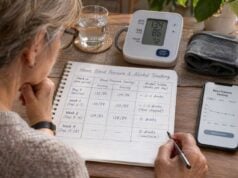
The best home use of HRR is as a trend under consistent conditions. You do not need to test it after every workout. A repeatable check every one or two weeks may be more useful than daily testing because it reduces noise and the temptation to overinterpret small changes.
A simple tracking template might include:
| Item | What to record |
|---|---|
| Exercise mode | Treadmill, bike, run, rower, etc. |
| Duration and effort | For example, 20 minutes at moderate effort |
| End-exercise heart rate | Heart rate at the moment the effort stops |
| 1-minute heart rate | Same device, exactly 60 seconds later |
| HRR | Difference between the two values |
| Recovery method | Sitting, standing, or slow walking |
| Context | Sleep, heat, illness, hard training, alcohol, medication change |
Look for changes that persist across several similar sessions. If your usual one-minute drop is around 30 bpm and it falls to 18 bpm once after a poor night of sleep, the isolated value may not matter. If it remains around 15–18 bpm over several weeks despite the same protocol, especially with reduced exercise tolerance or symptoms, that is more meaningful information to bring to a clinician.
Also remember that improvements can show up in other ways before HRR changes. You may be able to walk or cycle faster at the same heart rate, complete the same workout with less effort, or recover your breathing more quickly. Those are useful signs of adaptation too.
Resting heart rate can provide another trend, although it has its own limitations. See what resting heart rate says about fitness for a complementary metric.
Heart rate recovery is valuable precisely because it is simple. Its weakness is also its simplicity: it condenses a complex recovery process into one number. Treat it as one signal among many, measure it consistently, and give more weight to long-term patterns than to any single workout.
References
- Heart rate response and recovery in cycle exercise testing: normal values and association with mortality 2024
- Heart Rate Recovery: Up to Date in Heart Failure-A Literature Review 2024 (Review)
- Heart Rate Recovery (HRR) Is Not a Singular Predictor for Physical Fitness 2023
- Heart Rate Response to Exercise and Recovery: INDEPENDENT PROGNOSTIC MEASURES IN PATIENTS WITHOUT KNOWN MAJOR CARDIOVASCULAR DISEASE 2022
- Heart-rate recovery immediately after exercise as a predictor of mortality 1999
Disclaimer
This article is for general education and is not a diagnosis or personalized exercise prescription. Heart rate recovery can be affected by medical conditions and medications, and home-device readings may be inaccurate. Seek medical care for exercise-related chest pain, fainting, severe shortness of breath, or a sustained abnormal heartbeat.