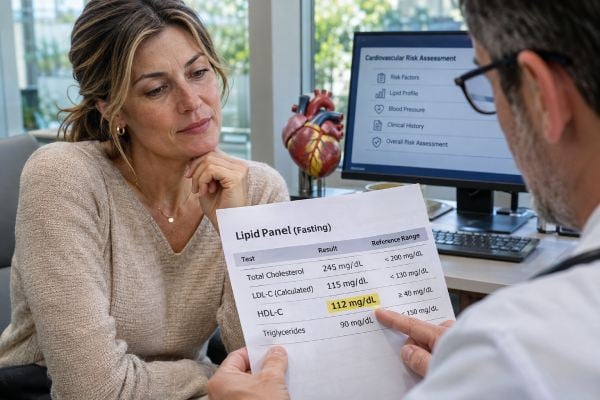
HDL cholesterol is often called “good” cholesterol, but a very high HDL level is not a guarantee of protection from heart disease. Low HDL has long been associated with higher cardiovascular risk, yet newer research shows that the relationship is not simply “the higher, the better.” Extremely high HDL can occur in healthy people, but it can also reflect genetics, alcohol use, liver or thyroid conditions, medications, or changes in how HDL particles function. Large studies have found a U-shaped pattern in which both low and very high HDL levels are linked with higher risk in some groups, especially men. More importantly, treatments that raise HDL cholesterol have generally not reduced heart attacks when LDL and other risk factors are already treated. The practical lesson is to stop treating HDL as a score you need to maximize. Look at LDL, non-HDL cholesterol, ApoB, triglycerides, blood pressure, diabetes, smoking, family history, and overall cardiovascular risk instead.
Table of Contents
- What HDL Cholesterol Actually Measures
- Why Very High HDL Is Not Always Protective
- What Counts as High or Very High HDL?
- Common Causes of High HDL Cholesterol
- What to Check When HDL Is Unusually High
- Should You Try to Lower High HDL?
- What Matters More Than a High HDL Number
What HDL Cholesterol Actually Measures
HDL stands for high-density lipoprotein. These particles carry cholesterol and other lipids through the bloodstream and participate in reverse cholesterol transport, a process that moves cholesterol away from peripheral tissues toward the liver for reuse or excretion.
A standard lipid panel reports HDL cholesterol (HDL-C) in mg/dL. That number measures how much cholesterol is being carried inside HDL particles. It does not directly measure how many HDL particles you have, how well they remove cholesterol from cells, or how effectively they perform antioxidant, anti-inflammatory, and endothelial functions.
That difference is central to the modern understanding of HDL. Two people can have the same HDL-C level but very different HDL particle size, composition, and function. Inflammation, diabetes, kidney disease, smoking, and other conditions can alter HDL biology even when the cholesterol content looks favorable.
Historically, population studies found that people with low HDL had more cardiovascular events. That association was strong enough that HDL became known as “good cholesterol.” But association is not the same as causation. Genetic studies and drug trials later showed that simply raising the HDL-C number does not reliably reduce cardiovascular events.
This is why a lipid panel should be read as a whole. If you need a refresher on all four common values, LDL, HDL, and triglycerides explained puts HDL in the right context.
Why Very High HDL Is Not Always Protective
The relationship between HDL-C and cardiovascular risk appears to be nonlinear. Low HDL is associated with higher risk, but very high HDL does not continue to provide more and more protection.
Recent reviews describe a U-shaped curve. In men, HDL-C around 80 mg/dL or higher has repeatedly been associated with increased all-cause or cardiovascular mortality in some cohorts. Findings in women are less consistent, and the level at which risk may rise appears to be higher. A 2024 meta-analysis of more than one million people found that very high HDL was not broadly protective against cardiovascular mortality; in dose-response analyses, risk rose at very high levels, particularly above about 94 mg/dL in men and 116 mg/dL in women.
These numbers should not be treated as universal danger cutoffs. They come from observational data, populations differ, and very high HDL may be a marker of other factors rather than a direct cause of harm.
Several explanations are possible:
- HDL particles may become dysfunctional, losing some of their protective properties.
- Genetic variants can raise HDL-C without lowering atherosclerotic risk.
- Heavy alcohol intake can increase HDL-C while raising blood pressure, triglycerides, arrhythmia risk, liver disease, and other health risks.
- Chronic disease can change HDL composition and function.
- Very high HDL may sometimes identify a subgroup with unusual lipid metabolism rather than “super-protection.”
Drug trials provide another clue. Niacin, fibrates in many settings, and several cholesteryl ester transfer protein approaches have raised HDL-C, yet raising HDL by itself has not reliably reduced heart attacks or strokes when compared with modern background treatment. That tells us HDL-C is not a simple therapeutic target in the way LDL cholesterol is.
The biology helps explain the paradox. HDL particles exchange proteins and lipids with other lipoproteins and tissues. They can help remove cholesterol from macrophages in artery walls, support endothelial function, and carry antioxidant enzymes. But these functions are not fixed. During chronic inflammation, kidney disease, diabetes, or oxidative stress, the HDL particle can be remodeled. A high concentration of cholesterol inside HDL particles may therefore coexist with poorer cholesterol-efflux capacity or altered anti-inflammatory behavior.
Researchers can measure HDL particle number, subclasses, or cholesterol-efflux capacity in specialized settings, but these tests are not yet routine tools for most primary-care decisions. There is no widely accepted “HDL function target” that clinicians treat toward. For everyday care, the safest interpretation is to avoid over-crediting a high HDL-C value and concentrate on risk factors with proven interventions.
Very high HDL can also distort some older risk calculators because those models generally treat higher HDL as progressively favorable. Newer reviews have argued that this may underestimate risk at the extreme upper end. That does not mean risk calculators are useless; it means a clinician should recognize when an unusual HDL level falls outside the assumptions that made the calculator work well in typical populations.
What Counts as High or Very High HDL?
Traditional lipid reports often consider HDL of at least 40 mg/dL in men and 50 mg/dL in women desirable, with 60 mg/dL or higher sometimes labeled “protective.” That older framing is too simplistic when HDL becomes very high.
There is no single universally accepted level at which HDL becomes “too high.” A practical interpretation is:
| HDL-C level | General interpretation |
|---|---|
| Below 40 mg/dL in men | Low HDL; associated with higher cardiovascular risk |
| Below 50 mg/dL in women | Low HDL; associated with higher cardiovascular risk |
| About 40–79 mg/dL | Common range; interpret with the full risk profile |
| 80 mg/dL or higher | Very high range in many studies; not automatically protective |
| Above 100 mg/dL | Unusually high; worth reviewing causes and the rest of the lipid profile |
Sex matters. Some studies have found stronger excess risk from very high HDL in men than women, and the risk curve in women may shift upward at higher values. That uncertainty is another reason not to use one threshold as a diagnosis.
What matters more is whether the high HDL is unexpected, persistent, and accompanied by other risk factors. An HDL of 88 mg/dL in a physically active person with favorable LDL, ApoB, triglycerides, blood pressure, and no heavy alcohol use may not require any special treatment. The same HDL in someone with LDL of 180 mg/dL, diabetes, smoking, and a strong family history does not make the overall profile safe.
For a full lipid-range overview, see normal cholesterol levels and target ranges.
Common Causes of High HDL Cholesterol
High HDL can be a normal inherited trait, but it can also be influenced by lifestyle, medications, and medical conditions.
Genetics: Variants affecting CETP, hepatic lipase, scavenger receptor pathways, or other aspects of HDL metabolism can produce very high HDL. Some genetic forms do not provide the expected cardiovascular protection.
Alcohol: Regular alcohol intake can raise HDL. That does not make alcohol a heart-health treatment. Higher intake can raise blood pressure and triglycerides, contribute to atrial fibrillation and liver disease, and increase cancer risk. Starting to drink alcohol to raise HDL is not recommended.
Exercise: Regular physical activity can modestly raise HDL while improving blood pressure, insulin sensitivity, fitness, and triglycerides. This is a favorable context because exercise benefits cardiovascular risk through many pathways, not because it pushes HDL as high as possible.
Estrogen and some medications: Hormonal factors and certain drugs can change HDL levels. Medication effects should be interpreted in the context of why the medicine is being used.
Thyroid or liver conditions: Some endocrine and liver disorders can alter lipoprotein metabolism. A very unusual lipid profile may prompt testing based on symptoms and history.
Inflammatory and metabolic conditions: Chronic disease can change HDL particle function even when the concentration is high. The number may therefore look “good” while the particle behavior is less protective.
A sudden change from your usual HDL is often more informative than a lifelong stable high value. If HDL rises sharply without a clear lifestyle explanation, review new medications, alcohol intake, weight change, thyroid symptoms, and liver history with a clinician.
Do not assume your HDL is high because you are doing everything right. Likewise, do not assume a high value is dangerous by itself. The job is to explain the pattern and judge the whole risk profile.
A few practical scenarios show why context matters. A lifelong HDL of 92 mg/dL in someone who rarely drinks alcohol, has LDL of 85 mg/dL, normal triglycerides, normal blood pressure, and no major family history is very different from a new HDL of 105 mg/dL in someone drinking several alcoholic beverages daily. It is also different from an HDL of 90 mg/dL paired with LDL of 190 mg/dL. In the last situation, the LDL level remains a major treatment priority regardless of the favorable-looking HDL.
Likewise, a high HDL does not neutralize an elevated lipoprotein(a), diabetes, smoking, or coronary calcium. These risk factors act through pathways that HDL-C cannot simply “cancel.” Thinking in terms of competing pluses and minuses is less accurate than identifying which causal risks are present and treating them directly.
What to Check When HDL Is Unusually High
If HDL is repeatedly above about 80–100 mg/dL, especially if it is new or unexpected, the next step is usually a broader cardiovascular review, not treatment aimed at lowering HDL.
Start with the rest of the lipid panel:
- LDL cholesterol
- Non-HDL cholesterol
- Triglycerides
- Total cholesterol
Then consider ApoB, particularly when triglycerides are elevated, diabetes is present, or LDL and non-HDL do not seem to tell the same story. ApoB estimates the number of atherogenic particles that can enter artery walls. A high HDL level does not cancel a high ApoB. ApoB versus LDL for heart-risk prediction explains why particle number can matter.
Other useful questions include:
- Do you smoke or vape nicotine?
- How much alcohol do you drink in a typical week?
- Is blood pressure controlled?
- Do you have diabetes, prediabetes, kidney disease, or inflammatory disease?
- Is there a family history of early heart attack or stroke?
- Is lipoprotein(a) elevated?
- Have liver or thyroid tests been abnormal?
- Do you already have coronary, carotid, or peripheral artery disease?
If cardiovascular risk remains uncertain, clinicians may use tools such as coronary artery calcium scoring in selected adults. The purpose is to look directly for evidence of atherosclerotic burden rather than assuming a high HDL protects you.
A clinician may also repeat the lipid panel if the result is surprising, especially after a major change in diet, alcohol use, weight, medication, or health status. Laboratory variation is usually modest, but confirming an outlier can prevent unnecessary workup. If the elevation is extreme and persistent or there is a strong family pattern, referral to a lipid specialist may be reasonable. Genetic testing is not routinely required for isolated high HDL, but it can be considered when the overall phenotype suggests an inherited lipid disorder.
The triglyceride-to-HDL ratio is sometimes discussed as a metabolic marker, but it should not replace standard risk assessment. If you are curious about it, what the triglyceride/HDL ratio means explains its strengths and limits.
Should You Try to Lower High HDL?
Usually, no. There is no established treatment goal to lower HDL-C simply because the number is high.
The association between very high HDL and mortality does not prove that lowering HDL itself would improve outcomes. In many cases, high HDL is a marker of genetics, alcohol exposure, or altered particle biology. Treating the underlying issue makes more sense than targeting the laboratory value.
If alcohol is contributing, reducing alcohol is appropriate because of its overall health effects, not because you are trying to force HDL downward. If a thyroid, liver, or medication issue is present, treat or adjust that problem based on its own clinical importance.
Do not stop exercising or eating unsaturated fats because these habits can raise HDL. Their cardiovascular benefits extend well beyond HDL and are supported by much stronger evidence.
Similarly, do not take a medication or supplement just to manipulate HDL. Past attempts to raise HDL pharmacologically taught an important lesson: changing the biomarker is not enough if clinical outcomes do not improve.
The better target is the burden of atherogenic particles, especially LDL-containing particles. If LDL is high, focus on proven methods to lower it through diet, weight management when relevant, statins, ezetimibe, bempedoic acid, PCSK9-directed therapy, or other evidence-based treatment depending on risk. High LDL causes and treatment is the more important article when both values are elevated.
What Matters More Than a High HDL Number
A high HDL should never be used as permission to ignore a high LDL, high ApoB, smoking, hypertension, diabetes, or a strong family history.
Think of cardiovascular risk as a portfolio rather than a single score. The most actionable priorities are usually:
- Lower atherogenic cholesterol when elevated. LDL and ApoB have a causal relationship with atherosclerosis and strong trial evidence for treatment.
- Control blood pressure. Hypertension damages blood vessels independently of HDL.
- Avoid tobacco. Smoking increases cardiovascular risk even when HDL looks excellent.
- Manage diabetes and insulin resistance. Glucose, triglycerides, weight, and blood pressure often improve together with effective treatment.
- Exercise consistently. Aim for sustainable aerobic activity plus resistance training rather than trying to “hack” HDL.
- Use alcohol cautiously or not at all. Do not drink for the purpose of raising HDL.
- Eat for LDL and overall risk. Replace excess saturated fat with unsaturated fats, eat soluble fiber, and build meals around minimally processed plant foods and appropriate protein sources.
- Consider family history and lipoprotein(a). These can reveal inherited risk that a favorable HDL obscures.
If your HDL is very high, the key question is not “How do I lower my good cholesterol?” It is “Does this number falsely reassure me about the rest of my risk?”
For many people, the answer will be reassuring: there is no disease to treat and no need to lower HDL. For others, the result is a prompt to look more carefully at LDL, ApoB, alcohol, genetics, or another condition. Either way, the old rule that more HDL is always better has outlived the evidence.
If you have established cardiovascular disease, the priority is even clearer: secondary prevention should not be relaxed because HDL is high. Proven therapies for LDL lowering, blood-pressure control, diabetes management, smoking cessation, exercise, and antiplatelet treatment when indicated remain important. High HDL is not a substitute for any of them.
The same principle applies to prevention before disease develops: use HDL as one clue, not as a shield against other measurable risks. A favorable-looking number should never stop you from treating a clearly unfavorable one.
References
- Association between very high HDL-C levels and mortality: A systematic review and meta-analysis 2024 (Systematic Review)
- High-Density Lipoprotein Cholesterol in Atherosclerotic Cardiovascular Disease Risk Assessment: Exploring and Explaining the “U”-Shaped Curve. 2023 (Review)
- Does Elevated High-Density Lipoprotein Cholesterol Protect Against Cardiovascular Disease? 2024 (Review)
- High-density lipoprotein in cardiovascular diseases: From high quantity to high quality 2026 (Review)
- HDL and ASCVD: is high HDL-C protective, harmful, or simply misleading? 2026 (Review)
Disclaimer
A high HDL cholesterol result cannot be interpreted safely without the rest of your lipid profile and cardiovascular risk factors. Do not change medications, alcohol intake, diet, or exercise solely to lower HDL; discuss unusually high or newly changed values with a healthcare professional, especially if LDL, ApoB, triglycerides, or family history are also concerning.