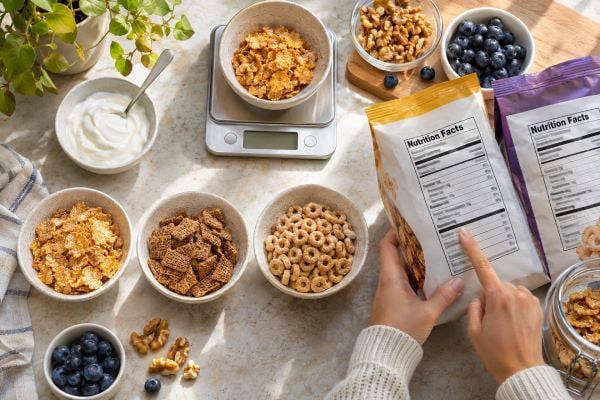
High-protein cereal can help you build a breakfast that produces a smaller rise in blood sugar, especially when it replaces a cereal with more digestible carbohydrate in the amount you usually eat. It can also make breakfast more filling.
But adding protein to sweetened flakes or puffs may leave the starch and sugar in your bowl much the same. Two boxes carrying the same protein claim can create very different breakfasts.
That matters when you’re shopping for prediabetes or diabetes and want something as easy as pouring a bowl of cereal. The useful numbers are on the back of the box, but they only make sense once you know how much you pour and what you add. Milk, yogurt, fruit, and a second handful can change the meal more than a few extra grams of protein in the cereal itself. A quick label comparison can show whether the higher-protein box earns its place in your cupboard.
Table of Contents
- How cereal protein affects blood sugar
- How to read a high-protein cereal label
- How high-protein and regular cereals compare
- How to build a more balanced cereal bowl
- How to check your own blood sugar response
- Is high-protein cereal worth buying?
How cereal protein affects blood sugar
Cereal can raise blood sugar even when it barely tastes sweet. During digestion, your body breaks much of the starch in grains into glucose. Finely ground grains and some puffed cereals can be digested quickly because processing changes the structure of the grain. The amount you eat, the type of grain or fiber in the cereal, and the rest of the meal all influence how high and how fast your blood sugar rises.
Protein can affect that response in two different ways. A cereal maker can replace some starch with protein, leaving less digestible carbohydrate in a similar-sized bowl. That’s a direct reason to expect a smaller rise, though the label cannot tell you exactly how your body will respond. A maker can also add protein while keeping much of the original starch and sugar. You get more protein that way, and the breakfast may keep you satisfied longer. The amount of carbohydrate your body still has to handle can be similar.
There’s a separate effect from eating protein with or around a meal. Some proteins can prompt insulin release and slow how quickly food leaves the stomach. In a review of 16 short-term trials with 244 adults, whey protein taken before a meal reduced the average glucose peak compared with water. The effect was more pronounced in participants with type 2 diabetes.
Those trials tested a separate serving of whey before eating. A bowl of flakes made with pea or soy protein, or even a cereal with whey baked into it, delivers a different combination of food, protein, and timing. Research on whey protein before meals can explain why protein might help, but it cannot predict the effect of a particular box of cereal.
A smaller rise after breakfast and a lower A1C are also different outcomes. A1C reflects average blood sugar over roughly three months. A cereal swap may improve the pattern you see after breakfast, but how much that matters over time depends on how often you eat it, the rest of your meals, and your overall diabetes care. The protein claim alone gives you little information about either outcome.
How to read a high-protein cereal label
Pick up the high-protein box and the cereal you’d otherwise buy. Compare them in the order below. Once you’ve done it a few times, you’ll know which numbers deserve a closer look.
Start with your portion and its total carbohydrate
Check the serving size in grams and cups. A cup of airy rings can weigh much less than a cup of granola. One box may list three-quarters of a cup as a serving while another lists a full cup. If you want to compare the formulas, use the same dry weight. If you want to know what you’ll eat for breakfast, use the amount you actually pour. Weighing your usual portion once can give you a better estimate than judging by how full the bowl looks.
Read Total Carbohydrate. On a U.S. Nutrition Facts label, this line includes starch, sugars, and dietary fiber. The sugar line gives you only part of the picture. A cereal can have 2 g of added sugar and still provide 30 g of total carbohydrate, much of it from starch.
For an actual bowl, divide the weight you pour by the labeled serving weight and multiply the carbohydrate grams by that number. If the label lists 24 g of carbohydrate per 40 g serving and you pour 60 g, the cereal contributes 36 g before milk or toppings.
If you count carbs for diabetes, use the method your care team taught you. The “net carbs” number on the front of a box may subtract all fiber or certain sweeteners, depending on the brand’s calculation. Use the Nutrition Facts panel as your starting point, especially when the count affects an insulin dose.
Check dietary fiber, added sugar, and protein
Look for a meaningful amount of fiber. Around 3 g or more in the amount you plan to eat is a practical shelf comparison, especially if your usual cereal supplies only 1 g or 2 g. For context, diabetes nutrition guidance recommends at least 14 g of fiber per 1,000 calories across the day.
The ingredient list can help you see where that fiber comes from. Whole oats, whole wheat, and wheat bran are common cereal ingredients. Some products get much of their fiber from ingredients such as inulin or chicory root fiber. These count toward the label total, and their effects on digestion and blood sugar can differ from those of fiber in a less processed grain. A large serving of cereal with added inulin may also cause gas or bloating.
Compare added sugars at the portion you’ll eat. If two cereals have similar total carbs and fiber, the one with less added sugar can help you cut back on added sugar overall. On U.S. labels, 5% Daily Value or less per labeled serving is considered low, and 20% or more is high. Honey, cane sugar, and syrups count as added sugars when used to sweeten cereal. The Total Sugars line already includes the amount listed under Added Sugars. A box with lower added sugar can still deliver a similar amount of starch, so circle back to total carbs before drawing a conclusion about glucose.
Read the actual protein grams. Check whether the number on the front applies to dry cereal or to cereal prepared with milk. Use the dry cereal column to compare boxes, then add the protein from whatever you normally serve with it. A bowl that already includes plain Greek yogurt may have plenty of protein for your needs. In a bowl with unsweetened almond milk, a higher-protein cereal could make a bigger difference to the meal’s protein content. These are two different reasons to buy the same box.
How high-protein and regular cereals compare
Imagine you’re choosing between three cereals and you plan to eat about 40 g of dry cereal. The figures below are made-up label examples. They show how two products with the same protein number can differ in ways that matter to your breakfast.
| Cereal | Total carbs | Fiber | Added sugars | Protein |
|---|---|---|---|---|
| Sweetened high-protein flakes | 26 g | 2 g | 8 g | 10 g |
| Higher-fiber protein cereal | 18 g | 5 g | 2 g | 10 g |
| Unsweetened whole-grain cereal | 29 g | 5 g | 0 g | 5 g |
The higher-fiber protein cereal gives you 8 g less total carbohydrate than the sweetened protein flakes at the same weight. It also delivers more fiber and less added sugar. If your goal is to reduce the amount of digestible carb in your usual bowl, that difference gives you more reason to try it than the protein claim does. The two cereals each supply 10 g of protein.
The unsweetened whole-grain cereal has the most total carbs of the three and the least added sugar. It could be a good choice if you enjoy the taste, want to spend less, or plan to serve the cereal with a protein-rich food. It also illustrates why a zero on the added-sugar line tells you little about the amount of starch in the bowl.
The comparison can change when you start pouring. Your usual bowl might hold 60 g of the higher-fiber protein cereal and 30 g of the unsweetened whole-grain cereal. Those portions would provide 27 g and about 22 g of total carbohydrate, respectively. The higher-fiber protein cereal still offers more protein in that example. The smaller bowl of whole-grain cereal supplies less total carb. Both comparisons are useful. One tells you what’s in the dry cereal gram for gram. The other tells you what you’re likely to eat.
Grain structure adds another piece of information. A review of trials comparing oat products with refined grains found that intact oat kernels and thick oat flakes reduced the rise in glucose after eating. The pooled comparisons for thin, quick, or instant oat flakes showed less clear benefits. That finding applies to the oat products tested. It explains why a cereal’s whole-grain ingredient can tell you something about what went into the box while leaving open how quickly the finished product digests. If you’re open to a hot breakfast, plain rolled or steel-cut oats give you a different grain texture and control over the sweetness.
Oats also contain a soluble fiber called beta-glucan, which forms a thick mixture when it dissolves in water. A separate review of trials in adults with type 2 diabetes found modest benefits for some measures of blood sugar over several weeks when people ate oats or oat beta-glucan. An oat-based cereal may contribute some of this fiber. The word “oat” on the box usually gives you too little information to compare the amount with what researchers tested.
How to build a more balanced cereal bowl
Start with the part of breakfast you want to keep. If it’s convenience, a cereal you like with plain yogurt requires about as much effort as a bowl with milk. If it’s the taste of a sweet cereal, a small amount can add flavor and crunch to a larger serving of plain yogurt. People who prefer a traditional bowl can keep the milk and adjust the cereal portion. Each option changes the meal in a different way.
Choose the liquid or yogurt you actually enjoy
Regular dairy milk contains protein and lactose, its naturally occurring sugar. Half a cup of plain cow’s milk typically adds about 6 g of carbohydrate and 4 g of protein. Using that estimate, the example higher-fiber protein cereal with 18 g of total carbs and 10 g of protein would provide about 24 g of total carbs and 14 g of protein with the milk. Sweetened or flavored milk can add more carbohydrate. Look up the numbers on the carton if you use a different quantity or type.
Unsweetened soy milk can give you a similar amount of protein to dairy milk, depending on the brand. Unsweetened almond milk often supplies less protein. Oat milk can add more carbs than you expect, even when it tastes mild. Check the label of the carton you buy and compare it using the amount you pour. If you use plain Greek yogurt or skyr, compare the carbohydrate and protein per portion. The flavored and plain versions from the same brand can differ considerably in added sugar.
Use toppings to solve a specific problem
If the bowl feels too small, try plain yogurt for more protein and volume. If the cereal tastes bland, berries or chopped apple can add sweetness and texture. Whole fruit contributes carbs, along with water and fiber. A small handful of walnuts or a spoonful of ground flaxseed can add crunch and fat. The toppings you choose should make the meal satisfying enough to carry you to your next planned meal or snack.
For a bowl with granola, try measuring the granola as a topping first. It’s dense, and a free pour can quickly turn a few spoonfuls into a full cereal serving. Adding granola, dried fruit, and honey at once can add more carbs than you meant to eat. Choose the topping you’ll enjoy most, taste the bowl, and decide whether it needs anything else.
Here are three combinations you can adapt using your own labels and appetite.
- For a familiar cold breakfast, pour a measured serving of whole-grain cereal and add plain dairy milk or unsweetened soy milk. Eat a plain yogurt or an egg alongside if you want more protein.
- For a crunchy yogurt bowl, top plain Greek yogurt with a few spoonfuls of your favorite cereal and a handful of berries. Use the cereal for texture, especially if the cereal you like is sweet.
- For a quick high-protein bowl, pair a cereal that fits your carb needs with the milk you already buy. If you’re still hungry well before lunch, try adding yogurt or nuts the next time and see whether the meal holds you longer.
How to check your own blood sugar response
If you already use a glucose meter or a continuous glucose monitor (CGM) as part of your care, breakfast is a practical meal to compare. Pick one question first. You could ask whether swapping cereals makes a difference when you keep the same milk and toppings, or whether a smaller portion of your current cereal with yogurt works better for you. Testing two complete breakfasts can help you choose between them. Changing just the cereal gives you a clearer sense of what the cereal itself contributed.
- Write down what goes in the bowl. Record the cereal and dry weight, the type and amount of milk or yogurt, and any toppings.
- Compare similar mornings. Aim for a similar breakfast time and routine. A walk after one breakfast, a poor night’s sleep, illness, or a change in medication can affect the comparison.
- Use the same reading times. Follow your usual monitoring plan. When your care team recommends after-meal checks, the timing is commonly one to two hours from the first bite. A premeal reading helps you see how much of the difference was already there before you ate.
- Look for a pattern across several mornings. Note how full you felt as well as what the readings showed. A small difference on one day can reflect ordinary day-to-day variation.
If one breakfast starts at 100 mg/dL and reaches 145 mg/dL at your usual checkpoint, that’s a rise of 45 mg/dL. If another starts at 120 mg/dL and reaches 150 mg/dL at the same checkpoint, the rise is 30 mg/dL, even though the later reading is slightly higher. Neither comparison by itself establishes which breakfast works better for you. Starting levels, how long readings stay elevated, and your personal targets all help you interpret the pattern. A single finger-stick reading also captures only one moment. With a CGM, you can see more of the curve, but sensor readings can lag behind blood glucose during rapid changes.
If you have prediabetes and don’t already monitor at home, you can make a reasonable choice using the labels, your appetite, and the lab follow-up you’ve planned with your clinician. A home reading after cereal cannot establish a diagnosis. If you take mealtime insulin or another medicine that can cause low blood sugar, follow your care plan when making a large reduction in your usual breakfast carbs. Bring repeated highs or lows to your care team so they can help you interpret them.
Is high-protein cereal worth buying?
It can be worth buying when the protein is useful to you and the rest of the label suits the bowl you’ll eat. If you usually eat sweetened cereal with a low-protein milk and want a breakfast that keeps you satisfied longer, a higher-protein cereal could make sense. If the new cereal also gives you less digestible carbohydrate in your usual portion, you have a reason to expect a smaller glucose rise. Look for fiber you tolerate and a portion that feels like breakfast.
If you already like an unsweetened, fiber-rich cereal, compare the price and taste of the protein version with the cost of serving your regular cereal with yogurt or an egg. A cheaper cereal you enjoy can be a good daily choice, and a higher-protein cereal can be a convenient option on rushed mornings. What you add to the bowl can give you more flexibility than switching boxes every time you see a new protein claim.
At the shelf, picture tomorrow’s breakfast. How much cereal will you pour, what will you pour over it, and will that bowl keep you satisfied? Compare the carbs, fiber, added sugar, and protein for that meal. Those numbers make it easier to see when extra protein earns its place and when your current cereal already does the job.
References
- 5. Facilitating Positive Health Behaviors and Well-being to Improve Health Outcomes: Standards of Care in Diabetes—2026 2026 (Guideline)
- Whey Protein Premeal Lowers Postprandial Glucose Concentrations in Adults Compared with Water-The Effect of Timing, Dose, and Metabolic Status: a Systematic Review and Meta-analysis 2023 (Systematic Review)
- A Systematic Review and Meta-Analysis of Randomized Controlled Trials on the Effects of Oats and Oat Processing on Postprandial Blood Glucose and Insulin Responses 2021 (Systematic Review)
- Effect of oats and oat ß-glucan on glycemic control in diabetes: a systematic review and meta-analysis of randomized controlled trials 2022 (Systematic Review)
- How to Understand and Use the Nutrition Facts Label 2024
Disclaimer
This article provides general nutrition information. If you take insulin or another medication that can cause low blood sugar, ask your diabetes care team how to handle significant changes to your usual breakfast carbohydrate intake. Use the glucose targets and monitoring schedule your clinician recommends for you.