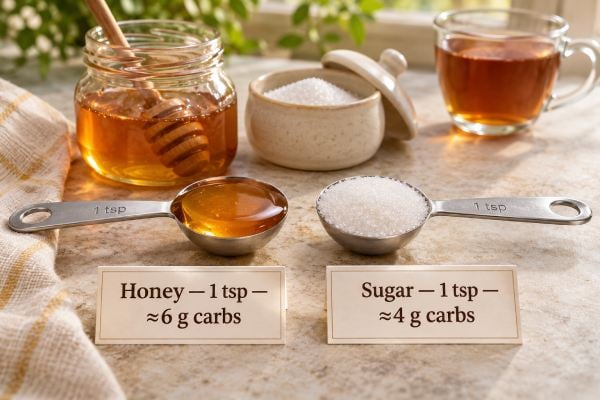
Honey can raise blood sugar, and swapping it for table sugar doesn’t reliably make the rise smaller. In studies that compare equal amounts of carbohydrate, some honeys produce a lower average glucose response than sugar. At home, though, the comparison usually starts with a spoonful: a level teaspoon of honey contains almost 6 grams of carbohydrate, while a teaspoon of granulated sugar holds about 4 grams. Honey is denser, so the same spoon delivers more carbs.
That difference matters when you stir honey into tea, drizzle it over oatmeal, or buy a cereal labeled “sweetened with honey.” If you enjoy the flavor and need less to sweeten, the swap can help you cut back on added sugar. If a drizzle becomes a tablespoon, the carbohydrate adds up quickly. Start with how much you actually use, then look at what else is in the meal. That tells you more about the likely effect on your blood sugar than the name of the sweetener alone.
Table of Contents
- Honey vs. Table Sugar by the Spoonful
- Why Honey Raises Blood Sugar
- What Studies Say About Honey and Glucose
- How to Use Honey in Meals and Drinks
- Honey With Prediabetes or Diabetes
- Can Honey Treat Low Blood Sugar?
Honey vs. Table Sugar by the Spoonful
Honey is mostly glucose and fructose, with water and smaller amounts of other sugars and compounds. White table sugar is nearly all sucrose — a molecule made of one glucose unit linked to one fructose unit. Your digestive system splits that link before absorbing the two sugars. Both sweeteners deliver carbohydrates that can affect blood sugar soon after you eat them.
The numbers depend on whether you measure by weight or volume. Gram for gram, honey contains less carbohydrate than granulated sugar because it is partly water. Spoon for spoon, it contains more because a given volume weighs more. That distinction explains why honey may look lower in sugar per gram and still deliver more grams of carbohydrate in a tablespoon.
| Amount | Honey | Granulated white sugar |
|---|---|---|
| ½ teaspoon | 3 g | 2 g |
| 1 teaspoon | Almost 6 g | About 4 g |
| 2 teaspoons | About 12 g | About 8 g |
| 1 tablespoon | About 17 g | About 13 g |
A U.S. tablespoon holds three teaspoons. The table rounds each row separately, so multiplying a teaspoon value can give a slightly different result than the tablespoon entry. If you count carbs for diabetes management, use the value on your product label when it’s available. An eating spoon can hold a different amount than a measuring spoon, and a squeeze bottle makes it easy to pour more than intended.
How much honey would make sense as a swap depends on what you’re replacing. If your tea usually takes two teaspoons of white sugar, switching to one teaspoon of honey cuts the added carbohydrate from about 8 grams to almost 6 grams. If you already use only one teaspoon of sugar, one full teaspoon of honey increases it. Half a teaspoon of honey supplies about 3 grams. Whether that tastes sweet enough depends on the honey, the drink, and your preference.
Treat honey you stir in, drizzle on top, or use in a recipe as added sugar. The same applies to honey in packaged foods. A jar of pure honey may show added sugars as a percentage Daily Value without listing a separate gram amount on that line. For carb counting, look at total carbohydrate for the stated serving and adjust for how much you use.
Why Honey Raises Blood Sugar
After you eat honey, glucose can enter your bloodstream from your intestine. Fructose takes a different route: your liver processes much of it, and it typically produces a smaller immediate rise in blood glucose than the same amount of pure glucose. Honeys vary in their mix of glucose and fructose, which helps explain why two jars can produce different results in a study. Both still supply readily absorbed sugars.
What the glycemic index can tell you
The glycemic index, or GI, compares blood sugar responses to foods given in portions that supply a fixed amount of digestible carbohydrate. Researchers usually track the overall rise over two hours and compare it with the response to pure glucose. A sample of honey with a lower GI than table sugar produced a smaller overall rise under those test conditions. That score alone can’t tell you how high your glucose will peak after a teaspoon of honey in coffee.
The GI of one honey also can’t stand in for every jar. The flowers bees visit affect the mix of sugars, so a score you see online may describe a particular honey tested in a small group while the jar on your counter contains a different variety or a blend. A spoonful adds another variable: the portion in a glycemic index test is set by carbohydrate weight, while the amount you eat is usually set by taste or by a recipe.
Glycemic load takes both GI and the carbohydrate in a serving into account. That helps explain how a modest GI difference can matter less than a generous pour. You can apply the same idea at breakfast without looking up a score: measure the honey, then consider how much carbohydrate it adds to everything else in your bowl.
Why the rest of the meal matters
Honey dissolved in tea adds sugar to a drink with essentially no fiber, protein, or fat. The same amount stirred into plain Greek yogurt with walnuts adds the same grams of carbohydrate from honey, but you’re eating it alongside protein and fat. That can change how quickly glucose rises. If you add honey to oatmeal with raisins, however, the oats and raisins also contribute carbohydrate. The whole bowl can supply much more carbohydrate than the tea, even if the rise follows a different pattern.
A meal can affect the height of the glucose rise, when it happens, and how long it lasts. Those details help explain why two foods can look similar at one point and different an hour later. A reading at a single time can be useful when it’s part of your care plan, but it captures only that moment — and a meal with protein and fat can shift the timing of the rise. Keep that in mind when making sense of post-meal blood sugar readings.
What Studies Say About Honey and Glucose
Studies about honey and blood sugar often measure different things. A study that tracks glucose in the hours after a serving can tell you about the immediate response. A study that measures fasting glucose after several weeks asks what happens between meals over time. A1C, which reflects average blood sugar over roughly the past two to three months, answers a longer-term question. A headline that says honey “lowers blood sugar” can blur those differences.
What happened when researchers matched the carbohydrate
In one randomized crossover trial, 55 adults with either normal or impaired glucose tolerance consumed honey, table sugar, and high-fructose corn syrup in separate two-week periods. Each sweetener supplied 50 grams of carbohydrate daily. The researchers found similar effects across the three sweeteners on measures of blood sugar control. Triglycerides rose with all three.
The trial’s strength was that each participant tried the different sweeteners and the researchers matched the carbohydrate dose. That dose was also much bigger than the almost 6 grams in a teaspoon of honey. Researchers measured fasting glucose and responses to a glucose tolerance test before and after each two-week period. The trial helps answer whether switching sweeteners at the same daily carbohydrate dose improved those measures over two weeks. How your glucose responds to a small amount in a particular meal is a separate question.
What the broader review found
A systematic review of 18 controlled trials with 1,105 participants reported that honey lowered fasting glucose by an average of about 4 mg/dL compared with the various controls. The researchers rated that evidence as low certainty. The results varied widely, and after a statistical adjustment for possible publication bias, the difference was no longer clear. Many of the studies compared honey with participants’ usual diets, while a smaller share compared it directly with table sugar.
Even if the small fasting difference holds up in future research, someone could still see their glucose rise after eating honey. Fasting glucose and the rise after eating measure different parts of blood sugar control. The review also found some promising results for raw honey and certain floral varieties, including clover honey. Those findings came from small subsets of trials and need confirmation before they can guide what you buy or how much you eat.
Raw, local, organic, and manuka honeys all supply glucose and fructose. Those terms describe processing, origin, production, or floral source. None gives you the grams of carbohydrate in your spoonful or predicts your glucose response. If a honey has a stronger flavor and you find that half a teaspoon is enough, the smaller serving offers a clear, measurable way to reduce added sugar. The same logic applies to a mild honey you enjoy in small amounts.
How to Use Honey in Meals and Drinks
Start with the foods you sweeten most often. A small change in something you eat every morning can make a bigger difference to your usual added sugar intake than changing a dessert you have once a month. Measure your usual amount once or twice, then see whether using less still gives you the flavor you want.
- Tea or coffee. Try ½ teaspoon and taste before adding more. If you use sweetened creamer or flavored milk, count that too. In a large mug, a squeeze of honey can look small even when it adds up to a tablespoon.
- Oatmeal. Start with plain oats and add berries, cinnamon, or nuts for flavor and texture. If you also want honey, try ½ to 1 teaspoon. If the bowl includes dried fruit or sweetened granola, those may already give you the sweetness you want.
- Yogurt. Buy plain yogurt and add a measured drizzle. A teaspoon adds almost 6 grams of carbohydrate to whatever is already in the yogurt. If you prefer a flavored yogurt, compare the labels using the serving you would actually eat.
- Salad dressing. Whisk a teaspoon of honey into a batch of dressing with oil, mustard, and lemon or vinegar. If you split the batch evenly into four servings, the honey contributes about 1½ grams of carbohydrate per serving.
- Baking. Choose a recipe designed for honey if you want its flavor. Honey adds moisture and can change how baked goods brown. To estimate its contribution in a batch, add up the carbs from the honey and divide by the number of equal pieces. Two tablespoons in 12 muffins contribute about 3 grams of carbohydrate per muffin from the honey alone. Flour, milk, fruit, and other ingredients can account for much more.
If you sweeten several parts of the same meal, look at them together. A teaspoon of honey in tea and another in yogurt add up to almost 12 grams of carbohydrate from honey. You might enjoy the meal just as much with honey in the yogurt and plain tea. If the tea is where you notice the flavor most, keep it there and try fruit in the yogurt. A swap you enjoy is easier to repeat.
How to read “sweetened with honey” on a package
For bread, granola, cereal, sauces, and snack bars, begin with the serving size, then check total carbohydrate and added sugars. The ingredient list tells you which sweeteners the product contains; the Nutrition Facts panel gives you amounts. A bar might use honey alongside sugar or syrup, and the added-sugar line combines their contributions. The total carbohydrate line also includes starches and naturally occurring sugars, which helps explain why products with similar added sugar counts can have different total carb counts.
Compare foods using the portion you pour or serve. If a granola lists 8 grams of added sugars per ¼ cup and you pour ½ cup, you’ll get 16 grams of added sugars from that bowl of granola. Double the total carbohydrate as well. The same calculation works for a honey-based sauce that lists one tablespoon per serving when you typically use two. With a homemade meal, you can estimate what the honey adds separately. With a packaged food, the label already includes it in the totals.
Honey With Prediabetes or Diabetes
A small amount of honey can fit into many eating plans for prediabetes or diabetes. How much fits depends on what else you’re eating, your glucose goals, and any medication you use. If you count carbs, include honey in the meal total. One tablespoon provides about 17 grams — a little more than the 15 grams commonly used as one carb serving in diabetes meal planning. A teaspoon contributes almost 6 grams, which can still matter if you add it along with cereal, milk, or toast.
For prediabetes, consider where most of your added sugar comes from before focusing on a favorite topping. If you drink honey-sweetened tea several times a day, measuring or gradually reducing the honey gives you a change you can track. If you already use a little honey on plain yogurt a few times a week, another part of your routine may offer more room for change. Regular activity and meals built around fiber-rich foods and protein are part of the broader picture.
If you use mealtime insulin, follow your established carb-counting and dosing plan. Count the honey using the amount you measured and the label when available. A low-GI claim on a jar gives you no basis for changing your insulin dose. Pregnancy can involve different glucose targets, so if you have gestational diabetes, use the meal and monitoring guidance from your prenatal diabetes team.
How to compare your own readings
If you already use a glucose meter or a continuous glucose monitor, compare a meal you normally eat on similar days. Keep the rest of the meal, the serving sizes, and the time of day as similar as you can. Follow your usual medication plan and check at the times your care team recommends. Include the pre-meal reading if you have it. If two meals start at different glucose levels, their after-meal readings can be hard to compare on their own.
Choose a comparison that reflects the decision you want to make. If you plan to replace two teaspoons of sugar with one teaspoon of honey, compare those real portions. If your goal is to see how the same amount of honey affects two different breakfasts, keep the honey portion steady and note what else each breakfast contains. Sleep, illness, and recent activity can all shift readings. A pattern across similar meals tells you more than one unusually high or low result.
You can make decisions about honey by measuring portions and looking at meal patterns even if you don’t track glucose at home. If you’re concerned that you might have prediabetes or diabetes, ask about standard testing. A home reading after a sweetened meal can help you describe what you observed, while diagnosis depends on appropriate clinical tests. If you already have diabetes and see repeated readings outside your targets, share the meal details and timing with your care team.
Can Honey Treat Low Blood Sugar?
Yes. For someone with diabetes who is alert and can swallow safely, honey can serve as a source of fast-acting carbohydrate during a low. Glucose tablets or glucose gel are generally preferred because they provide a measured dose of glucose. The CDC lists one tablespoon of honey as an option. This is a situation where a quick rise in blood sugar is the goal.
Follow your own plan for treating hypoglycemia, or low blood sugar. A common approach for adults with a reading below 70 mg/dL is to take about 15 grams of fast-acting carbohydrate, recheck after 15 minutes, and repeat if it’s still low. Children and some people who use automated insulin delivery may need a smaller amount under their care plan. If you take acarbose, use pure glucose for a low. Ask your care team about recurrent lows so they can help address the cause.
If someone is unconscious, having a seizure, or unable to swallow safely, call emergency services. Give glucagon if it’s available and you know how to use it. Keep honey, drinks, and other foods out of their mouth because of the risk of choking. Honey is also unsafe for children younger than 12 months because it can cause infant botulism. That applies to raw and processed honey and to products made with it.
For everyday use, think of honey as a sweetener you can measure. If you like the flavor and a smaller amount gives you the sweetness you want, it can help you cut back on added carbohydrate. A spoon-for-spoon switch can add more, so compare the portions you actually use.
References
- Effect of honey on cardiometabolic risk factors: a systematic review and meta-analysis 2023 (Systematic Review)
- Consumption of honey, sucrose, and high fructose corn syrup produce similar metabolic effects in glucose tolerant and glucose intolerant individuals 2015 (RCT)
- 6. Glycemic Goals, Hypoglycemia, and Hyperglycemic Crises: Standards of Care in Diabetes—2026 2026 (Guideline)
- Carb Counting 2024
- Treatment of Low Blood Sugar (Hypoglycemia) 2024
- Botulism Prevention 2026
Disclaimer
This article provides general information about honey and blood sugar. If you use insulin or other medication that can cause low blood sugar, follow your care team’s instructions for carb counting, glucose targets, and treating lows.