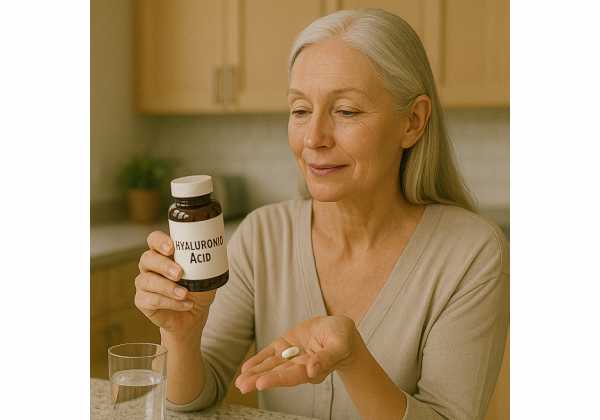
Hyaluronic acid supplements have moved from joint-health shelves into skin-aging routines because the idea is appealing: take a capsule, support skin moisture from within, and soften the look of fine lines over time. The evidence is now stronger than it was a few years ago, but it still points to a modest, specific benefit rather than dramatic rejuvenation. Oral hyaluronic acid appears most useful for dry, dull, or crepey-looking skin, especially when taken consistently for 8 to 12 weeks. It is not a replacement for sunscreen, retinoids, protein-rich nutrition, sleep, or medical procedures that restore volume. It also does not work like an injectable filler. A realistic view helps: oral hyaluronic acid is a hydration-and-barrier support supplement with early clinical evidence, good tolerability in short trials, and several unanswered questions about ideal dose, molecular weight, and long-term use.
Table of Contents
- How Hyaluronic Acid Changes With Aging
- What Clinical Studies Show
- Who Is Most Likely to Benefit
- Dose, Forms, and What to Buy
- Oral vs Topical vs Injectable Hyaluronic Acid
- Safety, Side Effects, and Quality
- How to Use It in a Skin Aging Plan
How Hyaluronic Acid Changes With Aging
Hyaluronic acid is a water-binding molecule found in skin, joints, eyes, and connective tissue. In skin, it helps create a hydrated gel-like environment around cells. That environment supports smoothness, elasticity, repair signaling, and the flexible structure of the dermis, the deeper layer where collagen and elastin sit.
The skin contains a large share of the body’s hyaluronic acid. Younger skin tends to hold more water and recover faster after stress partly because its extracellular matrix remains rich in hyaluronic acid, collagen, elastin, and other support molecules. With age, ultraviolet exposure, pollution, smoking, chronic inflammation, hormonal shifts, and normal cellular slowdown, that matrix changes. Skin becomes drier, thinner, less elastic, and more prone to fine lines.
Hyaluronic acid loss is not the only cause of visible aging. Collagen fragmentation, reduced elastin quality, slower cell turnover, oxidative stress, and loss of facial fat all contribute. That distinction matters because an oral hyaluronic acid supplement mainly targets moisture, barrier function, and possibly skin texture. It does not rebuild the whole architecture of aging skin.
A useful way to think about it:
- Hyaluronic acid supports water retention and plumpness.
- Collagen supports tensile strength and firmness.
- Elastin supports recoil and bounce.
- The skin barrier reduces water loss and irritation.
- Sun protection slows the ongoing damage that breaks these systems down.
Oral hyaluronic acid fits best in the “hydration and barrier support” lane. It is closer to a skin-quality supplement than a wrinkle-erasing treatment.
Why swallowing hyaluronic acid is biologically plausible
A common objection sounds logical: hyaluronic acid is a large molecule, so how would it survive digestion and reach the skin? The answer is not as simple as “it goes straight from capsule to face.”
Oral hyaluronic acid appears to be broken down into smaller fragments during digestion, with gut bacteria likely playing a role. Smaller fragments and related metabolites then interact with the intestine, immune signaling, and tissue repair pathways. Some research also suggests molecular weight influences absorption and biological response. In plain terms, the body probably does not absorb a giant hyaluronic acid molecule intact and deliver it unchanged to crow’s feet. The effect is more likely indirect: digestion products and signaling pathways influence hydration, barrier function, and the skin’s own extracellular matrix activity.
This does not make oral hyaluronic acid useless. Many nutrients and bioactive compounds work after digestion and transformation. It does mean that marketing claims about “replacing lost hyaluronic acid stores” are too simplistic.
What Clinical Studies Show
Oral hyaluronic acid has a growing set of randomized, placebo-controlled trials. Most are small to moderate in size, run for 6 to 12 weeks, and measure skin hydration, elasticity, wrinkle depth, transepidermal water loss, texture, or participant-rated appearance. The overall pattern is consistent: oral hyaluronic acid improves some skin-aging measures, especially hydration, with smaller and less consistent effects on wrinkles.
Recent meta-analytic evidence reports statistically significant improvements in hydration, elasticity, and wrinkle depth across randomized trials. That sounds impressive, but “statistically significant” does not always mean “visibly dramatic.” The changes are usually subtle to moderate. A person with dry, rough, fine-lined skin is more likely to notice a difference than someone with already well-hydrated skin, deep folds, or volume loss.
Clinical studies often use doses between 60 mg and 240 mg per day. Several trials use 120 mg per day. Benefits usually appear after several weeks, not after a single dose. A fair trial requires daily use for at least 8 weeks, with 12 weeks giving a clearer read.
Most consistent benefits
The strongest signal is skin hydration. This fits the biology of hyaluronic acid and the way most trials are designed. Better hydration often makes fine lines look softer because hydrated skin reflects light more evenly and appears smoother.
Other reported benefits include:
- Improved skin elasticity in some trials
- Reduced wrinkle depth, especially around the eyes
- Lower transepidermal water loss in some studies, suggesting better barrier function
- Improved smoothness, roughness, or brightness in certain product-specific trials
- Better self-rated skin dryness or comfort
The effect is not instant. Topical humectants change surface hydration quickly; oral hyaluronic acid needs repeated intake before measurable changes appear.
Where the evidence is weaker
The evidence is weaker for deep wrinkles, sagging, pigmentation, enlarged pores, and long-term photoaging reversal. These concerns involve collagen breakdown, elastin damage, fat redistribution, vascular changes, and pigment biology. Hyaluronic acid alone is not enough.
The trials also have limitations:
- Many include fewer than 100 participants.
- Several are funded by ingredient manufacturers.
- Products differ by molecular weight, source, dose, and added ingredients.
- Most studies last only 2 to 3 months.
- Participants are often healthy adults with mild to moderate skin-aging signs.
That does not erase the findings, but it does narrow the claim. Oral hyaluronic acid has supportive evidence for skin hydration and some visible aging markers. It does not yet have the kind of large, independent, long-duration evidence that would justify stronger anti-aging claims. For a broader view on separating promising biomarkers from real-world outcomes, see biomarkers versus outcomes in longevity.
What results feel like in real life
A successful response usually looks like this: the skin feels less tight after washing, makeup sits more smoothly, fine lines look less etched when the face is relaxed, and dry patches improve. A poor response looks like no clear change after 12 weeks, especially if the main concern is sagging, deep nasolabial folds, sun spots, or loss of cheek volume.
Use the right yardstick. Oral hyaluronic acid is a subtle skin-quality intervention, not a procedure.
Who Is Most Likely to Benefit
The best candidates are adults with dryness, dullness, fine surface lines, or early texture changes who already have the basics in place. Oral hyaluronic acid works best when the skin is not being constantly damaged by sun exposure, harsh cleansers, poor sleep, dehydration, or low protein intake.
You are more likely to notice benefit if you have:
- Dry or tight-feeling skin
- Fine lines that look worse when the skin is dehydrated
- Rough texture or dullness
- Seasonal dryness in winter or low-humidity environments
- Mild age-related loss of skin bounce
- A simple skincare routine that already includes moisturizer and sunscreen
You are less likely to be impressed if your main concern is deep folds, marked laxity, acne scarring, significant pigmentation, or facial volume loss. Those concerns usually need different tools: daily photoprotection, retinoids, pigment-directed ingredients, resurfacing procedures, lasers, microneedling, or injectables, depending on the issue.
Age also shapes expectations. A 40-year-old with early dryness and fine lines might notice a clearer cosmetic change than a 70-year-old with advanced photoaging and structural volume loss. That does not mean older adults never benefit. It means the visible effect will usually be smaller unless hydration is the dominant problem.
Skin type matters too. People with oily but dehydrated skin sometimes feel improvement in comfort and smoothness without wanting heavier creams. People with very sensitive skin should introduce any new supplement carefully, especially if using multi-ingredient “beauty blends” that include botanicals, high-dose vitamins, or flavoring agents.
When another strategy deserves priority
Choose the intervention that matches the problem. If the skin feels dry and crepey, oral hyaluronic acid is reasonable. If the skin looks thin and slow to recover, nutrition, resistance training, sleep, and collagen-supporting nutrients deserve attention too. If skin firmness is the main concern, evidence for collagen peptides for aging skin is often more directly relevant because collagen peptides target the structural protein network rather than only water balance.
If bruising, poor wound healing, bleeding gums, or very low fruit and vegetable intake are present, do not focus narrowly on hyaluronic acid. Vitamin C intake, protein adequacy, and medical evaluation become more important. A deeper look at vitamin C for collagen turnover fits that situation better than adding another beauty supplement.
Dose, Forms, and What to Buy
A practical dose range for oral hyaluronic acid is 60 mg to 120 mg per day. Some studies have used higher doses, but more is not automatically better. Starting at 120 mg per day is reasonable because it is common in skin trials and easy to compare across products. A lower 60 mg dose also has supportive evidence in newer studies, especially with specific branded matrices.
Take it daily for 8 to 12 weeks before judging the result. Skin measurements change slowly, and day-to-day hydration, sleep, salt intake, menstrual cycle changes, alcohol, weather, and skincare products all affect appearance. A 2-week trial is too short.
Hyaluronic acid supplements appear as:
- Capsules or tablets with hyaluronic acid or sodium hyaluronate
- Powders or drink mixes
- Combination skin formulas with collagen, vitamin C, ceramides, biotin, antioxidants, or botanicals
- Full-spectrum or multi-molecular-weight hyaluronan products
- Fermentation-derived or animal-derived forms
Sodium hyaluronate is the sodium salt form of hyaluronic acid. It is widely used and should not be confused with meaningful dietary sodium exposure at typical supplement doses. A 120 mg sodium hyaluronate supplement does not behave like a high-sodium food.
Molecular weight: useful detail, not magic
Molecular weight describes the size of the hyaluronic acid molecule. Products often advertise low, medium, high, or full-spectrum molecular weights. This detail matters scientifically because size influences digestion, absorption, and cellular signaling. It matters less as a shopping shortcut because labels do not always report molecular weight clearly, and trials use different forms.
A sensible buying approach is to prioritize human clinical evidence on the exact ingredient or a closely similar form rather than choosing only by molecular weight. “Low molecular weight” on a label is not enough by itself. Look for dose, ingredient identity, third-party quality testing, and transparent manufacturing.
Single-ingredient or combination formula?
A single-ingredient hyaluronic acid product is easier to test. If your skin improves, you know what likely helped. If you react poorly, the culprit is easier to identify.
Combination formulas are not automatically bad, but they blur the picture. A product with hyaluronic acid, collagen peptides, vitamin C, ceramides, astaxanthin, and botanicals might work, but the benefit may not come from hyaluronic acid alone. Combination products also raise the chance of unnecessary doses, allergens, sweeteners, or interactions.
Use this table to choose more calmly:
| Buying factor | Better choice | Be cautious with |
|---|---|---|
| Dose | 60–120 mg per day for a first trial | Very high doses without clear human evidence |
| Ingredient | Hyaluronic acid or sodium hyaluronate clearly listed | “Beauty complex” with hidden individual amounts |
| Evidence | Product or ingredient tested in human trials | Only animal, cell, or marketing claims |
| Formula | Simple formula when testing response | Large blends with many botanicals and stimulants |
| Quality | Third-party testing or strong quality controls | No manufacturer details or exaggerated claims |
Oral vs Topical vs Injectable Hyaluronic Acid
Oral, topical, and injectable hyaluronic acid are often discussed as if they do the same thing. They do not. They share a molecule family, but the delivery route changes the result.
Topical hyaluronic acid sits mostly in the upper skin layers and acts as a humectant, meaning it helps attract and hold water. It gives a fast smoothing effect, especially when sealed under a moisturizer. It is helpful for dehydration, tightness, and makeup texture. It does not restore deep volume.
Oral hyaluronic acid works more slowly. It is best viewed as systemic hydration and barrier support. It needs weeks of use and produces subtler changes than a well-formulated topical product does in one application, but it might support skin quality from a different route.
Injectable hyaluronic acid fillers are medical procedures. They place cross-linked hyaluronic acid gel under the skin to restore volume, contour, or shape. Fillers have immediate visible effects, higher cost, and procedure-related risks such as bruising, swelling, vascular complications, lumps, and asymmetry. Oral supplements do not produce filler-like lifting or contouring.
| Route | Main effect | Timeframe | Best for | Limit |
|---|---|---|---|---|
| Topical | Surface hydration | Minutes to days | Dehydrated texture and tightness | Temporary and mostly surface-level |
| Oral | Hydration, barrier support, skin quality | 8–12 weeks | Dryness, fine lines, dullness | Subtle, not structural lifting |
| Injectable | Volume and contour | Immediate, with settling over days to weeks | Folds, volume loss, shaping | Medical procedure with cost and risks |
A strong routine often uses topical and oral approaches differently. A topical hyaluronic acid serum under moisturizer helps the surface. Oral hyaluronic acid supports gradual internal skin-quality changes. Sunscreen prevents ongoing collagen and elastin damage. Retinoids, when tolerated, improve cell turnover and collagen signaling over time.
Do not expect one product to do every job.
Safety, Side Effects, and Quality
Oral hyaluronic acid has been well tolerated in short-term skin studies. Reported side effects are generally uncommon and mild. Still, “well tolerated in trials” is not the same as “risk-free for everyone.” Most trials exclude pregnant people, people with complex illnesses, and those taking certain medications. Long-term daily use over many years has not been studied well for skin aging.
Possible side effects include digestive discomfort, nausea, soft stool, headache, rash, or allergy-like symptoms. These are not common in published trials, but they are possible with any supplement. Stop taking the product if hives, swelling, wheezing, or a spreading rash occurs, and seek medical care for serious symptoms.
Use extra caution if you are pregnant, breastfeeding, immunocompromised, undergoing cancer treatment, living with an autoimmune condition, or taking multiple prescription medications. The issue is not that hyaluronic acid is known to be dangerous in these situations. The issue is that the evidence base is too thin to treat routine cosmetic use as necessary.
People with severe allergies should check the source. Many modern products use microbial fermentation, but some hyaluronic acid ingredients have historically come from rooster combs or other animal sources. The label or manufacturer should clarify this.
Supplement quality matters
Dietary supplements are not approved like prescription drugs before sale. Labels should list the dose, but quality varies. Buy from companies that provide batch testing, contaminant checks, clear ingredient amounts, and easy access to customer support. Avoid products that promise to “erase wrinkles,” “replace fillers,” “reverse aging,” or “rebuild skin from the inside out.” Those claims overreach.
A clean supplement trial also means changing only one major variable at a time. Starting hyaluronic acid, collagen, retinol, a new laser series, and a new moisturizer in the same week makes it impossible to judge what helped. The same principle applies across longevity experiments; a structured approach to safe self-experimentation prevents wasted money and confusion.
When to stop
Stop after 12 weeks if you see no meaningful change in dryness, smoothness, or fine lines. There is no strong reason to keep paying for a supplement that does not produce a noticeable benefit after a fair trial.
Stop sooner if you develop digestive symptoms, skin reactions, headaches that clearly track with use, or any symptom that concerns you. Rechallenge only with clinician guidance if the reaction was significant.
How to Use It in a Skin Aging Plan
Oral hyaluronic acid works best as one small part of a skin-aging plan. The foundation remains boring but powerful: daily sunscreen, enough protein, colorful plants, resistance training, sleep, stress management, and a skincare routine that protects the barrier.
A practical 12-week trial looks like this:
- Choose a product with 60–120 mg of hyaluronic acid or sodium hyaluronate per daily serving.
- Take it at the same time each day, with or without food according to comfort.
- Keep your skincare routine stable for the first 8 weeks.
- Take photos in the same lighting at baseline, week 8, and week 12.
- Track skin tightness, dryness, smoothness, and fine-line appearance once weekly.
- Continue only if the change is noticeable enough to justify the cost.
Do not use mirror checks every morning as your main measure. Skin appearance changes with sleep, salt intake, alcohol, menstrual cycle, exercise, travel, humidity, and lighting. Weekly notes and consistent photos give a cleaner signal.
Stacking it with other skin-supportive nutrients
Hyaluronic acid pairs logically with a protein-sufficient diet because skin structure depends on amino acids. It also pairs with vitamin C-rich foods, which support collagen formation. Collagen peptides, ceramides, omega-3s, carotenoids, and antioxidant-rich foods each target different parts of skin quality. More supplements are not automatically better, but a targeted combination sometimes makes sense.
For people interested in skin and oxidative stress, astaxanthin for aging skin and eyes is a related topic, especially when sun exposure and photodamage are part of the picture. Food still comes first: berries, citrus, leafy greens, legumes, fish, yogurt or kefir if tolerated, nuts, seeds, and olive oil create a better base than capsules alone.
Hydration also needs context. Drinking more water helps if intake is low, but excess water does not force the skin to become plump. The skin barrier, humidity, moisturizer use, fatty acid intake, hormones, and inflammation all influence how much water the skin retains.
A realistic place in longevity-focused skin care
Skin aging reflects whole-body aging, but it also reflects local exposure. A supplement that slightly improves skin hydration does not prove slower biological aging. It improves a visible tissue marker that people care about. That is still worthwhile when the supplement is safe, affordable, and honestly presented.
The strongest longevity-minded reason to care about skin is not vanity. Skin is a barrier organ. Dry, fragile, inflamed skin affects comfort, infection risk, sleep, confidence, and quality of life. Supporting skin hydration and barrier function has real value, especially in midlife and later life.
Oral hyaluronic acid deserves a measured verdict: yes, it appears to work for some aspects of skin aging, especially hydration and fine-line appearance, when taken daily for 8 to 12 weeks. No, it does not replace sunscreen, retinoids, collagen-supportive nutrition, or procedures for volume loss. The best use is a time-limited, well-tracked trial with realistic expectations.
References
- Oral Hyaluronic Acid Supplement: Efficacy in Skin Hydration, Elasticity, and Wrinkle Depth Reduction 2025 (Meta-analysis)
- Oral sodium hyaluronate improves skin hydration, barrier function and signs of aging: a randomized, double-blind, placebo-controlled trial in 150 healthy adults 2026 (RCT)
- Oral Supplementation with a New Hyaluronic Acid Matrix Ingredient Improves Skin Brightness, Hydration, Smoothness, and Roughness: Results from a Randomized, Double-Blinded, Placebo-Controlled Study 2025 (RCT)
- Oral administration of hyaluronic acid to improve skin conditions via a randomized double-blind clinical test 2023 (RCT)
- Oral Hyaluronan Relieves Wrinkles and Improves Dry Skin: A 12-Week Double-Blinded, Placebo-Controlled Study 2021 (RCT)
- Dietary Supplements: What You Need to Know 2023 (Fact Sheet)
Disclaimer
This article is educational and does not replace care from a qualified health professional. Talk with a clinician before using hyaluronic acid supplements if you are pregnant, breastfeeding, immunocompromised, undergoing cancer treatment, managing an autoimmune condition, or taking prescription medications. Stop use and seek medical advice if you develop an allergic reaction or symptoms that concern you.