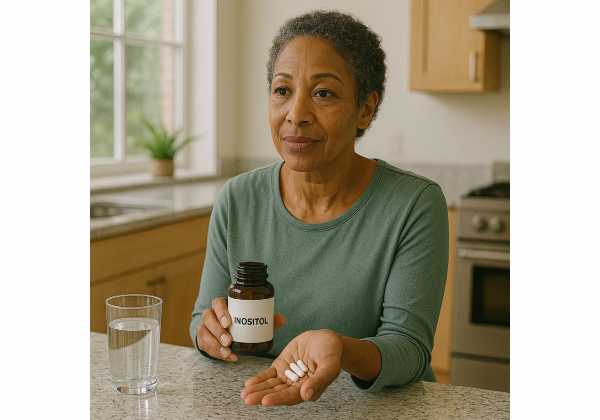
Inositol is best understood as a metabolic support compound, not a stand-alone longevity supplement. The body makes it, foods provide it, and cells use it in membrane signaling, insulin response, ovarian hormone signaling, nerve function, and fat metabolism. The form most often studied is myo-inositol, usually at 2 g twice daily.
For healthy aging, the strongest reason to consider inositol is insulin resistance. Insulin resistance tends to rise with visceral fat, inactivity, menopause, poor sleep, fatty liver, and loss of muscle. Inositol appears most relevant when fasting insulin, triglycerides, waist size, blood pressure, or post-meal glucose suggest a metabolic strain. The evidence is strongest in PCOS, gestational diabetes prevention, and smaller metabolic syndrome studies, including postmenopausal women. It is not a substitute for protein, resistance training, weight management, sleep, or medical care, but it has a practical place as an adjunct when metabolic signals point in the right direction.
Table of Contents
- What Inositol Is and Why It Matters for Metabolism
- How Inositol Supports Insulin Sensitivity
- What the Evidence Suggests for Healthy Aging
- Who Is Most Likely to Notice a Benefit
- Dose, Forms, Timing, and How to Take It
- How to Track Results Without Guessing
- Safety, Side Effects, Interactions, and Quality
- How to Use Inositol Well in a Longevity Plan
What Inositol Is and Why It Matters for Metabolism
Inositol is a naturally occurring carbohydrate-like compound that helps cells send signals. It is sometimes called “vitamin B8,” but it is not a true vitamin because the body makes it. It also comes from foods such as beans, citrus fruit, cantaloupe, whole grains, nuts, and organ meats.
The most common form in the body is myo-inositol. Other forms include D-chiro-inositol and scyllo-inositol, but most metabolic supplements focus on myo-inositol alone or a myo-inositol and D-chiro-inositol combination.
Inositol matters because metabolism runs on signals, not only calories. When insulin binds to its receptor, the cell must pass that message inward. Inositol-containing molecules take part in that message. They help regulate glucose transport, glycogen storage, fat handling, and hormone signaling.
That does not mean more inositol always produces better metabolism. It means inositol sits in a pathway that becomes relevant when insulin signaling is under pressure.
Healthy aging depends heavily on keeping glucose, insulin, lipids, blood pressure, liver fat, and waist size in a workable range over decades. People often focus only on fasting glucose or A1c, but insulin resistance usually begins earlier. Fasting insulin, triglycerides, waist circumference, blood pressure, and post-meal glucose patterns often show stress before glucose crosses into a diabetes range. For a deeper testing framework, A1c, fasting glucose, and fasting insulin belong together rather than in isolation.
Inositol fits into this picture as a support tool. It does not replace the major metabolic levers, but it has enough human evidence to take seriously in selected situations.
How Inositol Supports Insulin Sensitivity
Insulin sensitivity means cells respond well to insulin’s message. When sensitivity is high, the body needs less insulin to move glucose out of the blood and into muscle, liver, and fat tissue. When sensitivity falls, the pancreas releases more insulin to get the same effect. Over time, higher insulin levels often travel with higher triglycerides, more visceral fat, fatty liver, higher blood pressure, and greater hunger swings.
Inositol supports this system through several related mechanisms.
First, inositol-containing messengers help transmit insulin’s signal inside the cell. This is one reason myo-inositol and D-chiro-inositol have drawn attention in insulin-resistant states.
Second, myo-inositol appears to influence glucose uptake and glycogen handling. Glycogen is stored carbohydrate, mainly in muscle and liver. Better glycogen storage after meals helps reduce prolonged glucose and insulin exposure.
Third, inositol links metabolic signaling with reproductive hormone signaling. This explains much of its use in PCOS, where insulin resistance, ovarian androgen production, irregular cycles, and metabolic risk often overlap.
Fourth, inositol may support lipid metabolism. Some trials report improvements in triglycerides and HDL cholesterol, especially in people starting with metabolic syndrome or PCOS. These effects are not as predictable as medication effects, but they line up with the insulin pathway. When insulin resistance improves, triglycerides often improve too.
Insulin sensitivity also depends on muscle. Muscle is the largest storage site for post-meal glucose, and muscle loss makes aging metabolism less forgiving. Inositol should not be expected to compensate for low muscle mass or inactivity. It works best when paired with walking, resistance training, enough protein, and a diet that limits large glucose surges. The broader concept is covered in insulin sensitivity for longevity, where testing and lifestyle targets give supplements a more useful context.
What the Evidence Suggests for Healthy Aging
The evidence for inositol is promising but uneven. It is strongest in specific insulin-resistant groups rather than in healthy adults taking it only for lifespan extension. No clinical trial proves that inositol extends human lifespan. The better question is whether it improves metabolic markers that matter for healthspan.
Metabolic syndrome and postmenopause
One of the most relevant studies for aging involved postmenopausal women with metabolic syndrome. Participants used myo-inositol at 2 g twice daily for 6 months along with diet. Compared with diet plus placebo, the myo-inositol group improved several markers, including HOMA-IR, triglycerides, HDL cholesterol, and blood pressure.
This matters because menopause often worsens insulin resistance even without major weight gain. Estrogen changes, sleep disruption, visceral fat gain, and reduced muscle mass shift glucose and lipid control in the wrong direction. Inositol is not a hormone therapy and does not treat menopause symptoms directly, but it lines up with the metabolic pattern that often appears after midlife.
The limitation is size. This was not a large long-term outcomes trial. It does not prove fewer heart attacks, less dementia, or longer life. It does show that a common dose of myo-inositol can improve a cluster of cardiometabolic markers in a group that resembles many real-world midlife and older adults.
PCOS and insulin-resistant patterns
PCOS provides much of the clinical evidence because insulin resistance is common in this condition. Systematic reviews show that inositol improves some metabolic and hormonal measures in women with PCOS, with fewer gastrointestinal side effects than metformin in many comparisons. Current guideline language is cautious: inositol is a reasonable option for some women with PCOS, but the certainty of evidence is limited, and products vary.
The PCOS evidence matters beyond fertility because it gives insight into insulin signaling. Still, PCOS findings should not be stretched too far. A woman with PCOS and high fasting insulin is not the same as a lean 65-year-old man with normal glucose and excellent fitness. Inositol is most compelling when the person’s biology matches the studied pattern: insulin resistance, central adiposity, high triglycerides, irregular glucose handling, or PCOS-related metabolic changes.
Gestational diabetes research
Pregnancy studies are not longevity studies, but they add useful evidence on insulin resistance. Several trials and reviews have examined myo-inositol in women at higher risk of gestational diabetes. Some report lower rates of gestational diabetes and better oral glucose tolerance test results.
This evidence supports the idea that myo-inositol influences glucose handling under high insulin demand. Pregnancy creates a natural insulin-resistant state. Aging, visceral fat, poor sleep, and inactivity create different forms of insulin stress, but the shared feature is the need for stronger glucose control.
Pregnancy also requires medical supervision. No one should start supplements during pregnancy without a qualified clinician involved.
Cardiometabolic meta-analyses
Recent systematic reviews have pooled trials of inositol across metabolic outcomes. Overall, they suggest modest improvements in insulin, HOMA-IR, glucose, triglycerides, blood pressure, and some body size measures. The certainty varies by outcome, and many trials are short, small, or focused on specific populations.
This pattern should shape expectations. Inositol is not a dramatic weight-loss agent. It is not a glucose-lowering drug. It is better viewed as a low-burden adjunct that may improve insulin-related markers over 8 to 24 weeks when the starting problem is insulin resistance.
Who Is Most Likely to Notice a Benefit
Inositol makes the most sense when there is a clear metabolic reason to try it. A supplement trial works better when it starts with a defined problem and ends with repeat testing.
People most likely to benefit often have one or more of these patterns:
- Fasting insulin above the ideal range, even when fasting glucose looks normal
- HOMA-IR suggesting insulin resistance
- Triglycerides trending high, especially with low HDL cholesterol
- Waist size or waist-to-height ratio indicating central fat gain
- PCOS with metabolic symptoms
- Postmenopausal metabolic syndrome
- Fatty liver risk alongside glucose or triglyceride changes
- Strong post-meal glucose rises on finger-stick testing or a continuous glucose monitor
- Family history of type 2 diabetes plus early insulin resistance signs
Inositol is less likely to add much when metabolic markers are already excellent. A lean, active person with low fasting insulin, normal triglycerides, strong muscle mass, and stable post-meal glucose probably has little to gain.
It is also not the first answer when glucose is already in the diabetes range, blood pressure is uncontrolled, triglycerides are very high, or fatty liver is advanced. Those situations call for medical care, structured nutrition, and often medication. Supplements should support a plan, not delay treatment.
A practical way to think about inositol is as a “signal support” option. It belongs after the basics are moving: protein at meals, fiber-rich carbohydrates, regular training, sleep protection, and post-meal movement. It belongs before more aggressive self-experimentation. Anyone comparing it with stronger glucose supplements such as berberine for glucose and lipids should consider medication interactions, liver and kidney status, and clinician oversight.
Dose, Forms, Timing, and How to Take It
Most metabolic studies use myo-inositol at 2 g twice daily, for a total of 4 g per day. This is the most practical starting point because it matches the common research dose and is usually well tolerated.
Some products combine myo-inositol with D-chiro-inositol in a 40:1 ratio. A common example is 2,000 mg myo-inositol plus 50 mg D-chiro-inositol per serving, taken twice daily. This ratio is widely used in PCOS products because it resembles the approximate physiological balance often discussed in reproductive endocrinology. It is not proven to be the ideal ratio for every adult with insulin resistance.
D-chiro-inositol alone deserves caution. Higher-dose D-chiro-inositol is not the same as myo-inositol. It has different tissue actions, and long-term high-dose use is less established. For general metabolic support, myo-inositol alone is usually the simpler choice.
Common dosing options
| Approach | Typical daily amount | Best fit | Notes |
|---|---|---|---|
| Myo-inositol powder | 2 g twice daily | General insulin resistance, metabolic syndrome patterns | Usually the most cost-effective and flexible form |
| Myo-inositol capsules | Usually 2–4 g daily | People who dislike powders | Several capsules may be needed to reach studied doses |
| Myo-inositol plus D-chiro-inositol | Often 40:1 ratio, twice daily | PCOS-focused use | Useful when the product clearly lists each form and dose |
| Low-dose blends | Often below 1 g daily | Unclear | Many blends underdose inositol while emphasizing marketing claims |
Myo-inositol powder tastes mildly sweet and dissolves easily in water. Taking it with meals often makes sense for metabolic use, especially breakfast and dinner. Some people prefer one dose with breakfast and one dose before bed. Either schedule is reasonable if digestion feels fine and the routine is consistent.
A fair trial usually lasts 8 to 12 weeks. For slower markers such as A1c, 12 to 16 weeks gives a clearer read. For fasting insulin, triglycerides, and post-meal glucose, changes may show earlier.
Do not keep increasing the dose because “more” sounds stronger. Higher doses raise the chance of nausea, gas, loose stools, headache, or fatigue. The aim is not to flood the pathway. The aim is to use a studied dose long enough to see whether the person’s markers respond.
How to Track Results Without Guessing
Inositol is easy to take, which creates a common trap: people use it for months without knowing whether it helped. Better tracking turns it into a clean experiment.
Start with baseline markers. The most useful set includes fasting glucose, fasting insulin, A1c, triglycerides, HDL cholesterol, blood pressure, waist circumference, and weight. If liver fat is a concern, ALT, AST, GGT, platelet count, and a fibrosis score such as FIB-4 add context. People using glucose testing more deeply can add an OGTT or mixed-meal test; HOMA-IR, OGTT, and mixed-meal testing help separate fasting insulin resistance from post-meal glucose problems.
At home, track waist circumference, morning blood pressure, and a simple meal response. A repeatable meal test works well: choose one normal breakfast or lunch, check glucose before eating, then at 1 hour and 2 hours after eating. Use the same meal when retesting. This is not a diagnosis, but it shows whether the same meal produces a smaller glucose rise after the intervention.
Continuous glucose monitors add more detail, but they are not required. When used carefully, they help show whether post-meal spikes, overnight glucose, and dawn glucose patterns change. A CGM works best when paired with food and activity notes, not when every small rise causes anxiety.
Repeat labs after 8 to 12 weeks. Look for direction, not perfection. A useful response might include lower fasting insulin, lower HOMA-IR, lower triglycerides, smaller waist measurement, improved blood pressure, or less post-meal glucose exposure. If nothing changes and the lifestyle plan stayed consistent, inositol probably is not a high-value supplement for that person.
The most misleading result is weight alone. Inositol is not mainly a weight-loss supplement. A person might lose little weight but improve fasting insulin or triglycerides. Another person might lose weight because diet and training improved, not because inositol did the heavy lifting. Track enough markers to avoid giving the supplement too much credit or too much blame.
Safety, Side Effects, Interactions, and Quality
Inositol is generally well tolerated at common doses. The most frequent side effects are digestive: nausea, gas, cramping, or loose stools. Headache, dizziness, and fatigue are less common but reported. Starting with 1 g once or twice daily for the first week can reduce digestive surprises, then increasing toward 2 g twice daily if tolerated.
Higher doses, especially around 12 g per day and above, are more likely to cause gastrointestinal symptoms. There is rarely a reason to use high doses for metabolic aging goals without medical supervision.
People taking glucose-lowering medication should use extra care. Inositol is usually mild, but combining several glucose-lowering tools can push glucose too low in susceptible people. This matters most for people using insulin, sulfonylureas, or multiple diabetes medications. Metformin, GLP-1 receptor agonists, SGLT2 inhibitors, and other medications require individualized guidance.
Pregnancy, fertility treatment, bipolar disorder, kidney disease, and complex endocrine conditions also call for clinician input. Inositol has been studied in pregnancy, but pregnancy supplement decisions should not be self-directed. People with bipolar disorder should be cautious with any supplement that affects neurotransmitter-related pathways or sleep patterns.
Quality matters because supplements are not regulated like prescription drugs. Choose products that list the exact form, exact dose, serving size, and added ingredients. Powder often gives the cleanest label. Avoid proprietary blends that hide the inositol amount. Third-party testing is a plus, especially for long-term use.
Several product labels use “inositol” without clearly stating the form. For metabolic support, look for “myo-inositol.” If the product includes D-chiro-inositol, it should state the milligrams of both forms. Avoid assuming that a PCOS-focused blend is automatically appropriate for a man, a postmenopausal woman, or someone taking diabetes medication.
Inositol also should not crowd out nutrients with stronger evidence for a specific deficiency. For example, a person with high homocysteine may need B12, folate, B6, riboflavin, or thyroid evaluation. A person with low magnesium intake may need food changes or magnesium repletion. A person with low omega-3 status may need fatty fish or EPA/DHA. Supplement plans work best when each item has a defined job.
How to Use Inositol Well in a Longevity Plan
Inositol works best as part of a metabolic system. The largest improvements in insulin sensitivity usually come from muscle contraction, fat loss where needed, better sleep, and lower post-meal glucose load. Inositol can support these efforts, but it should not carry the plan.
Start with the meal pattern. Each main meal should contain protein, fiber-rich plants, and a fat source that slows digestion without turning the meal into a calorie overload. Beans, lentils, oats, berries, vegetables, Greek yogurt, eggs, fish, tofu, poultry, nuts, and olive oil all fit well. Large refined carbohydrate loads are harder to manage when insulin resistance is present. Inositol does not erase the effect of a high-sugar breakfast or late-night ultra-processed snacks.
Add movement after meals. A 10- to 20-minute walk after the largest carbohydrate meal often lowers the glucose curve. This habit is simple enough to repeat and powerful enough to measure. It pairs well with inositol because both target post-meal metabolism from different angles. The habit is covered more broadly in NEAT and post-meal walking.
Build muscle. Two to four weekly resistance sessions improve glucose disposal because trained muscle stores more glycogen and responds better to insulin. Inositol cannot replace this adaptation. Strength training also protects bone, balance, resting metabolic rate, and independence with age.
Use aerobic work as a second metabolic layer. Zone 2 training improves mitochondrial function and fat oxidation, while intervals improve cardiorespiratory fitness. For people with insulin resistance, Zone 2 training and insulin sensitivity often provide a strong return with a low injury risk.
Protect sleep. Short sleep and fragmented sleep raise hunger, worsen insulin resistance, and increase evening cravings. If glucose runs high in the morning, sleep apnea, alcohol, late meals, stress, and the dawn phenomenon deserve attention before adding more supplements.
After those pieces are moving, inositol becomes easier to judge. Use 2 g twice daily for 8 to 12 weeks, keep routines stable, and repeat the same markers. Continue only if the response is clear enough to justify another bottle.
A good supplement earns its place. Inositol earns consideration when metabolic markers improve, side effects stay low, cost remains reasonable, and the person does not use it as an excuse to ignore the basics. That is the right standard for any longevity nutraceutical: measurable benefit, low risk, and a clear role in the larger plan.
References
- Inositol supplementation efficacy in improving key cardiometabolic and anthropometric indices: a GRADE-assessed systematic review and meta-analysis of randomized controlled trials 2025 (Systematic Review)
- Inositol for Polycystic Ovary Syndrome: A Systematic Review and Meta-analysis to Inform the 2023 Update of the International Evidence-based PCOS Guidelines 2024 (Systematic Review)
- Recommendations From the 2023 International Evidence-based Guideline for the Assessment and Management of Polycystic Ovary Syndrome 2023 (Guideline)
- Myo-inositol supplementation for prevention of gestational diabetes mellitus in overweight and obese pregnant women: a systematic review and meta-analysis 2022 (Systematic Review)
- Effects of myo-inositol supplementation in postmenopausal women with metabolic syndrome: a perspective, randomized, placebo-controlled study 2011 (RCT)
- Inositol safety: clinical evidences 2011 (Review)
Disclaimer
This article is educational and does not replace care from a qualified healthcare professional. People with diabetes, PCOS, pregnancy, fertility treatment, kidney disease, bipolar disorder, or prescription glucose-lowering medication should discuss inositol with a clinician before using it. Supplements should not be used to delay diagnosis or treatment of high blood glucose, high blood pressure, high triglycerides, or fatty liver disease.