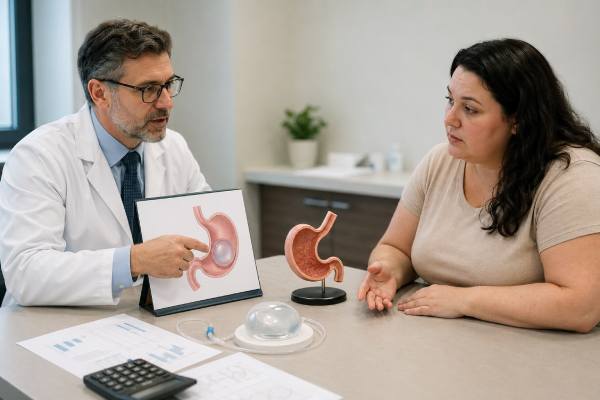
An intragastric balloon sits in the middle ground between lifestyle treatment, weight loss medication, and bariatric surgery. It is temporary, does not require incisions, and can produce meaningful short-term weight loss, but it is not a minor decision and it is not a “set it and forget it” solution. The real questions are practical ones: who it suits, how much weight it usually helps people lose, what the first week feels like, what the serious risks are, and whether the price makes sense for a treatment that usually lasts only a few months.
For the right patient, an intragastric balloon can work well as a short-term accelerator or bridge. For the wrong patient, it can be expensive, unpleasant, and followed by weight regain once the balloon comes out.
Table of Contents
- What an intragastric balloon actually is
- Cost and insurance reality
- Results you can realistically expect
- Common side effects and serious risks
- Placement, diet, and recovery timeline
- How it compares with other options
- Preventing regain after removal
What an intragastric balloon actually is
An intragastric balloon is a temporary device placed in the stomach to take up space and help you feel full sooner. Most versions are not surgery. Traditional balloon systems are placed through the mouth with an endoscope while you are sedated, then filled once they are inside the stomach. Some newer systems are swallowed in capsule form and follow a different placement and removal path depending on the device.
The basic idea is simple. A partially occupied stomach usually means smaller portions feel more satisfying, meals take less food to trigger fullness, and some patients find appetite control easier. The balloon may also slow gastric emptying and change how strongly satiety signals are felt after eating. But it does not “melt fat,” fix emotional eating, or permanently change stomach anatomy. It is a tool, not a cure.
In most programs, the best candidates are adults who:
- have obesity or are in the lower surgical-BMI range often targeted for endoscopic weight-loss procedures
- have not achieved enough weight loss with diet and exercise alone
- want something less invasive than surgery
- are willing to follow a structured food, movement, and follow-up plan
- understand that the balloon is temporary and maintenance work continues after removal
A balloon may also be considered for someone who needs a weight-loss bridge before a bigger medical step, such as orthopedic surgery, fertility treatment, or bariatric surgery that is currently considered too risky. That bridge role can make sense, but it should be framed honestly. A balloon can create momentum. It does not replace a long-term obesity plan.
It is also important to understand what makes someone a poor candidate. Many programs will be cautious or say no if there is a history of prior stomach or esophageal surgery, active stomach ulcer disease, major hiatal hernia, pregnancy, certain bleeding risks, significant liver disease, or an eating disorder that would make the device unsafe or poorly tolerated. Programs also tend to avoid it in patients who are unlikely to attend follow-up visits, because aftercare is not optional.
A practical detail people often miss is that “intragastric balloon” is not one single product. Different systems vary in whether they are fluid-filled or gas-filled, whether they require endoscopy for placement, how long they stay in the stomach, and how they are removed. That matters because safety profile, convenience, and weight-loss results are not identical from one balloon system to another. Availability also varies by country, by center, and by which devices a program is still actively offering.
For people deciding where this fits in the larger picture, it helps to compare it with prescription weight loss medications and with more permanent bariatric surgery options. The balloon is neither as minor as many marketing pages make it sound nor as intensive as surgery. It sits in the middle, which is exactly why it appeals to some patients and disappoints others.
Cost and insurance reality
Cost is one of the biggest reasons people hesitate, and for good reason. Intragastric balloons are often self-pay. In the United States, many hospitals and private programs treat them as out-of-pocket procedures rather than routinely covered obesity treatment.
A realistic way to think about price is not “What does the balloon cost?” but “What does the whole balloon program cost?” The bill may include:
- consultation and candidacy evaluation
- pre-procedure testing
- the device itself
- sedation or anesthesia
- the endoscopic placement
- medications for pain, reflux, nausea, or cramping
- the removal procedure
- nutrition follow-up
- behavioral or exercise support
- urgent visits if symptoms are difficult during the first week
That is why advertised prices can be misleading. A lower sticker price may not include removal, aftercare, or medications. A higher quote may include a full one-year support program. Comparing packages line by line matters more than comparing one headline number with another.
In current U.S. practice, a balloon program often lands in the several-thousand-dollar range and may reach well above that depending on center, device, and aftercare package. One academic medical center currently lists gastric balloon placement and removal at $6,700 as a general self-pay guideline, while other hospitals describe the procedure as out-of-pocket and note that actual quotes vary. In real life, it is sensible to expect a figure somewhere around the mid-thousands to low five figures rather than a small office-procedure price.
Insurance is even trickier. Some patients assume that because obesity is a medical condition, the balloon will be covered like any other medically indicated treatment. Often it is not. Even when bariatric surgery or medication has some insurance pathway, endoscopic balloons may still be treated as elective or excluded. That does not mean never covered. It means you should verify before you commit.
A good financial checklist includes four questions:
- Does the quote include both placement and removal?
- Does it include dietitian follow-up and symptom-management visits?
- What happens financially if the balloon must be removed early?
- Is there any insurance reimbursement pathway, health savings account option, or financing plan?
This is also where comparison shopping matters. A balloon can be cheaper than surgery, but it is not always cheap relative to its duration. It can also be more or less cost-effective than medication depending on whether medication is covered, how long medication is used, and how much weight the patient actually keeps off after balloon removal. For patients who want a broader structured framework before spending on any obesity intervention, a review of medically supervised weight loss programs can help clarify what level of support they really need.
The core financial truth is simple: the balloon is often sold as less invasive than surgery, but it should not be thought of as low-commitment. It is usually a meaningful out-of-pocket purchase tied to a narrow treatment window. That makes the maintenance plan after removal just as financially relevant as the procedure itself.
Results you can realistically expect
The most realistic expectation is meaningful short-term weight loss, not miracle-level transformation. Most patients who do well with an intragastric balloon lose weight fastest in the first few months, then see the pace slow as the body adapts and the easy early changes are already made.
A good general range is that many balloon programs produce around 10% total body weight loss over about six months, though results vary by device, baseline body size, program intensity, and how well a patient follows the eating plan afterward. In a pivotal U.S. study of a commonly used endoscopic balloon system, average total body weight loss was about 10.2% at the time of device removal around six months and 9.1% three months later. Academic programs often quote similar real-world expectations rather than promising extreme losses.
That does not mean every patient loses 10%. Some lose less. Some lose more. The spread is wide because the balloon is not doing all the work. People who tend to do better usually have several things in common:
- they tolerate the first week reasonably well
- they adopt smaller, more deliberate meal patterns quickly
- they stay engaged with dietitian and follow-up visits
- they maintain protein intake despite reduced volume
- they keep moving instead of letting fatigue or low intake crash daily activity
This last point matters more than many patients expect. A balloon can lower intake, but if the person becomes sedentary, under-hydrated, or inconsistent, the gap between expected and actual weight loss narrows quickly.
Another important expectation issue is timing. Balloon weight loss is usually front-loaded. Patients often notice the biggest behavior shift early, when fullness is dramatic and the motivation boost is fresh. That can create a false impression that the treatment will continue producing the same weekly losses forever. It usually does not. In that sense, balloon treatment resembles many fat-loss phases: the early phase feels rewarding, and the later phase demands better habits. If you want a more grounded frame for pace, this article on the safe rate of weight loss is a useful reminder that faster is not always better.
The harder truth is durability. Balloons are temporary, so the long-term result depends heavily on what remains after removal. Some patients maintain most of the loss. Some continue losing if the balloon helped them lock in strong habits. Many regain part of it. That is the central trade-off: a balloon can jump-start progress, but it does not create permanent appetite control or permanent stomach restriction.
This is why balloon results should be judged in two stages. Stage one is the weight lost while the balloon is in place. Stage two is the weight kept off after it comes out. A program that advertises only stage one is showing you the easy half of the story.
For the right patient, a short-term loss of 8% to 15% can still be very meaningful. It may improve blood pressure, blood sugar, sleep apnea symptoms, joint pain, and surgical candidacy. But if the expectation is permanent, surgery-like results from a temporary device, disappointment is likely.
Common side effects and serious risks
The first thing to know about side effects is that feeling rough at the beginning is common. The second thing to know is that “common” does not mean trivial.
Most balloon systems cause a fairly predictable early reaction as the stomach adjusts. Nausea, vomiting, abdominal cramping, pain, reflux, bloating, fatigue, and trouble drinking enough can be intense in the first few days. Some programs describe this as the expected adjustment phase. That framing is fair, but it can also understate how unpleasant the first week may be for some patients.
Common side effects often include:
- nausea
- vomiting or retching
- stomach cramping
- upper abdominal pain or heaviness
- reflux or heartburn
- trouble meeting fluid goals
- fatigue from low intake, dehydration, or poor sleep
These usually improve over several days to two weeks. But they can still be severe enough to lead to IV fluids, medication changes, urgent calls, or even early removal. That is why good programs routinely prescribe acid suppression and anti-nausea medications rather than waiting for patients to suffer through it.
Serious complications are much less common, but they matter because they are the reason balloon placement needs real follow-up rather than casual “check in if needed” care. Device labeling and FDA safety communications have described rare but important problems including balloon deflation and migration, spontaneous overinflation, gastric ulceration, stomach perforation, pancreatitis, obstruction, and the need for early removal.
| Symptom pattern | How it is usually interpreted | What to do |
|---|---|---|
| Nausea, cramping, reflux, poor appetite, and mild vomiting in the first few days | Often part of the expected adjustment phase | Use the prescribed medication plan, prioritize hydration, and stay in touch with your team |
| Symptoms that stay moderate to severe beyond the early period | Possible poor tolerance, dehydration, or balloon-related complication | Contact the treating team promptly |
| Severe abdominal pain, repeated vomiting, marked bloating, trouble breathing, or inability to keep liquids down | Possible obstruction, hyperinflation, pancreatitis, or another serious event | Seek urgent same-day medical evaluation |
| Black stools, vomiting blood, or signs of collapse | Possible bleeding or major complication | Get emergency care |
A practical nuance is that balloon marketing often emphasizes that it is non-surgical, which is true, but some patients hear that as “low-risk.” That is too simple. The balloon avoids surgical incisions, but it still places a foreign device in the stomach, provokes a strong physiologic reaction at first, and sometimes must be removed early because the body does not tolerate it well.
It also matters that serious complications may not appear only on day one. Sudden new pain later in the course still deserves attention. That is especially important because patients may assume that if they survived the first week, any later symptoms must be unrelated. That is not always true.
The safest mindset is neither fear nor casualness. Expect the first week to be uncomfortable. Do not expect severe, escalating, or unusual symptoms to be something you should “tough out.”
Placement, diet, and recovery timeline
The day of placement is usually outpatient, but it is still a real recovery event. Traditional balloon placement is done with endoscopy and sedation, and the procedure itself is fairly short. Many patients go home the same day. That does not mean they feel normal the same day.
The first 48 to 72 hours are often the hardest part of the entire treatment. Plans vary by center, but the usual sequence looks something like this:
- Procedure day: placement with sedation or light anesthesia, then discharge once stable.
- First few days: clear liquids or very light liquids while the stomach adjusts.
- Next phase: gradual progression to full liquids and then soft foods.
- Later progression: small regular meals once symptoms settle and the program allows it.
- Removal period: endoscopic removal for traditional balloons, usually around six months.
Patients often underestimate how strategic this period needs to be. The main job is not “eat as little as possible.” It is to avoid dehydration, protect the stomach, and relearn how to eat with much less volume available. That usually means slow sipping, tiny portions, careful chewing, and a lower threshold for stopping when fullness appears.
A few nutrition principles matter more than others:
- prioritize fluids before worrying about an ideal menu
- keep meal size small from the start
- aim for adequate protein so that weight loss is not mostly lean tissue and water
- avoid large high-fat meals that can intensify reflux, nausea, and heaviness
- do not treat the balloon like permission to live on sugar, ice cream, or “slider foods” that go down easily but undermine results
That last point is where balloon treatment can quietly fail. Patients who cannot tolerate solid protein at first sometimes drift into a soft, low-protein, high-calorie pattern. Weight may still drop early because intake is lower overall, but energy, satiety, and muscle retention suffer. A simpler structure such as a high-protein plate approach becomes especially useful once regular food returns.
You also need a realistic work and schedule plan. Some people bounce back fast. Others need several days off because nausea, poor sleep, and cramping make normal function hard. Planning as though you will feel fine tomorrow is not always wise.
Removal deserves just as much attention as placement. For standard balloons, removal is another procedure, usually outpatient, and it carries its own small procedural risks. Recovery is often easier than placement, but it also creates a psychological shift: the external restraint is gone. That is one reason protein, structure, and deliberate meal planning matter so much before the balloon comes out. Reviewing your daily protein intake targets before removal is often more useful than focusing only on calories.
A helpful way to view the balloon timeline is this: placement gives you a forced reset, the middle months are your training period, and removal is the test of whether the new habits are strong enough to survive without the device.
How it compares with other options
An intragastric balloon makes the most sense when it is chosen against real alternatives, not against wishful thinking. The question is not whether it works at all. It is whether it is the best fit compared with medication, other endoscopic procedures, or surgery.
| Option | Main role | Expected pattern | Main trade-off |
|---|---|---|---|
| Intragastric balloon | Temporary endoscopic or capsule-based aid for short-term weight loss | Front-loaded, moderate loss over months | High early symptom burden and meaningful risk of regain after removal |
| GLP-1 and related medications | Ongoing medical obesity treatment | Loss can be slower at first but often stronger over time if tolerated and continued | Requires ongoing medication use, coverage, and side-effect management |
| Endoscopic sleeve gastroplasty | Incisionless endoscopic stomach-volume reduction | Often more durable and stronger than a balloon | More invasive and generally more expensive than a balloon |
| Bariatric surgery | Most effective long-term structural treatment | Greatest average weight loss and durability | Surgery, recovery, and lifelong follow-up |
Compared with modern medication, the balloon appeals to patients who do not want a chronic drug, cannot tolerate medication, or want a non-pharmacologic jump-start. But that does not automatically make it the better option. Newer obesity medications can deliver more weight loss on average and may feel more sustainable because there is no abrupt “device removed” turning point. On the other hand, medication only works while you can access and tolerate it. That is why some people compare a balloon with GLP-1 medications rather than seeing them as mutually exclusive categories.
Compared with endoscopic sleeve gastroplasty, the balloon is less permanent and often simpler to explain, but it may also be less durable. If a patient wants a stronger endoscopic option and accepts a more involved procedure, endoscopic sleeve gastroplasty may deserve serious consideration.
Compared with bariatric surgery, the balloon is clearly less invasive but also clearly less powerful. That makes it a poor substitute for surgery in someone who strongly qualifies for, wants, and is ready for surgery, especially if the main goal is durable large-scale weight reduction and long-term metabolic improvement.
A useful rule is this:
- choose a balloon when you want temporary help and fully accept that maintenance is the real challenge
- choose medication when chronic treatment is acceptable and access is realistic
- choose ESG or surgery when stronger durability matters more than temporary simplicity
The mistake is choosing the balloon because it sounds like the easiest option. The better reason is that its specific balance of temporary restriction, reversibility, and moderate weight loss truly matches your situation.
Preventing regain after removal
This is the section that determines whether the balloon was worth the money and discomfort. Many patients can lose weight while the device is in place. Fewer keep all of it off after it is removed.
The reason is not mysterious. During treatment, the balloon creates an external limit. After removal, you are left with whatever internal habits, meal structure, and activity routine you actually built. If the balloon period was treated like a waiting game, weight regain becomes much more likely. If it was treated like a rehearsal for long-term eating, outcomes are better.
The maintenance plan should start before removal, not after. That plan usually works best when it includes:
- a consistent meal rhythm instead of drifting back into grazing
- protein at most meals
- a repeatable breakfast and lunch structure
- ongoing weigh-ins or other tracking so regain is noticed early
- a defined calorie or portion framework
- planned physical activity, not vague good intentions
Many patients also benefit from transitioning into a more deliberate maintenance setup rather than improvising it. That may include using structured meals for a while, continuing dietitian follow-up, or identifying a realistic calorie band instead of pretending hunger cues will instantly guide everything perfectly. A practical next step is to find your maintenance calories once weight loss stabilizes, then use that number as a guardrail rather than a rigid ceiling.
This is also where balloon treatment overlaps with plateau and maintenance thinking. The balloon is temporary, but your physiology after weight loss is not. Appetite often rises as the device effect disappears. Portion tolerance increases. Social eating becomes easier again. Without a plan, that feels like “the balloon stopped working.” In reality, the treatment phase ended and the maintenance phase began.
One of the most effective strategies is creating action triggers before regain becomes large. For example:
- If weight rises 3 to 5 pounds above trend, tighten meal structure for one week.
- If that does not work, review step count, restaurant eating, and liquid calories.
- If weight continues rising, return to a more formal calorie or portion plan for a set period.
- If relapse continues, revisit the clinician and discuss whether a medication, a different endoscopic tool, or a more durable intervention now makes sense.
That kind of plan works better than relying on motivation. It also reduces the all-or-nothing panic that causes many people to bounce between “the balloon saved me” and “none of this worked.”
The most honest way to think about an intragastric balloon is as a temporary accelerator that demands a permanent follow-through. If you are ready for that, it can be a valuable tool. If you are hoping it will do the maintenance work for you, it is likely to disappoint.
References
- AGA Clinical Practice Guidelines on Intragastric Balloons in the Management of Obesity 2021 (Guideline)
- AGA Technical Review on Intragastric Balloons in the Management of Obesity 2021 (Technical Review)
- Intragastric balloon for obesity treatment: Systematic review and meta-analysis of randomized controlled trials 2025 (Systematic Review and Meta-analysis)
- Weight-Loss and Weight-Management Devices 2026 (FDA)
- The FDA alerts health care providers about potential risks with liquid-filled intragastric balloons 2020 (FDA Safety Communication)
Disclaimer
This article is for general educational purposes only and explains how intragastric balloons are typically used, what results are realistic, and which side effects may need attention. It is not a substitute for personal medical advice, diagnosis, or treatment. Decisions about candidacy, safety, cost, and follow-up should be made with a qualified clinician who knows your health history.
If this article helped you understand whether a gastric balloon is the right fit, please share it on Facebook, X, or any platform where it may help someone compare weight loss options more clearly.