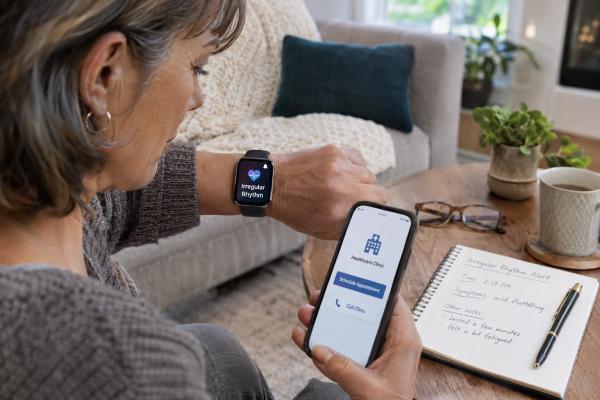
An irregular rhythm notification from a smartwatch or fitness tracker means the device detected a pulse pattern that may resemble atrial fibrillation (AFib). It does not prove that you have AFib, and a normal notification history does not rule out an arrhythmia. Most consumer devices use optical pulse sensors to look for irregularity while you are relatively still; some also let you record a brief single-lead ECG. Motion, poor skin contact, premature beats, and other rhythm changes can trigger alerts, while short or intermittent AFib episodes may be missed. The right next step depends on your symptoms and whether the alert repeats. Chest pain, severe shortness of breath, fainting, stroke symptoms, or a sustained very fast heartbeat with severe symptoms needs urgent or emergency evaluation. If you feel well, save the notification, record any available ECG, note the time and symptoms, and arrange clinical follow-up. A medical-grade ECG or ambulatory monitor is often needed to confirm the rhythm before treatment decisions are made.
Table of Contents
- What an Irregular Rhythm Notification Means
- What to Do Right Away
- When to Seek Emergency Care
- How AFib and Other Arrhythmias Are Confirmed
- False Positives, Missed Rhythms, and Device Limits
- What Happens If AFib Is Confirmed
- How to Use Wearables Without Letting Alerts Take Over
What an Irregular Rhythm Notification Means
Most smartwatch irregular-rhythm features do not continuously record a diagnostic ECG. Instead, they commonly use photoplethysmography, or PPG, which shines light into the skin and detects tiny changes in blood volume with each pulse. Software then looks for patterns of irregular timing that resemble AFib.
AFib is an abnormal rhythm in which the upper chambers of the heart activate rapidly and chaotically. The pulse is often irregular, and the rate can be slow, normal, or fast. Some people feel pounding, fluttering, fatigue, breathlessness, or dizziness; others feel nothing. A separate guide to atrial fibrillation symptoms can help you recognize the range of possible presentations.
A notification usually means the device found enough irregular pulse data to cross its algorithm’s threshold. That is useful as a screening signal, not a final diagnosis.
Large wearable studies show why that distinction matters. In the Fitbit Heart Study, only a small fraction of the very large study population received an irregular rhythm detection. Among participants who then wore an analyzable ECG patch, AFib was confirmed in a substantial minority during monitoring. When the device detected another irregular rhythm episode at the same time the ECG patch was being worn, the positive predictive value was very high. In plain language: repeated, concurrent alerts can be meaningful, but one consumer alert does not tell you with certainty what rhythm occurred.
A notification is not the same as an ECG diagnosis
An optical sensor is reading the pulse at the wrist, not directly measuring the heart’s electrical activity. Even a smartwatch ECG is generally a single-lead tracing, not the 12-lead ECG used in clinics and emergency departments.
If your device has an ECG feature, it can provide additional information. A tracing recorded during symptoms may be particularly helpful to a clinician. For more detail on what consumer recordings can and cannot show, see how smartwatch ECG features work and their limits.
The safest interpretation is: the alert deserves context and, when appropriate, confirmation—not panic and not dismissal.
What to Do Right Away
If you receive an irregular rhythm notification and you are not having emergency symptoms, take a few calm, practical steps.
- Stop and notice how you feel. Are you having palpitations, chest discomfort, shortness of breath, dizziness, unusual fatigue, or no symptoms at all?
- Sit still for a few minutes. Motion can create poor optical readings, and resting makes a repeat measurement more useful.
- Save the alert. Take a screenshot or note the date and time so you can show it to a clinician later.
- Record an ECG if your device supports it and you can do so safely. Follow the manufacturer’s instructions. Do not delay urgent care to obtain a tracing.
- Write down possible context. Exercise, illness, fever, alcohol, dehydration, poor sleep, caffeine, and medications can affect heart rate or symptoms.
- Arrange follow-up if the alert is new, recurrent, or unexplained. The urgency depends on symptoms and your medical history.
Do not repeatedly run dozens of recordings trying to force a normal result. Consumer algorithms can return “inconclusive” readings because the heart rate is outside a supported range, the signal is noisy, the watch fit is poor, or the rhythm is not one the software is designed to classify.
If this is your first alert and you feel fine
A single asymptomatic alert usually does not require an ambulance, but it should not automatically be ignored. Contact your primary care clinician or cardiology team, especially if you are older, have high blood pressure, diabetes, heart disease, prior stroke, sleep apnea, or repeated notifications.
A clinician may ask for the tracing, review your pulse history, perform a 12-lead ECG, and decide whether longer monitoring is worthwhile.
If alerts repeat
Repeated alerts increase the chance that there is a real rhythm issue worth documenting. The rhythm could be AFib, but it could also be premature atrial contractions, premature ventricular contractions, or another pattern. If your sensation is more like a skip or thump than sustained irregularity, premature beats and skipped heartbeats may help explain why the pulse feels uneven.
Do not start aspirin, an anticoagulant, or an antiarrhythmic drug based only on a wearable alert. Those treatments have real benefits in selected patients and real risks when used unnecessarily.
When to Seek Emergency Care
The device notification is less important than how you feel. Call emergency services for symptoms that could indicate a heart attack, stroke, dangerous arrhythmia, or circulatory instability.
Seek emergency care for an irregular or fast heartbeat accompanied by:
- Chest pressure, squeezing, or significant chest pain.
- Severe or rapidly worsening shortness of breath.
- Fainting or near-fainting with ongoing symptoms.
- New weakness or numbness on one side of the body.
- New facial droop, difficulty speaking, confusion, or sudden vision loss.
- Severe lightheadedness with inability to stand safely.
- A sustained very fast heart rate together with marked weakness, chest pain, or breathing difficulty.
Do not drive yourself if you may be having a heart attack or stroke. Emergency medical services can begin assessment and treatment while transporting you.
Stroke symptoms are especially important with AFib
AFib can allow blood to pool in the atria and contribute to clot formation. If a clot travels to the brain, it can cause an ischemic stroke. That is why confirmed AFib sometimes leads to anticoagulant therapy based on a person’s stroke-risk profile.
However, a watch alert by itself does not establish that you need anticoagulation. Stroke prevention decisions depend on confirmed rhythm information, episode context, medical history, age, blood pressure, diabetes, previous stroke, vascular disease, bleeding risk, and other factors.
If you feel well but notice your resting heart rate remains much faster than usual for a prolonged period, seek prompt clinical advice. The exact threshold depends on the person; symptoms, duration, and underlying heart disease matter more than one universal number.
How AFib and Other Arrhythmias Are Confirmed
A clinician confirms AFib by documenting the heart’s electrical rhythm, usually with an ECG. If the arrhythmia is not happening during the office visit, longer monitoring may be necessary.
Common options include:
- 12-lead ECG: A short recording that can diagnose AFib if the rhythm is present at that moment.
- Holter monitor: Continuous ECG monitoring, often for one or two days, useful when symptoms happen frequently.
- Patch monitor: A wearable ECG patch that may record for one to two weeks or longer.
- Event monitor or mobile cardiac telemetry: Longer monitoring that captures intermittent events.
- Implantable loop recorder: A device placed under the skin for very long-term monitoring in selected situations.
The choice depends on how often symptoms or alerts occur. A two-minute arrhythmia that happens once every three months is easy to miss with a 24-hour monitor. Longer monitoring increases the chance of capturing an intermittent rhythm.
If your clinician orders a patch, a guide to understanding patch-monitor results can help explain terms such as AFib burden, premature beats, pauses, and short runs of tachycardia.
Why one normal ECG does not always settle the question
Paroxysmal AFib starts and stops on its own. A normal ECG in the clinic only shows what happened during those seconds. It does not prove that every previous alert was false.
This is one reason recent wearable research has examined longer confirmation periods. When people with an initial wearable alert were monitored for more time, more AFib episodes were eventually documented. That does not mean every alert becomes AFib if you monitor long enough; it means intermittent rhythms require enough observation time to be caught.
Your saved wearable data can still help
Bring screenshots, heart-rate trends, ECG PDFs or tracings, and a short symptom log. Note whether an alert happened during sleep, rest, illness, alcohol use, exercise recovery, or another recognizable situation. This information can help a clinician choose the most useful monitor and interpret the event in context.
False Positives, Missed Rhythms, and Device Limits
Wearables are useful because they observe the heart far more often than a clinic ECG can. That strength also creates a weakness: they collect large amounts of imperfect data in everyday conditions.
Common reasons an irregular pulse alert may not represent AFib include:
- Premature atrial contractions.
- Premature ventricular contractions.
- Motion artifact.
- Loose or inconsistent sensor contact.
- Poor blood flow at the wrist, including in cold conditions.
- Tremor or repetitive hand movement.
- Other arrhythmias that produce an irregular pulse.
A device can also miss AFib. Algorithms often analyze only certain periods when the wearer is still enough to generate clean data. Episodes may be too short, occur while you are moving, fall outside supported heart-rate ranges, or simply not be sampled at the right moment.
“No alert” does not mean “no arrhythmia”
If you have recurrent palpitations, fainting, unexplained shortness of breath, or episodic rapid heartbeats, seek medical evaluation even if the watch never alerts. A consumer wearable is not a substitute for symptom-based medical assessment.
Similarly, if your device says “sinus rhythm,” that means the recorded tracing looked consistent with sinus rhythm under the algorithm’s criteria. It does not exclude every abnormal rhythm, structural heart problem, blocked artery, or future AFib episode.
The watch is not designed to diagnose everything
Consumer devices may be good at distinguishing AFib from sinus rhythm under appropriate conditions, but diagnostic performance varies across products, populations, and signal quality. They are not comprehensive electrophysiology laboratories.
A smartwatch may not reliably distinguish atrial flutter, supraventricular tachycardia, ventricular arrhythmias, heart block, or frequent ectopic beats. If the tracing is unusual, the correct response is clinician review rather than trying to decode it from a single automated label.
What Happens If AFib Is Confirmed
Confirmed AFib leads to a broader assessment rather than one automatic treatment. The major goals are to reduce stroke risk, control symptoms and heart rate, decide whether rhythm-control treatment is appropriate, and address conditions that make AFib more likely to recur.
Stroke-risk assessment
A clinician considers age, prior stroke or transient ischemic attack, high blood pressure, diabetes, heart failure, vascular disease, and other factors. For people whose stroke risk is high enough, an anticoagulant can substantially reduce the chance of an AFib-related stroke.
This decision is important enough that it should be based on confirmed clinical information, not a consumer alert alone.
Rate control and rhythm control
Some people need a medication that slows the ventricular rate. Others benefit from rhythm-control treatment intended to restore and maintain normal rhythm. Rhythm control may involve antiarrhythmic medication, electrical cardioversion, catheter ablation, or a combination.
Modern AFib guidelines increasingly emphasize earlier consideration of rhythm control for appropriate symptomatic patients and aggressive management of modifiable risk factors.
Treating the conditions around AFib
AFib rarely exists in isolation. High blood pressure, obesity, sleep apnea, diabetes, heavy alcohol use, and inactivity can increase AFib burden or recurrence. Managing these factors is part of the treatment, not an optional extra.
Alcohol, poor sleep, dehydration, and stress can also provoke symptoms in some people. See common AFib triggers for practical ways to recognize patterns without assuming every episode has one obvious cause.
If your wearable helped detect AFib, it may remain useful after diagnosis for symptom correlation. But treatment should not turn into constant self-surveillance. Your cardiology team can tell you which data are actually worth tracking.
How to Use Wearables Without Letting Alerts Take Over
Wearables can improve awareness, but they can also create anxiety. Research in people with AFib suggests that heavy wearable use may be associated with more symptom monitoring, health-care use, and preoccupation in some users. That does not make the device harmful; it means the way you use the information matters.
A practical approach is to decide in advance what each type of result will trigger.
For one asymptomatic irregular-rhythm alert: Save it, note the context, and contact your clinician if it is new or unexplained.
For repeated alerts: Arrange clinical evaluation and ask whether ambulatory ECG monitoring is appropriate.
For an alert with concerning symptoms: Follow the symptom severity, not the watch. Seek urgent or emergency care when indicated.
For normal readings after symptoms: Do not use them to dismiss persistent chest pain, fainting, severe breathlessness, or neurologic symptoms.
Set limits on checking
If you find yourself recording an ECG every few minutes, checking your pulse throughout the day, or avoiding activity because the number might change, discuss that pattern with your clinician. A useful monitoring plan usually specifies when to record, what symptoms matter, and how often data will be reviewed.
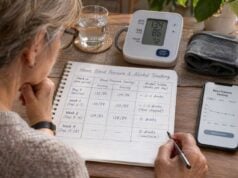
It may help to keep a simple log with only four fields: date/time, symptom, wearable result, and what you were doing. That is often more useful than hundreds of isolated screenshots.
Keep the technology in its proper role
A wearable is best viewed as an early-warning and documentation tool. It can notice something you might otherwise miss and help capture a rhythm during symptoms. It cannot determine your stroke risk, listen to your heart, evaluate heart structure, interpret all arrhythmias, or decide whether a medication is safe.
If an irregular rhythm notification leads to a proper ECG diagnosis and timely treatment, the technology has done something valuable. If it leads to repeated checking without clinical confirmation, it creates noise rather than clarity.
The next step after an alert is therefore not to ask, “Does my watch say I have AFib?” It is to ask, “Do my symptoms require urgent care, and if not, what is the best way to document and confirm the rhythm?” That approach uses the device’s strengths while respecting its limits.
It is also worth checking the basics that improve signal quality. Wear the device snugly enough to maintain skin contact, keep the sensor surface clean, and use the correct wrist and settings for the product. Record ECGs while seated and still, with the arm supported when the instructions recommend it. These steps reduce noise, but they do not turn a consumer device into a diagnostic monitor. If the watch repeatedly reports poor recordings despite proper use, mention that during clinical follow-up rather than repeatedly tightening the band or extending the session.
References
- 2023 ACC/AHA/ACCP/HRS Guideline for the Diagnosis and Management of Atrial Fibrillation: A Report of the American College of Cardiology/American Heart Association Joint Committee on Clinical Practice Guidelines 2024 (Guideline)
- Detection of Atrial Fibrillation in a Large Population Using Wearable Devices: The Fitbit Heart Study 2022 (Study)
- Wearable Irregular Heart Rhythm Detection Recurrences and Electrocardiographic Atrial Fibrillation Confirmation: The Fitbit Heart Study 2025 (Study)
- Smart watch applications in atrial fibrillation detection: Current state and future directions 2024 (Review)
- Comparison of diagnostic accuracy of electrocardiogram-based versus photoplethysmography-based smartwatches for atrial fibrillation detection: A Systematic Review and Meta-Analysis 2025 (Systematic Review and Meta-Analysis)
- Wearable Devices, Health Care Use, and Psychological Well-Being in Patients With Atrial Fibrillation 2024 (Study)
Disclaimer
This article is for general education and cannot diagnose an arrhythmia from a wearable notification. Seek emergency care for chest pain, severe shortness of breath, fainting, stroke symptoms, or other severe symptoms regardless of what a device displays. Do not start or stop aspirin, an anticoagulant, or a rhythm medication based only on a smartwatch or fitness-tracker alert.