Keto bread can produce a smaller blood sugar rise than your usual loaf, especially when the swap cuts down on the digestible starch in the portion you actually eat. A dense egg-and-almond-flour loaf gets there differently from a soft sandwich loaf built on wheat protein, added fiber, and modified starch. Both may carry a keto label, but they do not always behave the same way once they are on your plate.
The front of the bag hides details that matter at breakfast or lunch. A “1 g net carb” claim may describe one thin slice, while your sandwich takes two. A bread with no added sugar can still be full of starch. And the jam on your toast, or the chips beside your sandwich, can change what you see after eating. Start with the serving size, check what replaced the flour, and decide whether the actual meal gives you a reason to make the switch.
Table of Contents
- When keto bread can lower your glucose rise
- How to read the label beyond net carbs
- What the ingredients tell you
- Why blood sugar can still rise after keto bread
- How to compare two breads with a meter or CGM
- How to choose a bread you’ll keep eating
When keto bread can lower your glucose rise
Most regular bread gets much of its carbohydrate from flour. Your digestive system breaks down much of that starch into glucose, which then enters your bloodstream. The height of the rise depends partly on how much digestible carbohydrate you eat and how quickly it becomes available. It also depends on where your glucose started, how well your insulin responds, and whether you take any glucose-lowering medicine.
The swap is most likely to make a noticeable difference when it replaces a meaningful amount of digestible starch in the portion you normally eat. If your usual sandwich uses two slices of white bread, compare those with the two slices you would use from the keto loaf. A few grams saved per slice can add up across a sandwich. But a loaf that looks lower in carbs mostly because its slices are smaller may offer much less once you assemble a filling lunch.
Bread makers cut digestible starch in a few ways. Almond flour, ground flax, eggs, seeds, or wheat protein can supply some of the bulk and structure that regular flour provides. Other recipes use fibers and starches that resist digestion. A third option is simply to make thinner slices. That works well when one thin slice is enough for your usual meal.
“Low-spike” is best understood as a comparison. A smaller rise after keto toast than after your usual toast can be meaningful if the two meals are otherwise similar. There is no single change in mg/dL that makes a bread low-spike for everyone. Your usual post-meal blood sugar pattern and any target you’ve agreed on with your care team give the number context.
A smaller rise at lunch answers a short-term question. Whether the swap matters over time takes repeated changes across meals, not one good reading. The longer-term measure to watch is A1C, which reflects average blood sugar over roughly three months. The most telling test is a meal you actually eat often.
How to read the label beyond net carbs
On a U.S. Nutrition Facts label, Total Carbohydrate includes sugars, starches, and dietary fiber. Sugar alcohols, when present, also count toward that total. “Net carbs” is a front-of-package term without a standardized U.S. definition. Manufacturers commonly subtract dietary fiber and may also subtract sugar alcohols. The calculation can help explain how a brand arrived at its claim, but the result cannot tell you exactly how much your glucose will rise.
| Label item | What to look for | Why it matters |
|---|---|---|
| Serving size | Number of slices and weight in grams | A thin slice may weigh much less than a slice from your usual loaf. |
| Total Carbohydrate | Grams in the number of slices you plan to eat | This is the starting point for comparing labels and following a carb-counting plan. |
| Dietary Fiber | Grams per serving and possible sources in the ingredient list | Fiber helps explain why two loaves with similar total carbs can have different amounts of digestible starch. |
| Total Sugars and Added Sugars | Both numbers alongside Total Carbohydrate | A low sugar number leaves room for starch, which can also raise glucose. |
| Sugar Alcohols | The amount if listed and the sweetener’s name in the ingredients | Different sugar alcohols can have different effects on glucose and digestion. |
| Sodium and saturated fat | Milligrams of sodium and grams of saturated fat per usual portion | These matter if the bread will be an everyday food, especially when the fillings also supply them. |
Imagine one slice lists 12 g total carbohydrate and 10 g fiber. The bag advertises 2 g net carbs. In a two-slice sandwich, that becomes 24 g total carbohydrate and 20 g fiber. The brand’s calculation gives 4 g net carbs for the bread in the sandwich. Another loaf could reach the same 2 g claim per slice from 5 g total carbohydrate and 3 g fiber. Two slices of that loaf would contain 10 g total carbohydrate and 6 g fiber. From the front, the two claims look identical, yet the first loaf delivers more than three times as much fiber per sandwich. That difference may matter if a large serving of added fiber makes you bloated.
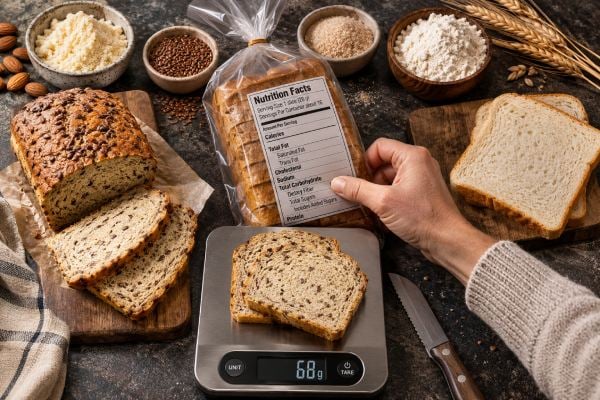
Slice weight gives you a second way to compare. If one slice weighs 25 g and another weighs 40 g, the per-slice numbers tell you how much you would eat in a one-slice serving. Comparing equal weights tells you how the recipes differ. For everyday decisions, start with your usual number of slices. Then check equal weights if the smaller loaf leaves you wanting an extra piece.
If you count carbs for diabetes, use the Total Carbohydrate line as your starting point. If you take mealtime insulin, follow the calculation your diabetes team gave you for high-fiber foods. “Zero net carbs” on the front of a bag is not a reliable basis for skipping or changing a dose. Your net carb calculation can explain the package claim without doubling as your dosing rule.
What the ingredients tell you
When flour gives way to nuts, seeds, or protein
A loaf built around almond flour, eggs, and ground flax leaves less room for the digestible starch you would get from a wheat-flour loaf. Coconut flour and psyllium husk, a fiber that absorbs water, can also help give a low-carb loaf structure. Recipes still vary. A bread made with almond flour may also contain tapioca starch, rice flour, or sweetener. Start with the ingredients near the top of the list, then use the nutrition panel to see what the finished recipe adds up to.
Packaged loaves sometimes use vital wheat gluten, a concentrated wheat protein that gives dough stretch and helps produce a chewy slice. Seeing it high on the list gives you a clue about the bread’s structure. Regular wheat flour or digestible starch can still be part of the recipe. Wheat-based keto breads also contain wheat allergens and can contain gluten. If you have celiac disease, look for a gluten-free label and check the ingredients for sources of gluten. If you have a wheat allergy, check the ingredient list and allergen statement for wheat.
When the bread relies on resistant starch or added fiber
Resistant starch escapes digestion in the small intestine. Some of it reaches the large intestine, where gut bacteria can ferment it. When it replaces some digestible starch in a recipe, there can be less glucose available from that serving. The result depends on the type of starch, the amount used, and how much digestible starch remains in the finished bread.
A review of 36 randomized trials in people with type 2 diabetes or prediabetes found that some types of resistant starch lowered glucose after eating. The clearest findings were for types 1 and 2, which include starch trapped in intact plant structures and starch naturally resistant to digestion in some high-amylose grains. The evidence for type 4, a chemically modified form that may be added to packaged foods, was more limited. In a small 2026 crossover study of 10 healthy adults, both the type 4 resistant-starch bread and the white bread landed in the medium glycemic index range. Glycemic index compares how quickly carbohydrate-containing foods raise blood sugar under standard test conditions. The study tested a specific recipe, so the finding offers little help in predicting how an untested supermarket loaf will perform.
Two similar names on an ingredient list can describe different things. “Resistant wheat starch” identifies a starch intended to resist digestion. “Modified food starch” is a broader term that can describe starch changed for properties such as texture or stability. When you see the broader term, use the listed fiber and total carbohydrate amounts to judge the loaf. The word “modified” alone leaves digestibility unclear.
Other added fibers do different jobs. Psyllium forms a gel when mixed with water, oat fiber adds bulk, and inulin or chicory root fiber can ferment in the gut. Oat fiber and oat flour are not the same ingredient: oat flour contains the ground grain, including its starch. If you’re sensitive to added fiber, pay attention to how you feel after a full sandwich. Gas or bloating after a high-fiber loaf may be reason enough to choose a different one, even if your glucose response was smaller.
Why blood sugar can still rise after keto bread
The portion can change the result. Two slices double everything listed for one slice. A third slice of a lower-carb loaf may reduce the advantage you expected from the swap. This is easy to miss with small, thin slices, especially if you add another piece of toast to feel as full as you did with your regular breakfast.
The bread can still contain digestible starch. A product may use a blend of resistant starch, conventional flour, and added fiber. A low added-sugar number tells you about the sugar in the recipe. A high fiber number tells you how much fiber is in the serving. A loaf can have both and still supply enough digestible carbohydrate to raise your glucose.
The rest of the meal counts. One slice topped with egg and tomato is a different meal from two slices topped with jam and served with orange juice. At lunch, a sweet sauce, chips, or a sweetened drink can contribute more carbohydrate than the bread swap saves. Protein and fat also affect how quickly a mixed meal is digested. A heavily filled grilled cheese may show a modest early rise and a later climb, which matters if you only check once. If the goal is to see whether the bread makes a difference, keep the rest of the meal the same.
The day you eat it matters. You may start breakfast higher after a poor night’s sleep or while you’re ill. A walk after one meal and a long stretch of sitting after another can also affect the comparison. Even the same meal can give you different readings on different days. A result that repeats tells you more about your personal glucose response to food than one unusually high or low reading.
Toasting, freezing, or reheating bread can also change its starch structure. Cooling cooked starch can create some resistant starch, but the effect depends on the recipe and preparation. Treat toast as the same portion of bread for meal planning. If you’re comparing two loaves, prepare both the way you normally eat them so the comparison helps with the choice you’ll make again.
How to compare two breads with a meter or CGM
If you already use a glucose meter or continuous glucose monitor (CGM), you can compare your usual bread with a keto loaf over a few ordinary meals. A CGM estimates glucose in the fluid just under your skin and shows how it changes over time. A fingerstick gives you a reading at a specific moment. Either can help answer a practical question: whether switching bread makes a worthwhile difference to your usual lunch.
- Pick a meal you repeat. Use the same fillings, sides, and drinks each time. Compare the portions you would actually eat, such as two slices of each loaf. If you want to compare the recipes by weight, weigh the slices and record the portions.
- Keep the conditions similar. Try the meals at the same time on different days, with your usual medication and routine. Record anything that could explain a difference, such as unusual exercise, poor sleep, or illness. People who take insulin or other medicines that can cause lows should follow their usual care plan throughout the comparison.
- Note your starting glucose and when you begin eating. If you use a fingerstick meter, wash and dry your hands before checking. For a simple comparison, check before the meal and at the same point afterward each time. If your care plan allows and you want to see more of the response, readings at one and two hours from the first bite can show whether glucose was still climbing at the later check.
- Look at both the reading and the change. A rise from 105 to 145 mg/dL is 40 mg/dL. A rise from 125 to 150 mg/dL is 25 mg/dL. The second meal produced the smaller rise, but the measured glucose was still higher because you started higher. If you use a CGM, look at the overall curve to see whether a smaller early rise was followed by a later peak.
- Repeat before deciding. If the difference is small or the results flip on another day, you may have no clear reason to choose one bread based on glucose alone. If one loaf gives you a consistently smaller rise, and the portions and fillings suit you, that’s a practical reason to buy it again.
For many nonpregnant adults with diabetes, a common clinical goal is a post-meal glucose below 180 mg/dL, checked one to two hours after the meal starts. Individual targets can differ, and pregnancy has separate goals. This number is a diabetes management target. A home reading after toast cannot diagnose diabetes or prediabetes. If you’re concerned about repeated high readings, bring the pattern to a clinician who can advise you about lab testing.
One sensor point also deserves some context. CGM readings can lag behind blood glucose when it changes quickly. If your symptoms and the sensor reading disagree, follow your device and care team’s instructions for confirming the reading. If you don’t normally monitor your glucose, you do not need to buy a device to choose bread. Comparing actual portions, ingredients, and whether the bread keeps you satisfied is a reasonable starting point.
How to choose a bread you’ll keep eating
Start with the job you want the bread to do. A soft, wheat-based keto loaf might make an easy swap for a daily sandwich. A denser seed or almond loaf may work better as one slice of toast with eggs. If the slice is so small that you need two for breakfast, use two in your comparison. For homemade bread, estimate the carbs from the full recipe and divide by the number of similar-sized slices you actually cut. The recipe’s suggested yield may differ from yours.
Give regular bread a fair comparison. A slice of whole-grain bread that you enjoy can fit into a blood sugar–conscious meal. Try it open-faced with hummus, chicken, or egg and add vegetables on the side. Whole-grain bread can still contain substantial digestible starch, and the texture, ingredients, and portion vary across loaves. If you’re weighing sourdough or whole-grain bread against a keto loaf, compare the bread as you would serve it. One substantial slice of whole-grain bread may work well where two smaller keto slices were more than you needed.
Factor in digestion and the rest of the label. A loaf with a large amount of added fiber can be a sudden change if you usually eat little fiber. Begin with a portion you’re comfortable with and increase gradually if it suits you. For recurring bloating, try a bread with less added fiber per serving or a different fiber source. If you eat bread every day, compare sodium in the portions you actually use, especially if you often add deli meat, cheese, or salty spreads. Compare saturated fat as well if the bread contains a lot of butter or coconut oil. These choices matter across weeks of meals even when the breads produce similar glucose readings.
Judge the trade-off in the meal you actually eat. A loaf that saves you a noticeable amount of digestible carbohydrate, works with your fillings, and tastes good enough to finish can be worth the switch. If the difference is small, consider what you’d prefer to spend and how satisfied you feel after eating. For a daily sandwich, the most practical choice is the bread that works in your usual portion, fits your glucose goals, and sits well afterward.
References
- 6. Glycemic Goals, Hypoglycemia, and Hyperglycemic Crises: Standards of Care in Diabetes-2026 2026 (Guideline)
- A comparison of the effects of resistant starch types on glycemic response in individuals with type 2 diabetes or prediabetes: A systematic review and meta-analysis 2023 (Systematic Review)
- Effect of Type IV Resistant Starch‐Enriched Breads on Appetite, Glycemic Index, and Glycemic Response 2026 (Crossover Study)
- Carb Counting 2024
- Choosing Healthy Carbs 2024
Disclaimer
This article provides general information about bread choices and post-meal glucose. If you use insulin or another medicine that can cause low blood sugar, check with your diabetes care team before making major changes to your carbohydrate intake or using package net carb claims to guide dosing. Follow the glucose targets and monitoring instructions set for you, including any separate guidance during pregnancy.