For many adults with type 2 diabetes and overweight or obesity, losing 5% to 7% of starting body weight is enough to improve blood sugar. At 200 pounds, that’s 10 to 14 pounds. Keeping off more than 10% usually brings greater benefits, and some people with type 2 diabetes reach remission.
How far your A1C falls depends on where it started, what treatment you use, and how long your glucose levels have been lower by the time you test.
If you have prediabetes, a smaller A1C change can still be meaningful. The starting number is usually closer to the normal range, so there’s less room for it to fall. Research on prediabetes also measures how often people return to normal glucose levels or develop type 2 diabetes over time. Those outcomes help explain why weight loss can matter even when the lab result moves by only a few tenths of a percentage point.
Knowing which outcome applies to you makes it easier to set a goal and judge your progress.
Table of Contents
- How much weight loss can improve A1C?
- How far can A1C fall with type 2 diabetes?
- What weight loss can do for prediabetes
- How much weight loss can lead to diabetes remission?
- When to retest A1C and how to read the result
- How to set a weight goal and track progress safely
How much weight loss can improve A1C?
The American Diabetes Association identifies 5% to 7% of starting weight as a range that improves blood sugar in adults with type 2 diabetes and overweight or obesity. A sustained loss of more than 10% usually brings greater benefits and can make remission possible for some people. For adults with overweight or obesity who are at high risk for type 2 diabetes, structured prevention programs also use 5% to 7% as a weight-loss goal.
These percentages refer to your weight at the start of the plan. If you weigh 200 pounds and lose 10 pounds, you’ve lost 5%. If you weigh 160 pounds, losing 10 pounds is a little over 6%. That’s why percentage-based goals are easier to adapt than fixed pound targets.
| Starting weight | 5% loss | 7% loss | 10% loss | 15% loss |
|---|---|---|---|---|
| 160 lb | 8 lb | 11.2 lb | 16 lb | 24 lb |
| 180 lb | 9 lb | 12.6 lb | 18 lb | 27 lb |
| 200 lb | 10 lb | 14 lb | 20 lb | 30 lb |
| 240 lb | 12 lb | 16.8 lb | 24 lb | 36 lb |
Think of 5% as a first milestone. Some people see better glucose readings with a smaller loss, especially if they’ve also become more active or changed what they eat. Others reach 5% and still have an A1C above their personal goal. At that point, the next decision might involve maintaining the loss, working toward a larger one, adjusting medication, or combining those approaches.
Weight loss can help because the liver and muscles may respond better to insulin as excess body fat declines. Insulin helps muscles take up glucose and signals the liver to release less of it. Better insulin sensitivity can bring down fasting glucose, after-meal glucose, or both. The pancreas’s ability to make enough insulin still matters, which helps explain why a similar weight loss can produce different results in two people.
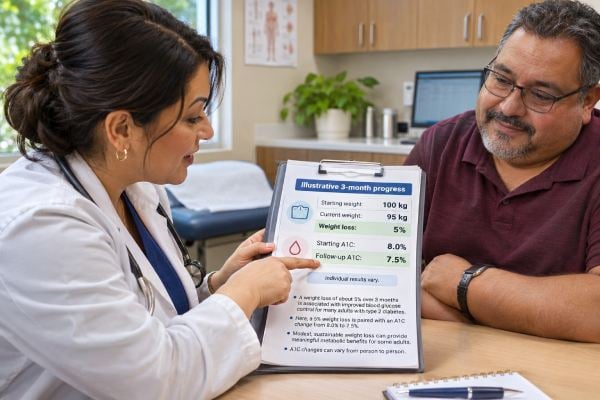
One last detail prevents a common mix-up: the percentages on a scale and on an A1C report describe different things. A 5% weight loss means you lost one-twentieth of your starting body weight. A fall in A1C from 8.0% to 7.5% is a drop of 0.5 percentage points. Keeping those units straight makes it easier to understand both study findings and your own lab results.
How far can A1C fall with type 2 diabetes?
A systematic review of 58 studies involving more than 17,000 adults with type 2 diabetes and overweight or obesity estimated that each kilogram of average weight loss was associated with a 0.1 percentage-point drop in A1C, on average. A kilogram is about 2.2 pounds. Using that estimate, an average loss of 5 kg, or about 11 pounds, corresponded to an A1C decline of roughly 0.5 percentage points. That’s the size of a change from 8.0% to 7.5%.
The researchers compared averages across treatment groups, with follow-up from 3 to 24 months. The trials included different ways to lose weight, and diabetes medication use sometimes changed along the way. The estimate gives you a sense of the size of the change observed in research. A prediction for an individual would also need to account for starting A1C, treatment, and how glucose responds over time.
The estimate came from adults with type 2 diabetes, so applying it to prediabetes would go beyond the evidence.
Why starting A1C matters
In the review, groups with higher starting A1C levels generally had larger drops with the same amount of weight loss. Someone starting at 9.0% has more room for average glucose to fall than someone starting at 6.9%. The person starting at 9.0% could show the bigger improvement and still be above their treatment goal.
The person starting at 6.9% might have a smaller change and already be near the level they agreed to aim for with their clinician. An A1C below 7% is appropriate for many nonpregnant adults with diabetes, but a clinician may set a different goal based on factors such as other health conditions, frailty, or the chance of low blood sugar.
It helps to ask two questions when you see a new result: How much did A1C change from your starting number? How close are you to the goal that fits your health and treatment?
Medication changes can alter what progress looks like
Suppose your A1C stays around 7.0% while your clinician reduces your insulin dose because your glucose readings have been running lower. You’re maintaining similar average glucose with less insulin, which is a meaningful treatment outcome. In another case, A1C might drop before much weight comes off because you started a medication that brings down glucose directly. Some GLP-1 medications, for example, can improve blood sugar while also helping with weight loss.
Record medication changes alongside weight and lab results. If your A1C fell from 8.2% to 7.2% after you lost weight, started a new medicine, and began walking regularly, the result shows how you responded to the plan as a whole. The same record can help your clinician decide whether the plan is working safely and which parts to adjust.
What weight loss can do for prediabetes
Prediabetes can be identified by an A1C of 5.7% to 6.4% or by elevated results on certain glucose tests. For adults with overweight or obesity who are at high risk for type 2 diabetes, the ADA recommends a structured program that aims for at least 5% to 7% weight loss and at least 150 minutes of moderate physical activity each week. A brisk walk is one example of moderate activity.
A systematic review of 44 randomized trials involving nearly 15,000 people with prediabetes looked at what happened over a median of two years. Compared with control groups, lifestyle programs aimed at weight loss helped about 11 more people out of every 100 return to normal glucose levels and led to about 8 fewer people out of every 100 developing type 2 diabetes. Across the trials, average weight loss ranged from 1% to 9%.
Greater loss within that range was associated with a better chance of returning to normal glucose levels and a lower chance of developing diabetes. Those figures describe what happened across groups following programs that included diet changes, physical activity, or both. They can help you understand the potential benefit of a prevention program, while your own risk also depends on factors such as how high your glucose is and whether you’ve had gestational diabetes.
The benefits researchers measured also took time to emerge. A three-month A1C check and a two-year diabetes prevention outcome answer different questions. If your A1C falls from 6.0% to 5.8%, it’s still in the prediabetes range, and the downward trend is worth following. A move from 5.8% to 5.6% crosses into the normal A1C range.
Small changes can also reflect ordinary test variation, especially near a cutoff. Your clinician can help interpret the result alongside past tests and decide whether fasting glucose or another test would clarify the picture.
A useful first goal is a change you can build on. For someone starting at 180 pounds, a 5% loss means about 9 pounds. Reaching that milestone gives you a chance to review how your glucose has responded and how manageable the plan feels. People with prediabetes can have different needs even at the same weight. If further weight loss would be inappropriate for you, a prevention plan can focus on activity, eating habits, and follow-up testing.
How much weight loss can lead to diabetes remission?
Sustained weight loss above 10% generally improves the chances of type 2 diabetes remission in adults with overweight or obesity. There’s no single weight or percentage that guarantees it. The usual clinical definition of remission is an A1C below 6.5% measured at least three months after stopping glucose-lowering medication. An A1C of 6.3% while taking medication can represent excellent glucose control; the remission definition is used to describe how glucose is doing after treatment with those medicines has stopped.
The UK Diabetes Remission Clinical Trial, known as DiRECT, gives a sense of what larger losses can achieve in a supervised program. The study enrolled adults who had been diagnosed with type 2 diabetes less than six years earlier and were managing it without insulin. The program used temporary meal replacements, a gradual return to regular food, and ongoing weight-maintenance support. The care team also managed changes to diabetes and blood pressure medicines.
At two years, 36% of participants assigned to the weight-management program were in remission. Among the 36 participants in that group who kept off more than 10 kg, or about 22 pounds, 29 were in remission. This smaller group had already achieved and maintained a substantial loss.
Its results show what was possible for some participants with relatively recent type 2 diabetes and access to structured care. Longer-term results put those gains in perspective: at five years, 11 of the 85 participants with data in the continued-support group were in remission, about 13%. The two-year figure for the original program group and the five-year figure for the extension group come from different sets of participants.
The researchers also followed people who had reached remission at two years. Among those with five-year follow-up data, about a quarter were still in remission. Blood sugar can rise again after remission, and glucose can become harder to manage if weight returns or the pancreas makes less insulin over time. People in remission still need regular glucose checks and routine screening for diabetes complications.
Some people also have reasons to stay on medicines with other health benefits. Decisions about stopping treatment belong in a conversation with the prescribing clinician. Better glucose control, fewer low blood sugar episodes, or a simpler medication plan can all be worthwhile outcomes at any weight.
When to retest A1C and how to read the result
A1C reflects average blood sugar over roughly two to three months. Glucose readings can improve before that change shows up fully on the lab report. If you started a new routine six weeks ago, for example, your next A1C still reflects some of the time before you started. The same applies if most of your weight loss happened in the last few weeks before the test.
For people with diabetes who recently changed treatment or whose glucose is above goal, A1C is often measured about every three months. People with diabetes whose glucose is stable and at goal may need testing only twice a year. The ADA recommends testing people with prediabetes at least annually for progression to type 2 diabetes. Your clinician may suggest an earlier check based on your last result and your risk. A look at how long it takes to lower A1C can help you put an early result in context.
When the scale and A1C tell different stories
If you’ve lost weight and A1C barely changes, start with timing and your starting result. You may have tested before your lower glucose readings had time to influence the average, or your A1C may already have been close to goal. A recent steroid prescription or changes to diabetes medication can also affect glucose during the same period.
If your fasting readings have improved but A1C remains high, look at the full day. Glucose may still be elevated after meals or at other times that a morning reading misses. A meter or a continuous glucose monitor, when appropriate for your care, can help you and your clinician spot those patterns. The same tools can show whether a lower A1C came with frequent lows. Two people can have the same A1C and very different day-to-day glucose levels.
Sometimes the A1C test itself needs a closer look. Iron deficiency anemia, recent blood loss or transfusion, and certain hemoglobin variants can affect how accurately A1C reflects average glucose. If the lab number repeatedly conflicts with your glucose readings, bring both sets of results to your clinician. They can review possible causes and decide whether glucose readings or another lab measure should guide care.
If A1C rises despite sustained weight loss, your care team can help check whether you need a change in diabetes treatment. Contact them sooner if you develop symptoms such as persistent thirst, frequent urination, or unexpected weight loss. Those symptoms are a reason to have your glucose checked promptly, even if your next A1C test is months away.
How to set a weight goal and track progress safely
If intentional weight loss fits your health needs, start with your current weight, most recent A1C, and medication list. A first milestone of about 5% gives you a specific point to review with your care team. At 200 pounds, that puts the first milestone at 190 pounds. You can then consider whether maintaining that loss or pursuing a larger one makes sense based on your glucose, treatment goals, and how you feel.
Build a routine that fits an ordinary week. For example, someone who relies on takeout could start by choosing a smaller portion of rice, keeping the protein, and adding vegetables. Someone who drinks sweetened beverages throughout the day could replace one regular drink with water or an unsweetened option. A person who sits most of the day might start with a short walk after dinner, then add more time or more days as it becomes manageable. Walking after meals can help with after-meal glucose while contributing to your weekly activity.
If you’re losing weight, adequate nutrition and strength training can help you hold on to muscle. Depending on your mobility and experience, that could mean chair stands, resistance bands, or lifting weights. A dietitian or a structured program can help you make changes that fit your schedule, food budget, and health needs. For some people, weight-management medication or metabolic surgery may be an appropriate part of care. The choice depends on medical history, treatment goals, and the benefits and risks of each option.
Track enough information to make the follow-up visit productive.
- Weight trend. If you track weight, use similar conditions each time and look at several weeks together. Fluid shifts can change the scale from one day to the next.
- A1C and test dates. Write down when you started the plan and when each sample was taken. That helps show how much of the test’s two-to-three-month window reflects your new routine.
- Glucose patterns and medication changes. Bring any readings your care team has asked you to collect, especially lows, as well as dates when medicines or doses changed.
- How the plan fits your life. Note patterns such as persistent hunger, fatigue, or trouble fitting meals and activity around work. These details help you decide what you can sustain and where you need more support.
If you take insulin or a sulfonylurea such as glipizide or glimepiride, review your glucose monitoring and medication plan with your care team before making major changes to food intake or activity. Glucose can fall before your next weigh-in or lab test. A reading below 70 mg/dL is low blood sugar and calls for prompt treatment according to your care plan. Get in touch with your care team if lows recur, and work with the prescribing clinician on any dose changes.
Once you’ve reached a weight you can maintain, keep following your glucose and the routines that help you manage it. A steady A1C at your personal goal, with a treatment plan you can live with and few or no lows, is a meaningful result. The scale can help you choose a starting goal. Your glucose trends and day-to-day health help you decide what comes next.
References
- 8. Obesity and Weight Management for the Prevention and Treatment of Diabetes: Standards of Care in Diabetes–2026 2026 (Guideline)
- Effect of weight reduction on glycated haemoglobin in weight loss trials in patients with type 2 diabetes 2017 (Systematic Review)
- Efficacy of lifestyle weight loss interventions on regression to normoglycemia and progression to type 2 diabetes in individuals with prediabetes: a systematic review and pairwise and dose-response meta-analyses 2024 (Systematic Review)
- 3. Prevention or Delay of Diabetes and Associated Comorbidities: Standards of Care in Diabetes-2026 2026 (Guideline)
- 5-year follow-up of the randomised Diabetes Remission Clinical Trial (DiRECT) of continued support for weight loss maintenance in the UK: an extension study 2024 (Trial Follow-Up)
- 6. Glycemic Goals, Hypoglycemia, and Hyperglycemic Crises: Standards of Care in Diabetes-2026 2026 (Guideline)
Disclaimer
This article provides general information for adults with prediabetes or type 2 diabetes. Ask your healthcare team whether weight loss is appropriate for you and how to monitor your glucose during changes to food or activity. If you take insulin or another medicine that can cause low blood sugar, work with your prescriber on any dose changes.