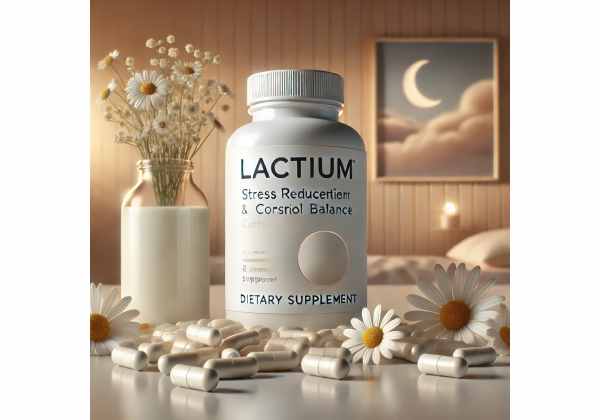
Lactium is not a vitamin, herb, or mushroom extract. It is a branded milk protein hydrolysate made from alpha-s1 casein, and its appeal comes from one very specific promise: calmer stress responses without the heavy sedation many people want to avoid. That makes it especially relevant to brain health and mental wellness, because poor sleep, elevated tension, mental fatigue, and constant physiological arousal can quietly erode focus, mood, and resilience over time.
The interest in Lactium has grown because it sits in a practical middle ground. It is often marketed for stress and sleep, yet its mechanism appears more targeted than a generic “relaxation blend.” At the same time, it is easy to overstate the evidence. Human studies are encouraging in some areas, but they are not strong enough to justify broad treatment claims. This guide explains what Lactium is, how it may work, where it seems most useful, how to take it, and what safety points deserve attention.
Table of Contents
- What Lactium Is and How It Differs
- How Lactium May Affect Brain and Stress
- Where the Benefits Look Most Relevant
- What the Human Research Actually Shows
- Dosage, Timing, and Best Use Cases
- Safety, Side Effects, and Precautions
What Lactium Is and How It Differs
Lactium is a milk-derived ingredient made by hydrolyzing alpha-s1 casein, one of the main proteins in cow’s milk. The hydrolysis process releases a bioactive peptide often referred to as alpha-casozepine. This matters because Lactium is not simply “milk in capsule form,” and it does not work like drinking a glass of milk before bed. It is a processed peptide ingredient designed for a more targeted calming effect.
That alone makes Lactium different from many other supplements in the brain-health space. It is not a stimulant, not a classic amino acid nootropic, and not an herb. Instead, it is usually discussed as a stress-modulating and sleep-support ingredient. For people trying to improve mental wellness, that distinction is useful. Chronic stress does not only affect mood. It also affects attention, reaction speed, memory retrieval, sleep quality, and emotional control.
Lactium is often compared with:
- melatonin, which directly nudges sleep timing
- magnesium, which may support relaxation more broadly
- L-theanine, which is often used for calm alertness
- botanical calming agents such as lemon balm
What makes Lactium stand out is that it appears to be aimed less at inducing sleep directly and more at reducing the stress-related activation that makes sleep and recovery harder in the first place. That also helps explain why some people use it for daytime tension, not just at night.
In supplement formulas, Lactium may appear:
- on its own as alpha-s1 casein hydrolysate
- in sleep blends with L-theanine or magnesium
- in anti-stress formulas with botanicals
- in functional foods or chewables
The quality of the product matters. Some formulas clearly disclose the branded ingredient and the dose, while others bury it inside a proprietary blend. Since Lactium is a specific ingredient rather than a broad plant category, label transparency is especially important. You should be able to see the actual amount.
A second important point is that Lactium is not suitable for everyone by default. Because it is milk-derived, people with milk protein allergy should avoid it. That is a much more relevant issue here than it would be with a mineral or botanical extract.
For brain and mental wellness, the practical value of Lactium is straightforward. It is best viewed as a targeted support tool for stress reactivity, sleep quality, and mental tension. It is not a direct cognition booster in the way people might expect from a stimulant or a classic nootropic. Its value, if it helps, is more about removing friction than creating stimulation.
How Lactium May Affect Brain and Stress
Lactium’s proposed mechanism is one reason it continues to attract attention. The most common explanation is that alpha-casozepine may interact with GABA-related signaling, especially the GABA-A receptor system. GABA is the brain’s main inhibitory neurotransmitter, so anything that gently supports this pathway may help reduce nervous system overactivation. That does not mean Lactium acts like a prescription sedative, but it does help explain why it is studied for stress and sleep.
This mechanism is important because mental wellness problems are often less about “low energy” and more about poor regulation. A person may feel tired all day and still be physiologically over-aroused at night. They may have mental fatigue but also racing thoughts. They may struggle with sleep not because they lack sleep pressure, but because their stress response does not switch off easily. In those cases, a calming peptide can be more relevant than a stimulating compound.
The most plausible effects of Lactium seem to involve:
- dampening the intensity of stress responses
- supporting calmer physiological arousal
- helping sleep initiation or sleep efficiency
- reducing the mental spillover from persistent tension
That broader picture matters for brain function. When stress remains high for long periods, attention becomes more scattered, memory feels less reliable, and emotional regulation often worsens. This is one reason Lactium belongs in the same conversation as stress-related cognitive overload, even though it is usually marketed as a sleep or relaxation supplement.
Some proposed mechanisms also involve downstream effects on:
- cortisol patterns
- blood pressure reactivity during stress
- sleep latency
- subjective feelings of calm or tension
The key word here is proposed. The mechanistic story is promising, but not every laboratory observation translates cleanly into a noticeable real-world benefit. That is especially true for supplements intended to influence mood or sleep, where placebo effects, study design, and individual differences all matter.
Another useful way to think about Lactium is that it may help the brain indirectly by improving the conditions the brain functions under. Better sleep quality, lower tension, and less stress reactivity can all support concentration, patience, and emotional steadiness the next day. That is a valid brain-health pathway even if the supplement is not directly enhancing memory circuits.
Still, expectations should stay grounded. Lactium is not a treatment for clinical anxiety, major insomnia, or depression. It may support calmness and sleep quality in some people, especially when stress is the main driver, but it is not a replacement for medical care or structured therapy. Its best fit is as a supportive tool for people who feel chronically “on edge,” overstimulated, or stuck in a pattern of mild-to-moderate sleep disruption tied to stress.
Where the Benefits Look Most Relevant
Lactium’s most believable use case is not “brain boosting” in the usual sense. It is better understood as a supplement that may improve the background conditions that allow the brain to function well. That makes it most relevant in people dealing with stress-driven sleep problems, persistent tension, or the kind of mental wear that builds when the nervous system does not fully settle.
The benefits that look most relevant include:
- Stress support
Lactium appears most often in research on stress perception, stress-related symptoms, and stress-linked sleep disruption. For people who feel mentally overloaded, this may matter more than raw sedation. - Sleep quality support
The evidence is more encouraging for sleep quality than for dramatic changes in sleep duration. Some studies suggest improvements in sleep efficiency, sleep latency, or overall sleep profiles, especially with continued use. - Daytime calmness
This is where Lactium differs from stronger sleep aids. Some people use it because they want less physiological tension without feeling slow, flat, or medicated. - Mental recovery
Better sleep and less stress reactivity often translate into better next-day steadiness. That can support focus, patience, and emotional control, particularly in people whose attention suffers under stress.
This is especially relevant for people who recognize themselves in patterns such as:
- feeling “wired but tired”
- falling asleep slowly because of mental tension
- waking unrefreshed despite spending enough time in bed
- having trouble switching off after demanding workdays
In those situations, Lactium may fit better than a stimulating nootropic. A person does not always need more activation. Sometimes they need a gentler off-ramp from chronic arousal. That is also why it may appeal to people interested in non-habit-forming approaches alongside strategies for sleep-disrupting worry.
Where Lactium looks less convincing:
- as a direct memory enhancer
- as a treatment for major insomnia
- as a proven anti-anxiety therapy
- as a fast solution for severe burnout or depression
The people most likely to value it are often those with mild to moderate issues rather than severe symptoms. Someone with occasional stress-linked sleep trouble or high evening tension may notice more than someone with a longstanding psychiatric or sleep disorder.
It may also work best in a broader routine that includes regular sleep timing, evening light control, and stress management. In that setting, Lactium may help reduce the friction that keeps the system overactivated. But it works less well as a stand-alone fix for a lifestyle that is otherwise chaotic.
So the real question is not “Will Lactium make me smarter?” It is closer to “Will it help me feel calmer, sleep better, and function more clearly the next day?” That is where its value appears most plausible.
What the Human Research Actually Shows
The human evidence on Lactium is encouraging, but it is not broad or definitive. The strongest theme is sleep and stress, not direct cognitive enhancement. That is an important distinction because a supplement can support mental wellness without being a true nootropic.
Clinical studies have examined alpha-s1 casein hydrolysate in people with poor sleep quality, chronic insomnia, or moderate stress. Several trials suggest that daily supplementation may improve subjective sleep measures and, in some studies, certain objective sleep outcomes such as sleep efficiency or sleep onset latency. This is probably the most solid part of the Lactium evidence base.
A few patterns stand out:
- Benefits are usually reported after consistent use, not a single dose.
- The clearest outcomes relate to sleep quality and stress symptoms, not memory or learning.
- Study sizes are often modest, which limits certainty.
- Some trials use combination products, making it harder to isolate Lactium’s exact contribution.
That last point matters. A product containing Lactium plus L-theanine or herbal ingredients may show benefit, but the results are not proof that Lactium alone produced the full effect. For that reason, the most useful evidence comes from trials using alpha-s1 casein hydrolysate on its own.
A practical reading of the human research is:
- Reasonable support for stress-linked sleep issues
- Some support for perceived stress reduction
- Limited direct evidence for cognition
- Generally good short-term tolerability in studied adults
This supports a conservative conclusion. Lactium may be useful for sleep quality and stress management, especially where mild insomnia and nervous tension overlap. It does not support strong claims about depression, anxiety disorders, ADHD, or major cognitive enhancement. That is why it fits better within a grounded discussion of evidence-aware supplement use than in a hype-driven “brain booster” category.
The research also suggests that benefits may be subtle rather than dramatic. That is not necessarily a weakness. For many people, a modest reduction in evening tension or a shorter time to fall asleep is meaningful. The problem is that marketing language often magnifies those effects into broad mental-health claims that the studies do not justify.
Another limitation is duration. Most trials are short, often around four weeks. That leaves open questions about long-term use, whether benefits plateau, and which people respond best. It also means the evidence is strongest for short-term supportive use, not for indefinite supplementation.
Overall, the clinical evidence makes Lactium worth considering for stress-related sleep support. It does not make it a proven treatment, and it does not justify promising life-changing effects. The most accurate position is somewhere in the middle: promising, targeted, and potentially useful, but still narrower than the marketing often suggests.
Dosage, Timing, and Best Use Cases
Lactium is usually taken in relatively modest doses compared with many sleep supplements. In human studies and commercial products, 150 mg to 300 mg daily is common, with 300 mg per day appearing frequently in trials on stress and sleep. Some people take it once daily, while others use split doses depending on the product and goal.
A useful starting framework is:
- 150 mg daily for cautious first use
- 300 mg daily as a common research-aligned dose
- taken in the evening or before bed when sleep is the main target
- taken earlier in the day in some cases when the goal is daytime calm under stress
The best timing depends on why you want to use it.
For sleep-focused use:
- Take it about 30 to 60 minutes before bed.
- Use it consistently for at least 2 to 4 weeks.
- Track sleep onset, night waking, and next-day refreshment.
For stress-focused use:
- Take it at a consistent time daily.
- Consider evening use if stress spills into sleep.
- Avoid changing several other supplements at the same time.
Lactium may also appear in formulas with magnesium, L-theanine, melatonin, or herbs. These combinations can be useful, but they make self-testing harder. If you want to know whether Lactium helps you specifically, a single-ingredient product is easier to evaluate than a broad sleep blend. This matters especially if you already use other calming aids such as magnesium for sleep and tension.
When choosing a product, look for:
- the actual Lactium amount per serving
- whether the ingredient is clearly named as alpha-s1 casein hydrolysate
- transparent labeling rather than proprietary blends
- third-party quality testing when available
- minimal unnecessary additives
Who may benefit most:
- people with mild stress-related sleep trouble
- people who want a non-melatonin option
- people who feel physically tense in the evening
- people who want a calmer supplement rather than a sedative
Who may benefit less:
- people expecting immediate knockout sleep effects
- people with severe, chronic insomnia
- people seeking direct focus enhancement
- people with milk protein allergy or strong dairy sensitivity
As with many nervous-system supplements, more is not automatically better. If 300 mg does not help after a fair trial, simply increasing the dose may not solve the problem. It may mean the issue is not a good match for this ingredient, or that the main driver is elsewhere, such as circadian disruption, caffeine use, untreated anxiety, or poor sleep habits.
Safety, Side Effects, and Precautions
Lactium appears to have a favorable short-term safety profile in the human studies available, and most reported side effects are mild. That said, safety still depends on context, especially because this is a milk-derived peptide rather than a universally tolerated nutrient.
The most important precaution is straightforward: people with a milk protein allergy should avoid Lactium. Because it comes from casein, this is not a situation where a person should assume a branded supplement will be safer than dairy itself.
Possible side effects, when they occur, may include:
- mild digestive discomfort
- nausea
- sleepiness
- headache
- feeling too relaxed or flat in some users
These effects are not especially common in the clinical literature, but real-world responses vary. If someone is sensitive to calming supplements in general, it makes sense to start with a lower dose.
A few other precautions matter:
- Be cautious if you already use sedating supplements or medications.
- Use extra care if you are pregnant or breastfeeding, since targeted safety data are limited.
- If you have persistent insomnia, severe anxiety, depression, or panic symptoms, do not rely on a supplement alone.
- If you have unusual reactions to milk-derived products, avoid guessing and ask a clinician first.
Lactium is sometimes positioned as a “natural benzodiazepine alternative,” but that framing is too casual. Even if the mechanism overlaps partly with GABA-related signaling, it is not the same as a medication, and it should not be used as a substitute for supervised treatment when symptoms are serious. That is particularly important for people dealing with significant insomnia, worsening mood symptoms, or chronic stress that is already impairing work and relationships.
From a practical standpoint, the biggest real-world safety issue is often misuse through oversimplification. Someone may take Lactium while continuing heavy evening caffeine, irregular sleep timing, or severe overwork and then conclude the supplement “failed.” In reality, it may simply be too gentle to overcome bigger drivers of arousal. Supplements like this work best when paired with the basics, such as good sleep hygiene, reduced evening stimulation, and strategies for calming a racing mind at night.
Used appropriately, Lactium seems reasonably safe for many adults and may be a useful option for stress-linked sleep support. But it should still be treated like any other active ingredient: choose a clear dose, test one variable at a time, and do not use it as a substitute for proper medical evaluation when symptoms are persistent, severe, or worsening.
References
- A Double-Blind, Randomized, Placebo-Controlled Crossover Clinical Study of the Effects of Alpha-s1 Casein Hydrolysate on Sleep Disturbance 2019 (RCT)
- Evaluation of Perceived Stress and Sleep Improvement With the Dairy Bioactive Lactium® 2022 (Clinical Study)
- The Anxiolytic-like Properties of a Tryptic Hydrolysate of Bovine αs1-Casein Are Mediated by Its Action on the GABAA Receptors and by Vagal Afférences 2022 (Mechanistic Study)
- The Impact of Alpha-s1 Casein Hydrolysate On Chronic Insomnia: A Randomized, Double-Blind Controlled Trial 2024 (RCT)
Disclaimer
This article is for educational purposes only and is not medical advice. Lactium is not a proven treatment for anxiety disorders, chronic insomnia, depression, or any neurological condition. Because it is derived from milk protein, it may be unsuitable for people with milk protein allergy. If you have persistent sleep problems, severe stress symptoms, significant mood changes, or take prescription medications, speak with a qualified healthcare professional before using it. Seek urgent medical care for suicidal thoughts, chest pain, severe panic symptoms, or sudden confusion.
If you found this article useful, consider sharing it on Facebook, X, or your preferred platform.