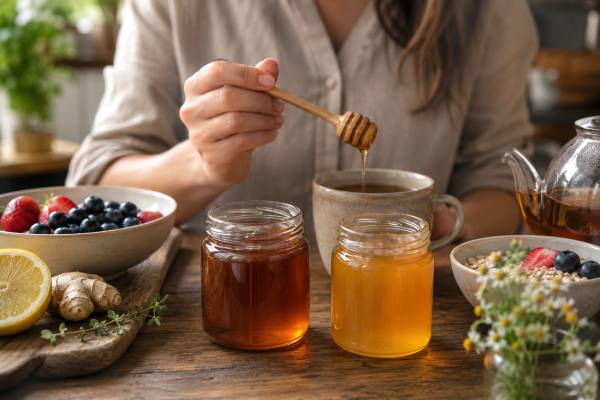
Honey has long sat at the border between food and remedy. A spoonful in tea can feel soothing when your throat is raw, and manuka honey in particular is often marketed as something more powerful: richer in bioactive compounds, more antibacterial, and somehow better for “immune support” than ordinary honey. That raises a fair question. If manuka honey costs several times more than regular honey, does the difference actually matter?
The answer depends on what you want it to do. Manuka honey does have unique properties, and UMF can help you judge whether a jar is authentic and how it was graded. But stronger labeling is not the same thing as stronger proof for everyday immune benefits. For cough and throat soothing, regular honey may do much of the practical work. For wound care, the conversation is different. This article explains what UMF means, where manuka truly stands apart, and when paying more makes sense.
Key Takeaways
- Manuka honey has distinctive antibacterial chemistry, but that does not automatically mean it provides superior everyday immune support when eaten by the spoon.
- UMF matters mainly as a quality and authenticity marker, not as proof that higher ratings deliver stronger real-world immune benefits.
- For sore throat and cough relief, regular honey may be enough for many people, especially if the goal is symptom soothing rather than premium manuka-specific properties.
- Honey should never be given to infants under 12 months, and adults with diabetes, bee-related allergies, or special medical needs should use extra caution.
- A practical approach is to use regular honey for routine kitchen use and reserve UMF-rated manuka for situations where you specifically want verified manuka quality.
Table of Contents
- What Makes Manuka Different
- What UMF Actually Means
- Does Manuka Help Immunity More
- Where Regular Honey Is Often Enough
- Safety and Limitations to Know
- How to Choose Based on Your Goal
What Makes Manuka Different
Not all honey is chemically identical, even when the jars look similar on a shelf. Honey varies by floral source, geography, processing, storage, and moisture content. Manuka honey comes from nectar associated with the mānuka plant in New Zealand, and it stands out because it has stronger non-peroxide antibacterial activity than most ordinary honeys. That difference is largely tied to methylglyoxal, often shortened to MGO, along with other compounds used to authenticate genuine mānuka honey.
This is the part of the story that is real, and it matters. In laboratory settings, manuka honey has shown unusually strong antimicrobial behavior compared with many standard honeys. That is why it has attracted interest not only as a food, but also in wound care, infection control research, and medical-grade honey products. In other words, manuka’s reputation did not appear from nowhere.
Still, there is a key distinction between lab potency and everyday immune support. A honey that performs impressively against bacteria in a controlled setting does not automatically become a proven oral immune aid when eaten. That leap is where many wellness claims become much shakier. Stronger antibacterial chemistry may help explain why manuka is so valued in topical and medical contexts, but it does not mean a spoonful every morning will measurably “boost” immune function in healthy people.
It also helps to remember what honey is doing when people feel better after taking it. Often, the benefit is mechanical and soothing rather than immune-transforming. Honey coats irritated tissue, makes warm drinks more pleasant, and can calm coughing enough to improve rest. That is useful, but it is not the same as changing the immune system in a dramatic or measurable way. This is why the broader discussion about what “boosting” really means is so important. Many products borrow immune language when the more accurate story is symptom support, comfort, or routine self-care.
Another point worth keeping in mind is that regular honey is not inert. It also contains sugars, acids, enzymes, and natural compounds that contribute to flavor, texture, and some antimicrobial effects. The difference is that manuka has a more distinctive profile and a stronger identity system around it. That makes it easier to market, easier to grade, and easier to premium-price.
So, what makes manuka different? It is not merely branding. It does have a unique chemical and antibacterial profile. But the most practical question is not whether it is different in a lab. It is whether that difference changes outcomes in the specific way you care about, such as throat relief, infection prevention, or daily immune resilience.
What UMF Actually Means
UMF stands for Unique Mānuka Factor, and it is best understood as a grading and assurance system, not a direct medical claim. Many people assume UMF is simply another word for strength. That is only partly true. A higher UMF rating does suggest higher tested potency markers, but the system is broader than a single number for antibacterial force.
One of the most important details is that UMF is not the same as MGO alone. MGO is a key compound linked to manuka honey’s antibacterial activity, but UMF looks beyond that. It also considers markers tied to authenticity and product quality, including whether the honey is genuinely mānuka and whether it has been stored or processed in ways that preserve expected characteristics. That distinction matters because the modern honey market includes a lot of confusing labels, and consumers often assume any jar with an impressive-looking number is equally meaningful.
This is where UMF has real value. It helps answer a practical buying question: if you are paying for manuka honey, are you actually getting verified manuka honey with a recognized grading system behind it? In that sense, UMF matters a great deal. It helps separate authenticity and quality assurance from vague marketing language. If you are investing in premium manuka, a trusted grading system makes more sense than buying a jar that simply says “active,” “raw,” or “bio” without much explanation.
At the same time, UMF can be overinterpreted. A higher number does not mean the honey has been proven to deliver better everyday immune outcomes in healthy adults. It also does not mean that a UMF 20+ jar will necessarily soothe a cough or sore throat more noticeably than a simpler honey in tea. That is the marketing trap. A grading system that is useful for quality control can be misread as clinical proof for all kinds of oral wellness claims.
This is similar to the problem seen across many “natural immunity” products. Once a measurable feature exists, people start treating it as if it guarantees a meaningful health result. Sometimes it does not. That is one reason immune-support buying decisions often benefit from the same skepticism discussed in immune myths and misleading claims.
So does UMF matter? Yes, but mainly in a narrower way than most advertising suggests. It matters if you want confidence that a jar is genuinely graded manuka honey. It matters if authenticity, traceability, and tested quality are priorities. It matters less if your real question is simply, “What should I add to warm water or tea when my throat hurts?” For that everyday use case, the gap between grading sophistication and practical effect may be much smaller than the price difference suggests.
Does Manuka Help Immunity More
This is the core search question, and the most honest answer is more restrained than many product pages suggest. Manuka honey may have more impressive antimicrobial features than regular honey, but that does not automatically translate into clearly superior oral immune support in daily life.
The strongest evidence around honey and illness is mostly about symptom relief, especially cough and throat discomfort, not about broadly strengthening immune defenses. Honey can make an irritated upper airway feel better, reduce coughing for some people, and support rest. That matters, because sleep and hydration are part of recovery. But those benefits are not exclusive to manuka honey. Many of the studies and practical recommendations around cough relief refer to honey in general rather than manuka specifically.
That distinction is easy to lose because “immune support” is often used as a catch-all phrase. It can mean anything from direct antimicrobial activity, to less throat irritation, to simply feeling cared for when sick. Manuka may well offer stronger laboratory antibacterial activity, yet the clinical evidence for taking it by mouth as a superior immune tool remains limited. The gap between bench science and everyday outcomes is the reason people often overpay for ingredients that sound special but have not clearly outperformed simpler alternatives in the situations they actually care about.
There is another layer to this. People rarely take honey in isolation. They use it in tea, before bed, during a sore throat, or while resting with a cold. In that context, the practical value may come from the whole routine: warm fluids, reduced throat irritation, easier swallowing, and better sleep. If that is the real benefit, the key question becomes whether manuka is noticeably better than regular honey for that purpose. Right now, the evidence does not strongly support a confident yes.
This does not mean manuka is useless. It means it is better framed as a specialized honey with distinctive properties rather than a proven upgrade for all immune goals. Readers comparing it with other wellness products may find that it belongs closer to the category of immune support supplements than to essential daily nutrition. Interesting, sometimes useful, but not automatically necessary.
A more grounded phrase than immune boosting is immune resilience. If manuka helps you soothe a cough, rest more comfortably, or enjoy supportive fluids when you are sick, that can be part of resilience. But the bigger drivers of immune health remain more ordinary: sleep, nutrition, stress, hydration, exercise, vaccination, and reduced exposure during respiratory illness. Honey can fit into that picture. It should not replace it.
So yes, manuka has qualities that make it more biologically interesting than regular honey. No, that does not mean higher UMF manuka has been shown to deliver dramatically better immune support when eaten in a routine wellness context.
Where Regular Honey Is Often Enough
Regular honey is often underrated because it looks ordinary. It does not come with a premium label system, and it is rarely sold with the same intensity of health storytelling. But for several everyday uses, it may be entirely sufficient.
The clearest example is cough and throat soothing. When someone adds honey to warm tea, warm water, or a spoonful before bed, the main practical goal is usually symptom comfort. They want less throat irritation, less coughing, and perhaps better sleep. For this purpose, regular honey can be a perfectly reasonable choice. It is widely available, less expensive, and far easier to use consistently. In fact, if your interest is mostly in upper-respiratory self-care, it makes sense to start with the simpler option and learn more from a practical guide to honey for sore throat and cough before assuming premium manuka is necessary.
Regular honey also makes more sense for food use. If you are sweetening yogurt, stirring some into oatmeal, adding it to herbal tea, or using it in a salad dressing, the culinary difference may matter more than the wellness label. Honey is still a concentrated sugar source, so moderation matters, but there is little reason to spend heavily on high-UMF manuka for routine kitchen tasks unless you simply enjoy it and value the product.
This is especially true because many people are not really choosing between manuka and regular honey. They are choosing between honey and a whole shelf of “immune shots,” syrups, gummies, lozenges, and wellness blends. In that comparison, ordinary honey may be the more practical and less overengineered option. A simple food can sometimes do enough without pretending to do everything. That is also why lists of best foods for immune support usually focus on daily dietary patterns, not premium niche products.
Another place regular honey may be enough is short-term sick-day support. If you are tired, mildly ill, and trying to stay comfortable, it is often more useful to focus on warm fluids, rest, enough food, and a realistic symptom plan than on buying the strongest-looking jar on the shelf. Honey becomes one part of a comforting routine, not the star of a precision intervention.
This does not erase manuka’s strengths. It simply puts them in context. If your goal is daily eating, tea, or general throat comfort, regular honey often delivers most of the practical value. Paying more for manuka makes more sense when you specifically care about verified manuka authenticity, distinctive flavor, or the particular bioactive profile that the grading system is designed to signal.
Safety and Limitations to Know
Honey has a healthy, natural image, but it still comes with limits that matter. The most important safety rule is clear: honey should never be given to infants younger than 12 months because of the risk of infant botulism. That rule applies to manuka honey and regular honey alike. Premium labeling does not change it.
For older children and adults, honey is usually tolerated well in modest amounts, but “natural” does not mean risk-free. The next major consideration is sugar load. Honey is still a concentrated sweetener, even when it contains interesting plant compounds. People with diabetes, prediabetes, significant insulin resistance, or careful carbohydrate goals should treat honey as a sugar source, not as a free health food. A higher UMF rating does not cancel out the metabolic reality of what is in the spoon.
Allergy is another issue. True honey allergy is not common, but people with bee-related product sensitivities, severe pollen reactions, or previous reactions to honey should be cautious. Digestive sensitivity can matter too. A product can be high quality and still simply not agree with you if you use too much of it or combine it with other throat remedies, lozenges, and sweet syrups throughout the day.
There is also a common category mistake around wound care. Because medical-grade manuka honey is used in some wound settings, people sometimes assume any manuka honey from a jar can be applied to cuts, burns, or irritated skin. That is not a wise shortcut. Sterility, formulation, and intended medical use matter. Pantry honey is food. Medical-grade honey dressings are something else.
The biggest limitation, though, is conceptual. Honey is not a substitute for appropriate treatment. If you have a severe sore throat, high fever, breathing trouble, dehydration, a persistent cough, or signs of bacterial infection, honey may help with comfort, but it does not replace evaluation or evidence-based care. The same is true when illness seems to linger. Soothing the throat is useful. It is not the same as treating the underlying problem.
This is where people can slide from self-care into wishful thinking. When a food is described as antimicrobial, antioxidant, and bioactive, it becomes tempting to ask too much of it. That is one reason it helps to keep broader immune habits in view and to understand how products fit into recovery rather than dominate it. Articles on immune support drinks can be helpful here because they place honey in a more realistic sick-day context.
Honey can absolutely be part of good self-care. It just needs to stay in proportion. The safest use is informed, moderate, and tied to a clear purpose rather than to the hope that a premium jar will solve every cold-season problem.
How to Choose Based on Your Goal
The easiest way to decide between manuka and regular honey is to stop asking which one is “best” in general and ask what you want the jar to do. Different goals lead to different answers.
If your goal is everyday kitchen use, regular honey is often the more sensible buy. It works well in tea, yogurt, oats, marinades, and home remedies for mild throat irritation. It is cheaper, easier to replace, and good enough for many routine uses. In that context, paying for UMF can feel like buying a specialty product for a non-specialty job.
If your goal is cough or sore throat comfort, regular honey may still be enough. This is especially true if the priority is simple symptom soothing before bed or during a cold. You are mostly paying for taste preference and manuka-specific positioning, not for strong proof that the jar will outperform standard honey in a way you will clearly feel.
If your goal is verified manuka authenticity, then UMF matters a lot. This is the clearest case for choosing it. A graded, traceable manuka honey gives you more confidence that the product matches the label and contains the characteristics associated with genuine mānuka honey. If you value that assurance, a UMF-rated product is a more rational purchase than an unverified premium honey with vague claims.
If your goal is serious medical use, pause and define the problem first. For wound-related questions, medical-grade honey products are the relevant category, not pantry honey. For respiratory infection, dehydration, severe throat pain, or prolonged illness, symptom support is not the same as diagnosis or treatment. Honey can be part of comfort care, but it is not a stand-in for proper medical judgment.
A practical buying framework looks like this:
- buy regular honey for tea, food, and simple symptom support
- buy UMF-rated manuka if authenticity and verified manuka quality are the main reasons for purchase
- do not assume higher UMF equals stronger everyday immune effects
- do not use price as a shortcut for evidence
- do not treat honey as a replacement for broader immune basics
In the end, UMF does matter, but mostly as a quality tool. It matters less as a guarantee of superior immune support from a spoonful of honey. For most people, that is the central takeaway. Choose manuka when you want real manuka and want it verified. Choose regular honey when everyday usefulness is the main goal. And remember that the larger foundation of immune health still rests on the ordinary things people are most likely to overlook.
References
- UMF vs MGO | UMF™ 2025
- Honey as a Natural Antimicrobial – PMC 2025 (Review)
- Studies on bioactivities of Manuka and regional varieties of honey for their potential use as natural antibiotic agents for infection control related to wound healing and in pharmaceutical formulations – PMC 2024 (Review)
- Honey for acute cough in children — a systematic review – PMC 2023 (Systematic Review)
- Sore Throat Basics | Sore Throat | CDC 2024 (Guidance)
Disclaimer
This article is for general educational purposes and is not a substitute for medical advice, diagnosis, or treatment. Honey may help soothe cough and throat discomfort, but it does not replace appropriate care for significant infection, dehydration, breathing difficulty, severe pain, or persistent symptoms. Never give honey to infants under 12 months. If you have diabetes, food allergy concerns, trouble swallowing, or symptoms that are worsening instead of improving, seek personalized medical advice.
If this article was useful, please share it on Facebook, X, or another platform where it may help someone make a more informed choice.