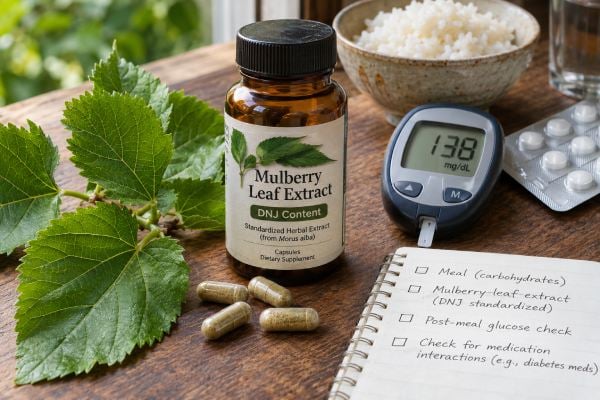
Mulberry leaf extract may modestly reduce the rise in blood sugar after a carbohydrate-containing meal. The mechanism is straightforward: compounds in the leaf slow the breakdown of starches and sugars in the intestine. The best-studied compound is 1-deoxynojirimycin (DNJ), which inhibits alpha-glucosidase enzymes involved in carbohydrate digestion. Small randomized trials and a 2023 meta-analysis suggest potential benefits for post-meal glucose and, with longer use, small improvements in fasting glucose and A1C in some adults.
That does not make mulberry leaf a substitute for diabetes treatment. Research products are often standardized to a known DNJ dose, while retail supplements can vary widely in extract strength and composition. The same glucose-lowering action that makes mulberry interesting can also create problems when it is combined with insulin, sulfonylureas, alpha-glucosidase inhibitors, or other glucose-lowering medications. Anyone considering it should focus on the actual DNJ content, timing with meals, medication interactions, and glucose monitoring, not just the milligrams printed on the front of a bottle.
Table of Contents
- How Mulberry Leaf Affects Blood Sugar
- What the Research Shows
- Mulberry Leaf Dosage and Timing
- Medication Interactions to Know
- Side Effects and Who Should Avoid It
- How to Choose and Use a Supplement More Safely
- Where Mulberry Leaf Fits in a Blood Sugar Plan
How Mulberry Leaf Affects Blood Sugar
White mulberry, Morus alba, has a long history of use as a food and traditional remedy. For blood sugar management, the most relevant part is the leaf, which contains DNJ along with flavonoids, phenolic compounds, and other plant chemicals. DNJ is important because it acts locally in the gut rather than relying on whole-body hormonal shifts.
After you eat starch or sucrose, digestive enzymes break larger carbohydrates into smaller sugars that can be absorbed. Alpha-glucosidase enzymes in the small intestine perform part of that final step. DNJ inhibits these enzymes, so some carbohydrate is broken down and absorbed more slowly. The likely result is a lower or delayed post-meal glucose peak.
This mechanism resembles, in broad terms, the action of prescription alpha-glucosidase inhibitors such as acarbose. However, a mulberry supplement is not equivalent to a prescription drug in dose, consistency, evidence, or oversight. The effect also depends heavily on what is eaten. There is less reason to expect a meaningful acute glucose effect with a meal that contains very little digestible carbohydrate.
That makes mulberry leaf most relevant to post-meal blood sugar spikes, not as a universal way to lower glucose at all times of day. A supplement taken with a rice-based meal, for example, may have a more noticeable effect than the same supplement taken with eggs and non-starchy vegetables.
The mechanism also explains a common side effect. If more carbohydrate escapes digestion in the small intestine, gut bacteria can ferment some of it later. That fermentation can produce gas, bloating, abdominal discomfort, or looser stools, especially at higher doses.
What the Research Shows
The evidence is promising but still limited. Many trials are small, short, use different extracts, and study different populations. Some test a single meal in healthy adults; others enroll people with prediabetes or type 2 diabetes. Those studies answer different questions, so their results should not be treated as interchangeable.
A 2023 systematic review and meta-analysis pooled 12 randomized trials with 615 participants. Mulberry leaf or leaf extract was associated with an average reduction in fasting blood glucose of about 0.47 mmol/L, or 8.5 mg/dL, and an A1C reduction of 2.92 mmol/mol, which is roughly 0.27 percentage points. The analysis suggested that longer interventions of at least eight weeks and studies in people with higher baseline glucose tended to show greater benefit. However, heterogeneity between trials means the average effect is not a guaranteed outcome for an individual.
Short-term meal studies give a clearer picture of the post-meal effect. In a 2023 crossover study in adults with type 2 diabetes, a blend containing 250 mg mulberry leaf extract providing 12.5 mg DNJ reduced glucose exposure after breakfast compared with the same blend without mulberry extract. The glucose incremental area under the curve was about 20% lower at one hour, 17% lower at two hours, and 15% lower at three hours. Because the product also contained fiber, vitamin D, and chromium in both comparison blends, the difference was designed to isolate the added mulberry extract.
Another 2023 randomized study in healthy adults found that acute mulberry leaf extract changed post-meal glucose or insulin responses, with timing-related differences between morning and evening testing. A 2024 crossover trial also found lower glucose and insulin responses after complex meals with several doses of a standardized mulberry extract.
These results support a real acute effect on carbohydrate handling, but they do not establish mulberry leaf as a treatment that prevents diabetes complications, replaces medication, or reliably produces large A1C reductions. Long-term evidence on hard outcomes such as cardiovascular disease, kidney disease, neuropathy, or retinopathy is not available.
There is another limitation that is easy to miss: a percentage reduction in a meal-test glucose curve is not the same thing as lowering an everyday glucose reading by that percentage. In controlled trials, researchers calculate measures such as incremental area under the curve, which summarizes glucose exposure above the starting value across several hours. A 15% reduction in that research measure does not mean a person whose glucose reaches 200 mg/dL will necessarily see it fall to 170 mg/dL. The real effect depends on the meal, baseline glucose, extract potency, medications, and individual physiology.
The evidence also does not show that mulberry allows people to eat unlimited carbohydrate without consequence. Alpha-glucosidase inhibition can slow or reduce early absorption, but total meal size and carbohydrate quality still matter. If a person uses the supplement as permission to increase refined starch or added sugar, the net glucose effect may disappear. This is why studies should be interpreted as evidence for a modest adjunct, not a metabolic “blocker.”
If you have prediabetes, it is reasonable to view mulberry as one of many optional strategies rather than a foundation. Evidence-based food patterns, activity, sleep, weight management when appropriate, and prescribed therapy have much stronger outcome data. The broader evidence around supplements for prediabetes is similarly mixed: some products influence a lab value without proving long-term benefit.
Mulberry Leaf Dosage and Timing
There is no universally established medical dose of mulberry leaf extract for blood sugar control. This is an important limitation because “500 mg mulberry leaf” can mean very different things depending on extraction method and DNJ concentration.
Clinical studies have used several formulations. Examples include about 250 mg of extract containing 12.5 mg DNJ with a meal, beverages containing 550 mg extract three times daily, and leaf preparations standardized to approximately 12 mg DNJ per dose. Other trials use different extract quantities because their DNJ concentration differs.
| Label or study detail | Why it matters | Practical interpretation |
|---|---|---|
| Total extract, such as 250 mg or 550 mg | Does not show potency by itself | Compare only when standardization is known |
| DNJ amount, such as 3–12.5 mg | More directly reflects alpha-glucosidase inhibition | More useful than extract weight alone |
| Timing with a carbohydrate-containing meal | The main action occurs during digestion | Research generally uses it at or shortly before meals |
| Daily use for 8–12 weeks | Relevant to fasting glucose or A1C studies | Longer use needs more attention to safety and medications |
For the acute post-meal effect, timing with or shortly before a meal makes the most biological sense because DNJ needs to be present while carbohydrate is being digested. Taking it hours away from food is unlikely to reproduce the meal-study conditions.
Avoid assuming that a larger extract dose is better. Alpha-glucosidase inhibition can increase gastrointestinal symptoms, and higher doses may create more glucose-lowering effect when combined with medication. A product that does not state DNJ content is difficult to compare with clinical research.
If you and your clinician decide a trial is reasonable, a cautious approach is to use one standardized product at the labeled dose, keep meal composition relatively consistent at first, and monitor glucose closely if you take diabetes medication. Do not use trial doses from research papers as a personal prescription.
Medication Interactions to Know
The most important interaction is additive glucose lowering. Mulberry leaf does not usually cause hypoglycemia by itself in the same way insulin can, but combining multiple glucose-lowering strategies can shift readings lower than expected.
Be especially careful with:
- Insulin. The carbohydrate from a meal may appear in the bloodstream more slowly or in a smaller peak, while the insulin dose still acts as usual. This can change meal-time matching and increase the chance of a low in some people.
- Sulfonylureas and meglitinides. Drugs that stimulate insulin release can cause hypoglycemia. Adding another glucose-lowering intervention warrants monitoring and clinician review.
- Alpha-glucosidase inhibitors such as acarbose or miglitol. The mechanisms overlap. Combining them may increase gastrointestinal effects and could further alter post-meal glucose.
- Other diabetes medications. Metformin, GLP-1 receptor agonists, SGLT2 inhibitors, DPP-4 inhibitors, and others have different mechanisms, but the total treatment effect still matters. A supplement should be included when your clinician reviews your regimen.
If you take medication that can cause lows, know how your treatment plan defines and handles hypoglycemia. For many adults with diabetes, glucose below 70 mg/dL (3.9 mmol/L) is considered clinically important and should prompt action according to the person’s diabetes plan.
Do not reduce prescription medication on your own because a supplement appears to be “working.” Changes in glucose can also come from food, activity, weight loss, illness, or measurement variability. Medication changes should be based on a consistent pattern and reviewed by the prescribing clinician.
There is much less clinical information about mulberry interactions with non-diabetes medications. Plant extracts can contain many compounds, and supplement interaction databases are not a substitute for direct pharmacokinetic studies. If you take multiple prescription drugs, anticoagulants, transplant medications, or medicines with a narrow therapeutic range, have a pharmacist check the specific product before use.
Side Effects and Who Should Avoid It
Short-term studies generally report that standardized mulberry leaf extract is reasonably well tolerated, but the safety database is much smaller than the database for approved diabetes medications.
The most plausible side effects are gastrointestinal:
- gas or bloating;
- abdominal discomfort;
- loose stools or diarrhea;
- changes in bowel frequency.
A 2022 randomized safety study tested a beverage containing 550 mg mulberry leaf extract three times per day for four weeks in healthy adults and did not find a higher rate of adverse reactions than placebo. That is reassuring for that specific preparation and timeframe, but it does not prove that every retail extract is equally safe or that long-term use is risk-free.
Pregnancy and breastfeeding: Avoid routine supplemental use unless a qualified prenatal clinician specifically recommends it. There is not enough high-quality human safety evidence to establish a safe dose in pregnancy or lactation, and glucose targets in pregnancy require close medical supervision.
Children and adolescents: Evidence is insufficient for unsupervised supplementation. Pediatric diabetes or prediabetes management should be clinician-directed.
Kidney or liver disease: Use extra caution. These groups are often excluded or underrepresented in supplement trials, and product contaminants or concentrated plant compounds can create additional concerns. A 2017 pilot trial in type 2 diabetes reported a small increase in serum creatinine with one mulberry extract, which is another reason not to assume all long-term formulations are harmless.
History of frequent hypoglycemia: Avoid adding mulberry leaf without clinician involvement, particularly if you use insulin or an insulin secretagogue.
Stop the supplement and seek medical advice for severe gastrointestinal symptoms, allergic symptoms, repeated low glucose readings, or any unexpected change after starting it.
How to Choose and Use a Supplement More Safely
A useful label should tell you more than “mulberry leaf 500 mg.” Ideally, it identifies the botanical species, plant part, extract amount, serving size, and standardized DNJ content or concentration. Without DNJ information, comparing the product with research is mostly guesswork.
Look for independent quality testing when available. Third-party certification does not prove that a supplement lowers glucose, but it can provide some assurance that the product contains what the label claims and is screened for certain contaminants. Avoid products that promise to “reverse diabetes,” replace insulin, or produce prescription-level effects without medical supervision.
If you are testing the effect on your own glucose pattern, make the experiment interpretable:
- Keep the supplement dose and brand consistent.
- Take it at the same meal timing used on the label or agreed with your clinician.
- Compare similar carbohydrate portions rather than completely different meals.
- Record pre-meal and post-meal glucose at consistent times if monitoring is appropriate for you.
- Stop and review the plan if glucose repeatedly drops below your safe range.
For people using a CGM, focus on repeated patterns rather than a single unusually flat curve. Glucose responses vary from day to day because of sleep, stress, exercise, menstrual-cycle changes, illness, and meal composition. A supplement deserves credit only when the effect repeats under similar conditions.
It can also help to compare the supplement with simpler food changes. More fiber, smaller refined-carbohydrate portions, protein or non-starchy vegetables alongside starch, and eating vegetables and protein before a large carbohydrate portion can reduce post-meal exposure without adding another pill.
Where Mulberry Leaf Fits in a Blood Sugar Plan
Mulberry leaf extract is best viewed as a possible adjunct for post-meal glucose, not a primary treatment. Its mechanism is credible, and human trials support a modest effect, particularly when the extract provides a known amount of DNJ and is taken around a carbohydrate-containing meal.
The case for using it is strongest when someone has a specific goal—such as reducing a repeatable post-meal rise—has already addressed basic meal composition, and can monitor for medication interactions. The case is weaker when the goal is vague, the product does not state its standardization, or the person expects it to compensate for large amounts of refined carbohydrate.
For type 2 diabetes, focus first on the treatments with proven benefits for A1C and long-term health. A supplement that reduces a two-hour glucose reading is not automatically equal to a therapy shown to reduce cardiovascular or kidney risk. If your A1C remains above target, review the full treatment plan rather than stacking multiple supplements. Understanding what A1C reflects can help separate a meaningful long-term change from a short-term meal effect.
For prediabetes, the same hierarchy applies. Regular activity, adequate sleep, high-fiber minimally processed foods, and weight loss when medically appropriate can improve insulin sensitivity across the entire day. Mulberry leaf may alter digestion at a meal, but it does not replace those broader metabolic effects.
The most practical takeaway is to read beyond the front-label dose. DNJ standardization, meal timing, medication use, and glucose response matter more than the words “mulberry leaf.” If you take glucose-lowering medication, discuss the supplement before adding it and monitor carefully during the first days of use.
References
- Effect of mulberry leaf or mulberry leaf extract on glycemic traits: a systematic review and meta-analysis 2023 (Systematic Review)
- A Randomized, Placebo-Controlled Crossover Study to Evaluate Postprandial Glucometabolic Effects of Mulberry Leaf Extract, Vitamin D, Chromium, and Fiber in People with Type 2 Diabetes 2023 (RCT)
- Effects of the timing of acute mulberry leaf extract intake on postprandial glucose metabolism in healthy adults: a randomised, placebo-controlled, double-blind study 2023 (RCT)
- Safety evaluation of a beverage containing mulberry leaf extract 2022 (RCT)
- Understanding the Impact of Different Doses of Reducose® Mulberry Leaf Extract on Blood Glucose and Insulin Responses after Eating a Complex Meal: Results from a Double-Blind, Randomised, Crossover Trial 2024 (RCT)
- Effect of Low-Dose Mulberry Fruit Extract on Postprandial Glucose and Insulin Responses: A Randomized Pilot Trial in Individuals with Type 2 Diabetes 2024 (RCT)
Disclaimer
This article is for general education and is not a substitute for medical care. Mulberry leaf extract can change post-meal glucose and may interact with diabetes medications; do not use it to replace prescribed treatment or change medication doses without a qualified clinician. Pregnancy, breastfeeding, recurrent hypoglycemia, and significant kidney or liver disease warrant extra caution.