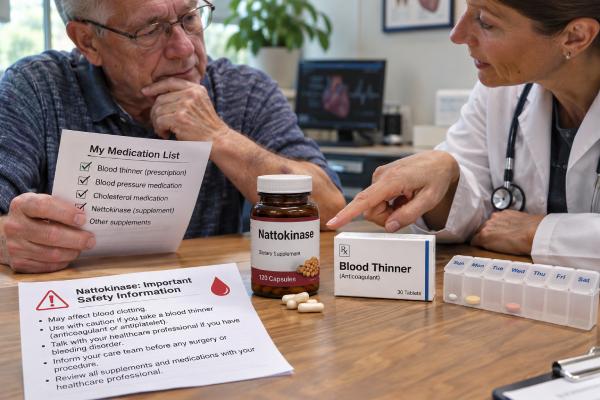
Nattokinase is an enzyme made during the fermentation of soybeans into natto. It is sold as a dietary supplement for circulation, blood pressure, and “blood thinning,” but those same clot-related effects create important safety concerns. The biggest issue is bleeding: nattokinase may increase fibrinolysis, the body’s process for breaking down fibrin in clots, and it may add to the effects of anticoagulant, antiplatelet, or clot-dissolving medicines. Human safety data are limited, so there is no reliable way to predict an individual person’s bleeding risk or to identify a universally safe dose. Nattokinase also should not be used as a substitute for prescribed anticoagulation. That can leave a person underprotected from stroke, valve thrombosis, deep vein thrombosis, or pulmonary embolism. If you take medicines that affect clotting, have a bleeding disorder, or are preparing for a procedure, treat nattokinase as a medically active supplement rather than a harmless food extract.
Table of Contents
- Why Nattokinase Can Affect Bleeding
- Blood Thinners and Drugs That May Interact
- Who Should Avoid Nattokinase
- Bleeding Warning Signs and When to Get Help
- Surgery, Dental Work, and Medical Procedures
- Dose, Product Quality, and Other Safety Issues
- How to Decide Whether Nattokinase Is Safe for You
Why Nattokinase Can Affect Bleeding
Nattokinase is not simply a vitamin. It is a biologically active enzyme associated with fibrinolytic activity, meaning it can influence the system that breaks down fibrin, a structural protein in blood clots. Laboratory and small human studies also suggest effects on several clotting and fibrinolysis markers. That mechanism is the reason nattokinase is marketed for circulation, but it is also the main reason clinicians worry about bleeding.
The key safety problem is uncertainty. Large trials have not established how often major bleeding occurs in people taking nattokinase, which doses create the most risk, or how the risk changes when the supplement is combined with common cardiovascular medicines. Case reports cannot tell us how frequently a complication occurs, but they show that serious events are possible. Published reports include intracranial bleeding in a person taking aspirin with nattokinase and fatal internal bleeding in an older adult who used an over-the-counter nattokinase product.
This does not mean everyone who takes nattokinase will bleed. It means the supplement has plausible clot-related effects, limited high-quality safety data, and enough reported harm to justify caution.
It is also important to separate nattokinase supplements from natto, the fermented soybean food from which the enzyme was originally isolated. Natto is naturally rich in vitamin K, which can reduce warfarin’s anticoagulant effect and make the international normalized ratio (INR) harder to control. A purified nattokinase supplement is not automatically equivalent to a serving of natto and may not contain the same amount of vitamin K. Check the product label rather than assuming the two are interchangeable.
If your goal is cardiovascular prevention, remember that an effect on a laboratory marker is not the same as proven prevention of heart attack or stroke. Current evidence does not establish nattokinase as a replacement for medicines with demonstrated cardiovascular outcome benefits. For a broader look at the evidence behind the supplement, see nattokinase for heart health.
Blood Thinners and Drugs That May Interact
The safest assumption is that nattokinase may have additive effects with medicines that reduce clot formation or promote clot breakdown. An interaction does not require two products to work through the exact same pathway. If both push the body toward less clotting, the combined effect may raise bleeding risk even when each product is taken at its usual dose.
The most important medication groups are:
- Anticoagulants, including warfarin, apixaban, rivaroxaban, dabigatran, edoxaban, unfractionated heparin, and low-molecular-weight heparins such as enoxaparin.
- Antiplatelet medicines, including aspirin, clopidogrel, prasugrel, and ticagrelor.
- Fibrinolytic or thrombolytic drugs, which are used in selected medical emergencies to dissolve clots.
- Other supplements with potential effects on bleeding, especially when several are combined. Examples can include high-dose fish oil products, garlic extracts, ginkgo, or other products promoted for circulation. The strength of evidence differs by product, so a pharmacist should review the full list rather than assuming “natural” products do not interact.
A particularly important warning applies to people prescribed anticoagulation for atrial fibrillation, a mechanical heart valve, venous thromboembolism, or another high-risk condition. Do not stop or replace the prescribed drug with nattokinase. A published case described a person with a mechanical aortic valve who substituted nattokinase for warfarin and later developed a clot on the valve that required repeat surgery. That case illustrates a separate danger from bleeding: a supplement may be too weak or inconsistent to provide the protection that a prescribed anticoagulant is intended to provide.
People taking warfarin need an additional distinction. Natto food contains substantial vitamin K and can interfere with warfarin therapy. If you use warfarin, sudden changes in vitamin K intake can alter INR. Discuss natto and any nattokinase product with the clinician or anticoagulation service that manages your warfarin.
Nattokinase may also lower blood pressure modestly in some studies. That raises the possibility of additive effects with antihypertensive medicines, especially in someone who already has low blood pressure, dehydration, or dizziness. The concern is different from a clotting interaction, but symptoms such as lightheadedness, weakness, or fainting deserve attention. If you are already being treated for hypertension, use your prescribed plan and track blood pressure and other heart numbers rather than adding a supplement without reviewing the combination.
Who Should Avoid Nattokinase
Some people have a much lower margin for error if a supplement increases bleeding or changes clotting. In these situations, avoiding nattokinase is generally the safer choice unless a clinician who knows your history specifically recommends otherwise.
You should not self-start nattokinase if you:
- take an anticoagulant, antiplatelet, or fibrinolytic medicine;
- have a diagnosed bleeding or clotting disorder;
- have active gastrointestinal bleeding, a bleeding ulcer, or unexplained recurrent bleeding;
- have a history of intracranial hemorrhage or another major bleeding event;
- have very low platelets or another blood disorder that increases bleeding risk;
- are preparing for surgery, an invasive procedure, or certain dental procedures;
- have a mechanical heart valve or another condition that requires prescribed anticoagulation;
- are pregnant or breastfeeding, because adequate safety data are lacking;
- are a child or adolescent, because safety and dosing have not been established for routine use;
- have a known allergy to natto, fermented soy, or an ingredient in the specific product.
People with a current or recent deep vein thrombosis or pulmonary embolism also need medical guidance. Some references raise a theoretical concern that increasing fibrinolysis could destabilize an existing clot. More importantly, these conditions require evidence-based anticoagulant treatment and follow-up; nattokinase is not a substitute.
Older adults deserve extra caution even if they are not taking a prescription blood thinner. Age often brings combinations of aspirin, nonsteroidal anti-inflammatory drugs, kidney disease, falls, fragile blood vessels, and other factors that can increase the consequences of bleeding. A medication review may reveal risk that is not obvious from the supplement label.
People with liver disease, kidney disease, poorly controlled hypertension, or frequent falls should also discuss nattokinase with a clinician before use. These conditions do not all create the same interaction, but they can change how dangerous a bleed would be or how medications are managed. Very high blood pressure, for example, is a recognized risk factor for intracranial hemorrhage.
Finally, be cautious if the reason for taking nattokinase is to treat a symptom that may signal cardiovascular disease. Chest pain, new shortness of breath, leg swelling, one-sided weakness, sudden speech difficulty, or fainting should not be self-treated with a supplement. Those symptoms can require urgent evaluation.
Bleeding Warning Signs and When to Get Help
Minor bruising and major internal bleeding exist on a spectrum, and serious bleeding is not always visible. If you use nattokinase, especially with another medicine or supplement that affects clotting, know which symptoms require prompt action.
Stop the supplement and contact a healthcare professional promptly for new or unexplained:
- frequent nosebleeds that are difficult to stop;
- bleeding gums unrelated to dental work;
- unusually large or numerous bruises;
- prolonged bleeding from small cuts;
- heavier-than-usual menstrual bleeding;
- pink, red, or brown urine;
- black, tarry stool or visible blood in stool;
- vomiting blood or material that resembles coffee grounds.
Seek emergency medical care for signs of potentially severe internal or intracranial bleeding, including:
- sudden severe headache, especially if unlike your usual headaches;
- new weakness, numbness, facial droop, confusion, or trouble speaking;
- fainting, severe dizziness, or marked weakness;
- vomiting blood or passing a large amount of blood;
- significant bleeding that does not stop with direct pressure;
- severe abdominal, back, or chest pain with weakness or lightheadedness;
- a major fall or head injury while taking products that affect clotting.
Do not rely on the absence of visible blood. Internal bleeding can first appear as fatigue, shortness of breath, pallor, dizziness, low blood pressure, or a fast heartbeat. If symptoms suggest significant blood loss, urgent assessment may include a blood count, examination, and imaging depending on the situation.
It is also useful to understand that there is no routine home test that proves a nattokinase dose is “safe.” INR is used to monitor warfarin, not nattokinase, and a normal INR does not rule out all bleeding effects from other drugs or supplements. Do not change warfarin, a direct oral anticoagulant, or antiplatelet therapy based on supplement use or an isolated laboratory value without medical guidance.
Surgery, Dental Work, and Medical Procedures
Tell the surgical, anesthesia, dental, or procedural team about nattokinase before an operation or invasive procedure. This includes over-the-counter products, even if you do not think of them as medicines. Clinicians need the complete list because some supplements can affect bleeding, anesthesia, blood pressure, or other perioperative decisions.
There is no universally validated nattokinase stop interval supported by strong clinical trials. General surgical advice for supplements is often more conservative because product half-life, biological effects, and formulation can vary. FDA consumer guidance notes that healthcare professionals may ask patients to stop certain dietary supplements two or three weeks before a procedure. Your own timeline should come from the clinician doing the procedure or the team managing your medications rather than from a generic online rule.
This is especially important if you also take prescribed anticoagulants or antiplatelet drugs. Those medicines have condition-specific perioperative plans. Some are held temporarily; others must be continued; and a small number of high-risk patients need a carefully coordinated alternative strategy. Nattokinase should not be used to “bridge” a prescription blood thinner during the interruption period.
Dental work deserves the same disclosure. A routine cleaning differs from an extraction, implant, periodontal surgery, or other procedure with more bleeding. Your dentist and prescribing clinician can decide whether any medication changes are appropriate. Never stop a prescribed antithrombotic drug solely because you are worried about dental bleeding without being told to do so.
After a procedure, ask when it is safe to restart supplements. The answer can depend on whether the wound is fully controlled, whether a drain is present, whether you have resumed anticoagulant therapy, and whether there were bleeding complications. If the procedure revealed anemia, a stomach ulcer, or another source of bleeding, nattokinase may no longer be appropriate at all.
Dose, Product Quality, and Other Safety Issues
Nattokinase products are often labeled in fibrinolytic units (FU) rather than milligrams because FU describe enzyme activity. A frequently studied amount is around 2,000 FU per day, but that should not be interpreted as an established therapeutic or universally safe dose. Trials have used different preparations, participant groups, and durations, and they have not defined a dose that reliably prevents cardiovascular events without increasing harm.
More is not necessarily better. Raising the dose in an attempt to get a stronger “blood-thinning” effect may increase uncertainty and risk. Taking several supplements with overlapping effects can create the same problem even when each bottle is used at the labeled dose.
Product quality also matters. In the United States, dietary supplements are regulated differently from prescription drugs and are not approved by the FDA for safety and effectiveness before they are marketed. The amount and activity of an enzyme product may therefore depend on manufacturing and storage. If a clinician agrees that you can use nattokinase, choose a product from a reputable manufacturer with transparent labeling and independent quality testing when possible. Avoid products that promise to replace anticoagulants, dissolve dangerous clots, prevent heart attacks, or treat emergencies.
Other practical safety issues include:
- Allergy: natto and soybean products can trigger allergic reactions in susceptible people. Hives, facial swelling, wheezing, or trouble breathing require urgent care.
- Low blood pressure: modest blood-pressure reductions may be undesirable in people prone to orthostatic dizziness or fainting.
- Pregnancy and breastfeeding: safety data are insufficient, so routine supplemental use is not established.
- Long-term use: there is less high-quality safety information than for commonly prescribed cardiovascular medicines, and absence of a reported problem does not prove long-term safety.
- Storage and formulation: enzyme activity can depend on product handling, and FU cannot be assumed to match milligrams across brands.
If your goal is lowering cardiovascular risk, focus first on interventions with stronger outcome data: controlling blood pressure, treating high LDL cholesterol when indicated, not smoking, managing diabetes, staying active, sleeping adequately, and eating a heart-supportive diet. A supplement should not displace these priorities.
How to Decide Whether Nattokinase Is Safe for You
A useful decision starts with the reason you want to take nattokinase. “Better circulation” is too vague to judge benefit against risk. A specific goal—such as lowering blood pressure, preventing a recurrent clot, or replacing aspirin—can be compared with treatments that have stronger evidence.
Before starting, use this checklist:
- List every medication and supplement you take. Include aspirin, pain relievers, prescription blood thinners, herbal products, and combination products. A pharmacist can often identify duplicate clotting effects quickly.
- Identify why each antithrombotic drug was prescribed. If it is protecting you from stroke, valve thrombosis, or recurrent venous clot, do not alter it to make room for nattokinase.
- Review bleeding history. Mention prior ulcers, gastrointestinal bleeding, brain hemorrhage, anemia, frequent nosebleeds, heavy menstrual bleeding, or unexplained bruising.
- Check upcoming procedures. If surgery, colonoscopy with possible biopsy, dental extraction, or another invasive procedure is planned, ask the procedural team before starting.
- Discuss the expected benefit. Ask what outcome is realistically being targeted and how you would know whether the supplement is helping.
- Set a stop rule. Know which symptoms mean you should stop the product and call a clinician, and which require emergency care.
For many people already taking a blood thinner or antiplatelet drug, the simplest answer is to avoid nattokinase unless the prescribing clinician has reviewed the combination. That is not because every interaction is proven to cause harm; it is because the potential benefit remains uncertain while the consequences of excessive bleeding or inadequate anticoagulation can be severe.
If you are considering nattokinase because of concern about cholesterol, blood pressure, or clot risk, ask whether your current treatment is achieving its target first. Evidence-based options can be adjusted with measurable goals. For cholesterol, understanding LDL, HDL, and triglyceride levels gives a clearer starting point than relying on a supplement marketed broadly for circulation.
The bottom line is straightforward: nattokinase deserves the same interaction review you would give any biologically active product. It may affect clotting, it has not been proven to replace anticoagulant or antiplatelet therapy, and its safety is least certain in the people who could be harmed most by bleeding. Bring the bottle or a photo of the label to your doctor or pharmacist so the exact product, dose, and other ingredients can be reviewed.
References
- Nattokinase Supplementation and Cardiovascular Risk Factors: A Systematic Review and Meta-Analysis of Randomized Controlled Trials 2023 (Systematic Review)
- Navigating the Effects of Anti-Atherosclerotic Supplements and Acknowledging Associated Bleeding Risks. 2025 (Review)
- Nattokinase as an adjuvant therapeutic strategy for non-communicable diseases: a review of fibrinolytic, antithrombotic, anti-inflammatory, and antioxidant effects 2024 (Review)
- Mixing Medications and Dietary Supplements Can Endanger Your Health 2025 (Official Guidance)
- Cerebellar hemorrhage provoked by combined use of nattokinase and aspirin in a patient with cerebral microbleeds 2008 (Case Report)
- Consequence of patient substitution of nattokinase for warfarin after aortic valve replacement with a mechanical prosthesis 2015 (Case Report)
Disclaimer
This article is for general educational purposes and is not a substitute for personal medical advice. Nattokinase may affect clotting and may interact with anticoagulant, antiplatelet, or other medicines; do not start it, stop a prescribed blood thinner, or change treatment without speaking with a qualified healthcare professional. Seek urgent medical care for severe or uncontrolled bleeding, symptoms of internal bleeding, or sudden neurologic symptoms.