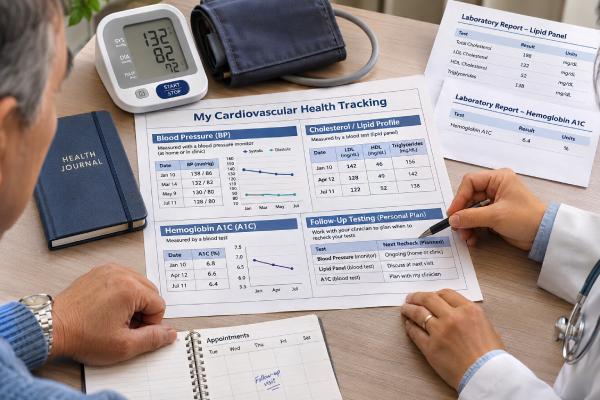
Your most useful “heart numbers” are not a single score. Blood pressure, LDL and other blood lipids, and A1C each describe a different part of cardiovascular risk, and each changes on a different timeline. Blood pressure can shift from minute to minute. Cholesterol values usually change over weeks to months. A1C reflects average blood sugar over roughly the past two to three months. That means the right way to track them is not to test everything as often as possible; it is to measure each number correctly, know what decision it can change, and recheck it at a sensible interval. For many adults, the core routine is accurate home blood pressure readings, periodic lipid testing, and A1C testing when diabetes or prediabetes is present or suspected. Your personal targets may be stricter if you already have cardiovascular disease, kidney disease, diabetes, or a high calculated risk. Use the framework below to build a simple record that is useful at appointments instead of collecting disconnected numbers.
Table of Contents
- Know What Each Heart Number Means
- Track Blood Pressure as an Average
- Read Your Lipid Panel in Context
- Use A1C to Track Longer-Term Blood Sugar
- Recheck After Treatment or Lifestyle Changes
- Build a Simple Heart-Number Dashboard
- Know Which Results Need Faster Follow-Up
Know What Each Heart Number Means
The most practical way to think about heart numbers is by asking what each one measures and how quickly it can change. They are related, but they are not interchangeable.
| Number | What it reflects | Typical time scale | Why it matters |
|---|---|---|---|
| Blood pressure | Pressure in the arteries during and between heartbeats | Minutes to days | Higher average pressure raises risk of stroke, heart disease, kidney disease, and other complications |
| LDL cholesterol | Cholesterol carried in LDL particles | Weeks to months | Higher lifelong exposure promotes atherosclerotic plaque |
| HDL cholesterol | Cholesterol carried in HDL particles | Weeks to months | Useful for risk assessment, but not usually a direct treatment target by itself |
| Triglycerides | Circulating fat influenced by diet, alcohol, weight, diabetes, and genetics | Hours to months | Very high levels can raise pancreatitis risk; moderate elevations can add cardiovascular risk information |
| A1C | Average blood glucose exposure over roughly 2–3 months | Months | Helps diagnose and monitor diabetes and estimate long-term glucose exposure |
A “normal” value is not always the same as your personal treatment goal. For example, a person who has already had a heart attack may need a much lower LDL cholesterol than someone with low short-term risk and no cardiovascular disease. Likewise, A1C goals are individualized according to age, health, treatment burden, and risk of low blood sugar.
Blood pressure categories are more standardized. In current U.S. guidance, normal is below 120/80 mm Hg, elevated blood pressure is systolic 120–129 with diastolic below 80, stage 1 hypertension is 130–139 systolic or 80–89 diastolic, and stage 2 is 140 or higher systolic or 90 or higher diastolic. If you want more context on how age and health affect interpretation, review normal blood pressure readings and age-related context rather than assuming that any rise with age is harmless.
The key principle is to follow trends that are measured consistently. A single number can start a conversation. A pattern is what usually guides decisions.
Track Blood Pressure as an Average
Blood pressure is the number most likely to mislead you if you focus on isolated readings. It changes with stress, pain, caffeine, exercise, sleep, a full bladder, medications, temperature, and measurement technique. The useful target is your average resting pressure, not your highest reading of the month.
For home monitoring, use a validated automatic upper-arm cuff that fits your arm. Wrist and finger devices are generally less reliable. Before measuring, avoid smoking, caffeine, and exercise for about 30 minutes, empty your bladder, and sit quietly for at least five minutes. Keep your back supported, feet flat, legs uncrossed, and arm supported at heart level. Put the cuff on bare skin and do not talk during the measurement.
When your clinician wants a home blood pressure log, a common practical approach is to measure twice in the morning and twice in the evening, with readings about one minute apart, for several days. Your clinician may choose a shorter or longer schedule. A structured home blood pressure monitoring schedule is more useful than checking randomly whenever you feel worried.
Record the readings rather than relying on memory. Include:
- Date and time.
- Systolic and diastolic pressure.
- Heart rate if your monitor reports it.
- Whether the reading was before or after medication, if that matters to your treatment plan.
- Unusual circumstances such as illness, severe pain, poor sleep, or a missed dose.
Do not over-annotate normal daily life. The goal is a clean trend, not an explanation for every fluctuation.
If your home readings do not match office readings, your clinician may check technique, cuff size, device accuracy, or consider ambulatory monitoring. A 24-hour monitor can help identify white-coat hypertension, masked hypertension, and overnight patterns. Understanding 24-hour ambulatory blood pressure results can be useful when home and clinic numbers tell different stories.
A single reading above your usual range is not automatically an emergency. Repeat it under proper resting conditions and interpret it with symptoms and the overall pattern. Extremely high readings are different; the final section explains when faster action is needed.
Read Your Lipid Panel in Context
A standard lipid panel usually reports total cholesterol, LDL cholesterol, HDL cholesterol, and triglycerides. The most important mistake to avoid is treating total cholesterol as the whole story. Cardiovascular prevention focuses more heavily on atherogenic particles—especially LDL and related measures—because they drive plaque formation over time.
LDL cholesterol is often the main treatment marker. Your target depends on your overall risk. Someone with established atherosclerotic cardiovascular disease, familial hypercholesterolemia, diabetes, chronic kidney disease, or high predicted risk may need much more aggressive LDL lowering than a low-risk adult.
HDL cholesterol is different. Higher HDL often travels with lower cardiovascular risk in population studies, but simply trying to “raise HDL” is not the main treatment strategy. Exercise, avoiding smoking, healthy eating, and weight management can improve the overall risk profile even when HDL changes little.
Triglycerides can move more than LDL after a recent meal, alcohol intake, poorly controlled diabetes, or a period of weight gain. For many people, nonfasting lipid testing is acceptable, although fasting may be requested when triglycerides are high, a result is unclear, or the clinician needs a more controlled comparison. The differences between fasting and nonfasting cholesterol tests matter most when triglycerides or calculated values need clarification.
Two additional numbers may be useful in selected people:
- Apolipoprotein B (ApoB) estimates the number of atherogenic lipoprotein particles. It can be helpful when LDL cholesterol may understate particle burden, such as with high triglycerides, metabolic syndrome, or diabetes.
- Lipoprotein(a), or Lp(a) is largely genetic. Contemporary lipid guidance supports measuring it at least once in adulthood to identify inherited risk that may not show up on a standard lipid panel.
If your LDL and ApoB seem to tell different stories, ApoB testing compared with LDL explains why particle number can add information in some situations.
Do not compare a new lipid panel with an old one without checking the context. A major medication change, weight loss, illness, thyroid problem, change in alcohol use, or different fasting status can affect the result. It is often more useful to ask, “Did this result move enough to change treatment?” than to focus on a small numerical shift.
Use A1C to Track Longer-Term Blood Sugar
A1C is a percentage that reflects how much glucose has attached to hemoglobin in red blood cells. Because red blood cells circulate for months, A1C acts as a longer-term marker rather than a snapshot of what you ate yesterday.
For diagnosis, an A1C below 5.7% is generally considered normal, 5.7% to 6.4% is in the prediabetes range, and 6.5% or higher can indicate diabetes when diagnostic criteria are met. Diagnosis sometimes requires repeat testing or confirmation with another glucose test, especially when symptoms are absent.
For many nonpregnant adults with diabetes, an A1C goal below 7% is a common starting point, but it is not universal. A tighter target may be reasonable for some people with low treatment risk. A less strict target may be safer for people with frailty, severe medical conditions, limited life expectancy, or a high risk of dangerous hypoglycemia. Your goal should come from a discussion with your clinician, not a generic chart.
A1C also has limitations. It can be misleading when red blood cell turnover is abnormal. Recent blood loss or transfusion, some anemias, hemoglobin variants, pregnancy, kidney disease, and other conditions can affect interpretation. In those cases, clinicians may rely more on glucose readings, continuous glucose monitoring, fructosamine, or another measure.
Why include A1C in a heart-number dashboard? Diabetes and chronic high glucose accelerate vascular damage and substantially increase cardiovascular risk. Improving blood sugar control for heart risk is therefore part of cardiovascular prevention, not a separate concern.
If you use a continuous glucose monitor, time in range and patterns of high or low glucose can add information that A1C cannot show. Two people can have the same A1C but very different daily swings. Still, A1C remains a useful standardized marker for long-term follow-up.
Recheck After Treatment or Lifestyle Changes
The right recheck interval depends on what changed and how quickly the marker can respond. Testing too soon can create noise. Waiting too long can miss a treatment problem.
| Situation | What is commonly rechecked | Typical timing |
|---|---|---|
| Starting or changing blood pressure treatment | Home BP and clinical follow-up | Home readings immediately; clinical reassessment often within weeks, with frequent follow-up until controlled |
| Starting or changing lipid-lowering medication | Lipid panel | About 4–12 weeks, then every 6–12 months when stable |
| Diabetes at goal with stable treatment | A1C or other glycemic assessment | At least twice a year |
| Diabetes not at goal or treatment recently changed | A1C or other glycemic assessment | About every 3 months, with additional checks as needed |
Blood pressure deserves special treatment because you can measure it at home. A medication may begin working before your next appointment, so a short, consistent home log can show whether pressure is moving in the right direction. Do not change doses on your own because one day looks better or worse. Some medicines also require blood tests for kidney function or electrolytes after initiation or dose changes; that schedule depends on the drug and your health.
For lipids, current dyslipidemia guidance recommends checking the lipid response roughly 4–12 weeks after starting or adjusting lipid-lowering therapy and then every 6–12 months after the regimen is stable. The first recheck answers two questions: did the treatment produce the expected reduction, and are you taking it consistently enough for the result to be meaningful?
Lifestyle-only changes are less standardized. If you make a substantial change in diet, weight, physical activity, or alcohol use, a clinician may choose to repeat lipids after a few months because that is long enough to see a meaningful trend. There is little value in checking LDL every week.
A1C needs time. Because it reflects roughly two to three months of glucose exposure, repeating it after only a few weeks usually does not capture the full effect of a treatment change. Stable diabetes may only need assessment twice yearly, while recent treatment changes or values above goal often justify testing about every three months.
The general rule is simple: recheck when the result could change what you do next.
Build a Simple Heart-Number Dashboard
You do not need an elaborate spreadsheet. A one-page record can be more useful than an app full of scattered readings. Keep the most recent result, the prior result, your agreed goal, and the next planned check.
A practical dashboard can include:
- Blood pressure: your 7-day or clinician-requested home average, not every individual reading.
- LDL cholesterol: current result, previous result, and treatment goal if one has been set.
- Triglycerides and non-HDL cholesterol: useful context when abnormal.
- A1C: current result and personal target if you have diabetes or prediabetes.
- Medication changes: name, dose, and date started or adjusted.
- Next recheck date: an actual month or date instead of “later.”
You can also record weight, waist circumference, activity, smoking status, or sleep if those are active goals, but do not let secondary metrics crowd out the numbers that guide treatment.
At each appointment, ask three questions: Which number matters most right now? What is my target? When should it be rechecked? Those questions turn a laboratory report into a plan.
Try to compare like with like. For blood pressure, use the same validated device, cuff, posture, and measurement routine. For lipid panels, note whether the tests were fasting or nonfasting when that difference is relevant. For A1C, compare results from reliable laboratory testing and tell your clinician about conditions that can affect red blood cells.
Avoid checking numbers in response to anxiety alone. Repeated blood pressure measurements taken minutes apart for reassurance can create more stress and higher readings. Similarly, ordering frequent cholesterol tests does not make cholesterol change faster. A planned schedule gives each measurement a purpose.
If you are working on cholesterol, understanding LDL, HDL, and triglyceride levels can help you decide which line of the report deserves attention rather than chasing total cholesterol alone.
Know Which Results Need Faster Follow-Up
Most heart-number follow-up is routine, but some results need prompt attention.
For blood pressure, a reading higher than 180/120 mm Hg should be repeated after at least one minute if you are not pregnant. If it remains that high and you have chest pain, shortness of breath, back pain, numbness, weakness, a vision change, difficulty speaking, or another new concerning symptom, seek emergency care immediately. Do not wait for the number to fall on its own. If the repeat reading is still above 180/120 but you have no concerning symptoms, contact your healthcare professional promptly for guidance. A guide to sudden blood pressure spikes can help explain common triggers, but emergency symptoms take priority over finding a cause.
Very high triglycerides also deserve timely medical review, particularly when they reach levels associated with pancreatitis risk. Severe abdominal pain, persistent vomiting, or other acute symptoms need urgent assessment rather than a routine repeat lipid test.
For glucose, symptoms such as confusion, severe weakness, dehydration, vomiting, deep or rapid breathing, or very high or very low glucose readings can signal an acute problem. People taking insulin or medicines that can cause hypoglycemia should have a specific plan for low blood sugar.
A major change from your personal baseline also matters even if the result does not cross a textbook threshold. A sudden rise in blood pressure, an unexpected jump in LDL despite taking medication, or an A1C that worsens sharply can point to missed doses, medication interactions, illness, thyroid disease, weight change, or another issue worth investigating.
The purpose of tracking is not to collect perfect numbers. It is to catch important trends early, confirm that treatment is working, and know when the next decision is due.
References
- 2025 AHA/ACC/AANP/AAPA/ABC/ACCP/ACPM/AGS/AMA/ASPC/NMA/PCNA/SGIM Guideline for the Prevention, Detection, Evaluation and Management of High Blood Pressure in Adults: A Report of the American College of Cardiology/American Heart Association Joint Committee on Clinical Practice Guidelines 2025 (Guideline)
- Home Blood Pressure Monitoring 2025
- 2026 ACC/AHA/AACVPR/ABC/ACPM/ADA/AGS/APhA/ASPC/NLA/PCNA Guideline on the Management of Dyslipidemia: A Report of the American College of Cardiology/American Heart Association Joint Committee on Clinical Practice Guidelines 2026 (Guideline)
- 6. Glycemic Goals, Hypoglycemia, and Hyperglycemic Crises: Standards of Care in Diabetes—2026 2026 (Guideline)
- The Role of Primary Care in Achieving Life’s Essential 8: A Scientific Statement From the American Heart Association 2024 (Position Statement)
Disclaimer
This article provides general education and is not a substitute for individualized medical care. Your blood pressure, lipid, and A1C targets and testing schedule may differ based on your diagnoses, medications, pregnancy status, and cardiovascular risk. Seek urgent medical care for severe readings accompanied by concerning symptoms.