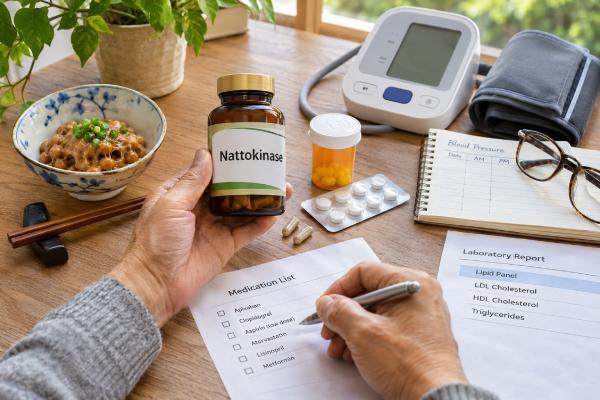
Nattokinase is a fibrinolytic enzyme produced when soybeans are fermented to make the Japanese food natto. Supplements are promoted for blood pressure, circulation, cholesterol, and clot prevention, but the human evidence is much more limited than the marketing suggests. Small trials and a recent meta-analysis indicate that nattokinase may modestly lower blood pressure in some people and can change laboratory measures related to clotting and fibrinolysis. However, a longer randomized trial found no benefit for progression of subclinical atherosclerosis, and there is no convincing evidence that nattokinase prevents heart attacks, strokes, or cardiovascular death. Safety also matters because an enzyme that influences clot breakdown may increase bleeding when combined with anticoagulant or antiplatelet drugs. Nattokinase can therefore be viewed as an experimental cardiovascular supplement, not as a substitute for blood-pressure treatment, statins, aspirin when prescribed, or anticoagulation. Anyone considering it should weigh a specific expected benefit against medication interactions and bleeding risk.
Table of Contents
- What Nattokinase Is and How It May Work
- What the Research Shows for Blood Pressure
- Cholesterol, Atherosclerosis, and Clotting Evidence
- Can Nattokinase Prevent Heart Attack or Stroke?
- Side Effects, Bleeding Risk, and Interactions
- Dose, Labels, and Supplement Quality
- Who Might Consider It and Who Should Not
What Nattokinase Is and How It May Work
Nattokinase is a proteolytic enzyme produced by Bacillus subtilis during fermentation of soybeans into natto. It is named for the food, but a capsule is not nutritionally equivalent to eating natto. Natto contains protein, fiber, minerals, and vitamin K2 along with the enzyme; purified supplements are standardized mainly by enzyme activity.
The cardiovascular interest centers on fibrin. Fibrin forms a mesh that helps stabilize a blood clot. Nattokinase can degrade fibrin in laboratory settings, and small human studies have reported changes in fibrinolytic and coagulation markers after supplementation. For example, a single-dose study in healthy men found temporary changes in D-dimer, fibrin-degradation products, factor VIII, antithrombin, and activated partial thromboplastin time after 2,000 fibrinolytic units (FU). Those findings show biological activity, but they do not prove that the supplement safely prevents harmful blood clots.
Researchers have also proposed several other mechanisms:
- effects on the renin-angiotensin system that could reduce blood pressure;
- reduced platelet aggregation or thromboxane activity;
- changes in blood viscosity and fibrinolysis;
- possible anti-inflammatory or antioxidant effects.
Most of those mechanisms come from laboratory, animal, or relatively small human studies. The gap between a plausible mechanism and a proven health benefit is important. A treatment can alter a biomarker without lowering the risk of heart attack, stroke, heart failure, or death.
That distinction is especially useful when evaluating supplements marketed for “circulation.” Cardiovascular prevention usually depends on measurable risk factors and proven treatments. If you are trying to understand your baseline risk, start with blood pressure, diabetes status, smoking, family history, and LDL, HDL, and triglyceride levels rather than assuming that more fibrinolysis is automatically better.
What the Research Shows for Blood Pressure
Blood pressure is the area where nattokinase has the clearest signal of possible benefit, although the evidence remains modest. A systematic review and meta-analysis of randomized controlled trials published in 2023 included six studies with 546 participants. Across the included trials, nattokinase supplementation lowered systolic blood pressure by about 3.5 mmHg and diastolic pressure by about 2.3 mmHg on average. That is a small effect, and the individual studies differed in dose, population, and design.
An older randomized trial of 86 adults with untreated prehypertension or stage 1 hypertension tested 2,000 FU daily for eight weeks. Among those who completed the study, the net change compared with placebo was about 5.6 mmHg lower systolic pressure and 2.8 mmHg lower diastolic pressure. A later North American trial also found reductions in blood pressure after eight weeks of a nattokinase preparation.
These results are promising enough to justify more research but not strong enough to make nattokinase a standard hypertension treatment. Several practical reasons matter:
- the trials are small compared with studies of established blood-pressure medicines;
- follow-up was generally short;
- products and doses were not identical;
- most studies measured blood pressure rather than heart attacks, strokes, or kidney outcomes;
- supplement quality can vary outside research settings.
A reduction of 3–5 mmHg can be meaningful at a population level, but an individual response may be smaller, larger, or absent. It also does not replace the larger body of evidence for lifestyle changes and approved medications when blood pressure remains above target.
If you want to lower blood pressure without adding another drug, evidence-based first steps include reducing excess sodium, increasing activity, managing weight, limiting alcohol, and using a DASH-style eating pattern. The DASH diet for high blood pressure has far stronger clinical support than relying on a single supplement. Anyone already taking antihypertensive medicine should monitor for lightheadedness or unusually low readings if a clinician approves nattokinase, because additive blood-pressure lowering is possible.
Cholesterol, Atherosclerosis, and Clotting Evidence
Claims that nattokinase lowers cholesterol or reverses plaque are less convincing. The 2023 meta-analysis found no consistent lipid benefit and, at relatively low total doses, some lipid measures actually moved in an unfavorable direction. That makes it difficult to recommend nattokinase as a cholesterol-lowering therapy.
One of the most informative trials followed 265 adults without clinical cardiovascular disease for a median of about three years. Participants received 2,000 FU of nattokinase daily or placebo. Researchers repeatedly measured carotid intima-media thickness and carotid arterial stiffness as markers of subclinical atherosclerosis, along with blood pressure and many laboratory markers. Nattokinase did not slow progression of the carotid measures and did not produce meaningful improvements in the measured cardiovascular biomarkers.
Other studies have reported favorable lipid changes, but interpretation requires care. A 2023 randomized trial used a combination of nattokinase and Monascus, commonly known as red yeast rice. A 2024 trial in people with stable coronary artery disease compared nattokinase, red yeast rice, their combination, and placebo. The combination produced several favorable cardiometabolic changes, but red yeast rice contains cholesterol-lowering compounds related to statins. Results from a combination product cannot be credited to nattokinase alone.
A large 2022 clinical report involving 1,062 participants described improvements in lipids and carotid atherosclerosis at a much higher nattokinase dose, 10,800 FU daily for 12 months. However, the study was not a conventional placebo-controlled randomized trial, so it provides weaker evidence than the long-term randomized study. Differences in study design, dose, and population may help explain the conflicting results.
The clotting data are biologically interesting but also double-edged. Human studies show that nattokinase can alter fibrinolytic or coagulation measures. In one eight-week trial, it prolonged collagen-epinephrine closure time and activated partial thromboplastin time. Those effects could be interpreted as antithrombotic, but they also support concern about bleeding when the supplement is combined with medicines that already reduce clotting.
The mixed findings also show why study design matters. An uncontrolled before-and-after study can make a supplement look impressive if participants also change diet, exercise, weight, or medicines during the same period. Randomization and a placebo group help separate the product’s effect from those changes. Longer follow-up is important for atherosclerosis because plaque develops over years, not days. For that reason, the neutral long-term randomized trial deserves substantial weight even though some shorter or less controlled studies reported favorable markers.
If you try nattokinase for a measurable goal with your clinician’s approval, decide in advance how you will judge it. For blood pressure, use a validated upper-arm monitor and compare averaged readings over several days rather than one reading before and after a capsule. For cholesterol, repeat a standard lipid panel at an appropriate interval. Do not use bruising, prolonged bleeding, or a change in clotting tests as a sign that the supplement is “working.” Those findings may represent harm rather than useful cardiovascular protection.
For high LDL cholesterol, therapies should be chosen according to cardiovascular risk and the amount of LDL reduction needed. If statin tolerance is an issue, there are evidence-based statin alternatives with defined dosing, monitoring, and outcome data.
Can Nattokinase Prevent Heart Attack or Stroke?
At present, there is no strong clinical evidence that nattokinase prevents heart attack, ischemic stroke, cardiovascular death, or recurrent blood clots. This is the most important limitation to understand.
Most nattokinase trials have focused on intermediate outcomes such as blood pressure, lipids, carotid ultrasound measurements, or clotting markers. Those outcomes can be useful in early research, but cardiovascular medicine ultimately asks whether an intervention prevents events that matter to patients. Large outcome trials have not established that benefit for nattokinase.
This matters because people may be tempted to use the supplement in place of a proven drug. That can be dangerous. A published case described a patient with a mechanical aortic valve who replaced warfarin with nattokinase. A clot formed on the valve, and the patient needed another valve operation. The lesson is not that nattokinase always causes clots; it is that the supplement cannot be assumed to provide the anticoagulant effect required for high-risk medical conditions.
The same principle applies to atrial fibrillation, prior deep vein thrombosis or pulmonary embolism, and some forms of coronary or cerebrovascular disease. If a clinician has prescribed an anticoagulant or antiplatelet drug to prevent stroke or recurrent clotting, do not replace it with nattokinase. The dose, pharmacology, monitoring, and clinical benefit of prescription therapies have been studied in ways that nattokinase has not.
Also be skeptical of claims that nattokinase “cleans arteries” or “dissolves plaque.” Atherosclerotic plaque is not simply a fibrin clot. It is a complex lesion involving cholesterol, inflammatory cells, connective tissue, calcium, and vessel-wall changes. Lowering atherosclerotic risk requires control of LDL cholesterol, blood pressure, smoking, diabetes, and other established drivers.
For people without established cardiovascular disease, the best prevention plan usually starts by estimating overall risk rather than adding a clot-active supplement. Lifestyle measures and, when appropriate, medications should target the specific risk factors that are actually elevated.
Side Effects, Bleeding Risk, and Interactions
The most important potential adverse effect is bleeding. Nattokinase has fibrinolytic and antithrombotic activity, and published case reports describe serious hemorrhage. The absolute risk is unknown because large safety trials have not quantified major bleeding rates.
Avoid combining nattokinase on your own with medicines that affect clotting, especially:
- warfarin;
- apixaban, rivaroxaban, dabigatran, or edoxaban;
- heparin or enoxaparin;
- aspirin;
- clopidogrel, prasugrel, or ticagrelor;
- fibrinolytic drugs used to dissolve acute clots.
The risk may also be harder to predict if several supplements with antiplatelet or anticoagulant effects are taken together. A medication and supplement review with a pharmacist is often the fastest way to identify overlap.
Warfarin deserves a separate note because natto food is rich in vitamin K, which can oppose warfarin’s effect. Purified nattokinase supplements are not necessarily high in vitamin K, so the food and the supplement should not be treated as identical. Still, anyone on warfarin should discuss both natto and nattokinase with the clinician managing INR.
Stop the supplement and seek medical advice for unexplained bruising, recurrent nosebleeds, prolonged bleeding, blood in urine, black stools, or unusually heavy menstrual bleeding. Emergency care is appropriate for uncontrolled bleeding, vomiting blood, sudden severe headache, new neurologic symptoms, fainting, or signs of major internal bleeding.
People preparing for surgery, dental extraction, biopsy, or another invasive procedure should tell the procedural team about nattokinase. There is no well-validated universal stop interval for the supplement, so the timing should be individualized. Do not use nattokinase as a substitute while a prescribed blood thinner is being held for a procedure.
Other possible concerns include allergic reactions to natto or soy-related ingredients and excessive blood-pressure lowering in susceptible people. Safety during pregnancy, breastfeeding, and childhood has not been established. For a more focused interaction guide, see nattokinase safety with blood thinners.
Dose, Labels, and Supplement Quality
Nattokinase is commonly labeled in fibrinolytic units (FU), a measure of enzyme activity. Many clinical studies have used around 2,000 FU per day, while some reports have tested much higher amounts. There is no officially established dose proven to prevent cardiovascular events, and a higher FU number should not be assumed to mean greater net benefit.
Milligrams and FU are not interchangeable. Two bottles may list similar milligram amounts but different enzyme activity. Conversely, a product that clearly states FU is still not guaranteed to produce the same clinical effect as the formulation used in a research trial.
Dietary supplements in the United States do not go through the same premarket approval process for safety and effectiveness as prescription drugs. That makes quality control important. If a healthcare professional agrees that nattokinase is reasonable for you, look for:
- a clearly stated amount of nattokinase and FU per serving;
- a complete ingredient list rather than a vague proprietary blend;
- independent testing for identity and contaminants when available;
- lot numbers and a manufacturer with accessible contact information;
- no claims that the product can replace anticoagulants, dissolve dangerous clots, or treat a cardiovascular emergency.
Also check whether the product contains additional ingredients such as red yeast rice, vitamin K, herbs, or other enzymes. Combination formulas can create new interactions and make it impossible to know which ingredient caused a benefit or adverse effect.
Do not increase the dose because you do not “feel” an effect. Blood pressure can be measured, but fibrinolytic activity is not something you can safely judge by sensation. More supplement could increase biological activity without providing additional cardiovascular protection.
Who Might Consider It and Who Should Not
A person at low bleeding risk who is interested in a modest possible blood-pressure effect might discuss nattokinase with a clinician, especially if lifestyle changes are already in place. Even then, the expected benefit should be framed realistically: a few millimeters of mercury in some studies, with no proven reduction in cardiovascular events.
Nattokinase is generally a poor choice for self-treatment if you:
- take anticoagulant, antiplatelet, or thrombolytic medication;
- have a bleeding disorder or history of major bleeding;
- have a mechanical heart valve;
- have atrial fibrillation, prior DVT, pulmonary embolism, or another reason for prescribed anticoagulation;
- are scheduled for surgery or another invasive procedure;
- are pregnant or breastfeeding;
- are a child or adolescent;
- have recurrent unexplained bruising or bleeding;
- want to use it instead of a prescribed cardiovascular medicine.
Before buying a supplement, define the problem you are trying to solve. If the goal is high blood pressure, measure home readings correctly and review them with a clinician. If the goal is high LDL, determine how much LDL reduction is needed. If the concern is blood clots, find out whether you have a medical indication for anticoagulation rather than trying to create an unmeasured “blood-thinning” effect.
A practical comparison is to ask three questions: What benefit is proven? How large is it? What risk am I adding? For nattokinase, possible modest blood-pressure lowering is supported by limited trial data; cholesterol and atherosclerosis results are inconsistent; prevention of heart attack and stroke is unproven; and bleeding interactions remain a meaningful concern.
That balance makes nattokinase different from a standard heart-health treatment. It may be an interesting research supplement, but it should sit well behind the fundamentals: blood-pressure control, LDL reduction when indicated, smoking cessation, regular activity, nutritious eating, healthy weight, and appropriate management of diabetes or other conditions. If you use it at all, do so with a medication review and a clear reason rather than as general insurance against cardiovascular disease.
References
- Nattokinase Supplementation and Cardiovascular Risk Factors: A Systematic Review and Meta-Analysis of Randomized Controlled Trials 2023 (Systematic Review)
- Nattokinase atherothrombotic prevention study: A randomized controlled trial 2021 (RCT)
- Lipid-lowering, antihypertensive, and antithrombotic effects of nattokinase combined with red yeast rice in patients with stable coronary artery disease: a randomized, double-blinded, placebo-controlled trial 2024 (RCT)
- The Effect of Nattokinase-Monascus Supplements on Dyslipidemia: A Four-Month Randomized, Double-Blind, Placebo-Controlled Clinical Trial 2023 (RCT)
- Nattokinase as an adjuvant therapeutic strategy for non-communicable diseases: a review of fibrinolytic, antithrombotic, anti-inflammatory, and antioxidant effects 2024 (Review)
- Navigating the Effects of Anti-Atherosclerotic Supplements and Acknowledging Associated Bleeding Risks. 2025 (Review)
Disclaimer
This article provides general education and does not replace individualized medical advice. Nattokinase may affect clotting and may interact with anticoagulant, antiplatelet, blood-pressure, or other medicines. Do not replace a prescribed cardiovascular drug with nattokinase or start the supplement if you have significant bleeding or clotting risk without discussing it with a qualified healthcare professional.