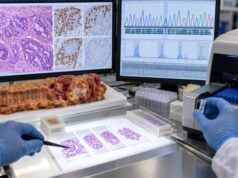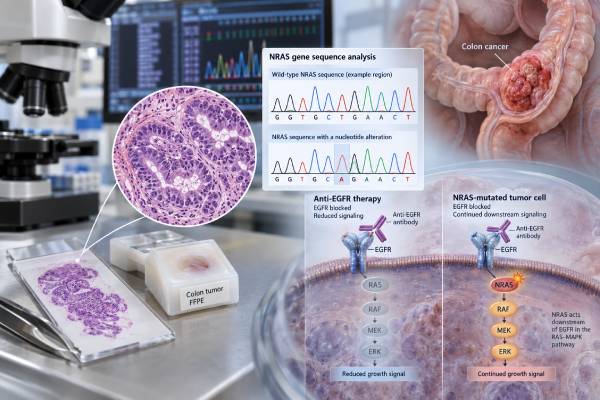
An NRAS test for colon cancer looks for activating mutations in the NRAS gene, usually as part of extended RAS testing that also includes KRAS. The result is especially important in metastatic colorectal cancer because an activating NRAS mutation predicts resistance to the anti-EGFR antibodies cetuximab and panitumumab. In practical terms, a tumor must generally be RAS wild-type before those drugs are considered in treatment settings where they are otherwise appropriate. NRAS is not a blood tumor marker, and a “positive” mutation result does not tell how much cancer is present. It describes a signaling change inside the tumor. Most NRAS mutations are acquired tumor changes rather than inherited mutations, so the result usually does not imply a hereditary cancer syndrome. Interpretation also depends on which exon and codon were tested, whether the assay covered the full clinically relevant RAS regions, cancer stage, tumor sidedness, and other biomarkers such as BRAF, MSI/MMR, HER2, and KRAS G12C.
- An activating NRAS mutation usually means cetuximab and panitumumab are unlikely to work and are generally avoided for that tumor.
- NRAS wild-type means no tested activating NRAS mutation was found, but KRAS must also be wild-type before a tumor is considered RAS wild-type.
- The test is mainly used for treatment selection in metastatic colorectal cancer, not for screening or measuring tumor burden.
- NRAS mutations are usually somatic tumor changes and do not by themselves indicate an inherited cancer risk.
- A complete result should specify the assay and the clinically relevant RAS regions examined rather than simply saying “NRAS negative.”
Table of Contents
- What NRAS Does in Colon Cancer
- When and How NRAS Testing Is Performed
- What a Positive NRAS Mutation Means
- What NRAS Wild-Type Means
- How NRAS Guides Anti-EGFR Treatment
- Other Biomarkers That Matter With NRAS
- Limitations, Resistance, and Questions to Ask
What NRAS Does in Colon Cancer
NRAS belongs to the RAS family of genes, which also includes KRAS and HRAS. RAS proteins act as molecular switches in signaling pathways that regulate cell growth and survival. When a growth signal reaches the epidermal growth factor receptor (EGFR) on the cell surface, RAS can transmit that signal downstream through pathways such as RAF-MEK-ERK.
An activating NRAS mutation can lock the signaling switch in an “on” state. The tumor cell can then keep sending growth signals even if EGFR itself is blocked. This is the biological reason NRAS mutations matter so much for anti-EGFR therapy: blocking the receptor upstream may have little effect when the downstream RAS pathway is already activated.
NRAS mutations are less common than KRAS mutations in colorectal cancer. Depending on the population and assay, NRAS alterations are generally found in only a few percent of colorectal tumors. Their low frequency does not make them unimportant. Missing an NRAS mutation can lead to use of an anti-EGFR drug in a patient whose tumor has a well-established resistance mechanism.
Clinically relevant RAS testing is broader than checking one famous mutation. Extended RAS testing usually includes activating variants in selected regions of KRAS and NRAS, particularly exons 2, 3, and 4. These regions contain codons where activating substitutions are known to predict lack of benefit from cetuximab or panitumumab.
A tumor with an NRAS mutation is often described as RAS-mutant. A tumor can only be called RAS wild-type after the clinically relevant regions of both KRAS and NRAS are found to be wild-type. This distinction matters because older reports sometimes tested only KRAS exon 2. Such a report may not be sufficient for modern anti-EGFR treatment selection.
NRAS mutation status is a predictive biomarker in metastatic colorectal cancer. Its strongest established use is predicting lack of benefit from anti-EGFR monoclonal antibodies. It is not primarily used as a diagnostic marker, screening test, or hereditary-risk test.
When and How NRAS Testing Is Performed
NRAS testing is most important when colorectal cancer is metastatic or unresectable and systemic treatment choices are being planned. Many centers order RAS testing early in the metastatic workup so the result is available before first-line or later-line therapy is selected.
The laboratory usually uses preserved tumor tissue from the original colon or rectal tumor, a metastatic biopsy, or another adequate specimen. No fasting or medication adjustment is normally required because the patient is not being tested through a routine chemistry blood draw.
Testing methods include targeted PCR-based assays and next-generation sequencing. Broad NGS panels can evaluate NRAS at the same time as KRAS, BRAF, HER2-related alterations, NTRK fusions, and other genomic markers. The exact panel varies.
A good report should answer several questions:
- Was adequate tumor tissue present?
- Which NRAS exons or codons were covered?
- Were the clinically relevant KRAS regions also tested?
- What specific variant was detected, if any?
- What was the assay’s sensitivity or limit of detection?
- Was the result generated from tissue or circulating tumor DNA?
Tissue testing remains a standard approach. Circulating tumor DNA from plasma can also identify RAS mutations, especially in metastatic disease where enough tumor DNA is being shed into the bloodstream. A positive plasma result can be highly informative, but a negative plasma result may be less conclusive if tumor shedding is low. In that situation, tissue testing can still be necessary.
Timing becomes more complex after anti-EGFR treatment. Tumors can acquire RAS-pathway resistance mutations during cetuximab or panitumumab therapy. These resistant clones may later decline after the drug is stopped. This biological evolution is one reason ctDNA has become useful in anti-EGFR rechallenge research and selected clinical practice.
For a newly diagnosed metastatic tumor, however, the basic goal is straightforward: establish baseline RAS status before using an anti-EGFR strategy.
What a Positive NRAS Mutation Means
A positive NRAS result means the laboratory detected a pathogenic or likely activating NRAS alteration in the tumor. The most important immediate consequence is that the cancer is considered RAS-mutant, and standard anti-EGFR antibodies are generally not expected to provide meaningful benefit.
The word “positive” can be misleading if a patient interprets it as “cancer is getting worse.” The mutation result does not measure cancer quantity. It can remain positive in the tumor regardless of whether the visible disease is small or extensive.
A positive NRAS mutation also does not usually mean the patient was born with that mutation. In colorectal cancer, NRAS alterations are typically somatic, meaning they arose in the cancer cells. Germline NRAS-related syndromes exist in other genetic contexts, but an NRAS mutation on routine tumor profiling is not by itself evidence of a hereditary colorectal cancer syndrome.
The exact mutation can be listed using protein notation, such as a codon change in exon 2, 3, or 4. The oncologist and molecular pathologist determine whether the variant is an established activating alteration. Not every rare NRAS change has the same evidence, which is why an unusual variant may require interpretation rather than a simple mutant/wild-type label.
NRAS-mutant colorectal cancers can still receive many effective treatments. Depending on stage, tumor location, prior therapy, fitness, and other biomarkers, options may include chemotherapy combinations, anti-VEGF therapy, later-line agents, surgery or ablation for selected metastases, radiation in specific situations, or clinical trials.
The mutation can also coexist with other molecular findings. Some combinations are uncommon because certain driver mutations tend to be mutually exclusive, but tumor biology is not perfectly tidy. A comprehensive report may therefore identify additional changes that influence prognosis, trial eligibility, or treatment.
A positive NRAS result should not be viewed as “no targeted options exist.” It specifically closes or weakens the anti-EGFR route in standard care, while other biomarker-directed strategies may still be relevant.
What NRAS Wild-Type Means
NRAS wild-type means no clinically relevant activating NRAS mutation was detected within the regions covered by the assay. That is necessary but not sufficient for anti-EGFR eligibility.
The next question is KRAS status. If KRAS contains an activating mutation, the tumor is still RAS-mutant and anti-EGFR treatment is generally avoided. Only when both clinically relevant KRAS and NRAS regions are wild-type is the tumor considered RAS wild-type.
Even then, “RAS wild-type” does not guarantee that cetuximab or panitumumab will work. It identifies a population in which benefit is possible. Other factors strongly influence the expected benefit:
- whether the primary tumor arose on the left or right side of the colon;
- BRAF V600E status;
- HER2 amplification or overexpression;
- MSI/MMR status;
- prior anti-EGFR exposure;
- treatment line;
- disease burden and symptoms; and
- the chemotherapy backbone being considered.
For first-line metastatic treatment, anti-EGFR therapy has its clearest role in left-sided, RAS wild-type tumors when other clinical factors support the approach. Right-sided tumors generally derive less benefit from first-line anti-EGFR therapy even if RAS is wild-type, so alternative biologic strategies are often favored.
A wild-type report also depends on test quality. If an old report examined only NRAS exon 2 or did not state which regions were assessed, it may not establish complete RAS wild-type status. Likewise, a plasma test that is negative during a period of low tumor shedding may not exclude a tissue mutation with the same confidence as a well-performed tumor assay.
Patients should therefore look for the phrase extended RAS testing or equivalent detail rather than relying on a one-line “NRAS negative” result.
How NRAS Guides Anti-EGFR Treatment
Cetuximab and panitumumab are monoclonal antibodies that bind EGFR. In a RAS wild-type tumor, blocking EGFR can interrupt growth signaling. In a tumor with an activating NRAS mutation, the pathway is switched on downstream of EGFR, so the signal can continue despite receptor blockade.
This relationship is strong enough that RAS testing is a standard treatment-selection step in metastatic colorectal cancer. Clinical guidelines recommend restricting anti-EGFR therapy to appropriately selected RAS wild-type disease.
The impact is clearest in three situations.
First-line treatment
For many patients with left-sided, RAS wild-type metastatic colorectal cancer, a chemotherapy doublet combined with an anti-EGFR antibody is an established first-line option. An NRAS mutation removes the patient from that biomarker-defined group.
Later-line treatment
Cetuximab or panitumumab can also be used later in the disease course when the tumor remains RAS wild-type and the patient has not previously received an anti-EGFR antibody in a way that makes the strategy inappropriate. Again, an activating NRAS mutation predicts resistance.
Rechallenge after earlier anti-EGFR therapy
A more specialized scenario involves patients who initially had RAS wild-type disease, responded to anti-EGFR treatment, later developed resistance, and then spent time off the drug. Resistant RAS-mutant subclones can sometimes fall to very low levels after the selective pressure is removed. Research has shown that ctDNA can help identify patients in whom resistance mutations are no longer detectable and who may benefit from anti-EGFR rechallenge.
This is very different from a baseline tumor that is clearly NRAS-mutant. A patient whose original cancer contains a clonal activating NRAS mutation is not the typical candidate for anti-EGFR rechallenge.
Treatment decisions should also account for toxicity. Anti-EGFR antibodies can cause acneiform rash, dry skin, nail changes, diarrhea, electrolyte abnormalities such as low magnesium, and infusion reactions. Biomarker eligibility does not eliminate the need to balance benefit against adverse effects and patient preferences.
Other Biomarkers That Matter With NRAS
Metastatic colorectal cancer is now treated using a biomarker profile rather than a single gene result. NRAS should be read as one part of that profile.
KRAS: The most common RAS driver in colorectal cancer. Any established activating KRAS mutation generally predicts resistance to cetuximab and panitumumab. KRAS G12C has additional treatment implications because targeted combinations are available in later-line settings.
BRAF V600E: Identifies a biologically distinct subgroup with specific targeted-treatment options. BRAF status also helps interpret MLH1/PMS2-deficient colorectal tumors in the Lynch syndrome workup.
MSI/MMR: MSI-H/dMMR metastatic colorectal cancers may receive immune checkpoint blockade, often making immunotherapy a more important first-line consideration than anti-EGFR treatment.
HER2: Amplification or overexpression can provide a target in selected RAS wild-type metastatic colorectal cancers and can also act as a mechanism of resistance to anti-EGFR therapy.
NTRK fusions: Rare but actionable. Their low frequency makes broad molecular profiling useful in selected patients, particularly when common driver mutations are absent.
Tumor sidedness: Not a gene, but clinically important. Left-sided primary tumors with RAS wild-type status derive the clearest first-line benefit from anti-EGFR combinations. Right-sided primary tumors are approached differently in many guidelines.
The full biomarker picture also helps prevent a common sequencing error: choosing a drug because one marker appears favorable while ignoring another marker that has stronger treatment implications.
Limitations, Resistance, and Questions to Ask
No molecular test is perfect. Low tumor content can reduce sensitivity. Rare variants may be difficult to classify. An assay may not cover all clinically relevant regions. Tissue and plasma results can disagree because of tumor heterogeneity or low ctDNA shedding.
A negative result should therefore be interpreted in light of the method. “No mutation detected” means no mutation was found within the assay’s technical and genomic limits; it does not prove that every cancer cell has a completely normal RAS pathway.
Cancer also evolves under treatment pressure. A baseline RAS wild-type tumor can acquire NRAS or KRAS mutations during anti-EGFR therapy. This is acquired resistance, not a laboratory error. When resistant clones expand, the drug can stop working. When therapy is withdrawn, those clones may decline, which underlies the rationale for ctDNA-guided rechallenge research.
Useful questions after an NRAS test include:
- Was complete extended RAS testing performed, including KRAS and NRAS?
- Which exons and codons were covered?
- What exact NRAS variant was found?
- Is the variant considered activating and clinically actionable?
- Does the result rule out cetuximab or panitumumab in my current treatment setting?
- Is my primary tumor left-sided or right-sided?
- What are my BRAF, MSI/MMR, HER2, and KRAS results?
- Was the test performed on tissue or plasma, and is confirmation needed?
- If I previously received anti-EGFR therapy, would ctDNA testing ever be relevant before rechallenge?
The practical interpretation is concise: NRAS-mutant means anti-EGFR resistance is expected; NRAS wild-type means anti-EGFR therapy remains possible only if the rest of the RAS profile and clinical setting are appropriate. That distinction is why a small gene on a molecular report can have a large effect on treatment planning.
Baseline RAS status is usually highly concordant between a primary colorectal tumor and untreated metastases because an activating driver is often established early in tumor development. Even so, later treatment can reshape the cancer’s clonal composition. A metastasis sampled after several lines of therapy may contain resistance alterations that were absent or below detection in the original specimen. This is one reason clinicians distinguish baseline predictive testing from acquired-resistance testing.
NRAS status also should not be used to estimate whether surgery for liver or lung metastases is worthwhile. Resectability depends on the number and location of metastases, ability to remove all visible disease, remaining organ function, response to systemic therapy, and multidisciplinary expertise. The mutation helps choose systemic drugs; it does not by itself define whether local curative-intent treatment is possible.
References
- Treatment of Metastatic Colorectal Cancer: ASCO Guideline 2023 (Guideline)
- Metastatic colorectal cancer: ESMO Clinical Practice Guideline for diagnosis, treatment and follow-up 2023 (Guideline)
- Mutant RAS and the tumor microenvironment as dual therapeutic targets for advanced colorectal cancer 2022 (Review)
- Unveiling acquired resistance to anti-EGFR therapies in colorectal cancer: a long and winding road 2024 (Review)
- The role of anti-EGFR rechallenge in metastatic colorectal cancer, from available data to future developments: A systematic review 2024 (Systematic Review)
Disclaimer
This article is for general education and does not replace individualized oncology advice. NRAS results must be interpreted with the complete RAS profile, tumor location, stage, prior therapy, and other molecular findings. Cancer treatment should be selected with the treating oncology team.