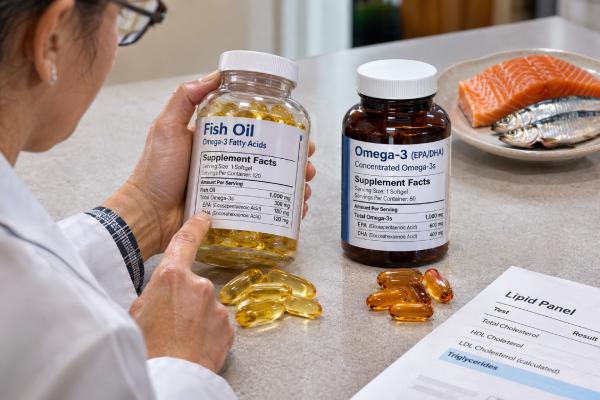
If your goal is to lower triglycerides, “omega-3” and “fish oil” are not the same thing. Omega-3 is a family of fatty acids that includes EPA, DHA, and the plant-based omega-3 ALA. Fish oil is simply one source of EPA and DHA. For triglyceride lowering, the strongest evidence is for gram-level doses of EPA and/or DHA, especially standardized prescription products. A typical low-dose fish oil capsule may contain too little EPA and DHA to make a large difference.
That does not mean every high-dose supplement is equivalent to a prescription medicine. Fish oil, krill oil, algal oil, flax oil, and cod liver oil differ in their active omega-3 content, evidence, safety considerations, and dosing practicality. The number of milligrams printed on the front of a bottle can also be misleading if it refers to total oil rather than EPA plus DHA. This guide explains which omega-3 forms lower triglycerides most reliably and how to compare products without confusing marketing claims with therapeutic dosing.
Table of Contents
- Omega-3 and Fish Oil Are Different
- Which Omega-3 Options Lower Triglycerides Most?
- EPA, DHA, and the Dose That Matters
- How to Compare Supplement Labels
- When Prescription Omega-3 Is the Better Choice
- Safety, Side Effects, and Common Mistakes
- A Practical Plan for Lowering Triglycerides
Omega-3 and Fish Oil Are Different
Omega-3 describes a group of polyunsaturated fatty acids. The three most familiar are alpha-linolenic acid (ALA), eicosapentaenoic acid (EPA), and docosahexaenoic acid (DHA). ALA comes mainly from plant foods such as flaxseed, chia seeds, walnuts, soybean oil, and canola oil. EPA and DHA are concentrated in fatty fish, seafood, fish oil, krill oil, and some algal oils.
Fish oil is a product made from fish tissue that usually supplies EPA and DHA. The amount varies widely. A 1,000-mg fish oil softgel might contain only 300 mg of EPA plus DHA, while a concentrated formula may contain two or three times that amount.
This difference matters because triglyceride lowering is tied much more closely to the dose of EPA and DHA than to the total grams of oil swallowed. A supplement that contains 1,000 mg of oil is not automatically a 1,000-mg omega-3 dose.
ALA also should not be counted as an equal substitute for EPA and DHA. The body can convert ALA to EPA and then DHA, but conversion is limited. Flaxseed and chia are nutritious foods and can fit a heart-healthy diet, but an ALA-rich oil does not reliably deliver the same triglyceride-lowering effect as a therapeutic dose of long-chain EPA/DHA. For broader heart-health uses of these foods, see flaxseed and chia for heart health.
The practical takeaway is simple: when evaluating an omega-3 product for triglycerides, first ask which omega-3 fatty acids it contains and how many milligrams of EPA and DHA it actually provides.
Which Omega-3 Options Lower Triglycerides Most?
The most reliable triglyceride-lowering option is a prescription omega-3 product used at its therapeutic dose, commonly 4 g per day. These products provide standardized EPA alone or EPA plus DHA and have been tested specifically as medications.
Nonprescription supplements can also lower triglycerides when they deliver enough EPA and DHA, but the evidence and product consistency are less predictable. A useful way to compare common options is by the strength of triglyceride-specific evidence and the practicality of reaching an effective dose.
| Omega-3 source | Main omega-3s | Triglyceride-lowering potential | Key limitation |
|---|---|---|---|
| Prescription EPA or EPA+DHA | EPA alone or EPA+DHA | Strong and predictable at therapeutic doses | Requires clinician evaluation and prescription |
| Concentrated fish oil supplement | EPA+DHA | Can lower triglycerides if EPA+DHA dose is high enough | Variable concentration, quality, and clinical evidence |
| Krill oil | EPA+DHA, often in phospholipids | May lower triglycerides modestly | Usually lower EPA+DHA dose per serving and higher cost |
| Algal oil | DHA, sometimes EPA+DHA | Potentially useful if it provides meaningful EPA/DHA | Many products are DHA-dominant and lower dose |
| Flax or chia oil | ALA | Not a reliable substitute for EPA/DHA therapy | Limited conversion of ALA to EPA and DHA |
| Cod liver oil | EPA+DHA plus vitamins A and D | Contains long-chain omega-3s | High-dose use can provide excessive vitamins A or D |
A 2024 meta-analysis comparing fish oil with corn oil found that fish oil significantly reduced triglycerides, although the size of the effect varied among trials. A 2023 dose-response meta-analysis similarly found greater triglyceride lowering as EPA/DHA intake increased, particularly above roughly 2 g per day.
Krill oil has evidence for modest lipid effects, and a 2023 meta-analysis found a reduction in triglycerides across randomized trials. However, that does not establish krill oil as a better treatment than prescription omega-3. Absorption may differ, but the clinically important question remains how much EPA and DHA reaches the patient at a studied dose. The article on krill oil vs fish oil for triglycerides explores that comparison in more detail.
Algal oil deserves a separate note because “plant-based omega-3” can mean two very different things. Flax and chia mainly provide ALA, while algae can be used to produce the same long-chain DHA—and in some products EPA—found in marine oils. An algal product that supplies substantial EPA and DHA can therefore be a useful option for someone who avoids fish. The problem is that many algal supplements are designed mainly as low-dose DHA products, so their label still needs the same dose check as fish oil.
Cod liver oil is a poor choice for trying to build a high triglyceride-lowering dose. It contains EPA and DHA, but it also naturally contains vitamins A and D. Taking enough cod liver oil to chase gram-level EPA/DHA can push vitamin intake higher than intended. If the goal is therapeutic omega-3 dosing, a product designed around EPA/DHA content is easier to use safely and predictably.
Food remains important, but it plays a different role. Two servings of fatty fish per week can support a heart-healthy eating pattern, yet the EPA/DHA content of fish varies by species, serving size, season, and preparation. That is useful nutrition, not a precise drug dose. Someone with severe hypertriglyceridemia should not delay medical treatment while trying to reproduce a 4-g prescription dose through meals.
EPA, DHA, and the Dose That Matters
For triglyceride lowering, EPA and DHA are the main omega-3 fatty acids to look for. Both reduce the liver’s production and export of triglyceride-rich particles, although their effects on the rest of the lipid profile differ.
At pharmacologic doses, omega-3 fatty acids often reduce triglycerides by about 20% to 30%, with larger percentage reductions possible when the starting level is very high. The most established prescription dose is 4 g per day of a specific omega-3 medication. This is not the same as taking four 1,000-mg fish oil capsules unless those capsules happen to provide the same active EPA/DHA amount—which most standard products do not.
DHA can raise LDL cholesterol in some people with severe hypertriglyceridemia even while lowering triglycerides. EPA-only prescription therapy generally does not have the same LDL-raising pattern. This is one reason a clinician may choose one formulation over another. For a deeper explanation of their differences, see EPA vs DHA.
Why “more omega-3” is not always better
The dose-response relationship does not mean people should keep increasing supplements on their own. At high doses, omega-3 products can cause gastrointestinal effects and may increase the risk of atrial fibrillation or bleeding in some people. A 2023 safety meta-analysis found small increases in several adverse effects, including diarrhea and bleeding tendency, across omega-3 trials.
Dose also depends on the treatment goal. A person eating fish for general nutrition does not need the same amount used to treat severe hypertriglyceridemia. Someone with triglycerides of 180 mg/dL also has a different clinical situation from someone with a fasting level of 800 mg/dL.
When triglycerides are very high, treatment should be coordinated with a clinician because the goal may include preventing pancreatitis, not simply improving a laboratory number.
How to Compare Supplement Labels
The most useful numbers are on the Supplement Facts panel, not the front of the bottle. Look for EPA and DHA in milligrams and note the serving size.
For example, a label might say:
- Fish oil: 1,000 mg
- EPA: 180 mg
- DHA: 120 mg
- Serving size: 1 softgel
That product supplies 300 mg EPA+DHA, not 1,000 mg EPA+DHA. If the serving size were two softgels, you would need to check whether the listed numbers apply to one softgel or both.
A concentrated product might instead provide 600 mg EPA and 400 mg DHA per two-softgel serving. That would supply 1,000 mg EPA+DHA per serving. The same “fish oil” category can therefore hide a threefold or fourfold difference in active omega-3 dose.
When comparing products, check these points:
- EPA per serving and DHA per serving.
- Number of capsules per serving.
- Whether the product is fish oil, krill oil, algal oil, or another source.
- Added vitamins, particularly vitamins A and D in cod liver oil.
- Whether independent testing for identity, purity, and contaminants is available.
- Expiration date and storage instructions, because oils can oxidize over time.
Do not rely on terms such as “maximum strength,” “triple strength,” or “pharmaceutical grade.” These are not substitutes for checking the actual EPA/DHA content.
The serving cost is worth calculating from EPA+DHA too. A cheaper bottle can be more expensive in practice if it requires four or six softgels to provide the same long-chain omega-3 dose that a concentrated product supplies in one or two. Divide the price by the total grams of EPA plus DHA in the bottle, not by the number of capsules. That comparison does not prove clinical quality, but it prevents a common shopping mistake and makes the real dose easier to see.
Also avoid making a direct milligram-for-milligram comparison between ALA and EPA+DHA. A tablespoon of flaxseed oil can contain several grams of ALA, but only a small fraction is converted to longer-chain EPA and DHA. It is still a useful food fat, but it is not equivalent to several grams of marine EPA/DHA for treating triglycerides.
When Prescription Omega-3 Is the Better Choice
Prescription treatment becomes especially relevant when triglycerides are 500 mg/dL or higher, and the need for medical management becomes more urgent as levels approach or exceed 1,000 mg/dL. At those levels, pancreatitis risk becomes a major concern and treatment usually includes a broader plan rather than a supplement alone.
A clinician may recommend prescription omega-3, a fibrate, a statin, or a combination strategy depending on the triglyceride level and cardiovascular risk. Lifestyle treatment remains essential. Important steps can include eliminating or sharply reducing alcohol, reducing added sugars and refined carbohydrates, controlling diabetes, losing excess weight when appropriate, and adjusting dietary fat when triglycerides are extremely high. For the broader treatment picture, see causes and treatment of high triglycerides.
Current U.S. dyslipidemia guidance does not recommend dietary supplements as a substitute for evidence-based lipid-lowering treatment. That is especially important when triglycerides are severely elevated or when cardiovascular-risk reduction—not general nutrition—is the goal.
Prescription products have several practical advantages for medical treatment:
- Standardized active ingredients and dose.
- Medication-level manufacturing requirements.
- Clinical trials supporting triglyceride lowering.
- Clear prescribing instructions and safety information.
- Predictable capsule counts to reach the intended therapeutic dose.
One prescription product, icosapent ethyl, also has evidence for reducing cardiovascular events in selected high-risk patients taking statins. That outcome should not be generalized to ordinary fish oil supplements or to every EPA+DHA product.
If you are considering taking enough supplement capsules to reach several grams of EPA+DHA daily, that is a good signal to discuss prescription options instead. The comparison of prescription omega-3 vs fish oil explains why equivalent-looking gram amounts can still represent different therapies.
Safety, Side Effects, and Common Mistakes
Most people tolerate moderate amounts of omega-3 supplements well, but high-dose use deserves more caution. Common effects include fishy aftertaste, belching, indigestion, nausea, loose stools, or diarrhea. Taking a product with food or splitting the dose may help some gastrointestinal symptoms, depending on the formulation.
High-dose omega-3 therapy has also been associated with more atrial fibrillation in several cardiovascular trials. This does not mean omega-3 causes an arrhythmia in everyone, but someone with a history of atrial fibrillation or flutter should discuss high-dose treatment with a clinician.
Bleeding is another consideration. Omega-3 fatty acids can affect platelet function, and the risk matters more if you also take anticoagulants or antiplatelet medicines. Tell your clinician if you use warfarin, apixaban, rivaroxaban, dabigatran, clopidogrel, aspirin, or similar drugs.
Common mistakes include:
- Counting total fish oil milligrams instead of EPA+DHA milligrams.
- Assuming flax oil has the same triglyceride effect as fish oil.
- Taking cod liver oil in very large amounts without considering vitamins A and D.
- Choosing a supplement solely because krill oil is advertised as “better absorbed.”
- Believing that any omega-3 supplement has proven heart-attack prevention benefits.
- Using high-dose supplements instead of seeking care for triglycerides above 500 mg/dL.
Fish and shellfish allergy also deserves product-specific advice. Manufacturing processes vary, and people with serious allergies should not assume every marine-derived oil is safe.
A Practical Plan for Lowering Triglycerides
For most people, the best triglyceride strategy begins with the cause of the elevation rather than the supplement aisle. Triglycerides rise for many reasons, including excess calories, alcohol, added sugar, uncontrolled diabetes, obesity, hypothyroidism, kidney disease, certain medicines, and inherited lipid disorders.
A sensible sequence is:
- Know your actual triglyceride level. Mild or moderate elevation calls for a different plan from severe hypertriglyceridemia.
- Correct major drivers. Alcohol, sugary drinks, refined carbohydrates, uncontrolled blood glucose, and weight gain can have a large effect.
- Use food strategically. Fatty fish can provide EPA and DHA as part of a heart-healthy eating pattern, but food alone may not supply a therapeutic dose for very high triglycerides.
- If using a supplement, calculate EPA+DHA. Do not calculate from the total fish oil number.
- Use medical therapy when indicated. Severe elevations or high cardiovascular risk often require treatment beyond supplements.
- Recheck the lipid panel. The response to diet, medication, or supplements should be measured rather than guessed.
Diet can sometimes move triglycerides more than people expect. Cutting alcohol and sugary drinks, improving blood sugar, and reducing excess refined carbohydrate can make a meaningful difference. The guide to diet changes for lowering triglycerides covers these levers in practical detail.
If you want a supplement for general nutrition rather than treatment, a modest-dose EPA/DHA product may be reasonable for some people. But if the purpose is to treat a high triglyceride result, the best-supported approach is not to search for the biggest “fish oil” number. It is to identify the needed EPA/DHA dose, consider whether prescription therapy is appropriate, and monitor the response with a clinician.
A repeat lipid panel is usually more informative than judging a product by symptoms because elevated triglycerides are often silent. For a new intervention, clinicians commonly reassess after several weeks once the dose and lifestyle changes have been consistent. The exact interval depends on how high the level is and whether other lipid medicines are being adjusted. A falling triglyceride level confirms that the plan is working; a poor response should trigger a review of adherence, alcohol intake, blood sugar, diet, medications, and possible inherited causes rather than an automatic increase in supplement dose.
It also helps to put percentage changes into real numbers. A 25% reduction from 240 mg/dL is about 60 mg/dL, leaving a value near 180 mg/dL. A 25% reduction from 800 mg/dL is about 200 mg/dL, leaving a value near 600 mg/dL. The same percentage effect can therefore mean very different residual risk and next steps. With very high triglycerides, the target is not merely “some improvement”; clinicians may need a larger absolute reduction to move the person away from the range associated with pancreatitis.
Finally, remember that lowering triglycerides is only one part of cardiovascular prevention. LDL cholesterol, non-HDL cholesterol, blood pressure, diabetes, smoking, physical activity, and overall diet may have a greater effect on long-term heart and stroke risk. A supplement that lowers triglycerides modestly should not distract from treatments with stronger evidence for the person’s overall risk profile.
If you switch products, recalculate the EPA+DHA dose from the new label instead of carrying over the old capsule count. Two brands can require very different numbers of softgels for the same active dose, and that simple check prevents accidental underdosing or unnecessarily high intake.
References
- 2026 ACC/AHA/AACVPR/ABC/ACPM/ADA/AGS/APhA/ASPC/NLA/PCNA Guideline on the Management of Dyslipidemia: A Report of the American College of Cardiology/American Heart Association Joint Committee on Clinical Practice Guidelines 2026 (Guideline)
- Association Between Omega-3 Fatty Acid Intake and Dyslipidemia: A Continuous Dose-Response Meta-Analysis of Randomized Controlled Trials 2023 (Meta-Analysis)
- Comparison of fish oil supplements and corn oil effects on serum lipid profile: a systematic review and meta-analysis of randomized controlled trials 2024 (Systematic Review and Meta-Analysis)
- Clinical effectiveness of krill oil supplementation on cardiovascular health in humans: An updated systematic review and meta-analysis of randomized controlled trials 2023 (Systematic Review and Meta-Analysis)
- Safety of Supplementation of Omega-3 Polyunsaturated Fatty Acids: A Systematic Review and Meta-Analysis of Randomized Controlled Trials 2023 (Systematic Review and Meta-Analysis)
- Omega-3 Fatty Acids 2025 (Official Fact Sheet)
Disclaimer
This article is for general education and does not replace medical diagnosis or treatment. Do not use high-dose omega-3 supplements to self-treat severe hypertriglyceridemia or replace prescribed lipid medication without speaking with a qualified clinician, especially if you take blood thinners or have a history of atrial fibrillation. Triglycerides at or above 500 mg/dL warrant prompt medical evaluation because pancreatitis risk increases as levels rise.