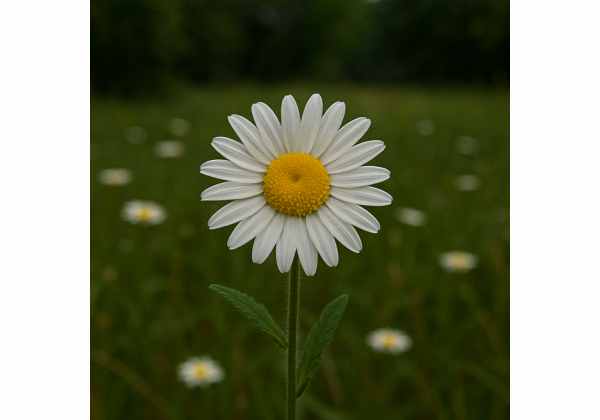
Ox-eye daisy, or Leucanthemum vulgare, is a familiar meadow flower with white rays and a yellow center, but its story does not end in ornament. In folk medicine, this hardy daisy has been used for coughs, minor wounds, bruises, burns, and simple topical washes. Modern interest is more cautious. Researchers have identified flavonoids, volatile oil compounds, and other daisy-family constituents that may help explain its traditional reputation, yet the plant is still lightly studied in humans. That means ox-eye daisy sits in an important middle ground: it has real historical use and some promising laboratory data, but it is not a well-established medicinal herb with standardized extracts or clinically proven dosing.
For readers, the practical question is not whether the plant is fascinating. It is. The real question is how to think about it responsibly. Ox-eye daisy may offer mild antioxidant, soothing, and traditional expectorant value, but it also belongs to a plant family known for allergy and skin sensitivity in susceptible people. Used wisely, it is a modest folk herb. Used carelessly, it becomes an unnecessary risk.
Quick Overview
- Ox-eye daisy shows mild antioxidant potential and contains flavonoids and aromatic compounds of medicinal interest.
- Traditional use centers on cough support and external use for minor wounds, bruises, and burns.
- A cautious nonstandard trial range is about 1 to 2 g dried aerial parts in 200 mL water once daily at first.
- People with Asteraceae allergy, pregnancy, breastfeeding, or known plant-contact dermatitis should avoid self-treatment.
Table of Contents
- What Ox-Eye Daisy Is and Why It Earned a Medicinal Reputation
- Key Ingredients and Phytochemical Profile
- Potential Health Benefits and What the Research Actually Supports
- Traditional Medicinal Properties and Folk Uses
- How Ox-Eye Daisy Is Used in Food and Home Preparations
- Dosage, Timing, and Practical Limits
- Safety, Side Effects, and Who Should Avoid It
What Ox-Eye Daisy Is and Why It Earned a Medicinal Reputation
Ox-eye daisy is a perennial member of the Asteraceae family, the same broad botanical group that includes chamomile, calendula, yarrow, and arnica. It grows widely in meadows, roadsides, and disturbed grasslands, which helps explain why it entered folk medicine so easily. People tend to experiment with abundant plants, especially those that are easy to identify and gather in quantity. Ox-eye daisy met those conditions long before modern herbals and clinical research existed.
Historically, the plant developed a reputation as a simple country remedy. In older European use, it was associated with bruises and minor injuries, which is why names such as “bruisewort” became attached to it. In more recent ethnobotanical records, it appears in decoctions and pastes for cough, wounds, and burns. That traditional profile tells us something important: ox-eye daisy was usually treated as a practical herb for ordinary complaints, not as a dramatic cure for severe disease.
That distinction still matters now. Many lightly studied herbs are made to sound more powerful than they really are. Ox-eye daisy is better understood as a modest medicinal plant with a strong folk identity and a weak clinical identity. In other words, there is real tradition behind it, but not enough modern evidence to elevate it to the front rank of evidence-based herbal medicine.
Part of its appeal comes from family resemblance. Many Asteraceae herbs carry bitter, aromatic, or soothing properties, and readers often assume this family connection guarantees similar effects. It does not. Still, the relationship is useful because it places ox-eye daisy in a recognizable botanical pattern. Like chamomile’s better-known daisy-family profile, ox-eye daisy has been associated with mild external soothing and gentle internal folk use. The difference is that chamomile has been studied much more thoroughly and standardized more carefully.
Another reason ox-eye daisy attracts attention is that it exists at the border between medicine and food. Some local traditions have eaten the flowers in salad, while herbal practice has used aerial parts in teas, washes, or poultices. That mixed identity can be useful, but it can also create confusion. A plant that is occasionally edible is not automatically safe in medicinal quantities, and a flower with a folk reputation is not automatically effective in modern clinical terms.
The most realistic opening view is this: ox-eye daisy deserves interest, but also restraint. Its medicinal reputation comes from genuine traditional use, not marketing invention. Yet its modern evidence base remains thin, so it should be approached as a low-certainty herb rather than a proven therapeutic agent.
Key Ingredients and Phytochemical Profile
When people ask what is “inside” ox-eye daisy, they are usually asking which compounds might explain its folk uses. The answer is layered. Ox-eye daisy is not defined by one famous active constituent. Instead, its profile seems to involve a mix of flavonoids, phenolic compounds, volatile oil components, and likely some of the sensitizing compounds that are common across the daisy family.
Modern phytochemical work on Leucanthemum vulgare suggests three broad groups deserve attention.
The first is flavonoids and related phenolics. Reviews of edible flowers have listed ox-eye daisy among species containing notable flavonoid compounds, including quercetin-related molecules and isoquercitrin-type patterns. These are the kinds of plant chemicals often associated with antioxidant behavior, cell protection, and mild anti-inflammatory activity. That does not prove a therapeutic effect in humans, but it gives the plant a reasonable biochemical basis for some of its traditional uses.
The second is volatile oil constituents. A study of the flowering tops identified major aromatic compounds including caryophyllene oxide, aromadendrene oxide, cis-β-farnesene, and trans-caryophyllene. Those compounds are interesting because similar terpenoid-rich oils in other plants often show antimicrobial, antioxidant, or sensory activity in laboratory settings. With ox-eye daisy, the key point is not that these compounds make it a strong essential-oil herb, but that they help explain why the plant has a mild but measurable phytochemical identity.
The third is family-level irritant and allergenic chemistry. Asteraceae plants are well known for sesquiterpene lactones and related sensitizing compounds. Ox-eye daisy is not as heavily documented in this regard as some stronger daisy-family herbs, but it should still be viewed within that pattern. That is why the same family that gives us soothing and useful herbs can also give us dermatitis, pollen sensitivity, and cross-reactive allergy in the wrong person.
A practical way to understand its chemistry is to separate likely benefit-related compounds from caution-related compounds:
- Benefit-facing compounds
- Flavonoids such as quercetin-related molecules
- Phenolic compounds with antioxidant potential
- Volatile oil terpenes that may contribute mild antimicrobial or aromatic activity
- Caution-facing compounds
- Likely daisy-family sensitizers
- Volatile constituents that can irritate in concentrated form
- Unstandardized compounds that vary by region, season, and preparation
Compared with better-known flowers such as calendula and other Asteraceae herbs, ox-eye daisy has a far less developed phytochemical and therapeutic literature. That matters because it means concentration, composition, and clinical relevance are less predictable. A plant can contain promising compounds and still remain too poorly studied for confident medicinal use.
So the phrase “key ingredients” should not be read too aggressively here. Ox-eye daisy has identifiable bioactive chemistry, but not in a way that supports bold supplement-style claims. The chemistry is interesting enough to justify attention, yet still incomplete enough to demand humility.
Potential Health Benefits and What the Research Actually Supports
The best way to discuss ox-eye daisy’s health benefits is to sort them by certainty. That keeps the article useful without overstating what the plant can do.
The first and most defensible category is antioxidant potential. Reviews of edible flowers and lab-based studies suggest that ox-eye daisy contains phenolics and flavonoids with free-radical-scavenging activity. This supports a modest claim that the plant has antioxidant chemistry. It does not prove that a cup of tea or a folk preparation will create meaningful disease-level protection in humans. Still, it is a legitimate starting point.
The second category is mild antimicrobial or antifungal potential. Volatile oil research on flowering tops found measurable antifungal activity in laboratory settings. This is encouraging, especially when viewed alongside the plant’s traditional topical use. But this evidence remains preclinical. It is useful for understanding why people may have found the plant helpful in washes or external applications, yet it is not enough to recommend ox-eye daisy as a treatment for infections.
The third category is traditional respiratory support, especially for cough. Ethnobotanical records from Kashmir describe leaf decoctions used orally for cough, while older European use also associated the plant with bronchial complaints. This is one of the more believable folk applications because mild bitter-aromatic herbs are often used in this way. Even so, the support is historical and observational, not clinical.
The fourth category is minor topical support for bruises, burns, and wounds. Traditional pastes and washes suggest ox-eye daisy was used externally as a simple field herb. This may relate to a combination of mild antimicrobial, antioxidant, and soothing actions. But here again, the real evidence is traditional practice plus plant chemistry, not randomized human trials.
A sensible hierarchy looks like this:
- Most plausible
- Mild antioxidant support
- Traditional external use for minor skin complaints
- Folk use for mild cough
- Possible but still weakly evidenced
- Mild antifungal activity
- Supportive external cleansing for small skin injuries
- Not established
- Strong anti-inflammatory treatment
- Reliable bronchodilator effects
- Broad immune support
- Internal long-term tonic use
This ranking matters because people often hear “medicinal herb” and assume a level of proof that simply is not there. Ox-eye daisy does not belong in the same confidence category as established digestive herbs, mucilage-rich wound herbs, or standardized topical botanicals. It is a smaller, more uncertain plant medicine.
That does not make it irrelevant. In fact, its value may lie in modesty. Some herbs work best as low-intensity helpers rather than headline remedies. Ox-eye daisy may fit that model, especially in short-term folk use. But it should never crowd out better-supported choices or delay real medical care.
The most helpful summary is simple: ox-eye daisy may offer mild antioxidant, topical, and traditional cough-related value, but the research supports possibility rather than certainty. That is an honest conclusion and, for this plant, the most responsible one.
Traditional Medicinal Properties and Folk Uses
Traditional plant use often preserves the most practical clues about how a herb was valued before formal pharmacology. With ox-eye daisy, the traditional picture is modest but consistent enough to be useful. It points toward an herb used for common household complaints rather than specialized diseases.
In folk records, ox-eye daisy has been associated with several properties:
- mild expectorant or cough-soothing use
- topical use for bruises and wounds
- washes or pastes for burns and skin irritation
- occasional use as a tonic, diuretic, or warming country remedy in older herbals
One of the strongest modern ethnobotanical records comes from Jammu and Kashmir, where Leucanthemum vulgare was documented as a leaf decoction for cough and as a paste for burns and wounds. That is important because it is detailed, recent, and specific to the plant. Another more local Italian survey recorded the flowers being eaten in salad, showing that the plant has also crossed into food use in at least some traditions.
These uses share a recognizable pattern. Ox-eye daisy was typically used where a person wanted something simple, available, and nearby. It was not a rare imported botanical. It was a field herb. That gives the plant a grounded character in traditional medicine. It was meant for practical care: a cough tea, a wound wash, a rough poultice, a seasonal household remedy.
That background also explains the old “bruisewort” reputation. Plants that were crushed and applied externally often gained names tied to their visible uses. Whether the benefit came from mild anti-inflammatory action, cleansing, cooling, or simply the value of any clean moist poultice is harder to determine now. What matters is that the plant had a recognized place in everyday care.
At the same time, folk use should not be mistaken for guaranteed efficacy. Traditional medicine records tell us what communities used, not what modern trials have proven. A plant may have survived in local memory because it was somewhat helpful, because it was abundant, or because it fit a cultural pattern of healing. Sometimes all three are true.
That is why comparison helps. Ox-eye daisy has a topical and wound-centered folk logic that loosely echoes yarrow’s more established reputation in traditional wound care, but it does not have yarrow’s depth of modern herbal recognition. The resemblance is helpful for context, not for equivalence.
Traditional medicinal properties therefore need to be read in two ways. First, ox-eye daisy was genuinely used for coughs, bruises, wounds, and burns. Second, those uses remain provisional in modern evidence terms. Folk medicine gives this plant a meaningful story, but not a free pass. It is a source of clues, not proof.
How Ox-Eye Daisy Is Used in Food and Home Preparations
Because ox-eye daisy sits between wildflower and folk herb, its practical use today should stay simple. Complex extracts, essential-oil experimentation, or strong medicinal claims do not fit the evidence. Traditional and low-intensity home use fit it better.
The flowers have occasionally been recorded as edible, especially in small salad use. That does not mean the plant should be treated as a carefree everyday salad flower. Daisy-family plants vary widely in palatability and sensitivity potential, and ox-eye daisy is not among the most widely embraced edible flowers. If used as food, it is better treated as an occasional garnish or tiny addition, not as a bulk green.
More typical home preparations are herbal rather than culinary. These include:
- Infusion or light decoction
A small amount of dried aerial parts steeped in hot water for mild internal use - Cooled wash
A strained infusion used externally on intact skin for simple cleansing or soothing - Poultice or mash
Fresh plant material crushed and applied briefly in traditional practice - Short folk-style compress
A cloth soaked in cooled tea and applied to a minor bruise or non-serious skin irritation
These forms share one advantage: they are weak and local. That is appropriate for a lightly studied herb. A dilute preparation leaves less room for dosing mistakes and reduces the chance of strong irritation.
If someone is trying ox-eye daisy in a cautious home context, a few rules make sense:
- Use only clearly identified plant material.
- Prefer dried or freshly cleaned aerial parts rather than improvised concentrates.
- Keep internal use small and brief.
- Use external preparations only on minor, non-infected, non-severe problems.
- Stop immediately if itching, redness, nausea, or mouth irritation appears.
For topical care, ox-eye daisy should be considered a low-confidence folk option, not a first-line treatment. In many cases, a more established external botanical such as witch hazel for gentle topical care or another standard wound-care approach will be easier to justify.
Source quality matters too. Ox-eye daisy often grows in roadsides, field margins, and disturbed ground. Those sites may contain pesticides, road dust, runoff, or animal contamination. A clean-looking wildflower is not always a clean medicinal plant. Harvesting from polluted or sprayed areas defeats the purpose of using a gentle herb.
The best modern use of ox-eye daisy is therefore restrained and observational. It can be part of traditional herbal curiosity, but not a substitute for proven respiratory care, wound care, or allergy management. In the home, it belongs on the mild end of the spectrum: simple tea, brief topical use, careful sourcing, and no heroic dosing.
Dosage, Timing, and Practical Limits
The most important fact about ox-eye daisy dosage is that no validated human medicinal dose has been established. There are no standard clinical monographs, no routine capsule doses supported by trials, and no strong evidence that one preparation is reliably superior to another. Any dosage guidance must therefore be cautious, provisional, and clearly separate from evidence-based prescribing.
For a traditional-style adult trial, the most reasonable starting point is a weak infusion made from the aerial parts. A conservative practical range is:
- 1 to 2 g dried aerial parts in 200 mL hot water
- taken once daily at first
- for only a short trial of a few days
Some people may prefer to stay even lower, around 0.5 to 1 g per cup, especially if they are sensitive to daisy-family plants or have never used the herb before. This is not a proven therapeutic dose. It is a risk-reduction range for exploratory folk use.
For external use, a slightly stronger infusion can be prepared for a wash or compress, but only for intact skin and short contact time. There is no clear benefit to making very concentrated preparations, and there is a greater chance of irritation.
A practical dose ladder may look like this:
- First trial
- 1 g dried herb per 200 mL water
- once daily
- taken after food
- If well tolerated
- up to 2 g per 200 mL
- once or twice daily
- only for brief use
- External trial
- infusion allowed to cool fully
- applied for 5 to 10 minutes
- patch-tested first on a small area
Timing matters mostly for tolerance. If used internally, ox-eye daisy is probably best taken:
- after meals rather than on an empty stomach
- earlier in the day if testing it for cough or digestive sensitivity
- for no more than several days without clear reason or supervision
Duration matters even more than dose. Since ox-eye daisy is not a standardized tonic herb, it should not become an open-ended daily routine. A brief observational trial is sensible. Long-term daily use is not.
There are also forms that should generally be avoided in self-care:
- concentrated extracts of uncertain strength
- essential oil taken internally
- combined formulas where ox-eye daisy is only one unidentified wild component
- repeated topical application to irritated or damaged skin
For readers who want certainty, the reality is plain: ox-eye daisy is not the herb to choose when you need a well-defined dose. It is a plant best handled conservatively, with the understanding that the safest “dose” may often be no medicinal use at all. That is not a dismissal. It is simply the correct response to limited evidence.
Safety, Side Effects, and Who Should Avoid It
Safety is where ox-eye daisy requires the most respect. The plant may be mild in some contexts, but it belongs to a family with real allergic and sensitizing potential. A herb does not need to be strongly toxic to be a bad fit for the wrong person.
The main safety concern is Asteraceae sensitivity. People who react to ragweed, mugwort, chamomile, marigold, or other daisy-family plants may be more likely to experience trouble with ox-eye daisy. This can show up as skin irritation, itching, rash, sneezing, oral discomfort, or more complex cross-reactive symptoms in sensitized individuals. Not everyone with pollen allergy will react, but the overlap is important enough to justify caution.
Possible side effects include:
- contact irritation or dermatitis from fresh plant handling
- mouth or throat irritation in sensitive users
- stomach upset or nausea after internal use
- headache or general intolerance from bitter-aromatic preparations
- worsening of existing pollen-related sensitivity in susceptible people
The next safety issue is uncertain standardization. A lightly studied herb can vary by growing conditions, harvest timing, and plant part. That means two home preparations may not be equivalent. One cup may be mild, another more irritating. This unpredictability is one reason ox-eye daisy is better suited to cautious folk use than to routine supplementation.
Another issue is source contamination. Because ox-eye daisy often grows in roadsides and managed fields, it may be exposed to herbicides, exhaust residues, agricultural sprays, or contaminated runoff. Improperly sourced wild herbs can create more risk than benefit.
The groups most likely to do better avoiding ox-eye daisy altogether are:
- people with known Asteraceae allergy
- those with a history of plant-triggered dermatitis
- pregnant or breastfeeding people
- children
- people with asthma worsened by pollen exposure
- anyone with severe eczema or broken skin planning topical use
- people taking multiple medicines and adding unstandardized herbs casually
This is also not the right herb for self-treatment of serious conditions. It should not be used as a substitute for:
- persistent cough evaluation
- burn care beyond very minor skin irritation
- infected wounds
- severe allergy management
- chronic respiratory disease treatment
A useful comparison is with arnica and other daisy-family topicals, which can be beneficial in the right context yet are also well known for sensitivity problems and misuse. Ox-eye daisy deserves the same mindset: modest potential, real limits, and a low threshold for stopping.
The safest bottom line is clear. Ox-eye daisy may be acceptable in small, short-term, carefully sourced preparations for some adults, but it is not a universally gentle herb. The people most attracted to “wildflower medicine” are often the very people who should slow down most when allergy and skin sensitivity are part of the story.
References
- Saving the local tradition: ethnobotanical survey on the use of plants in Bologna district (Italy) 2024 (Ethnobotanical Study)
- Diagnostic Workup in IgE-Mediated Allergy to Asteraceae Weed Pollen and Herbal Medicine Products in Europe 2024 (Review)
- A Cross-Cultural Analysis of Medicinal Plant Utilization among the Four Ethnic Communities in Northern Regions of Jammu and Kashmir, India 2022 (Ethnobotanical Study)
- Phytochemicals and Antioxidant Properties of Edible Flowers 2022 (Review)
- Chemical Composition, Some Allelopathic Aspects, Free-Radical-Scavenging Property and Antifungal Activity of the Volatile Oil of the Flowering Tops of Leucanthemum vulgare Lam. 2015 (Preclinical Study)
Disclaimer
This article is for educational purposes only and should not be used as a substitute for medical advice, diagnosis, or treatment. Ox-eye daisy is a lightly studied medicinal plant with no validated human clinical dose and limited modern evidence for safety or effectiveness. Do not use it to self-treat persistent cough, infected wounds, burns, asthma, or allergy-related illness. Avoid self-treatment if you are pregnant, breastfeeding, have daisy-family allergies, or are prone to contact dermatitis. Seek urgent care for breathing trouble, facial swelling, severe rash, or worsening skin reactions after plant exposure.
If this article was helpful, please share it on Facebook, X, or your preferred platform.