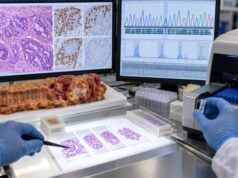
A PALB2 test in pancreatic cancer looks for harmful changes in a gene that helps repair double-strand DNA breaks through homologous recombination. A pathogenic PALB2 variant can matter in two different ways. If it is found in normal DNA from blood or saliva, it may be a germline variant that was inherited and can affect cancer risk for the patient and relatives. If it is found only in tumor tissue, it may be a somatic change limited to the cancer. In pancreatic ductal adenocarcinoma, PALB2 is clinically important because homologous-recombination-deficient tumors can be especially sensitive to platinum chemotherapy, and clinical research supports activity of PARP inhibition in selected PALB2-mutated disease. However, PALB2 should not be confused with the narrower FDA maintenance olaparib indication for metastatic pancreatic cancer with a germline BRCA1 or BRCA2 mutation. Correct interpretation depends on whether the finding is germline or somatic, whether it is pathogenic or a variant of uncertain significance, tumor stage, prior platinum response, and the specific drug indication or clinical trial being considered.
- A pathogenic germline PALB2 variant can explain hereditary cancer risk and may have implications for relatives as well as pancreatic cancer treatment.
- A PALB2 variant found on tumor sequencing should often prompt germline testing because tumor-only testing cannot reliably prove whether the change was inherited.
- PALB2-mutated pancreatic cancers can show enhanced sensitivity to platinum chemotherapy because PALB2 is central to homologous-recombination DNA repair.
- A PALB2 variant of uncertain significance is not treated like a pathogenic variant and should not guide family testing or targeted therapy by itself.
- PARP inhibitor evidence exists in PALB2-mutated pancreatic cancer, but drug approvals and insurance coverage depend on the exact agent, setting, and mutation type.
Table of Contents
- What PALB2 Does in DNA Repair
- Germline Versus Somatic PALB2 Testing
- How to Interpret PALB2 Variant Results
- Hereditary Cancer Risk and Family Testing
- How PALB2 Can Affect Pancreatic Cancer Treatment
- Testing Methods and Common Limitations
- Practical Next Steps After a PALB2 Result
What PALB2 Does in DNA Repair
PALB2 stands for partner and localizer of BRCA2. The protein acts as a bridge within the homologous recombination repair pathway, helping BRCA1 and BRCA2 coordinate accurate repair of dangerous double-strand DNA breaks. When PALB2 function is lost, cells become less able to repair this type of damage correctly.
Cancer cells with defective homologous recombination may become unusually dependent on backup DNA-repair pathways. This creates a biological weakness that can be exploited by some treatments. Platinum drugs create DNA crosslinks and damage that are especially difficult for homologous-recombination-deficient cells to repair. PARP inhibitors interfere with another repair process and can produce a synthetic-lethal effect in selected tumors with BRCA1, BRCA2, PALB2, or related homologous-recombination defects.
PALB2 is less commonly altered than KRAS in pancreatic ductal adenocarcinoma. Its importance comes from actionability rather than prevalence. Across pancreatic cancer populations, pathogenic germline variants in cancer-susceptibility genes are found in a meaningful minority of patients, and PALB2 accounts for a small subset of those findings.
A PALB2 test is therefore not a general pancreatic cancer screening blood test and does not measure tumor burden. It answers a molecular question: Is a clinically important PALB2 alteration present, and if so, is it inherited or confined to the tumor?
The answer can affect three areas:
- choice of systemic therapy, particularly interest in platinum-based treatment;
- consideration of PARP inhibitor strategies or clinical trials; and
- hereditary cancer counseling and cascade testing for relatives.
These roles overlap, but they require different specimens and different interpretation. A tumor result can guide therapy yet still leave the hereditary question unresolved. A germline result can explain inherited risk yet does not by itself show that every tumor cell has lost the remaining normal PALB2 copy. That is why pancreatic precision oncology often combines germline testing with tumor molecular profiling.
Germline Versus Somatic PALB2 Testing
A germline PALB2 test examines DNA that represents the person’s inherited genome, usually from blood or saliva. If a pathogenic variant is present in germline DNA, it is typically present throughout the body and can be passed to children.
A somatic or tumor test examines DNA from the cancer. It can detect inherited variants, because germline DNA is also present in tumor cells, but it can also detect mutations acquired only by the tumor. Tumor testing therefore cannot always determine origin.
This distinction matters in pancreatic cancer because guidelines and implementation studies support broad germline genetic testing for patients with pancreatic ductal adenocarcinoma, regardless of whether the family history looks strongly hereditary. Family history alone misses carriers. Point-of-care and mainstream testing programs have shown that pathogenic variants are found in patients who would not have met older family-history-based criteria.
If tumor sequencing reveals a pathogenic PALB2 variant and germline status is unknown, confirmatory germline testing is often appropriate. The result may fall into one of two broad patterns:
Germline positive: the same pathogenic variant is found in normal DNA. This has hereditary implications for relatives and may help explain the pancreatic cancer predisposition.
Germline negative: the variant is not found in normal DNA, supporting a somatic tumor-only event. It may still be relevant to treatment, but relatives do not inherit that tumor-specific change.
A tumor report may also show a variant allele fraction. A value around 50% can raise suspicion for a germline variant, but it is not proof. Tumor purity, copy-number changes, loss of heterozygosity, and clonal structure can push allele fractions higher or lower. Normal-tissue testing is the reliable way to answer the hereditary question.
How to Interpret PALB2 Variant Results
Genetic laboratories classify variants according to evidence for whether they disrupt gene function. The most clinically important categories are pathogenic, likely pathogenic, variant of uncertain significance, likely benign, and benign.
A pathogenic or likely pathogenic PALB2 variant is considered disease-causing or strongly likely to be disease-causing. In the germline setting, it supports a hereditary cancer-predisposition diagnosis. In the tumor setting, it may also indicate homologous-recombination deficiency and influence treatment discussion.
A variant of uncertain significance, or VUS, is different. It means the laboratory has found a DNA change but does not have enough evidence to decide whether it impairs PALB2 function. A VUS should not be used to label relatives as high-risk, recommend preventive surgery, or select a targeted drug as though the variant were pathogenic.
Over time, laboratories may reclassify a VUS as more evidence accumulates. Patients should keep contact information updated with the testing laboratory or genetics clinic so clinically meaningful reclassifications can be communicated.
A negative germline test means no pathogenic variant was found in the genes and regions tested. It does not make pancreatic cancer nonhereditary with absolute certainty. Some inherited risk may involve genes not covered by the panel, variants that current technology cannot detect, or polygenic and familial factors that are not explained by one high-penetrance mutation.
A negative tumor PALB2 result means no reportable PALB2 alteration was found. Other homologous-recombination genes may still be altered, including BRCA1, BRCA2, ATM, and additional DNA repair genes. The strength of evidence for treatment sensitivity differs across those genes, so they should not all be treated as equivalent.
Patients should also distinguish a single pathogenic PALB2 variant from biallelic loss or functional loss of the remaining normal copy in the tumor. Homologous-recombination deficiency may be strongest when both functional copies are lost, but routine clinical reports do not always prove this mechanism directly.
Hereditary Cancer Risk and Family Testing
Germline PALB2 pathogenic variants are associated with increased risks of several cancers. The strongest established association is female breast cancer, with additional increased risks for pancreatic cancer and ovarian cancer. Male breast cancer risk is also elevated compared with the general population.
For a patient with pancreatic cancer, a germline PALB2 result can therefore affect relatives even if no one else in the family has had pancreatic cancer. The variant is usually inherited in an autosomal-dominant pattern for cancer susceptibility: each first-degree relative has a 50% chance of carrying the familial variant.
Once a familial pathogenic variant is known, relatives generally receive targeted cascade testing for that exact variant rather than repeating an unfocused workup. A relative who tests negative for the known familial variant can usually avoid the intensified surveillance that is specifically tied to that mutation, although their general cancer risks still depend on personal factors.
A relative who tests positive should receive gene-specific counseling. Recommendations may include earlier and more intensive breast screening, discussion of ovarian risk management, and pancreatic surveillance in selected high-risk individuals. Pancreatic surveillance programs often use MRI/MRCP and/or endoscopic ultrasound at experienced centers, with starting age based on the gene, family history, and guideline.
Genetic counseling is especially useful because a result can affect several relatives at once. Counselors can also address reproductive implications. Rarely, inheriting pathogenic PALB2 variants from both parents can cause a Fanconi anemia phenotype, which is distinct from the usual single-variant adult cancer-predisposition state.
Family history remains important after testing. A pathogenic variant may explain part of the pattern, while cancers on the other side of the family may have a different cause. Conversely, a negative panel does not erase a strong familial pancreatic cancer history.
How PALB2 Can Affect Pancreatic Cancer Treatment
The strongest practical treatment signal for PALB2-mutated pancreatic cancer is sensitivity to platinum chemotherapy. Platinum agents such as oxaliplatin and cisplatin create DNA damage that is especially difficult to repair when homologous recombination is defective.
In pancreatic cancer, platinum-containing regimens may include modified FOLFIRINOX, which contains oxaliplatin, or gemcitabine plus cisplatin in selected DNA-repair-deficient disease. The choice depends on stage, performance status, organ function, neuropathy, prior therapy, and clinician judgment.
Recent reviews describe BRCA1-, BRCA2-, and PALB2-mutated pancreatic cancers as a therapeutically important homologous-recombination-deficient subgroup with notable platinum sensitivity. This does not mean every PALB2-mutated tumor will respond or that a non-PALB2 tumor will not respond. Biomarkers change probabilities rather than guaranteeing outcomes.
PARP inhibitors
PARP inhibitors are another area of interest, but the regulatory distinction is important. Olaparib maintenance is FDA-approved for metastatic pancreatic adenocarcinoma with a deleterious or suspected deleterious germline BRCA1 or BRCA2 mutation after at least 16 weeks of first-line platinum chemotherapy without progression. PALB2 is not included in that specific labeled pancreatic indication.
Clinical evidence nevertheless supports PARP sensitivity in some PALB2-mutated pancreatic cancers. A phase II maintenance rucaparib study enrolled patients with pathogenic germline or somatic BRCA1, BRCA2, or PALB2 variants and platinum-sensitive advanced pancreatic cancer. Responses occurred in the small PALB2 subgroup, providing important proof-of-concept.
This means a patient with a PALB2 pathogenic variant should discuss PARP inhibitors, but the discussion must specify whether use is on-label, off-label, supported by a trial, or available through a clinical study. Insurance coverage can differ accordingly.
Localized disease
For resectable or borderline-resectable pancreatic cancer, PALB2 status may influence interest in platinum-containing neoadjuvant or adjuvant strategies, but stage, surgical anatomy, performance status, and multidisciplinary planning remain dominant. A germline result should not delay potentially curative surgery when urgent local treatment is needed.
Testing Methods and Common Limitations
Germline PALB2 testing is usually performed with a multigene hereditary cancer panel rather than a PALB2-only test. Panels commonly include BRCA1, BRCA2, ATM, CDKN2A, mismatch repair genes, and other pancreatic cancer susceptibility genes.
Tumor testing may use next-generation sequencing of a surgical specimen, biopsy, or metastatic site. Some assays also evaluate copy-number loss, structural variants, or genomic signatures related to homologous-recombination deficiency.
Liquid biopsy can identify tumor PALB2 variants in circulating DNA, particularly in metastatic disease with sufficient shedding. A negative plasma result is not always conclusive because some tumors release little ctDNA.
Common limitations include:
- inadequate tumor tissue or low tumor percentage;
- inability of a panel to detect certain large rearrangements;
- uncertain classification of rare variants;
- tumor results that do not establish germline origin;
- clonal hematopoiesis confounding some blood-based tumor assays; and
- incomplete evidence linking every homologous-recombination gene to the same treatment sensitivity.
A frequent mistake is assuming that any “DNA repair gene mutation” has the same meaning as PALB2 or BRCA2. The evidence is gene-specific and sometimes variant-specific. Another mistake is treating a VUS as actionable.
The report should be reviewed for the exact gene, nucleotide and protein change, classification, specimen, allele fraction when relevant, and whether germline confirmation is recommended.
Practical Next Steps After a PALB2 Result
After a PALB2 finding, the next steps should answer both the treatment question and the hereditary question.
If the result came from tumor sequencing, ask whether germline testing has already been performed. If not, a blood or saliva hereditary cancer panel can clarify whether the variant is inherited.
If the result is germline pathogenic or likely pathogenic, ask for genetic counseling and a written family letter that explains cascade testing. Adult relatives can then decide whether to test for the known familial variant.
If the result is a VUS, avoid using it as a positive result. Continue treatment based on established clinical factors and any other actionable biomarkers. Ask whether the laboratory has a process for future reclassification.
For treatment, useful questions include:
- Is my PALB2 variant pathogenic or likely pathogenic?
- Is it germline, somatic, or not yet determined?
- Does this result favor a platinum-containing regimen in my situation?
- Have I already shown platinum sensitivity?
- Is a PARP inhibitor appropriate on-label, off-label, or only through a clinical trial?
- Are there trials specifically enrolling PALB2 or homologous-recombination-deficient pancreatic cancer?
- What other tumor biomarkers were tested?
- Should my relatives receive targeted genetic testing?
- If a relative carries PALB2, what surveillance is recommended and when should it begin?
The most useful way to think about PALB2 is as a bridge between hereditary cancer genetics and precision oncology. A single pathogenic finding can explain inherited susceptibility, identify relatives who may benefit from prevention and surveillance, and reveal a DNA-repair weakness that can shape systemic therapy. Those benefits depend on careful classification and on keeping germline and tumor results conceptually separate.
For germline-positive families, the timing of cascade testing matters. Testing an affected relative first is usually more informative than testing many healthy relatives without a known familial variant. Once the pathogenic PALB2 change is documented, targeted testing can provide a clear positive or true-negative result for adult relatives. Screening recommendations can then be matched to carrier status rather than family anxiety alone.
Tumor biology may add another layer. Some PALB2-mutated cancers lose the remaining normal copy of the gene, creating stronger homologous-recombination deficiency. Other tumors may retain partial repair capacity. This helps explain why not every pathogenic variant produces the same treatment response and why platinum sensitivity, prior response, and the full genomic context remain clinically important.
References
- Targeting BRCA and PALB2 in Pancreatic Cancer 2024 (Review)
- Pancreatic cancer: ESMO Clinical Practice Guideline for diagnosis, treatment and follow-up 2023 (Guideline)
- Outcomes of Universal Point-of-Care Genetic Testing in Diverse Patients With Pancreatic Ductal Adenocarcinoma 2023 (Study)
- Should We Offer Universal Germline Genetic Testing to All Patients with Pancreatic Cancer? A Multicenter Study 2024 (Study)
- Universal Genetic Testing for Pancreatic Cancer: Closing the Gap on a Missed Opportunity 2026 (Review)
- Phase II Study of Maintenance Rucaparib in Patients With Platinum-Sensitive Advanced Pancreatic Cancer and a Pathogenic Germline or Somatic Variant in BRCA1, BRCA2, or PALB2 2021 (Clinical Trial)
Disclaimer
This article is for general education and does not replace advice from an oncologist or genetics professional. PALB2 results must be interpreted by variant classification, germline versus somatic origin, stage, prior treatment, and current drug indications. Do not change cancer treatment or family screening based on a PALB2 result without professional review.