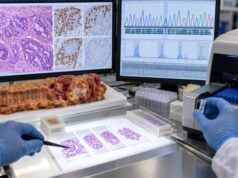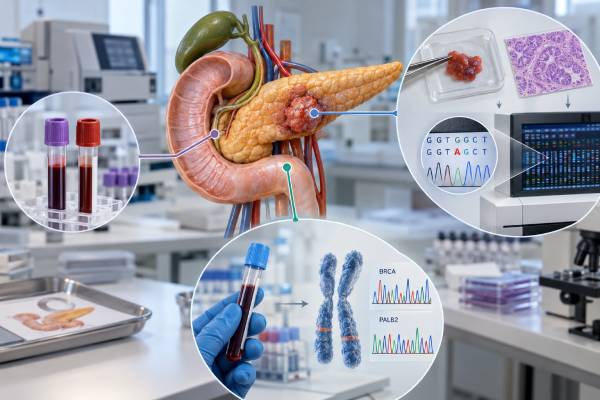
A pancreatic cancer biomarker panel is not one universal test. It is a combination of blood markers, tumor molecular tests, and inherited genetic tests that answer different clinical questions. CA 19-9 is the most widely used serum marker for pancreatic ductal adenocarcinoma, mainly for establishing a baseline and following disease over time; it is not accurate enough to screen the general population or diagnose cancer by itself. CEA can provide supportive information but is less sensitive and less specific. Tumor sequencing commonly identifies KRAS, which is mutated in more than 90% of pancreatic ductal adenocarcinomas, while a smaller subset has actionable alterations in DNA-repair genes such as BRCA1, BRCA2, and PALB2 or rare targets such as NTRK, NRG1, BRAF, or KRAS G12C. Germline testing can reveal inherited cancer risk and treatment-relevant variants. The key to using a biomarker panel correctly is knowing whether each result is diagnostic, prognostic, predictive, hereditary, or useful for monitoring. No single marker replaces imaging, pathology, stage, and clinical assessment.
- CA 19-9 is mainly a monitoring marker; rising or falling values are most useful when interpreted as a trend with imaging and bilirubin levels.
- Biliary obstruction and cholangitis can markedly raise CA 19-9 even without cancer progression, so results may need reassessment after drainage.
- About 5%–10% of people cannot produce meaningful CA 19-9 because of Lewis-antigen biology, making the marker unreliable in that group.
- KRAS is mutated in more than 90% of pancreatic ductal adenocarcinomas, but only selected KRAS variants currently have matched targeted treatments.
- BRCA1/2 and PALB2 findings can affect both systemic therapy and hereditary-risk counseling, so germline and tumor testing serve complementary roles.
Table of Contents
- What a Pancreatic Cancer Biomarker Panel Includes
- CA 19-9 Levels and How to Interpret Trends
- CEA and Other Blood Tumor Markers
- KRAS and Tumor Molecular Profiling
- BRCA, PALB2, and Hereditary DNA Repair Markers
- How Biomarkers Are Used at Different Stages
- Limitations, Common Mistakes, and Next Steps
What a Pancreatic Cancer Biomarker Panel Includes
The phrase “pancreatic cancer biomarker panel” can be misleading because several unrelated test types are often grouped together. The most useful approach is to divide them by purpose.
Serum tumor markers are measured in blood. CA 19-9 is the main marker used in pancreatic adenocarcinoma, while CEA is sometimes checked as an additional baseline or monitoring marker.
Tumor molecular profiling examines DNA or RNA from a biopsy, surgical specimen, or circulating tumor DNA. It looks for mutations, gene fusions, amplifications, and genomic signatures that may identify treatment targets.
Germline genetic testing uses normal DNA, commonly from blood or saliva, to identify inherited pathogenic variants. In pancreatic ductal adenocarcinoma, broad germline testing is recommended because clinically important variants can occur even without a striking family history.
Pathology biomarkers can include mismatch repair proteins or MSI status. These are not serum markers, but they can be highly actionable because MSI-H/dMMR pancreatic cancers may respond to immune checkpoint inhibitors.
The tests answer different questions. CA 19-9 may help answer, “Is the disease marker falling during therapy?” Tumor sequencing may answer, “Is there an actionable KRAS G12C mutation or NTRK fusion?” Germline testing may answer, “Is a BRCA2 or PALB2 variant inherited, and does the family need cascade testing?”
A result becomes useful only when the question is clear. Ordering every marker without understanding its role can create noise, false reassurance, and unnecessary anxiety.
CA 19-9 Levels and How to Interpret Trends
CA 19-9, or carbohydrate antigen 19-9, is the best-established serum biomarker in pancreatic ductal adenocarcinoma. Many laboratories use an upper reference limit around 37 U/mL, although the exact cutoff can differ by assay.
A value above the laboratory reference range is not diagnostic of pancreatic cancer. CA 19-9 can rise in benign conditions, especially biliary obstruction, cholangitis, pancreatitis, and other hepatobiliary disorders. Very high values can occur when bile flow is blocked, sometimes falling sharply after a stent or drainage procedure.
This makes bilirubin and biliary status essential context. If a patient with a pancreatic head tumor has obstructive jaundice and a CA 19-9 of 2,000 U/mL, that number cannot be interpreted in the same way as 2,000 U/mL after bilirubin has normalized. Clinicians often repeat CA 19-9 after effective biliary decompression to establish a more reliable baseline.
CA 19-9 is also limited by Lewis-antigen phenotype. People who are Lewis antigen-negative may produce little or no CA 19-9 even with advanced pancreatic cancer. Roughly 5%–10% of the population is often cited as having this biology. A persistently undetectable or very low CA 19-9 therefore does not exclude cancer.
The marker is most useful as a trend within the same person. During systemic therapy, a substantial decline can support treatment response, especially when imaging and symptoms improve. A sustained rise can raise concern for progression or recurrence, but it should generally prompt clinical review and imaging rather than an automatic change in treatment.
After surgery, CA 19-9 may be followed as part of surveillance in patients who produced the marker before treatment. A new rise can precede radiographic recurrence in some cases, but false positives occur. The goal is to integrate the marker with CT or MRI findings, symptoms, liver tests, and the preoperative baseline.
Assay variability also matters. Trends are easiest to interpret when the same laboratory or comparable assay is used. A small change from 42 to 48 U/mL may reflect biological or analytical variability and is rarely meaningful in isolation. Large, sustained changes across several measurements carry more weight.
CEA and Other Blood Tumor Markers
CEA, or carcinoembryonic antigen, is another serum glycoprotein marker. It is much more familiar in colorectal cancer, but some pancreatic cancers also produce it. CEA may be useful when CA 19-9 is not informative, including selected patients who appear to be nonsecretors.
CEA is not specific for pancreatic cancer. It can be elevated in several malignancies and in benign conditions, and cigarette smoking can raise baseline levels. Reference ranges differ by laboratory and smoking status.
Because of its lower sensitivity for pancreatic ductal adenocarcinoma, CEA is usually a secondary marker, not the main serum test. A clinician may track both CA 19-9 and CEA when both were elevated at diagnosis, but neither should replace imaging.
Other blood biomarkers are under active research. Circulating tumor DNA, circulating tumor cells, exosomes, proteins, metabolites, and multi-analyte signatures are being studied for earlier detection and monitoring. Some ctDNA assays are already used clinically for molecular profiling, but no blood biomarker panel currently replaces tissue diagnosis for a suspicious pancreatic mass.
This distinction is important for screening. CA 19-9 and CEA perform poorly as general-population screening tools because pancreatic cancer is relatively uncommon and the markers have many false-positive and false-negative causes. High-risk pancreatic surveillance relies mainly on expert imaging such as MRI/MRCP and endoscopic ultrasound, not routine CA 19-9 screening alone.
KRAS and Tumor Molecular Profiling
KRAS is the dominant oncogenic driver in pancreatic ductal adenocarcinoma. More than 90% of PDACs harbor a KRAS mutation, most commonly variants involving codon 12. Historically, KRAS was more useful for understanding tumor biology than for selecting therapy because the protein was difficult to target.
That has started to change. KRAS G12C is uncommon in pancreatic cancer but can be targeted with specific inhibitors in appropriate treatment settings. New drugs aimed at KRAS G12D and other variants are being studied, and combinations designed to overcome pathway feedback are an active research area.
A tumor that is KRAS wild-type deserves careful molecular review because it is more likely than a typical KRAS-mutant PDAC to contain another actionable driver. Potential findings include:
- NTRK gene fusions;
- NRG1 fusions;
- BRAF alterations;
- RET or other rare fusions;
- HER2 amplification; or
- other pathway changes.
This is one reason RNA-inclusive next-generation sequencing can be particularly useful in KRAS wild-type pancreatic adenocarcinoma: some of the most important alternative drivers are gene fusions that can be missed by limited DNA testing.
Tumor profiling also assesses MSI/MMR and sometimes tumor mutational burden. MSI-H/dMMR is rare in pancreatic cancer but highly actionable because checkpoint inhibitors can be effective across tumor types with this phenotype.
A molecular report may contain many additional mutations, including TP53, SMAD4, and CDKN2A. These are common biologically important drivers, but they do not all have established standard targeted drugs. A long mutation list should therefore be sorted into actionable, potentially actionable or trial-relevant, prognostic, and currently nonactionable findings.
BRCA, PALB2, and Hereditary DNA Repair Markers
BRCA1, BRCA2, and PALB2 are part of the homologous recombination DNA-repair pathway. Pathogenic variants can create a tumor phenotype that is particularly sensitive to DNA-damaging platinum chemotherapy.
The finding can come from germline testing or tumor testing. Germline BRCA2 is one of the more common inherited findings in pancreatic cancer, while BRCA1 and PALB2 occur less often. ATM and other susceptibility genes can also be found, although treatment implications are not identical across genes.
Broad germline testing matters because family history is an imperfect filter. A patient can carry a pathogenic BRCA2 or PALB2 variant despite having few affected relatives. The result can guide treatment and can also identify relatives who may benefit from targeted genetic testing and intensified cancer prevention.
A pathogenic BRCA1/2 or PALB2 variant can increase interest in a platinum-containing regimen. For metastatic disease with a germline BRCA1 or BRCA2 pathogenic variant that has not progressed during at least 16 weeks of first-line platinum chemotherapy, maintenance olaparib is an established FDA-approved option. That specific pancreatic indication should not be broadened automatically to every homologous-recombination gene.
PALB2-mutated pancreatic cancer has shown PARP inhibitor activity in clinical studies, including maintenance rucaparib research, but use depends on drug, setting, label, and access. An ATM mutation should also not be assumed to carry the same PARP sensitivity as BRCA2 or PALB2.
A tumor-detected pathogenic DNA-repair variant may need germline confirmation. Variant allele fraction alone cannot reliably prove whether an alteration was inherited.
How Biomarkers Are Used at Different Stages
Biomarker priorities change across the pancreatic cancer pathway.
At diagnosis
Pathology confirms the diagnosis, while CT or MRI establishes resectability and stage. CA 19-9 is often measured before treatment as a baseline, ideally after biliary obstruction is corrected. Germline genetic testing should be initiated early enough that actionable results can influence systemic therapy.
For advanced or metastatic disease, tumor molecular profiling is especially important. If tissue is limited, the oncology team may use a plasma ctDNA assay while trying to preserve or obtain adequate tissue.
During neoadjuvant therapy
In borderline-resectable or locally advanced disease, CA 19-9 trends can complement imaging and clinical response. A large decline after bilirubin normalization can support treatment activity, while persistently rising values may trigger reassessment. Surgery is not selected by CA 19-9 alone; vascular involvement, metastatic evaluation, performance status, and multidisciplinary judgment remain essential.
After surgery
The final pathology stage and margins drive adjuvant planning. CA 19-9 can establish a postoperative baseline. Germline results may affect the chemotherapy discussion and family counseling. Tumor profiling may be more useful if recurrence occurs, although many centers obtain it earlier to avoid later tissue limitations.
Metastatic treatment
Biomarkers can directly select treatment. BRCA/PALB2 biology may favor platinum. Germline BRCA1/2 can establish eligibility for maintenance olaparib after platinum-sensitive first-line therapy. MSI-H/dMMR can support immunotherapy. KRAS G12C and rare gene fusions can provide targeted options in selected settings.
CA 19-9 and sometimes CEA are then followed as response markers, but treatment should not be declared successful or failed on a single blood value without clinical and radiographic correlation.
Limitations, Common Mistakes, and Next Steps
A biomarker panel can improve precision only if each test is used for the right purpose.
Mistake 1: diagnosing pancreatic cancer from CA 19-9. Benign biliary disease can produce striking elevations, while some pancreatic cancers produce little marker. Diagnosis requires imaging and usually tissue confirmation in settings where pathology is needed.
Mistake 2: interpreting CA 19-9 during jaundice without context. Cholestasis can inflate the value. Repeat testing after biliary drainage and bilirubin improvement may be more informative.
Mistake 3: assuming every KRAS mutation is targetable. Most pancreatic KRAS variants still lack an approved direct inhibitor, although the field is changing rapidly.
Mistake 4: treating all DNA-repair genes as equivalent. BRCA1, BRCA2, PALB2, ATM, and other genes have different levels of evidence for platinum and PARP sensitivity.
Mistake 5: confusing tumor and germline results. A tumor-detected BRCA2 or PALB2 variant can be inherited or acquired. Germline testing answers that question and determines family implications.
Mistake 6: treating a VUS as a positive hereditary test. Variants of uncertain significance should not direct family cascade testing or risk-reducing procedures.
Useful questions to ask the oncology team include:
- What was my CA 19-9 before and after biliary drainage?
- Am I a reliable CA 19-9 producer?
- Is CEA useful in my case?
- Has my tumor had broad DNA and RNA profiling?
- What is the exact KRAS variant?
- Are MSI/MMR, NTRK, NRG1, BRAF, HER2, and other rare targets covered?
- Have I had germline genetic testing, including BRCA1, BRCA2, and PALB2?
- Which findings actually change treatment now?
- Which findings are only trial-relevant or prognostic?
- How will biomarkers be combined with imaging to judge response?
The most useful “panel” is therefore not a fixed list of six markers. It is a coordinated testing strategy that combines blood trends for monitoring, tumor profiling for treatment targets, and germline testing for inherited risk. When those roles are kept separate, the results become easier to interpret and more clinically useful.
A practical monitoring plan should record when each marker was drawn relative to biliary procedures and treatment cycles. CA 19-9 obtained before stenting, during cholangitis, and two weeks after bilirubin normalization can represent three different physiological states. Plotting values with bilirubin and treatment dates often makes the trend far more interpretable than reading a list of isolated numbers.
The same principle applies after chemotherapy starts. Oncologists generally look for a sustained directional change across cycles rather than reacting to one modest fluctuation. Imaging remains the reference for measurable disease response, while marker trends provide supportive evidence. If symptoms, imaging, and CA 19-9 disagree, the discrepancy should trigger reassessment rather than automatic acceptance of whichever test looks most alarming.
Biomarker testing should also be planned around tissue stewardship. A small endoscopic ultrasound biopsy may need to support diagnosis, MMR testing, and broad DNA/RNA sequencing. Sending multiple sequential single-gene tests can exhaust the block. When advanced disease is suspected, coordinated comprehensive profiling can preserve tissue and shorten the time to an actionable result.
Patients can make the panel more useful by keeping copies of both the germline and tumor reports. These documents answer different questions and may be needed years later if treatment options change. The exact variant and assay matter more than a chart summary such as “BRCA negative” or “KRAS positive.”
References
- Pancreatic cancer: ESMO Clinical Practice Guideline for diagnosis, treatment and follow-up 2023 (Guideline)
- Pancreatic cancer biomarkers: A pathway to advance in personalized treatment selection 2024 (Review)
- CA19-9 and CEA biosensors in pancreatic cancer 2024 (Review)
- Genomic determinants of biological aggressiveness and poor prognosis of pancreatic cancers: KRAS and beyond. 2024 (Review)
- Targeting BRCA and PALB2 in Pancreatic Cancer 2024 (Review)
- Should We Offer Universal Germline Genetic Testing to All Patients with Pancreatic Cancer? A Multicenter Study 2024 (Study)
Disclaimer
This article is for general education and does not replace evaluation by a pancreatic cancer specialist. Tumor markers and molecular findings must be interpreted with bilirubin, imaging, pathology, stage, treatment history, and the exact laboratory method. Do not make treatment decisions from a single biomarker value or mutation report without oncology review.