Pasta fits into a blood-sugar-friendly diet more easily than people often assume. Its dense structure traps starch in a protein matrix, making it less rapidly available than the same wheat milled into many breads. However, pasta remains a concentrated carbohydrate source, so portion size is the biggest practical lever you have. Cooling cooked pasta and reheating it later increases resistant starch, which can modestly reduce the post-meal glucose response. Choosing higher-fiber or legume-based varieties helps too. None of these adjustments make a large bowl “free” carbohydrate; the sauce, vegetables, protein, and side dishes often change the meal’s impact as much as the noodle itself. A reliable strategy is straightforward: keep the portion moderate, cook it until just tender, add plenty of non-starchy vegetables and a clear protein source, use cooling when convenient, and judge the whole meal rather than labeling pasta as strictly good or bad.
Table of Contents
- Why Pasta Can Raise Blood Sugar More Slowly Than Expected
- Does Cooling and Reheating Pasta Lower the Glucose Spike?
- The Pasta Portion Matters More Than Most Hacks
- Regular, Whole-Wheat, and Legume Pasta Compared
- How to Build a More Blood-Sugar-Friendly Pasta Meal
- Common Pasta Mistakes and Misleading Claims
- How to Test Your Own Pasta Response
Why Pasta Can Raise Blood Sugar More Slowly Than Expected
Pasta is made from starch, so it raises blood glucose. The surprise is that traditional pasta often produces a lower and slower glucose response than many other refined grain foods when equal amounts of available carbohydrate are compared.
The reason lies in food structure. During pasta making, starch granules become trapped in a dense protein network. Even after cooking and chewing, that structure can slow the access of digestive enzymes to the starch. In controlled research, spaghetti and penne made from durum wheat produced smaller post-meal glucose responses than bread or couscous made from similar wheat ingredients.
This is a useful reminder that “refined carbohydrate” is too broad a category to predict a glucose curve perfectly. The physical structure of a food matters, not just whether the flour is whole or refined. The same principle helps explain why glycemic index and glycemic load can give different information about a meal.
Still, lower does not mean low enough for every person. If two cups of pasta supply roughly twice the digestible carbohydrate of one cup, the larger serving creates a much bigger glucose excursion even if the pasta itself has a moderate glycemic index.
Cooking texture changes starch availability
Pasta cooked until very soft generally has more fully gelatinized starch than pasta cooked al dente. Gelatinization occurs when starch is heated with water, causing granules to swell and become easier for digestive enzymes to attack.
Cooking pasta just until tender helps preserve some of its slower-digesting structure. The effect is not large enough to cancel an oversized serving, but it is a reasonable choice if you prefer the texture anyway.
The type of pasta shape can also slightly change digestion because thickness, density, and surface area differ. Those effects are small compared with total carbohydrate, however. You do not need to search for one “perfect” noodle shape.
Does Cooling and Reheating Pasta Lower the Glucose Spike?
Yes, cooling cooked pasta can increase resistant starch and reduce the post-meal glucose response, although the size of the effect depends on the pasta, cooling conditions, reheating, and the person eating it.
When cooked starch cools, some starch molecules realign into structures that digestive enzymes cannot break down as easily. This process is called retrogradation. The resulting material is often described as type 3 resistant starch. Because less of that starch is digested rapidly in the small intestine, the glucose rise can be smaller.
A 2026 randomized crossover study in 32 adults with type 1 diabetes provides unusually direct evidence. Participants ate freshly cooked pasta or pasta that had been cooled for 24 hours at 4°C and reheated. Both meals supplied 50 g of available carbohydrate, and insulin dosing was standardized through pump bolus calculators. The cooled-and-reheated pasta increased resistant starch and produced a lower glucose peak and much smaller three-hour glucose area under the curve than fresh pasta in that study.
A 2024 study in healthy adults found a similar direction with chickpea pasta. Cooling for 24 hours and reheating increased resistant starch from 1.83 to 3.65 g per 100 g and lowered the measured glycemic index from 39 to 33. Other research with cooled wheat foods also supports the basic mechanism.
That does not mean yesterday’s pasta contains half the carbohydrate or will always cut your glucose spike in half. Laboratory resistant-starch measurements and real-world glucose responses vary. The most accurate takeaway is that cooling and reheating can be a useful small-to-moderate advantage, not a metabolic loophole.
For a fuller explanation of the same phenomenon in other foods, resistant starch from cooling rice and other starches follows the same basic chemistry.
A practical cooling method
If you are already meal-prepping pasta, cook it, cool it promptly, store it covered in the refrigerator, and reheat the portion you plan to eat. You can also eat cooled pasta in a salad if you prefer it cold.
Food safety comes first. Do not leave cooked pasta sitting at room temperature for long periods just to “create more resistant starch.” Refrigeration is the useful part of the process. Reheating does not necessarily erase all of the resistant starch formed during cooling.
The Pasta Portion Matters More Than Most Hacks
For most people trying to limit a glucose spike, reducing an oversized pasta portion will have a larger effect than obsessing over al dente cooking or cooling.
One cup of cooked pasta commonly contains around 40–45 g of total carbohydrate, depending on the product and how tightly it is packed. Restaurant bowls can hold two, three, or more cups before sauce, bread, drinks, or dessert are counted.
A practical starting portion is about 1 cup cooked pasta, then adjust for your body size, activity, diabetes treatment, hunger, and glucose response. Some people do well with 1½ cups in a balanced meal. Others with marked insulin resistance may get a smaller excursion with ½–¾ cup plus more vegetables and protein.
The right portion is not defined by a perfectly flat CGM line. Some rise after carbohydrate is normal. The goal is a meal that fits your overall glucose targets and nutrition needs.
Use the plate to keep the portion visible
A bowl of pasta makes it easy for noodles to become the entire meal. A plate makes balance easier to see. Try using roughly half the plate for non-starchy vegetables, one quarter for protein, and the remaining quarter for pasta or another starch.
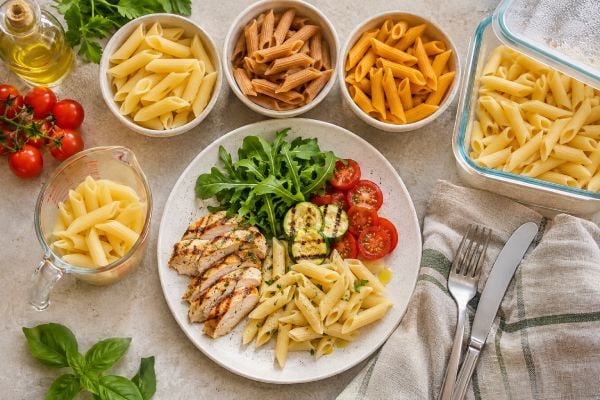
That does not have to be mathematically exact. It is simply a visual guardrail. For example, one cup of pasta with grilled chicken, zucchini, mushrooms, spinach, and tomato sauce is a very different glucose challenge from three cups of pasta with a small amount of sauce.
People who want more options can compare blood-sugar-friendly whole grains and beans with pasta rather than trying to eliminate carbohydrate completely.
Regular, Whole-Wheat, and Legume Pasta Compared
There is no single best pasta for everyone. Look at fiber, protein, total carbohydrate, texture, and the portion you will actually enjoy eating.
| Pasta type | Potential advantage | What to watch |
|---|---|---|
| Traditional durum-wheat pasta | Dense structure; often moderate glycemic response | Still concentrated in carbohydrate; easy to overserve |
| Whole-wheat pasta | Usually more fiber and micronutrients | Glucose advantage may be modest if carbohydrate portions are equal |
| Chickpea or lentil pasta | Often more protein and fiber; can produce a lower glycemic response | Carbohydrate is still present; texture and tolerance vary |
| High-fiber or reduced-starch pasta | Can reduce post-meal glucose when fiber replaces digestible starch | Formulas differ widely, so read the label |
| Vegetable-flavored wheat pasta | May add flavor or small amounts of plant compounds | Often nutritionally similar to regular wheat pasta |
Whole-wheat pasta is a solid default because it usually gives you more fiber than regular pasta. But the glycemic difference is not always dramatic. Pasta structure itself already slows digestion, and a large portion of whole-wheat pasta can still contain a large carbohydrate load.
Legume pasta can make a bigger nutritional shift because chickpeas, lentils, or beans contribute protein and fiber along with starch. In a 2024 trial, chickpea pasta had a low measured glycemic index, and cooling it lowered the response further. A separate 2022 study found that a specially formulated low-starch, high-fiber pasta produced a smaller glucose response than standard pasta and rice in both healthy participants and people with type 2 diabetes.
Read the nutrition label instead of judging the front of the box. Compare serving size, total carbohydrate, fiber, and protein. Some “protein pasta” products are mostly wheat with a modest protein boost, while others are primarily legumes.
How to Build a More Blood-Sugar-Friendly Pasta Meal
The most reliable pasta strategy is to improve the whole meal, not just the noodle.
Start with a moderate pasta portion, then add a substantial protein source. Chicken, fish, shrimp, eggs, tofu, tempeh, lean meat, cottage cheese, or beans can all work depending on the dish. Protein increases satiety and reduces the percentage of the meal coming from starch.
Next, add volume with non-starchy vegetables. Broccoli, spinach, peppers, eggplant, zucchini, mushrooms, asparagus, tomatoes, and leafy greens work naturally with pasta. The fiber and water help make a smaller pasta serving feel like a full meal.
Fat can slow gastric emptying, but more is not always better. Olive oil, pesto, nuts, seeds, or cheese can be useful in modest amounts. Very rich cream sauces may flatten the early glucose curve while adding a large calorie load and sometimes delaying a glucose rise until later.
Meal order can help a little
If practical, eat vegetables and protein before most of the pasta rather than starting with bread and noodles on an empty stomach. Studies of food order suggest that eating carbohydrate later in a mixed meal can reduce the early post-meal glucose rise. Eating vegetables and protein before carbohydrates is an easy experiment because it does not require special products.
A short walk after the meal is another useful tool. Active muscles take up glucose, so even 10–20 minutes of comfortable walking can reduce the post-meal excursion for many people. Walking after meals often has a more predictable effect than minor recipe hacks.
Watch the extras that turn pasta into a much larger glucose load
Bread baskets, sugary drinks, large garlic breads, dessert, and oversized restaurant portions can turn a moderate pasta meal into a very high-carbohydrate event. Tomato sauce itself is usually not the main problem, although sweetened jarred sauces can add extra sugar.
If you want bread with pasta, consider shrinking the pasta portion. You do not need to eliminate every carbohydrate food, but stacking several starches in one meal is a common reason glucose runs higher than expected.
Common Pasta Mistakes and Misleading Claims
Several popular claims contain a piece of truth but get exaggerated.
- “Cold pasta does not count as carbs.” False. Cooling can increase resistant starch, but most of the starch remains digestible.
- “Whole-wheat pasta cannot spike blood sugar.” False. It usually has more fiber, but portion size still matters.
- “Al dente pasta is basically low-carb.” False. Firmer cooking may slow digestion modestly; it does not remove carbohydrate.
- “Protein pasta is always better.” Not necessarily. Some products contain only a small protein increase, and total carbohydrate may remain similar.
- “A flat CGM curve means the meal was healthy.” Not always. Very high-fat meals can delay the glucose rise, and calorie density still matters.
- “People with diabetes should never eat pasta.” Too absolute. Many people can fit a measured portion into a balanced meal and remain within individualized glucose targets.
Another mistake is changing five variables at once. If you cool the pasta, halve the portion, add a large salad, walk for 20 minutes, and then see a better CGM curve, you will not know which change mattered most. That is fine if your only goal is a better meal, but it is poor experimentation if you want to understand your personal response.
How to Test Your Own Pasta Response
Pasta responses differ enough that personal testing can be more useful than arguing about one universal glycemic index value.
Use the same brand and roughly the same portion on two or three occasions. Keep the sauce and protein similar. Note whether the pasta was fresh, cooled, or reheated and whether you walked afterward. If you use a CGM, compare the size and duration of the rise rather than focusing only on the highest point. If you use a meter, follow the timing your clinician recommends.
Then change one variable. You might compare:
- 1½ cups versus 1 cup of the same pasta;
- fresh versus refrigerated-and-reheated pasta;
- regular versus chickpea pasta with the same meal structure;
- pasta alone versus pasta with protein and vegetables;
- the same dinner with and without a 15-minute walk.
For many people, the most useful order of operations is portion first, meal balance second, activity third, then cooking and cooling details. That hierarchy prevents a resistant-starch trick from distracting from a serving that is simply too large for the person’s current glucose tolerance.
People can also vary in their glucose response to the same food. Sleep, stress, menstrual-cycle phase, illness, prior exercise, and time of day all change glucose handling. A single unusual reading is not enough to ban pasta. Looking for patterns across repeated meals is more informative. Individual blood-sugar responses to food are real, but they should be interpreted in context rather than used to build an increasingly restrictive diet.
If you use mealtime insulin, cooling and changing the composition of a pasta meal can alter the timing of glucose absorption. High-fat sauces may delay the rise, while smaller portions may lower insulin needs. Discuss recurrent post-meal highs or lows with your diabetes team rather than experimenting with large insulin changes on your own.
Pasta does not need a health halo or a warning label. A moderate portion, a dense pasta structure, vegetables, protein, and regular movement can make it a workable carbohydrate choice for many people. Cooling and reheating are useful bonuses when they fit your routine, not requirements for eating pasta safely.
There is also a difference between managing one post-meal curve and improving overall metabolic health. If a smaller pasta portion leaves you satisfied and helps keep total calorie intake reasonable, that is useful even when the glucose curve is not perfectly flat. If a very high-fat sauce delays the peak but leaves you eating far more energy than intended, the flatter first hour does not necessarily make the meal better. Long-term A1C, lipids, blood pressure, body composition, and dietary quality matter alongside any single CGM graph.
For restaurant meals, decide on the portion before you are very hungry. You can ask for a side salad or vegetables, eat part of the entrée, and save the rest. This is often more effective than trying to estimate whether a restaurant noodle is al dente enough to change glucose meaningfully.
References
- Does Resistant Starch Formed by Cooling Pasta Decrease the Postprandial Glycemic Response in Type 1 Diabetes? A Randomized Single-Blind Crossover Study. 2026 (RCT)
- The Effect of Cooking and Cooling Chickpea Pasta on Resistant Starch Content, Glycemic Response, and Glycemic Index in Healthy Adults 2024 (RCT)
- Partial starch substitution with resistant starch lowers postprandial glucose and glycaemic variability in people with type 2 diabetes. 2025 (RCT)
- Effect of cooking and storage temperature on resistant starch in commonly consumed Indian wheat products and its effect upon blood glucose level 2023 (Clinical Study)
- Impact of low-starch high-fiber pasta on postprandial blood glucose 2022 (RCT)
- Pasta Structure Affects Mastication, Bolus Properties, and Postprandial Glucose and Insulin Metabolism in Healthy Adults 2021 (RCT)
Disclaimer
Pasta portions and post-meal glucose targets should be individualized, especially if you have diabetes or use insulin or medicines that can cause hypoglycemia. Cooling, reheating, and changing meal composition can alter glucose timing, so discuss repeated highs, lows, or medication adjustments with your healthcare professional.