Okra water is easy to make, inexpensive, and heavily promoted online as a way to “flatten” blood sugar. The concept is straightforward: sliced or whole okra pods sit in water for several hours, releasing soluble fiber and mucilage to produce a thick, slightly slippery drink. Okra itself is a nutritious vegetable, and clinical research on powders, extracts, and whole-food preparations suggests it may modestly improve fasting glucose and A1C in some people with type 2 diabetes.
But that evidence does not prove that a glass of homemade okra water has the same effect. The amount of fiber and other compounds that actually move into the water is uncertain, preparation methods vary wildly, and the strongest studies have generally used measured doses of okra rather than a TikTok-style infusion. Okra water can fit into a healthy routine, but it is best viewed as an optional food habit—not a treatment, detox, or substitute for medication, balanced meals, activity, or medical care.
Table of Contents
- What Okra Water Is and Why It Became Popular
- What the Research Actually Shows for Blood Sugar
- How Okra Could Affect Glucose
- How to Make and Use Okra Water Safely
- Risks, Side Effects, and Who Should Be Cautious
- Whole Okra vs Okra Water: Which Is Better?
- What to Expect—and What Not to Expect
What Okra Water Is and Why It Became Popular
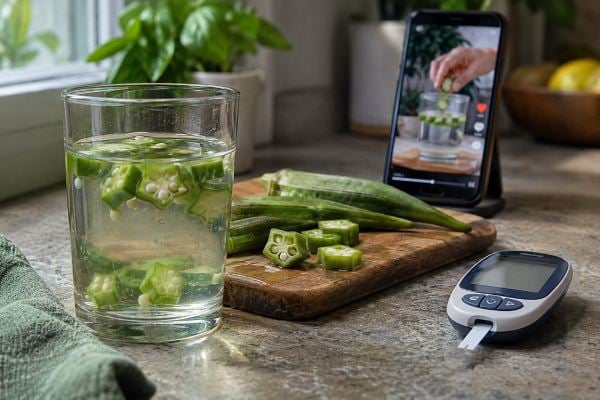
Okra water is simply water infused with fresh okra pods, usually overnight. The typical recipe involves slicing two to four pods lengthwise, placing them in roughly 8 to 16 ounces of water, refrigerating the mixture for several hours, then removing the pods and drinking the liquid. The texture often becomes slightly thick because okra releases mucilage, a gel-forming mixture of soluble plant compounds.
The drink gained traction because it combines several plausible ideas: okra contains fiber, viscous fibers can slow carbohydrate digestion, and slower digestion can reduce the size of a post-meal glucose rise. Social media frequently compresses this chain of reasoning into much stronger claims—that soaking okra in water “pulls out” compounds that lower blood sugar quickly or even reverse insulin resistance.
That last step is where the evidence becomes much less certain. Okra water is not standardized. One person may use two small pods for six hours; another may blend four pods into water and drink the solids. Those are nutritionally different products. A homemade infusion also cannot be assumed to deliver the same dose as 3,000 mg of okra powder, 10 g of okra powder mixed into food, or a concentrated extract used in a clinical trial.
It helps to separate three distinct questions:
- Is okra a healthy food? Yes. It provides fiber, vitamins, minerals, and plant compounds.
- Can measured okra preparations improve glucose markers? Possibly. Recent trials and meta-analyses report modest benefits, although study quality varies.
- Has ordinary okra water been proven to lower blood sugar in a reliable, clinically meaningful way? No. Direct evidence is sparse and much weaker than the online claims suggest.
If your main goal is fewer post-meal spikes, habits with better evidence include matching carbohydrate portions to your needs, adding protein and fiber, and walking after meals.
What the Research Actually Shows for Blood Sugar
Recent research on okra is more encouraging than the “no evidence at all” response sometimes seen online—but it still requires careful interpretation.
Several recent systematic reviews and meta-analyses have pooled small clinical trials of okra in people with type 2 diabetes or prediabetes. Across these analyses, okra supplementation was associated with lower fasting glucose and A1C. Some analyses also found improvement in HOMA-IR, a research estimate related to insulin resistance, while others did not find a statistically clear effect on insulin resistance.
One 2025 meta-analysis of six randomized controlled trials found an average reduction in fasting glucose of about 22 mg/dL and A1C of about 0.42 percentage points. A broader 2026 review that included 14 randomized trials also found reductions in fasting glucose, two-hour glucose, A1C, and HOMA-IR. However, the authors rated the certainty of evidence as low or very low for many outcomes because the trials were small, short, and heterogeneous.
Those limitations matter. The studies differed in:
- the form of okra used, including powders, capsules, extracts, fiber, and food preparations;
- the amount consumed;
- treatment duration, often only a few weeks to a few months;
- participants’ baseline glucose control and medications;
- study quality and blinding;
- whether the comparison group received an appropriate placebo.
A 2023 randomized, double-blind trial provides a useful example. Adults with type 2 diabetes received 1,000 mg of powdered okra fruit three times daily for three months while continuing usual diabetes therapy. The okra group improved fasting glucose and A1C compared with placebo. That is clinically interesting, but it does not tell us how much benefit comes from soaking a few pods in water and discarding the pods.
Direct research on okra water is limited. Reviews of the literature have identified small studies using soaked okra water, but these studies are generally weaker than the randomized capsule or powder trials. An older randomized study in adults without diabetes found no significant difference in post-meal glucose after okra water compared with placebo. More recent nonrandomized reports have suggested short-term glucose improvements, but designs without good control groups cannot separate the effect of the drink from medication use, hospital care, diet changes, regression to the mean, or other factors.
So the evidence supports a measured conclusion: okra as a food or standardized supplement may have a modest glucose-lowering effect, but the benefit of homemade okra water specifically is unproven. Anyone with persistent high readings should focus first on established evaluation and treatment rather than relying on a viral drink. If you are unsure what numbers require attention, see high blood sugar symptoms and warning signs.
How Okra Could Affect Glucose
Okra contains several components that could plausibly influence glucose metabolism. The most important is likely its fiber rather than a single “active” molecule.
Viscous fiber can slow digestion
Okra contains soluble, gel-forming fiber. In the digestive tract, viscous fiber can thicken the contents of a meal and slow the movement and absorption of carbohydrate. That may reduce the speed of the glucose rise after eating. This is the same broad principle behind better-established fiber strategies such as increasing soluble and total fiber for blood sugar control.
But most of the fiber in an okra pod stays in the pod. A slippery texture proves that some mucilage entered the water; it does not prove that the drink contains a therapeutically meaningful dose of fiber. If you strain and discard the pods, you are almost certainly getting less total fiber than if you eat the vegetable.
Polyphenols may contribute
Okra also contains polyphenols and other plant compounds with antioxidant and metabolic effects in laboratory models. These compounds may influence digestive enzymes, inflammation, or cell signaling related to glucose metabolism. Human trials cannot yet tell us how much these mechanisms contribute to the observed changes in fasting glucose or A1C.
Meal displacement may matter too
Sometimes the benefit of a health drink comes from what it replaces. If okra water replaces sweet tea, soda, fruit juice, or a sugar-heavy coffee, blood sugar may improve because the person removed a rapidly absorbed carbohydrate drink—not because okra water has a drug-like effect.
The same principle applies to breakfast or snacks. If a person uses okra water alongside a meal that is high in refined starch and low in protein, the drink is unlikely to “cancel out” the carbohydrate load. A more reliable approach is to build the meal around appropriate carbohydrate portions, protein, vegetables, and fiber. The vegetables-first, protein-next, carbs-last approach may also help reduce post-meal glucose in some settings.
How to Make and Use Okra Water Safely
If you enjoy okra water, you can treat it like any other unsweetened vegetable infusion. There is no proven “best” recipe or clinically established dose, so avoid claims that a precise number of pods or a precise drinking time is medically required.
A simple food-safe approach is:
- Wash two to four fresh okra pods under running water.
- Trim the stem ends and slice the pods lengthwise or into pieces.
- Place them in a clean covered container with 8 to 16 ounces of drinking water.
- Refrigerate for several hours or overnight rather than leaving cut produce at room temperature for long periods.
- Remove the pods before drinking, or eat them if you like the texture and want more of the whole-food fiber.
- Discard the mixture if it smells unusual, appears spoiled, or has been stored longer than you would normally keep cut fresh produce.
Do not add honey, sugar, syrup, juice, or sweetened flavored powders if the goal is blood sugar control. Those additions can easily contribute more rapidly absorbed carbohydrate than the drink is likely to offset.
When should you drink it?
There is no high-quality evidence showing that okra water must be consumed on an empty stomach, first thing in the morning, or exactly 30 minutes before a meal. Those timing rules come mostly from social-media routines rather than established clinical evidence.
If you want to test your own response, keep the rest of the meal similar on comparison days. For example, compare the same breakfast with and without okra water rather than comparing pancakes one day with eggs the next. People who already use a glucose meter or CGM can look for repeated patterns, but one unusually low or high reading is not proof of an effect. CGMs measure interstitial glucose and can show normal lag, sensor noise, or compression artifacts; the article on CGM accuracy problems and false readings explains those limitations.
What result would be meaningful?
For someone tracking post-meal glucose, the useful question is not “Did my graph look flatter once?” but “Does the same meal consistently produce a meaningfully lower peak or smaller overall rise when I use this habit?” Even then, a home experiment cannot prove that okra water will lower A1C or reduce long-term complications.
If you take diabetes medication, do not change a dose because of an online food hack or a few CGM readings. Medication adjustments should be made with your prescribing clinician.
Risks, Side Effects, and Who Should Be Cautious
For most people, ordinary culinary amounts of okra are low risk. The main concern is not that okra water is inherently dangerous; it is that exaggerated claims can lead people to delay effective care or combine concentrated products with medications without monitoring.
Potential issues include:
- Low blood sugar when combined with medication. Okra is not known to commonly cause hypoglycemia by itself, but if it truly lowers glucose, the effect could add to insulin, sulfonylureas, or other glucose-lowering therapy. People at risk of hypoglycemia should monitor according to their care plan.
- Digestive symptoms. Okra’s fermentable carbohydrates and fiber can cause gas, bloating, or loose stools in some people, especially in larger amounts. A strained infusion may contain less fiber than whole okra, but tolerance still varies.
- Unstandardized supplement doses. Capsules and extracts may deliver much more concentrated material than food or infused water. Product quality and actual dose can vary.
- Replacing medical treatment. This is the biggest practical risk. A1C, fasting glucose, and medication needs should not be managed by symptoms or social-media advice alone.
- Food safety. Cut raw vegetables should be handled with clean hands and containers and kept refrigerated during a long soak.
People who are pregnant, have significant kidney or liver disease, take multiple glucose-lowering drugs, or are considering concentrated okra supplements should discuss the plan with a clinician or pharmacist. Whole-food okra in normal dietary amounts is different from taking gram-level powders or extracts every day.
Be especially skeptical of claims that okra water can “reverse diabetes in seven days,” replace metformin, clean sugar out of the blood, or permanently repair insulin receptors. Those claims are not supported by clinical evidence. If you are looking at supplements or concentrated plant products more broadly, supplements for prediabetes can help separate modest evidence from marketing.
Whole Okra vs Okra Water: Which Is Better?
If your goal is nutrition and blood sugar support, eating the okra is generally the more useful choice. Whole okra provides the fiber, micronutrients, and plant material that remain behind when you only drink the soaking liquid.
A serving of cooked okra can be added to a meal in ways that support glucose control without relying on a special beverage. Try roasted okra with fish, chicken, tofu, or beans; add sliced okra to tomato-based stews; or sauté it with onions and spices. Cooking does not make okra “bad” for blood sugar. What matters more is the total meal—especially the amount of digestible carbohydrate and the presence of fiber and protein.
A practical plate might include:
- a generous portion of nonstarchy vegetables, including okra;
- a protein source such as fish, eggs, chicken, tofu, Greek yogurt, or beans;
- a moderate portion of a higher-fiber carbohydrate such as lentils, brown rice, barley, or whole-grain bread;
- a small amount of unsaturated fat from olive oil, nuts, seeds, or avocado.
This approach is more likely to produce a reliable benefit than adding okra water to a meal that still contains a very large load of refined carbohydrate. If choosing carbohydrates is the hard part, see better carbohydrate choices for blood sugar.
Okra water can still have a place. It is unsweetened, hydrating, and may help someone replace a sugary drink. Some people simply like the ritual. The key is to value it for what it can reasonably do rather than treating it as a medicine.
What to Expect—and What Not to Expect
Okra deserves more credit than a dismissive “just a trend,” but okra water deserves less certainty than social media gives it.
Clinical trials and recent meta-analyses suggest that measured okra preparations may modestly lower fasting glucose and A1C in people with type 2 diabetes. At the same time, the research is limited by small studies, different preparations, short follow-up, and variable quality. A homemade overnight infusion is not equivalent to the okra powders or extracts used in many trials, and there is no established okra-water dose that has been shown to lower A1C.
Use this hierarchy when deciding what to do:
- Keep proven care in place. Continue prescribed medication, glucose monitoring, recommended lab testing, and follow-up.
- Build meals that work without a “hack.” Focus on carbohydrate amount, protein, fiber, and minimally processed foods.
- Use movement strategically. Even a brief post-meal walk can help the muscles use glucose.
- Eat whole okra when practical. It gives you more of the fiber and nutrients than strained soaking water.
- Treat okra water as optional. Drink it if you like it, preferably unsweetened, but do not expect it to neutralize a high-carbohydrate meal or replace treatment.
If fasting glucose, A1C, or post-meal readings remain high, the next step is not to make the drink stronger. It is to review the pattern, diet, activity, sleep, medications, and possible causes with a healthcare professional. For a broader explanation of the underlying issue, see what insulin resistance is and how it is treated.
References
- Therapeutic potential of okra (Abelmoschus esculentus) in dysglycaemia and metabolic dysfunction: A systematic review and meta-analysis across the diabetes spectrum 2026 (Systematic Review)
- The Impact of Okra (Abelmoschus esculentus) Supplementation on Diabetes and Obesity Biomarkers in Type 2 Diabetes Patients: A Systematic Review and Meta-Analysis of Randomized Controlled Trials 2025 (Systematic Review)
- Beneficial effects of okra (Abelmoschus esculentus L.) consumption on anthropometric measures, blood pressure, glycaemic control, lipid profile and liver function tests in randomised controlled trials: a GRADE-assessed systematic review and dose-response meta-analysis. 2025 (Systematic Review)
- The cardiometabolic benefits of okra-based treatment in prediabetes and diabetes: a systematic review and meta-analysis of randomized controlled trials 2024 (Systematic Review)
- Clinical efficacy and safety of okra (Abelmoschus esculentus (L.) Moench) in type 2 diabetic patients: a randomized, double-blind, placebo-controlled, clinical trial. 2023 (RCT)
Disclaimer
Okra water is a food preparation, not a proven treatment for diabetes or prediabetes. If you use insulin or other glucose-lowering medication, have recurrent low blood sugar, or are considering concentrated okra supplements, discuss the change with your healthcare professional and do not adjust medication on your own.