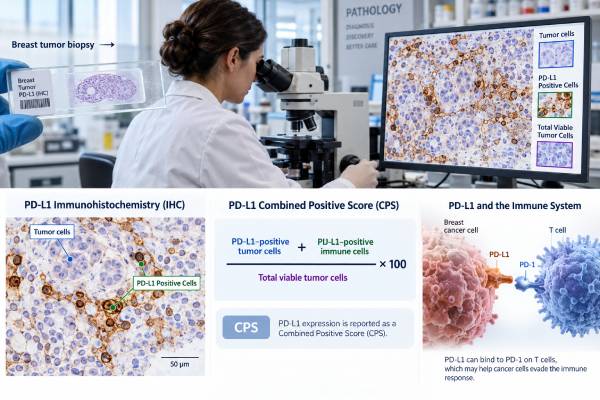
The PD-L1 test for breast cancer is an immunohistochemistry test used mainly to help determine whether certain patients with advanced triple-negative breast cancer may benefit from pembrolizumab plus chemotherapy. In the current U.S. metastatic setting, the clinically established breast cancer companion diagnostic uses the PD-L1 IHC 22C3 pharmDx assay and reports a Combined Positive Score, or CPS. A CPS of 10 or higher is the key threshold for pembrolizumab eligibility in locally recurrent unresectable or metastatic triple-negative breast cancer when the other treatment criteria are met. PD-L1 testing is not a general cancer screening test, does not measure inherited risk, and is not interpreted the same way across every breast cancer stage or every immunotherapy drug. In high-risk early-stage triple-negative breast cancer, pembrolizumab can be used without requiring a positive PD-L1 result. Understanding the assay, specimen, scoring method, and treatment setting is therefore more important than seeing the words “positive” or “negative” alone.
- PD-L1 in breast cancer is measured on tumor tissue by immunohistochemistry, not by a routine blood test.
- For metastatic triple-negative breast cancer, the FDA-linked 22C3 assay uses a Combined Positive Score, or CPS.
- CPS 10 or higher is the established U.S. threshold for pembrolizumab plus chemotherapy in eligible advanced TNBC.
- Early-stage high-risk TNBC pembrolizumab treatment does not require PD-L1 positivity.
- PD-L1 assays and scoring systems are not interchangeable, so the report should identify the antibody assay and score method.
Table of Contents
- What the PD-L1 test measures
- How the Combined Positive Score is calculated
- PD-L1 testing in metastatic triple-negative breast cancer
- Why early-stage TNBC is different
- Sample, assay, and report details that matter
- What positive and negative results do and do not mean
- Questions to ask after PD-L1 testing
What the PD-L1 test measures
PD-L1, or programmed death-ligand 1, is a protein that can be expressed on tumor cells and immune cells. It binds to the PD-1 receptor on T cells and can reduce immune activity. Tumors may use this pathway as one way to avoid immune attack. Drugs called immune checkpoint inhibitors block PD-1 or PD-L1 signaling and can restore antitumor immune activity in some cancers.
In breast cancer, PD-L1 testing has its clearest routine role in triple-negative breast cancer. TNBC lacks the standard treatment targets defined by estrogen receptor, progesterone receptor, and HER2 positivity, so immune biomarkers became particularly important in advanced disease.
The test is performed by immunohistochemistry, or IHC, on a formalin-fixed, paraffin-embedded tissue section. A pathologist evaluates brown membrane staining produced by an antibody directed against PD-L1. Unlike a mutation test, PD-L1 IHC is measuring protein expression in the tissue microenvironment at the time and site represented by that specimen.
This matters because PD-L1 expression can vary within one tumor and between a primary breast cancer and a metastatic site. It may also change over time or after treatment. The result therefore belongs to a particular specimen rather than representing a permanent inherited characteristic of the person.
PD-L1 is also not the same as PD-1. PD-1 is mainly a receptor on immune cells; PD-L1 is one of its ligands. Clinical pathology reports for breast cancer usually measure PD-L1, while pembrolizumab is an antibody that blocks PD-1.
A PD-L1 result should be interpreted within the broader breast cancer biomarker profile. ER, PR, and HER2 determine the major subtype first. PD-L1 then answers a more specific treatment-selection question in the appropriate setting.
How the Combined Positive Score is calculated
The Combined Positive Score is designed to include PD-L1 staining on both tumor cells and selected immune cells. For the 22C3 assay used with pembrolizumab in TNBC, the pathologist counts PD-L1-staining tumor cells, lymphocytes, and macrophages and relates them to the total number of viable tumor cells.
The formula is:
CPS = (PD-L1-staining tumor cells + PD-L1-staining lymphocytes + PD-L1-staining macrophages) ÷ total viable tumor cells × 100
The score is reported as a number, generally up to 100. Because immune cells are included in the numerator but not the denominator, CPS is not simply “the percentage of cancer cells that are positive.” A specimen can have relatively little tumor-cell staining yet still reach a clinically meaningful CPS because of PD-L1-positive immune cells in and around the tumor.
For metastatic TNBC and pembrolizumab, the clinically important threshold is:
| CPS result | Usual interpretation for the U.S. metastatic TNBC pembrolizumab indication |
|---|---|
| CPS <10 | Does not meet the PD-L1 companion-diagnostic threshold for pembrolizumab plus chemotherapy in this indication |
| CPS ≥10 | Meets the PD-L1 expression threshold, assuming the patient also meets the other clinical treatment criteria |
A CPS of 10 does not mean 10% of tumor cells are positive, and a CPS of 50 does not mean immunotherapy has a 50% response rate. CPS is a biomarker score linked to evidence from clinical trials; it is not a direct probability of treatment success.
The scoring system also depends on the assay and treatment indication. Tumor Proportion Score, immune-cell percentage, and CPS are different methods. A result such as “PD-L1 1%” from another assay cannot automatically be converted into a CPS of 1 or compared directly with the CPS 10 threshold.
This assay-specific principle became especially important in breast cancer because earlier treatment strategies used a different PD-L1 assay and immune-cell scoring method. Historical reports using the Ventana SP142 assay may therefore look very different from current 22C3 CPS reports.
PD-L1 testing in metastatic triple-negative breast cancer
The strongest treatment-selection role for PD-L1 testing in breast cancer is in previously untreated, locally recurrent unresectable or metastatic TNBC when pembrolizumab plus chemotherapy is being considered.
The KEYNOTE-355 trial studied pembrolizumab with chemotherapy compared with chemotherapy alone. In tumors with PD-L1 CPS of 10 or higher, adding pembrolizumab improved overall survival. The final overall-survival analysis reported a median overall survival of 23.0 months with pembrolizumab plus chemotherapy versus 16.1 months with chemotherapy alone in the CPS 10-or-higher subgroup. That trial established CPS 10 as the clinically important selection threshold for this indication.
The FDA lists PD-L1 IHC 22C3 pharmDx as the companion diagnostic for triple-negative breast cancer treated with pembrolizumab in this setting. The treatment indication is not simply “any breast cancer with CPS 10.” The disease must fit the relevant TNBC and advanced-disease criteria, and the treatment plan must be appropriate for the individual.
A positive result therefore means the tumor meets an evidence-based biomarker threshold associated with benefit from adding pembrolizumab to certain chemotherapy regimens. It does not guarantee response. Some PD-L1-positive tumors do not respond, and immune checkpoint treatment can cause serious immune-related adverse effects involving organs such as the thyroid, lungs, liver, bowel, skin, pituitary gland, and others.
A negative result below CPS 10 means the tumor does not meet this specific companion-diagnostic threshold. It does not mean there is no immune activity in the tumor, nor does it prove that every form of immunotherapy would be ineffective in every possible future setting. It means the evidence and current indication do not support using this PD-L1 result to qualify for pembrolizumab plus chemotherapy under the metastatic TNBC pathway.
Other biomarkers may still matter in advanced TNBC. Germline BRCA1/2 findings can affect eligibility for PARP inhibitors, and some rare tumor-agnostic biomarkers can open different targeted options. PD-L1 is therefore one element of a broader treatment profile rather than the only advanced-disease test.
Why early-stage TNBC is different
A common source of confusion is that PD-L1 is important for selecting pembrolizumab in metastatic TNBC but is not required for pembrolizumab use in high-risk early-stage TNBC.
KEYNOTE-522 tested pembrolizumab with neoadjuvant chemotherapy before surgery, followed by pembrolizumab after surgery. The regimen improved pathologic complete response and event-free survival, and FDA review found benefit regardless of tumor PD-L1 status. As a result, the early-stage indication is based on the clinical risk and treatment setting, not on reaching CPS 10.
That means a patient with high-risk early TNBC should not assume that a low or negative PD-L1 result rules out pembrolizumab. Likewise, a very high CPS does not by itself determine whether an early breast cancer needs immunotherapy. Stage, tumor size, lymph nodes, planned neoadjuvant therapy, overall health, and contraindications to immune checkpoint treatment are the key considerations.
The difference reflects how biomarkers work: a marker may be required for one drug indication but not another, even when the same drug and cancer subtype are involved. The evidence comes from different clinical trials in different disease stages.
This is also why reports should never be interpreted without the clinical context. “PD-L1 positive” is incomplete information unless the reader knows:
- whether the cancer is early-stage or recurrent/metastatic;
- whether the breast cancer is truly triple-negative by current ER, PR, and HER2 testing;
- which PD-L1 assay was used;
- which scoring method was used; and
- which treatment is being considered.
A PD-L1 result obtained during an early-stage workup may still be part of the pathology record, but it does not control current early-stage pembrolizumab eligibility in the way CPS does for the metastatic indication.
Sample, assay, and report details that matter
PD-L1 testing can be performed on a suitable biopsy or surgical specimen containing invasive tumor. In metastatic disease, either archival tumor tissue or a more recent metastatic biopsy may sometimes be available. The best specimen depends on tissue quality, tumor content, prior treatment, biopsy safety, and laboratory requirements.
Because PD-L1 can be heterogeneous, the site and age of the sample matter. Studies comparing paired primary and metastatic breast tumors have found discordance, including both loss and gain of PD-L1 expression. Some metastatic sites may also be harder to evaluate. Bone specimens that require harsh decalcification can compromise immunohistochemistry, for example, so another tissue block may be preferable when available.
A useful PD-L1 report should identify:
- the assay or antibody clone, such as PD-L1 IHC 22C3 pharmDx;
- the scoring system, such as CPS;
- the numerical score or category;
- whether the specimen was adequate for interpretation; and
- the specimen source, such as breast, lymph node, liver, lung, or another site.
For the pembrolizumab metastatic TNBC indication, the combination of the validated 22C3 assay and CPS scoring is important. Different assays can stain different proportions of cases, and analytical studies have shown that SP142, SP263, and 22C3 are not perfectly concordant. A pathologist should not simply translate one assay’s old threshold into another assay’s current threshold.
If an older report says “SP142 immune cells ≥1%,” that was connected to the former atezolizumab breast cancer pathway. The manufacturer voluntarily withdrew the U.S. atezolizumab metastatic TNBC indication in 2021, so that historical result should not be treated as equivalent to current pembrolizumab CPS testing.
When a prior specimen is PD-L1 negative and a new metastatic biopsy is available, clinicians may consider whether retesting could be informative, especially if the original assay, specimen quality, or disease site is not ideal. Retesting is not automatically required for every patient, but the possibility is reasonable because expression can differ across sites and time.
What positive and negative results do and do not mean
A PD-L1 result is a predictive biomarker in a defined treatment setting. It is not a general prognosis score. Although PD-L1 expression is related to the tumor immune environment and has been studied as a prognostic factor, routine clinical use in breast cancer is primarily about treatment selection.
A CPS of 10 or higher in advanced TNBC means:
- the tissue meets the validated PD-L1 threshold for the pembrolizumab indication;
- the result supports considering pembrolizumab with appropriate chemotherapy; and
- the final decision still depends on disease status, prior therapy, medical conditions, and immune-related treatment risks.
It does not mean:
- immunotherapy will definitely shrink the cancer;
- the score is the percent chance of response;
- chemotherapy is unnecessary;
- the cancer is more advanced because PD-L1 is high; or
- relatives have inherited an immune-related cancer risk.
A CPS below 10 means the specimen does not meet the threshold for this particular advanced TNBC treatment pathway. It is not a statement that the immune system cannot recognize the cancer. PD-L1 is an imperfect biomarker, and immune response depends on many tumor and host factors.
The result also cannot establish that a tumor is triple-negative. That classification comes from ER, PR, and HER2 testing. If receptor status is uncertain or has changed at recurrence, those markers should be resolved first. HER2-low expression can occur within hormone receptor-negative disease and does not make a tumor HER2-positive; that distinction may create other treatment options later in metastatic care.
PD-L1 is not a hereditary test and should not replace germline testing when inherited risk is suspected. For example, BRCA1/BRCA2 testing answers whether an inherited DNA-repair variant may affect treatment and family risk, which is completely different from measuring PD-L1 protein expression in tumor tissue.
Questions to ask after PD-L1 testing
The easiest way to avoid misreading a PD-L1 report is to connect the score directly to the treatment decision it is intended to inform.
Ask the oncology or pathology team:
- Which tissue sample was tested, and when was it collected?
- Was the assay PD-L1 IHC 22C3 pharmDx?
- Is the result reported as CPS, or by another scoring system?
- What is the exact CPS number?
- Is my breast cancer currently classified as triple-negative?
- Is the disease early-stage, locally recurrent unresectable, or metastatic?
- If my CPS is 10 or higher, what absolute benefit and risks are expected from pembrolizumab plus chemotherapy?
- If my CPS is below 10, would a different suitable specimen or newer biopsy ever be worth testing?
- Are there other biomarkers, including germline BRCA1/2 or tumor genomic findings, that could affect treatment?
- Do I have autoimmune disease, organ-transplant history, or another condition that changes immunotherapy risk?
A score should be read as “CPS X on this specimen using this assay,” not simply “PD-L1 positive” or “PD-L1 negative.” That wording preserves the information needed to match the result to evidence and regulatory indications.
For advanced TNBC, CPS 10 is a decision threshold because a randomized trial showed an overall-survival benefit in that selected group. For early high-risk TNBC, PD-L1 status is not required because benefit was demonstrated regardless of PD-L1 expression. Keeping those two settings separate is the central rule for interpreting a breast cancer PD-L1 result accurately.
If treatment is being planned from an older pathology report, ask whether the assay and scoring method still match the current drug indication. PD-L1 terminology changed quickly in breast cancer as different checkpoint inhibitors were studied, and a historically “positive” result may have been generated with a method that is no longer linked to a current U.S. breast cancer indication.
References
- List of FDA-Authorized Companion Diagnostic Devices (In Vitro and Imaging Tools) 2026 (FDA)
- Biomarkers for Systemic Therapy in Metastatic Breast Cancer: ASCO Guideline Update 2022 (Guideline)
- Pembrolizumab plus Chemotherapy in Advanced Triple-Negative Breast Cancer 2022 (Randomized Trial)
- Event-free Survival with Pembrolizumab in Early Triple-Negative Breast Cancer 2022 (Randomized Trial)
- FDA Approval Summary: Pembrolizumab for Neoadjuvant and Adjuvant Treatment of Patients with High-Risk Early-Stage Triple-Negative Breast Cancer 2022 (FDA Review)
- Comparison of PD-L1 (22C3) Expression in Paired Primary and Metastatic Breast Carcinoma 2024
Disclaimer
This article is for general education and does not replace medical advice from an oncology or pathology team. PD-L1 eligibility depends on the breast cancer subtype, disease stage, assay, specimen, scoring system, and the specific immunotherapy indication. Do not start, stop, or rule out immunotherapy based only on a PD-L1 label or score without reviewing the complete treatment context and potential immune-related risks.