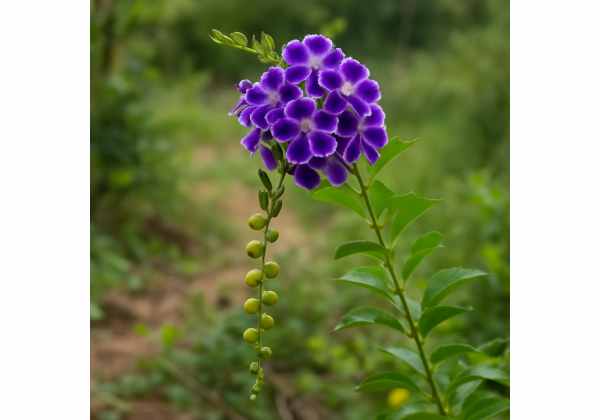
Pigeon berry, also known as Duranta erecta, is a tropical ornamental shrub better known for its hanging blue flowers and yellow-orange berries than for safe everyday herbal use. In traditional medicine, different parts of the plant have been used for fever, skin complaints, intestinal worms, swelling, and other folk purposes. Modern laboratory and animal studies add some intrigue. Extracts of the leaves and fruits have shown antioxidant, anti-inflammatory, antimicrobial, enzyme-inhibiting, antiulcer, and hepatoprotective signals in experimental settings. That makes the plant pharmacologically interesting.
But this is not a simple wellness herb. Pigeon berry sits in a category where promising chemistry and serious caution exist side by side. The berries and other parts are associated with toxicity concerns, especially when eaten, and there is no validated human self-care dose for oral use. For most readers, the most honest and helpful approach is to see Duranta erecta as a plant with experimental medicinal potential, but one that should be approached more as a toxic ornamental with research value than as a reliable home remedy.
Key Facts
- Pigeon berry shows antioxidant and anti-inflammatory potential in laboratory and animal studies.
- Experimental extracts have shown hepatoprotective and antiulcer activity, but this does not establish safe or effective human treatment.
- The safest unsupervised oral amount is 0 g because no validated human oral dose exists and the fruit may be poisonous.
- Children, pregnant or breastfeeding people, pets, and anyone considering homemade oral preparations should avoid it.
Table of Contents
- What Pigeon Berry Is and Why Medicinal Interest Comes With Caution
- Key Ingredients and Medicinal Properties
- Pigeon Berry Health Benefits and What the Evidence Actually Supports
- Traditional Uses and How Researchers Have Studied It
- How Pigeon Berry Is Used and Why Ornamental Use Is the Safest Default
- Dosage and Why Self-Medicating Is Not Advised
- Safety, Toxicity, and Who Should Avoid It
What Pigeon Berry Is and Why Medicinal Interest Comes With Caution
Duranta erecta is a woody shrub in the Verbenaceae family, often sold under ornamental names such as golden dewdrop, skyflower, and pigeon berry. Gardeners value it for its cascading violet, blue, or white flowers and its bright, bead-like fruits. In warm climates it is often used as a hedge or accent plant. In herbal discussions, however, its beauty can distract from the central fact that this is not a low-risk kitchen herb or an established self-care botanical.
The plant’s medicinal reputation comes mainly from traditional use in parts of Asia, Africa, and Latin America, where leaves, bark, roots, and fruits have been used for fever, parasitic complaints, malaria-like illness, skin conditions, swelling, wound care, and digestive disturbances. Modern reviews have taken those traditions seriously enough to examine the plant’s chemistry and biological actions. That research has identified a large number of potentially active compounds and several promising experimental effects. On paper, that sounds impressive.
The problem is that pigeon berry’s evidence profile is uneven. There is a fair amount of in vitro work, some animal data, and a growing phytochemical literature, but essentially no strong human clinical evidence that would justify recommending it as a routine medicinal plant. This is a recurring pattern with ornamental medicinals: attractive traditional stories, interesting laboratory findings, and a much weaker real-world evidence base than online summaries often imply.
There is also a more practical concern. Toxicity warnings are not a small side note here. Poison-information resources describe the plant as potentially toxic and note that the fruit can cause gastrointestinal irritation, vomiting, and diarrhea when eaten. Other horticultural toxicology sources warn even more strongly about risks to children and pets. That does not mean every contact with the plant is dangerous. It does mean the default assumption should be caution, especially around the berries.
That balance shapes the entire article. Pigeon berry is worth discussing because it is chemically rich and genuinely promising in early pharmacologic research. It is not worth romanticizing as a safe natural remedy. If your main goal is a better-known medicinal shrub with a clearer track record, herbs such as neem for broader traditional and researched applications sit on more familiar ground.
So the best opening perspective is simple. Duranta erecta is a research-interest plant first, a traditional medicinal second, and a poor choice for casual oral experimentation. Once that is clear, its benefits and its limits become much easier to understand.
Key Ingredients and Medicinal Properties
Pigeon berry contains a surprisingly broad range of phytochemicals, which helps explain why researchers keep returning to it. Reviews and analytical studies describe iridoid glycosides, phenylethanoid glycosides, flavonoids, alkaloids, saponins, tannins, terpenoids, phenolic compounds, coumarinolignoids, and volatile components across different plant parts. That is a chemically busy profile, and it gives the plant several plausible pharmacological directions.
One of the most important constituents discussed in the literature is acteoside, also known as verbascoside. This phenylethanoid glycoside is widely studied in plant pharmacology for antioxidant, anti-inflammatory, and tissue-protective actions. Pigeon berry is considered a meaningful source of it, and some of the plant’s broader claims likely lean heavily on acteoside-rich chemistry. Other notable compounds include scutellarein derivatives, pectolinaringenin-related flavonoids, iridoid glycosides, and repenin-type antioxidant compounds. Leaf-oil studies also show cultivar-dependent profiles that may include vitamin E, thunbergol, hydrocarbons, and other compounds with enzyme-inhibitory and antioxidant relevance.
That chemical diversity translates into a list of possible medicinal properties rather than firmly established clinical effects. The most realistic ones are:
- Antioxidant
- Anti-inflammatory
- Potentially antimicrobial
- Potentially antiparasitic
- Potentially hepatoprotective
- Potentially antiulcer
- Potentially enzyme inhibitory
- Potentially irritating or toxic when ingested
That last point is just as important as the first seven. A plant can contain biologically useful compounds and still be unsafe for unsupervised use. In pigeon berry, that tension is obvious. Some compounds appear promising for inflammation and oxidative stress, while others are implicated in toxicity concerns associated with the berries and possibly other plant parts.
Another important nuance is that the chemistry varies by plant part. Leaves, fruits, stems, flowers, and oils do not behave identically. This matters because many broad claims about pigeon berry do not say which part was used. A leaf oil study cannot automatically justify berry use. A fruit extract study in rats cannot automatically justify a human tea from the leaves. The plant’s chemistry is rich, but it is not interchangeable across all forms.
This is one reason strong laboratory activity can be misleading in consumer content. When a plant has many compounds, it becomes easy to write a long list of possible benefits. But practical value depends on bioavailability, dosage, extraction method, safety margin, and human evidence. Pigeon berry clears the first hurdle well, but not the later ones. If you are more familiar with gentler, better-characterized topical herbs, calendula for skin-focused herbal support is a good example of how different the evidence and safety balance can look when a plant is more established.
So the key-ingredient story is impressive, but it should not be oversold. Pigeon berry has real phytochemical interest. It does not yet have a safe, validated, consumer-friendly medicinal profile.
Pigeon Berry Health Benefits and What the Evidence Actually Supports
The phrase “health benefits” needs unusual restraint here. For Duranta erecta, the strongest evidence does not come from human trials. It comes from phytochemical reviews, cell-based work, enzyme assays, and animal studies. That means the plant’s “benefits” are best described as experimental signals, not confirmed self-care outcomes.
The most credible benefit category is antioxidant activity. Reviews and part-specific studies consistently show that pigeon berry extracts contain phenolics and flavonoids that can scavenge free radicals and demonstrate reducing power in lab models. This is one of the most reproducible directions in the literature and likely underlies some of the plant’s broader anti-inflammatory and tissue-protective claims.
A second promising area is anti-inflammatory potential. Newer work on leaf constituents has identified compounds with cyclooxygenase and lipoxygenase inhibitory activity, which fits the plant’s traditional use for swelling, pain, and inflammatory discomfort. This is scientifically meaningful because it connects plant chemistry to well-known inflammation pathways. What it does not do is prove that pigeon berry is a safe or effective anti-inflammatory remedy for people.
A third area is hepatoprotective potential. In animal models, hydroethanolic extracts from certain Duranta erecta parts, especially ripe fruits, reduced markers of chemically induced liver injury and improved antioxidant defenses. That is one of the more interesting experimental findings attached to the plant. But it is also exactly the sort of result that can be misunderstood. Animal hepatoprotection does not mean people should swallow homemade fruit extracts, especially when the fruit is also associated with poisoning concerns. For readers seeking better-established liver-support conversations, milk thistle and its more familiar liver-focused evidence base offer a much safer comparison.
A fourth area is antiulcer and digestive-protective potential. Some newer research suggests fruit extracts may reduce ulcer-related damage in animal models. Again, that is promising as a pharmacology clue, not as an invitation to home oral use.
Other experimentally discussed benefits include:
- Antimicrobial activity against selected organisms
- Antiparasitic or antimalarial interest
- Enzyme inhibition related to carbohydrate metabolism
- Insecticidal and agricultural bioactivity
These findings may matter for drug discovery, veterinary investigation, or agricultural applications. They matter much less for everyday human wellness advice unless stronger safety and clinical data emerge.
So what does the evidence actually support in plain language?
- Pigeon berry contains compounds worth studying.
- Extracts can produce measurable laboratory and animal effects.
- Traditional uses are not random and often align with plausible mechanisms.
- None of that establishes a safe, proven human oral remedy.
That last point is the one people most need. Pigeon berry is a plant with research promise, not a plant with a dependable home-use health profile. The gap between those two categories is where most misinformation appears.
Traditional Uses and How Researchers Have Studied It
Traditional medicine has used Duranta erecta for a surprisingly wide range of purposes. Ethnomedicinal reports describe the plant as a vermifuge, febrifuge, diuretic, antimalarial, antiparasitic, wound herb, and treatment for inflammatory or skin-related complaints. In some settings, leaf, bark, root, and fruit preparations have been used for abscesses, boils, swelling, malaria-like fever, intestinal complaints, and local skin trouble. This breadth can make the plant sound impressively versatile, but it also raises a common herbal warning sign: when one plant is used for everything, the strength of evidence for any single use is often weak.
Researchers have approached pigeon berry in several ways. Some have focused on reviewing its traditional uses and phytochemistry, asking whether the folk record matches modern compound identification. Others have focused on specific plant parts, such as leaves, ripe fruits, unripe fruits, or leaf oils. Still others have used bioactivity-guided isolation, which tries to identify the exact compounds responsible for observed actions such as antioxidant or anti-inflammatory effects.
This research strategy matters because it reveals both the plant’s promise and its limitations. For example:
- Studies on leaf oils help explain antioxidant and enzyme-inhibitory potential.
- Fruit-extract studies in animals help explain hepatoprotective and antiulcer claims.
- Review papers connect widespread traditional use with compounds such as acteoside and related phenolics.
- Toxicity research reminds readers that “used traditionally” does not mean “safe in all forms.”
This mix is why pigeon berry fits so awkwardly into consumer herbal writing. It is too pharmacologically interesting to ignore, but too poorly established and potentially risky to recommend casually. Many plants in folk medicine eventually become gentle modern remedies. Pigeon berry has not made that transition in any clear way.
Traditional-use context still matters, however, because it tells us where researchers should look. Plants repeatedly used for fever, worms, skin complaints, or swelling are often rich in bitter, aromatic, antimicrobial, or anti-inflammatory compounds. In pigeon berry, that expectation turns out to be broadly correct. The plant does seem to contain real bioactivity. What is missing is the step from ethnobotanical plausibility to validated, safe human guidance.
This is a good place to separate traditional credibility from clinical confidence. Traditional credibility means there is a long enough record of use to take the plant seriously as a research subject. Clinical confidence means there is enough evidence to guide dose, timing, safety, interactions, and expected results in humans. Pigeon berry has the first far more than the second.
That distinction is essential because many people search for medicinal plants hoping to find a hidden but practical remedy. In pigeon berry, what they mostly find is a plant that belongs in cautious pharmacologic research. For more grounded digestive or fever-support traditions with better-known household roles, ginger as a safer traditional medicinal plant is far easier to place in real-life use.
How Pigeon Berry Is Used and Why Ornamental Use Is the Safest Default
From a practical standpoint, pigeon berry is mainly used as an ornamental shrub, and that is still the safest default role for the plant. It grows quickly, flowers attract pollinators, and the fruit is visually striking. As a landscape plant, the main question is usually not “How do I dose this?” but “How do I keep children and pets away from the berries?” That tells you a lot about its true position in home use.
Traditional medicinal use has involved leaves, fruits, bark, roots, and topical preparations, but modern self-care should not copy those uses casually. The plant’s chemistry is too variable, and the toxicity margin is too unclear. Even in research settings, different preparations behave differently. A hydroethanolic extract used under controlled experimental conditions is not the same thing as a backyard decoction or crushed fruit preparation.
If people still explore the plant medicinally, it is usually through one of four paths:
1. Folk topical use
Some traditional systems have used leaf or other plant-part preparations externally for boils, abscesses, swelling, and minor skin complaints. This is more understandable than oral use, but even here caution matters because plant contact can irritate sensitive skin. A gentler comparison for skin-focused herbal thinking is aloe vera for soothing topical support, which has a much clearer household safety role.
2. Experimental internal use in research
Animal studies have used measured extracts for liver protection, antioxidant support, or ulcer-related models. These are research uses, not consumer uses.
3. Traditional oral folk remedies
This is the area where caution is highest. Historical use exists, but no validated modern human dosing framework supports it.
4. Agricultural or bioactive-interest use
Because the plant shows insecticidal and antimicrobial activity, it may matter for broader plant-science or natural-product research rather than for home health use.
The most useful practical advice is therefore not “how to use pigeon berry at home,” but “when not to.” Do not experiment with the berries because they look harmless. Do not assume that birds eating the fruit means the fruit is safe for humans. Do not move from one animal study or review abstract straight to self-treatment.
If your interest is purely botanical, pigeon berry is a beautiful and chemically intriguing species. If your interest is medicinal, its role is mostly educational: it teaches how a plant can be promising in the lab and still remain unsuitable for unsupervised home herbalism. In that sense, the safest real-world use is to enjoy it as an ornamental and let the medicine remain in the research setting until much stronger human data appear.
Dosage and Why Self-Medicating Is Not Advised
This is the section where honesty matters most. There is no validated human oral self-care dose for pigeon berry. No well-established tea dose, tincture dose, capsule dose, or berry count exists that can be responsibly recommended for home medicinal use. That fact should shape every practical decision around the plant.
You may see numbers in the research literature, but they do not solve the problem. Animal studies have used specific extract doses, such as 250 mg/kg in hepatoprotective experiments, and some toxicity studies have explored far higher levels in rats. Those numbers are useful for pharmacology. They are not instructions for people. Translating animal-extract doses into human herbal practice is already difficult with gentle plants. With pigeon berry, it is even less appropriate because the plant carries genuine toxicity concerns.
That is why the safest practical dosing guidance looks unusual:
- Oral self-care dose: none recommended
- Berry self-testing: avoid
- Homemade extracts or decoctions: avoid
- Children and pets: keep away from the fruit
This may feel unsatisfying in an herb-style article, but it is the most useful answer. Sometimes the right dosage section is not a dosing ladder. It is a red line.
For external use, the situation is only slightly less uncertain. Traditional topical applications exist, but no standardized modern topical dose or preparation can be recommended with confidence. Strength, extraction method, solvent, freshness, and contact time all influence risk. Patch testing would be prudent for any external experiment, but even that does not turn the plant into a good do-it-yourself herb.
A sensible rule for medicinal plants is this: if a safe consumer dose is not clear, the plant should not be used casually by mouth. Pigeon berry fits that rule perfectly. In contrast, herbs with better dosing frameworks allow much more practical guidance. For example, dandelion for tea and gentle traditional use has a far more understandable home-use profile.
So what should readers do with the idea of dose?
- Do not look for a “small safe berry amount.”
- Do not rely on folklore alone.
- Do not use animal-study doses as a template.
- Treat lack of human dosing data as a real safety warning.
In short, the most accurate consumer dose is zero for unsupervised oral use. That is not a limitation of the article. It is the most medically responsible interpretation of the evidence currently available.
Safety, Toxicity, and Who Should Avoid It
Pigeon berry’s safety profile is the single most important part of the article. The plant is often described as potentially toxic, and the fruit is the main concern for accidental ingestion. Poison-information guidance notes gastrointestinal irritation, vomiting, and diarrhea after eating the berries, while horticultural toxicology resources warn more broadly about danger to children and pets. Even if severe poisoning is not common, the plant has no business being treated like a casual edible or a low-risk household herb.
The main safety concerns include:
- Berry ingestion
- Gastrointestinal irritation
- Possible skin or eye irritation from contact
- Unclear safety of homemade extracts
- Lack of validated human dosing
- Potential prolonged-use organ stress suggested by animal toxicity work
That last point needs context. Some animal work suggests certain extracts may appear relatively safe acutely yet still show signals of concern with longer exposure, especially for kidney or liver-related measures. This does not prove the same outcome in humans, but it reinforces the larger message that “natural” and “traditionally used” are not enough to guarantee safety.
Who should avoid pigeon berry entirely or treat it as off-limits?
Children
Children are the highest practical concern because the berries are colorful and attractive. A plant that invites accidental tasting should be handled with extra caution in family spaces.
Pregnant or breastfeeding people
There is no reliable medicinal-use safety data to justify exposure beyond incidental garden contact.
Pet owners
Dogs and cats are commonly mentioned in toxicity warnings. If the shrub is grown in a shared yard, fallen fruit should not be ignored.
Anyone planning oral self-treatment
This includes people looking for parasite remedies, liver tonics, fever herbs, or ulcer support. Pigeon berry is not suitable for unsupervised oral use.
People with sensitive skin
If the plant is handled for pruning or experimental topical use, gloves and hand washing make sense.
Possible symptoms after unwanted exposure may include:
- Nausea
- Vomiting
- Diarrhea
- Abdominal discomfort
- Local irritation to skin or eyes
A practical safety rule is easy to remember: ornamental does not mean edible, and medicinally interesting does not mean medicinally ready. That is especially true for pigeon berry.
If there are children or pets in the home, fruit removal is a sensible precaution. If someone may have eaten the berries and symptoms develop, formal poison-center or medical guidance is more appropriate than home experimentation. Plants like this are best respected, not repurposed casually.
References
- Duranta erecta Linn: A critical review on phytochemistry, traditional uses, pharmacology, and toxicity from phytopharmaceutical perspective 2022 (Review)
- Bioactivity-guided isolation and molecular modeling of the anti-inflammatory constituents from the leaves of Duranta erecta Linn. 2025
- The Antioxidant and Enzyme Inhibitory Potential of n-Hexane-Extracted Oils Obtained from Three Egyptian Cultivars of the Golden Dewdrop Duranta erecta Linn. Supported by Their GC-MS Metabolome Analysis and Docking Studies 2022
- Evaluation of the Acute Hepatoprotective Potential of Hydroethanolic Extract of Duranta erecta L. Parts 2020
- Duranta (Duranta erecta, Duranta repens) | Queensland Poisons Information Centre 2024 (Official Toxicity Guidance)
Disclaimer
This article is for educational purposes only and is not medical advice, diagnosis, or treatment. Pigeon berry is a toxicologically concerning ornamental plant with promising laboratory and animal research, but it does not have a validated, safe oral self-care role for the general public. Do not use the berries, leaves, or homemade extracts to treat ulcers, liver disease, parasites, infections, or other symptoms without qualified medical and toxicological guidance. Seek professional help promptly after accidental ingestion, especially in a child or pet.
If you found this article useful, please share it on Facebook, X, or another platform you prefer.