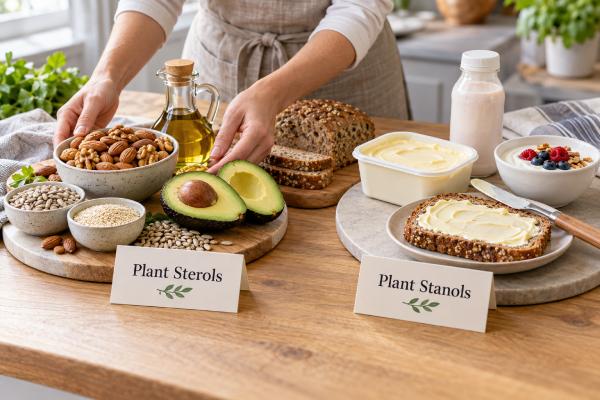
Plant sterols and plant stanols are closely related compounds that can lower LDL cholesterol by reducing how much cholesterol the intestine absorbs. For practical cholesterol management, they work more alike than differently. At commonly used doses of about 1.5–3 g per day, both can lower LDL cholesterol by roughly 7%–12% in many people, with the exact response depending on dose, baseline cholesterol, food format, and individual biology. They do not reliably raise HDL, produce major triglyceride reductions, or replace medication when cardiovascular risk calls for stronger LDL lowering.
The main difference is chemical: plant sterols contain a double bond in their ring structure, while plant stanols are the saturated form. Sterols occur more commonly in ordinary plant foods; stanols are present in much smaller natural amounts. Reaching a cholesterol-lowering dose usually requires fortified foods or a standardized supplement rather than diet alone. The best choice is therefore less about “stanol versus sterol” and more about getting an effective daily dose, taking it with meals, and using it as part of an overall heart-healthy eating pattern.
Table of Contents
- What Plant Sterols and Stanols Are
- Sterols vs Stanols: The Important Differences
- How Much They Can Lower LDL Cholesterol
- Best Food Sources and Fortified Products
- How to Use Sterols or Stanols Effectively
- Safety, Side Effects, and Who Should Avoid Them
- Where They Fit in a Cholesterol-Lowering Plan
What Plant Sterols and Stanols Are
Plant sterols and stanols, often grouped under the term phytosterols, are natural compounds found in plant cell membranes. Their structure resembles cholesterol closely enough that they compete with cholesterol during digestion.
When you eat cholesterol, bile also delivers cholesterol into the intestine. Before that cholesterol can enter the bloodstream, it has to be incorporated into microscopic particles called mixed micelles. Plant sterols and stanols compete for space in this process. Less cholesterol is absorbed, more leaves the body in stool, and the liver responds by increasing LDL receptors that remove LDL particles from the blood.
That is why the main measurable effect is a reduction in LDL cholesterol.
Plant sterols are much more abundant in the food supply than plant stanols. Common sterols include beta-sitosterol, campesterol, and stigmasterol. Stanols such as sitostanol and campestanol are hydrogenated versions of related sterols and occur naturally in smaller quantities.
Normal diets provide only a few hundred milligrams of phytosterols per day. That amount may contribute to the benefits of plant-rich eating, but it is usually below the dose used specifically to lower LDL cholesterol.
Sterols vs Stanols: The Important Differences
For LDL lowering at usual doses, sterols and stanols are broadly comparable. The chemistry differs more than the practical effect.
| Feature | Plant Sterols | Plant Stanols |
|---|---|---|
| Chemical structure | Contain a double bond | Saturated form of sterols |
| Natural abundance | Relatively common in plant foods | Present in much smaller amounts |
| Absorption into the body | Very low, but higher than stanols | Extremely low |
| LDL-lowering effect | About 7%–12% at effective doses | About 7%–12% at effective doses |
| Common product forms | Fortified spreads, dairy-style products, supplements | Fortified spreads and selected functional foods |
Older dose-response meta-analyses found very similar LDL reductions when sterols and stanols were analyzed separately up to about 3 g per day. More recent reviews continue to treat both as effective cholesterol-lowering ingredients.
One theoretical difference involves circulating plant sterol levels. The intestine absorbs only a small fraction of plant sterols and even less plant stanols. Because unusually high plant sterol concentrations occur in the rare genetic disorder sitosterolemia, researchers have examined whether the modest rise seen after sterol-fortified foods could itself promote atherosclerosis.
Current evidence has not established that ordinary use of sterol-fortified foods increases cardiovascular events. A 2023 German expert statement concluded that available human evidence does not show a specific atherogenic effect at typical exposures. Still, there are no large, long-term randomized trials proving that plant sterols or stanols themselves reduce heart attacks or strokes. Their role is based mainly on the well-established importance of lowering LDL cholesterol.
How Much They Can Lower LDL Cholesterol
A realistic expectation is about a 7%–12% reduction in LDL cholesterol when roughly 1.5–3 g per day is consumed consistently. The effect often becomes visible within a few weeks and continues while the product is used.
A 2023 systematic review and meta-analysis of 125 studies found that phytosterol-fortified foods significantly lowered LDL cholesterol, with larger doses generally producing larger reductions. More recent umbrella reviews have reached the same overall conclusion: LDL lowering is the clearest and best-supported cardiometabolic effect.
To make the percentage concrete, consider someone with an LDL cholesterol of 160 mg/dL. A 10% reduction would be about 16 mg/dL, bringing LDL to roughly 144 mg/dL if everything else stayed the same. Someone starting at 120 mg/dL would see about a 12 mg/dL reduction with the same percentage response.
That can be useful, but it may not be enough for a person with familial hypercholesterolemia, established cardiovascular disease, very high ApoB, or another reason to need a large LDL reduction. In those situations, phytosterols are usually an add-on rather than the central treatment.
More is not always better
The dose-response curve begins to flatten as intake rises. There is little practical reason for most people to push far beyond about 3 g per day. Higher doses add cost and complexity without proportional LDL lowering.
Products also vary in delivery. Fortified spreads, yogurts, milk-type drinks, and other foods can work, but the dose needs to be high enough. A product that contains only a few hundred milligrams per serving may require several servings to reach the studied range.
They lower LDL, not every lipid marker
Plant sterols and stanols do not consistently increase HDL cholesterol and generally have only small effects on triglycerides. If triglycerides are the main problem, reducing alcohol, refined carbohydrate, excess calories, and improving metabolic health usually has a larger impact.
If you are trying to understand whether LDL is the main target in your situation, an overview of high LDL cholesterol and treatment options provides the larger clinical context.
Best Food Sources and Fortified Products
Natural plant foods contain phytosterols, but ordinary foods alone rarely provide the 1.5–3 g daily dose used for targeted LDL lowering.
Useful natural sources include:
- Vegetable oils, especially corn, canola, and some seed oils
- Nuts such as almonds, pistachios, and walnuts
- Seeds such as sesame and sunflower seeds
- Whole grains and wheat germ
- Legumes including beans, peas, and lentils
- Avocado
- Fruits and vegetables in smaller amounts
These foods are still valuable because they bring fiber, unsaturated fats, minerals, and other nutrients. But it would be impractical to eat enough of most natural foods solely to reach 2 g of phytosterols daily.
Fortified foods are the easiest way to reach an effective dose
Depending on the country and brand, plant sterols or stanols may be added to:
- Margarine-style spreads
- Yogurt or yogurt drinks
- Milk or plant-based dairy alternatives
- Orange juice
- Snack bars
- Some breads or cereals
Check the label for the amount per serving, not simply whether the product says “with plant sterols.” A practical product should make it reasonably easy to reach the intended daily dose without adding excessive calories, saturated fat, sugar, or sodium.
For example, if a fortified spread provides 1 g per tablespoon, two tablespoons spread across meals would provide 2 g. If a yogurt drink contains the full 2 g dose, one serving may be enough.
Supplements can work, but format matters
Capsules, tablets, and softgels may provide a standardized amount, but they should be taken with meals so they are present when cholesterol is being processed in the intestine. Food-based products have the longest evidence base, and some research suggests the food matrix can influence the magnitude of response.
Do not assume a “cholesterol support” supplement contains an evidence-based amount. Read the actual plant sterol or stanol dose on the Supplement Facts panel.
How to Use Sterols or Stanols Effectively
The most useful routine is simple: take an effective total daily dose with meals and keep the rest of the diet heart healthy.
Aim for about 1.5–3 g per day
Many products and clinical recommendations cluster around 2 g daily because that dose is practical and consistently effective. Going slightly above or below is unlikely to make a dramatic difference, but taking only 200–400 mg from a fortified product is usually below the range used for therapeutic LDL lowering.
Divide the dose across meals when practical
Because phytosterols work inside the intestine during digestion, taking them with food makes physiologic sense. One or two meal-time doses can work. There is no need to take them on an empty stomach.
Recheck cholesterol after a consistent trial
A useful trial is roughly four to 12 weeks, similar to the timeframe used to assess other cholesterol-lowering changes. Keep the dose and diet reasonably consistent, then repeat a lipid panel if you and your clinician are using the result to guide decisions.
When you compare before-and-after results, look at the absolute LDL change as well as the percentage. A drop from 170 to 153 mg/dL is 17 mg/dL, or 10%. That may be worthwhile for a person making a dietary improvement, but it may still leave LDL well above an individualized target. Also avoid changing several major treatments during the same short test period if your goal is to learn how much the phytosterol product itself helped.
If LDL barely changes, first confirm the actual daily dose and adherence. Some people are also biological “nonresponders” or have other factors driving LDL strongly upward.
Combine them with interventions that work through different mechanisms
Phytosterols reduce cholesterol absorption. Soluble fiber traps bile acids and changes cholesterol handling in another way. Replacing saturated fat with unsaturated fat reduces LDL through yet another mechanism. These strategies can be combined.
For example, a breakfast with oats and fruit, a lunch built around beans and vegetables, and a sterol-fortified spread used with a meal can create additive dietary effects. A guide to soluble fiber for lowering LDL can help build that combination deliberately.
Likewise, replacing butter, fatty processed meats, and other high-saturated-fat foods with olive oil, nuts, seeds, fish, and other unsaturated-fat sources usually matters more than simply adding a fortified product to an otherwise unchanged diet. The comparison between saturated and unsaturated fats is central to long-term cholesterol management.
Safety, Side Effects, and Who Should Avoid Them
Plant sterols and stanols are generally well tolerated at recommended doses. They are minimally absorbed, and gastrointestinal side effects are uncommon.
The main nutritional concern is that regular use can modestly lower blood concentrations of some carotenoids, especially beta-carotene. This does not usually cause deficiency when the diet contains plenty of colorful vegetables and fruit. Rather than taking extra beta-carotene supplements, emphasize foods such as carrots, leafy greens, peppers, squash, tomatoes, and citrus.
Sitosterolemia is an important exception
People with sitosterolemia, a rare inherited condition caused by variants affecting the ABCG5 or ABCG8 transporters, absorb and retain unusually large amounts of plant sterols. They can develop premature atherosclerosis and other complications. Sterol-enriched foods or supplements are generally inappropriate in this condition.
Sitosterolemia is rare, but it may be considered when a child or young adult has unexpectedly severe hypercholesterolemia, tendon or skin xanthomas, hemolytic anemia, low platelets, or an unusual response to standard treatment.
Pregnancy, breastfeeding, and children
Fortified phytosterol products are generally marketed for adults who need cholesterol lowering, not for routine use in pregnancy, breastfeeding, or young children. Cholesterol has important roles in growth and hormone synthesis. Unless a specialist has recommended them for a specific condition, whole-food dietary patterns are the better default in these groups.
Do they interfere with statins?
No major harmful interaction is expected. In fact, phytosterols can produce additional LDL lowering when used with statins because they act through a different pathway. The same concept applies to other lipid-lowering therapies, although medication plans should still be coordinated with a clinician.
Where They Fit in a Cholesterol-Lowering Plan
Plant sterols and stanols are best viewed as a targeted dietary tool for modest LDL reduction. They are most attractive when someone wants an additional non-drug reduction, has borderline or moderately elevated LDL, or needs extra lowering on top of a healthy diet or medication.
They are less useful when the treatment goal requires a 30%, 50%, or greater LDL reduction. Statins, ezetimibe, PCSK9-directed therapies, and bempedoic acid can produce larger effects depending on the drug and dose. If medication is needed, fortified foods should not be used as a reason to delay effective therapy. An overview of nonstatin LDL-lowering options explains how the major medications differ.
A good sequence for many people is:
- Know your baseline LDL and overall cardiovascular risk. The same LDL value can mean different treatment intensity for different people.
- Fix the largest dietary drivers first. Reduce saturated fat where intake is high and increase soluble fiber and minimally processed plant foods.
- Add 1.5–3 g per day of sterols or stanols if a modest additional LDL reduction would be useful. Choose a product you can take consistently with meals.
- Recheck the lipid panel. Confirm whether the change produced a meaningful response.
- Escalate treatment when risk requires it. Do not rely on dietary phytosterols alone when guideline-directed medication is indicated.
There is no compelling evidence that most people should choose stanols over sterols or vice versa. Product dose, cost, taste, calorie content, and consistency matter more. If one product fits your eating pattern and reliably delivers about 2 g per day, that is usually a better choice than a theoretically “better” form you do not use.
The most important perspective is that sterols and stanols are not magic ingredients. Their LDL effect is real and well supported, but it is modest. They work best as one component of a broader plan that reduces atherogenic lipoprotein exposure over years.
How to compare products at the grocery store
Ignore marketing claims first and find the actual dose. Check how many grams or milligrams of plant sterols or stanols are delivered in the amount you would realistically eat. Then look at calories, saturated fat, added sugar, and sodium. A fortified spread that lowers LDL is less attractive if you use so much of it that calories or saturated fat rise sharply. Likewise, a sweetened fortified drink may be unnecessary if a lower-sugar option supplies the same phytosterol dose.
Cost matters because the benefit depends on continued use. Calculate the price per effective daily dose rather than price per package. If one product supplies 2 g in a single serving while another requires four servings, the cheaper-looking package may actually cost more. Choose the format that fits an existing meal so adherence is easy instead of creating a new snack solely to take phytosterols. If two products provide the same effective dose, neither sterol nor stanol labeling alone makes one automatically superior. Taste, nutrient profile, affordability, and whether you will actually use the product consistently every day are more important practical differences.
References
- Use of phytosterol-fortified foods to improve LDL cholesterol levels: A systematic review and meta-analysis. 2023 (Systematic Review)
- Health outcomes associated with phytosterols: An umbrella review of systematic reviews and meta-analyses of randomized controlled trials 2024 (Umbrella Review)
- Efficacy of phytosterols for reduction of cardiometabolic risk factors: An umbrella review of systematic reviews and meta-analyses and updated dose-response meta-analyses of randomized trials 2026 (Umbrella Review)
- Phytosterols and Cardiovascular Risk Evaluated against the Background of Phytosterolemia Cases-A German Expert Panel Statement 2023 (Position Statement)
- Plant Sterols and Plant Stanols in Cholesterol Management and Cardiovascular Prevention. 2023 (Review)
- Heart-healthy diets including phytostanol ester consumption to reduce the risk of atherosclerotic cardiovascular diseases. A clinical review 2024 (Review)
Disclaimer
This article is for general education and does not replace individualized medical or nutrition advice. People with known or suspected sitosterolemia, severe inherited cholesterol disorders, cardiovascular disease, pregnancy, breastfeeding, or childhood lipid disorders should discuss phytosterol products with a qualified clinician or dietitian before using them therapeutically.