Probiotics are live microbes used for a specific health effect, not a general “gut reset.” In healthy aging, their strongest roles relate to digestion, antibiotic-associated diarrhea risk, bowel regularity, immune signaling, and selected markers of inflammation. Evidence for cognition, body composition, glucose control, and frailty is promising but still uneven, and the result depends heavily on the strain, dose, population, and trial length.
A good probiotic plan starts with a clear reason: looser stools after antibiotics, constipation, bloating, recurrent digestive disruption, or a measured inflammatory concern. The label should list the genus, species, strain, colony-forming units through the expiration date, storage needs, and suggested use. Food sources such as yogurt, kefir, and fermented vegetables support dietary diversity, but supplements work best when matched to a defined outcome. More CFU does not automatically mean a better product, and multi-strain formulas are not always superior.
Table of Contents
- What Probiotics Mean for Healthy Aging
- How Probiotics Work in the Gut and Immune System
- Strains, Functions, and Evidence Strength
- Best-Supported Uses in Midlife and Older Adults
- How to Choose a Probiotic Product
- Food, Prebiotics, Postbiotics, and Synbiotics
- Safety, Side Effects, and Who Should Be Careful
- A Simple Probiotic Trial Plan
What Probiotics Mean for Healthy Aging
A probiotic is a live microorganism that gives a health benefit when taken in an adequate amount. That definition matters because it separates true probiotics from ordinary fermented foods, marketing blends, and capsules that list bacteria without showing a human benefit.
The aging gut changes in several ways. Gut transit often slows. Medication use rises. Antibiotics, acid-suppressing drugs, metformin, opioids, and some anticholinergic medications alter bowel function and microbial balance. Diet quality also shifts when appetite, chewing, income, cooking energy, or social routines change. These changes do not make probiotics necessary for everyone, but they explain why older adults often notice a stronger response when a probiotic is matched to a real problem.
The gut microbiome also links to immune aging. A large share of immune activity happens near the intestinal lining, where microbes, food compounds, bile acids, mucus, and immune cells interact every day. With age, low-grade inflammation becomes more common, gut barrier resilience can weaken, and immune responses to infections and vaccines often become less robust. Probiotics are not immune “boosters.” A better description is immune modulation: some strains help nudge immune activity toward a more balanced response.
Probiotics also fit into a broader healthspan plan. They do not replace fiber, protein, sleep, exercise, dental care, medication review, or treatment for gastrointestinal disease. They work best as one tool in a plan that also includes plant-rich meals, enough fluids, regular movement, and attention to constipation triggers. People who want to understand their own gut data should treat commercial microbiome reports with caution; microbiome testing for longevity rarely gives strain-level supplement instructions that are ready for medical use.
How Probiotics Work in the Gut and Immune System
Probiotics work through several overlapping pathways. Different strains use different pathways, which is why the full name on the label matters.
Some probiotics support colonization resistance. This means they help the gut environment resist overgrowth by unwanted microbes. They compete for space, interact with resident bacteria, produce acids or antimicrobial compounds, and help maintain a lower colonic pH. This effect is especially relevant after antibiotics, when the normal gut community has been disturbed.
Other strains influence the gut barrier. The intestinal lining is a selective barrier: it absorbs nutrients while keeping many microbial fragments and toxins away from the bloodstream. Probiotic effects on mucus production, tight junctions, and local immune cells may reduce signals that feed chronic inflammation. This does not mean a probiotic “seals leaky gut” in a guaranteed way. It means certain strains have measurable effects on barrier-related biology in controlled settings.
Probiotics also produce or influence metabolites. Short-chain fatty acids, especially acetate, propionate, and butyrate, are made when microbes ferment fibers and resistant starches. These compounds support colon cells, immune signaling, and appetite-related pathways. Many probiotic strains do not produce large amounts of butyrate directly, but they can support networks of microbes that do.
The gut-brain connection adds another layer. Gut microbes interact with the nervous system through immune signals, microbial metabolites, the vagus nerve, tryptophan metabolism, and stress-hormone pathways. Human trials in cognition and mood show mixed but interesting results, especially in adults with mild cognitive impairment or high stress. Probiotics should not be presented as memory supplements for healthy adults with no symptoms. Brain aging is better served by a larger pattern that includes exercise, blood pressure control, sleep, hearing care, and brain healthy eating patterns.
Aging also changes how people respond. Baseline diet, sex, medication use, bowel habits, health status, and existing microbiome patterns all shape results. Two people taking the same capsule for 12 weeks do not necessarily get the same shift in stool pattern, bloating, or immune markers.
Strains, Functions, and Evidence Strength
The words Lactobacillus and Bifidobacterium are not enough. A probiotic name should read like an address: genus, species, and strain. For example, Lacticaseibacillus rhamnosus GG is not the same intervention as another L. rhamnosus strain. Bifidobacterium longum 35624 is not the same as every B. longum product.
Many older studies used the former Lactobacillus names. Scientific naming changed in 2020, so labels and papers do not always look consistent. That is annoying for shoppers, but the strain code remains the most useful identifier.
| Organism or strain example | Commonly studied function | How to interpret it |
|---|---|---|
| Lacticaseibacillus rhamnosus GG | Antibiotic-associated diarrhea, immune and gut-brain research | One of the best-known strains, but benefits still depend on indication and dose. |
| Saccharomyces boulardii CNCM I-745 | Antibiotic-associated diarrhea and some diarrhea-related uses | A probiotic yeast, not a bacterium; avoid casual use in high-risk immunocompromised people. |
| Bifidobacterium animalis subsp. lactis strains | Stool frequency, transit time, immune markers | Often used in yogurts and capsules; strain identity still matters. |
| Bifidobacterium longum strains | IBS symptoms, immune signaling, cognitive and stress-related research | Promising for selected outcomes, not a universal brain or mood treatment. |
| Lactiplantibacillus plantarum strains | Bloating, inflammation markers, barrier and immune effects | Research is strain-specific; different L. plantarum strains should not be treated as interchangeable. |
| Live yogurt cultures | Lactose digestion and general dietary support | Useful food source, especially when it replaces low-nutrient snacks. |
Evidence strength differs by outcome. Digestive outcomes have the most mature research. Antibiotic-associated diarrhea prevention has a larger evidence base than claims about longevity, body composition, or cognitive decline. Constipation studies in older adults are encouraging, especially when products improve stool frequency or consistency, but formulas vary widely.
Immune and inflammation findings look biologically plausible and increasingly relevant to aging. Trials have reported changes in immune cell profiles, gut microbes, lipopolysaccharide-binding protein, and inflammatory markers after probiotic use. These are useful signals, but they are not the same as proof that a probiotic prevents heart disease, dementia, cancer, or frailty.
Cognition research is the most tempting to overstate. Some trials in middle-aged and older adults with mild cognitive impairment report improvements after 12 weeks or longer, often alongside changes in gut microbes. Other studies show little or no cognitive benefit in healthy adults. The more accurate message is that probiotics are a research-backed gut-brain intervention under study, not a stand-alone cognitive longevity supplement.
Best-Supported Uses in Midlife and Older Adults
Probiotics work best when the use case is specific. “Healthy aging” is too broad for product selection. A better starting point is the symptom, risk period, or measurable target.
Antibiotic-associated diarrhea
Antibiotics disrupt the gut microbiota. Some people recover quickly; others develop diarrhea, bloating, or prolonged bowel changes. Certain probiotic strains reduce antibiotic-associated diarrhea risk in adults, including older adults, when started near the antibiotic course and continued for a short period afterward.
This use still needs caution. People taking antibiotics for serious infections, people with central venous catheters, and people who are severely immunocompromised should ask their clinician before adding a live microbial supplement. Timing also matters: probiotics are usually separated from antibiotic doses by at least 2 hours, although strain and treatment context influence advice.
Constipation and slow transit
Constipation becomes more common with age because of slower transit, lower fluid intake, lower fiber intake, reduced activity, pelvic floor dysfunction, and medication effects. Probiotics can improve stool frequency and consistency in some older adults, but they rarely fix constipation alone.
The foundation still comes from fluids, fiber, movement, and medication review. Gradual fiber changes work better than sudden jumps. People who struggle with regularity often need food-based support from legumes, oats, chia, ground flaxseed, vegetables, fruit, and higher-fiber meals. Probiotics fit best when these basics are already improving and stool patterns remain irregular.
Bloating and IBS-type symptoms
Some probiotic strains reduce bloating, gas, abdominal discomfort, or global IBS symptoms. Others do nothing or worsen gas at first. People with IBS-type symptoms should trial one product at a time and track symptoms for 4 to 8 weeks.
A sudden increase in fermented foods, inulin, or resistant starch can trigger bloating in sensitive people. A smaller dose, slower ramp, and simpler formula often works better than a high-CFU blend with several prebiotic fibers added.
Immune resilience and inflammation
Several strains influence immune markers and may reduce the duration or frequency of some respiratory infections. In older adults, trials have also studied inflammatory signals and immune cell patterns. This area fits the longevity conversation because chronic low-grade inflammation is linked to many age-related conditions.
A probiotic should not be used as the only response to elevated inflammation markers. Poor sleep, gum disease, visceral fat, smoking, untreated infection, autoimmune disease, and overtraining can all raise inflammatory signals. Anyone tracking hs-CRP or related markers should interpret them in context, as explained in inflammation markers for healthy aging.
Metabolic health
Probiotic trials in glucose control, lipids, fatty liver, and weight show mixed results. Some formulas improve insulin resistance markers, triglycerides, liver enzymes, or body weight modestly in specific groups. The effects are usually smaller than the effects of weight loss when needed, resistance training, walking after meals, adequate protein, sleep, and a Mediterranean-style eating pattern.
For people with prediabetes, type 2 diabetes, fatty liver, or metabolic syndrome, probiotics are an add-on rather than a primary lever. It makes more sense to track A1c, fasting glucose, fasting insulin, waist, triglycerides, HDL, and blood pressure than to assume a gut supplement is changing risk. For deeper metabolic tracking, A1c, fasting glucose, and fasting insulin give a stronger view of insulin-related aging than symptoms alone.
How to Choose a Probiotic Product
A good probiotic label should make the product easy to judge. Vague labels create guesswork.
Look for these details:
- Full strain names, not just “Lactobacillus blend”
- CFU listed through the expiration date, not only “at time of manufacture”
- Storage instructions, including whether refrigeration is required
- A suggested dose tied to the product’s intended use
- Lot number, expiration date, and manufacturer contact information
- Third-party quality testing when available
- No unnecessary megadose claims or disease-cure language
CFU stands for colony-forming units, a measure of live microbes able to grow under lab conditions. Many products provide 1 billion to 10 billion CFU per serving, while some studied products use lower or much higher amounts. More CFU is not automatically better. A strain supported at 1 billion CFU is more convincing than a 100 billion CFU blend with no outcome-specific evidence.
Single-strain and multi-strain products both have a place. Single-strain products make cause and effect easier to judge. Multi-strain products can be useful when the exact formula has been studied, but a long species list does not prove broader benefit. A capsule with 12 organisms is not automatically more advanced than one well-studied strain.
Shelf stability matters because probiotics are alive. Heat, humidity, oxygen, and time reduce viability. A product that sits in a hot car, bathroom cabinet, or unrefrigerated warehouse may deliver less than the label promises. Refrigeration is not always required, especially for stable spore-forming strains, but storage directions should be clear.
Avoid choosing a product based on a generic microbiome score. Most commercial stool tests do not tell a person which probiotic strain will improve their constipation, immune markers, or cognition. A more useful approach is an N-of-1 trial with one product, one main outcome, and a defined stop date. That fits the broader principles of safe self-experimentation in longevity.
Food, Prebiotics, Postbiotics, and Synbiotics
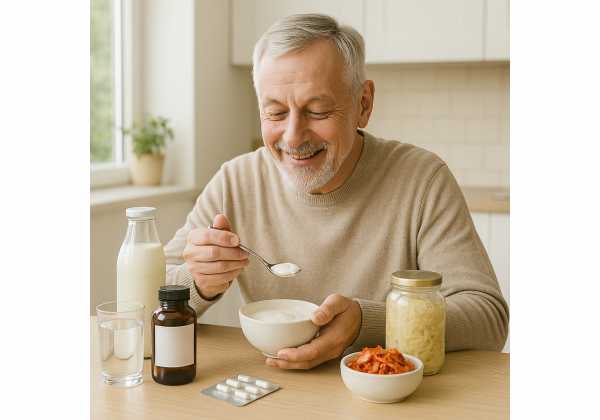
Fermented foods and probiotic supplements overlap, but they are not the same. Yogurt or kefir with live cultures may help lactose digestion and increase dietary quality. Kimchi, sauerkraut, miso, tempeh, and some fermented vegetables add flavor and microbial exposure, although many products do not list clinically tested strains. Heat-treated fermented foods still offer nutrients and flavor, but they do not deliver live probiotics unless live microbes remain in the final product.
Fermented foods work best as part of a meal pattern, not as a spoonful of medicine. A simple approach is to add plain yogurt with berries, kefir in a smoothie, miso in soup after cooking heat has lowered, or a small serving of sauerkraut with a protein-rich meal. People with high blood pressure should watch sodium in brined vegetables and choose lower-salt options when needed. A practical food-first route is covered in fermented foods and healthy aging.
Prebiotics are different. They are compounds used by beneficial microbes. Common examples include inulin, fructo-oligosaccharides, galacto-oligosaccharides, resistant starch, beta-glucans, and some fibers in legumes, oats, onions, garlic, asparagus, green bananas, cooked-and-cooled potatoes, and cooked-and-cooled rice. Prebiotics often create a stronger long-term shift than probiotics because they feed resident microbes every day. They also cause gas when increased too quickly. A gradual increase over 2 to 4 weeks works better than a sudden high-dose powder.
Synbiotics combine probiotics and prebiotics. The best synbiotic formulas match the microbe with a substrate it can use or combine both ingredients for a documented effect. Randomly adding inulin to a probiotic does not make it superior. People with IBS, small intestinal bacterial overgrowth, or major bloating often tolerate low-dose synbiotics better than high-dose formulas.
Postbiotics are preparations of inactivated microbes, microbial fragments, or metabolites that provide a benefit. They are not “dead probiotics” in a casual sense; they need their own evidence. Postbiotics appeal to researchers because they may offer stability and safety advantages, especially for people who should avoid live microbes. For supplement comparisons, prebiotics and postbiotics for longevity helps separate these categories.
A food-first gut plan also supports polyphenol intake. Berries, cocoa, coffee, tea, olives, herbs, spices, beans, and colorful vegetables feed microbial networks and produce metabolites that interact with inflammation and vascular function. The strongest gut strategy usually combines fibers, polyphenols, fermented foods, and enough protein rather than relying on a capsule alone.
Safety, Side Effects, and Who Should Be Careful
Probiotics are generally well tolerated in healthy adults. The most common side effects are gas, bloating, mild cramping, and temporary stool changes during the first several days. These effects often improve when the dose is reduced or taken with food.
Some people need medical guidance before using live microbial supplements. Caution is especially important for:
- Severe immune suppression from chemotherapy, transplant drugs, advanced HIV, high-dose steroids, or biologic immune therapies
- Central venous catheters or ports
- Recent major surgery or critical illness
- Short bowel syndrome or severe intestinal barrier problems
- Active pancreatitis
- Severe heart valve disease with infection risk concerns
- Recurrent bloodstream infections or unexplained fever
- Premature infants, unless under specialist care
The concern is rare but serious infection from probiotic organisms or contamination. Saccharomyces boulardii, for example, has a long history of use but has also been linked to bloodstream infection in vulnerable patients. High-risk people should not open capsules or mix probiotic powders near central lines.
Quality also affects safety. Dietary supplements are not regulated like prescription drugs. Products can differ in identity, potency, contamination control, and storage stability. Choose brands that provide strain-level labeling, expiration-date potency, lot numbers, and quality testing.
People with histamine intolerance sometimes react to fermented foods or certain probiotic strains. Symptoms may include flushing, headaches, itching, nasal congestion, or digestive discomfort after fermented products. This does not mean all probiotics are off-limits, but it supports a slower and more selective trial.
People with small intestinal bacterial overgrowth often feel worse with probiotics or prebiotic blends, especially formulas that include fermentable fibers. In that case, bloating, belching, pressure, or diarrhea soon after starting a product is a reason to stop and reassess.
Medication interactions are uncommon, but context matters. Anyone using probiotics during antibiotic treatment, immunosuppressive therapy, cancer treatment, or hospitalization should involve a clinician. For broader supplement planning, working with clinicians on longevity goals helps keep labs, medications, and risks connected.
A Simple Probiotic Trial Plan
A probiotic trial should answer one question at a time. The question should be concrete: “Does this strain improve stool frequency?” works better than “Does this improve my gut health?”
Start with a baseline week. Track the main symptom before taking anything. For constipation, track bowel movements per week, stool form, straining, and rescue laxative use. For bloating, track severity after meals and evening abdominal distension. For antibiotic use, track stool frequency, urgency, and diarrhea days. For general immune support, track respiratory infection days over a season, not daily feelings.
Then choose one product matched to that outcome. Avoid starting a probiotic at the same time as a new magnesium powder, fiber supplement, fasting routine, or major diet change. Too many changes make results impossible to interpret.
A reasonable trial looks like this:
- Pick one main outcome and write it down.
- Record symptoms for 7 days before starting.
- Take the product as labeled for 4 weeks, unless side effects are significant.
- Keep diet, fiber, medications, and exercise as stable as practical.
- Compare the final 7 days with the baseline week.
- Continue only if the benefit is clear enough to justify cost and effort.
Some outcomes need longer. Constipation and bloating often show signals within 2 to 4 weeks. Cognitive, inflammatory, or immune outcomes usually need 8 to 12 weeks in research settings, and even then the result may not be noticeable without formal testing. For everyday use, a supplement that produces no clear symptom or measurable benefit after a fair trial should be stopped.
Dosing should stay close to the studied or labeled dose. Doubling or tripling a probiotic rarely improves the answer and often increases gas. Starting with half the labeled dose for several days is reasonable for sensitive people, then increasing if tolerated.
A probiotic is worth keeping when it produces a clear improvement: fewer diarrhea days during antibiotics, more comfortable bowel movements, less bloating, improved stool consistency, or a measurable marker that improves alongside a clinician-guided plan. It is not worth keeping because the label promises “balance,” “detox,” “immunity,” or “longevity.”
The most durable gut plan remains simple: eat enough fiber, include legumes and plants regularly, use fermented foods if tolerated, stay active, hydrate, sleep well, manage medications that slow the bowel, and treat real disease. Probiotics add value when they are chosen with the same discipline used for any longevity supplement: a reason, a dose, a timeframe, and a clear decision point.
References
- World Gastroenterology Organisation Global Guidelines: Probiotics and Prebiotics 2024 (Guideline)
- Probiotics – Health Professional Fact Sheet 2025 (Official Fact Sheet)
- Efficacy and Safety of Probiotics in Geriatric Patients with Constipation: Systematic Review and Meta-Analysis 2023 (Systematic Review)
- Probiotic supplementation has sex-dependent effects on immune responses in association with the gut microbiota in community-dwelling older adults: a randomized, double-blind, placebo-controlled, multicenter trial 2023 (RCT)
- The gut microbiome, mild cognitive impairment, and probiotics: A randomized clinical trial in middle-aged and older adults 2022 (RCT)
- Probiotic-Reduced Inflammaging in Older Adults: A Randomized, Double-Blind, Placebo-Controlled Trial 2025 (RCT)
Disclaimer
This article is educational and does not replace care from a qualified health professional. People with immune suppression, central venous catheters, serious illness, recent surgery, recurrent infections, or complex gastrointestinal disease should seek medical guidance before using live probiotic supplements. Stop a probiotic and get medical advice if it causes fever, worsening abdominal pain, persistent diarrhea, allergic symptoms, or unusual illness.