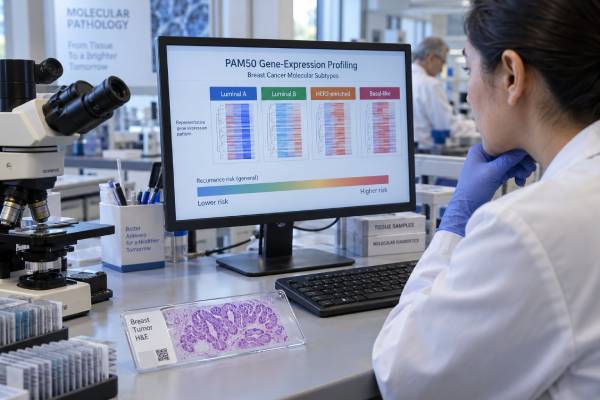
The Prosigna PAM50 test is a gene-expression assay used in selected patients with early-stage, hormone receptor-positive breast cancer to estimate the risk of distant recurrence and describe the tumor’s intrinsic molecular subtype. It measures the activity of 50 breast cancer genes in preserved tumor tissue and combines that biology with clinical information to generate a Risk of Recurrence, or ROR, score from 0 to 100. The assay also classifies the tumor as Luminal A, Luminal B, HER2-enriched, or Basal-like. Prosigna is primarily a prognostic test: it helps estimate how likely the cancer is to return at a distant site over about 10 years in the populations for which it was validated. It is not a hereditary genetic test, does not diagnose metastatic disease, and should not be treated as a stand-alone chemotherapy prescription. Menopausal status, lymph-node involvement, tumor size, grade, ER/PR/HER2 results, and local guideline recommendations all affect whether the test is appropriate and how the score is interpreted.
- Prosigna measures tumor RNA expression using the PAM50 gene set and reports an intrinsic molecular subtype.
- The Risk of Recurrence score ranges from 0 to 100; higher scores generally indicate greater distant-recurrence risk.
- Risk categories depend on lymph-node status and can differ by regulatory labeling or regional implementation.
- The strongest routine clinical use is in postmenopausal, hormone receptor-positive early breast cancer.
- Prosigna is prognostic and should be combined with clinical risk factors rather than used as a stand-alone chemotherapy rule.
Table of Contents
- What Prosigna PAM50 measures
- What the PAM50 molecular subtypes mean
- How the Risk of Recurrence score is interpreted
- Who may be considered for Prosigna testing
- How Prosigna can inform treatment decisions
- How the test is performed and reported
- Questions to ask after receiving a Prosigna result
What Prosigna PAM50 measures
Prosigna is a tumor gene-expression test. It analyzes messenger RNA from formalin-fixed, paraffin-embedded invasive breast cancer tissue. The core PAM50 signature measures 50 genes that capture patterns related to hormone signaling, HER2 biology, proliferation, and other features of breast cancer.
The assay also uses housekeeping genes for normalization and laboratory controls to make sure the run is technically valid. Unlike tests that amplify selected DNA mutations, Prosigna measures gene-expression patterns. It therefore describes the tumor’s active biological program rather than looking for an inherited cancer-risk variant.
The test produces two closely related types of information:
- an intrinsic subtype based on PAM50 gene-expression similarity; and
- a numerical Risk of Recurrence score that incorporates molecular information and clinical variables.
The ROR calculation reflects the tumor’s molecular subtype and proliferation-related expression, and clinical implementation also considers tumor size and nodal status. The goal is to refine recurrence prognosis beyond routine pathology alone.
Prosigna does not replace the standard breast cancer biomarker panel. ER, PR, HER2, tumor grade, size, and lymph nodes are established first. The assay is considered only when additional genomic prognostic information could affect an adjuvant treatment decision.
It is also not a germline test. If family history or age at diagnosis suggests inherited susceptibility, blood or saliva testing for genes such as BRCA1, BRCA2, PALB2, CHEK2, or ATM is a separate process. The PAM50 result describes the breast tumor and does not tell relatives whether they inherited a cancer-risk variant.
What the PAM50 molecular subtypes mean
PAM50 classifies breast cancers into four intrinsic molecular subtypes: Luminal A, Luminal B, HER2-enriched, and Basal-like. These subtypes were originally defined from gene-expression patterns and are not identical to the simpler categories assigned by ER, PR, HER2, and Ki-67 immunohistochemistry.
Luminal A
Luminal A tumors generally show strong hormone-related gene expression and lower proliferation. In hormone receptor-positive early breast cancer, Luminal A is usually associated with a more favorable prognosis than Luminal B. Many Luminal A tumors are ER-positive and HER2-negative by standard pathology, but the molecular label comes from the expression pattern rather than receptor staining alone.
Luminal B
Luminal B tumors also have luminal or hormone-related biology but usually show greater proliferation and a higher recurrence risk than Luminal A. A tumor can be ER-positive by IHC and still be Luminal B by PAM50. The molecular subtype may therefore add prognostic information beyond simply calling the cancer “hormone receptor-positive.”
HER2-enriched
HER2-enriched is a gene-expression subtype, not the same as HER2-positive pathology. Some HER2-positive tumors are HER2-enriched, but a tumor classified as HER2-enriched by PAM50 is not automatically eligible for HER2-targeted therapy. Drug eligibility still depends on validated HER2 IHC and/or ISH testing under current HER2 guidelines.
Basal-like
Basal-like tumors have a gene-expression pattern often seen in triple-negative breast cancer, but the terms are not interchangeable. A hormone receptor-positive tumor can occasionally have a non-luminal PAM50 subtype. The clinical receptor results remain the basis for defining hormone receptor and HER2 status.
This distinction prevents a common mistake: intrinsic subtype is a molecular classification, whereas ER/PR/HER2 status is a validated clinical biomarker classification. One cannot be substituted for the other when choosing endocrine or HER2-directed therapy.
The subtype also contributes to the ROR score. In general, Luminal A biology tends to lower the genomic risk estimate, while Luminal B and non-luminal patterns tend to raise it, but the final ROR score is not determined by subtype alone.
How the Risk of Recurrence score is interpreted
The Prosigna Risk of Recurrence score runs from 0 to 100. A higher score indicates a greater estimated risk of distant recurrence in the validated population. The score is not the same as a direct percentage of recurrence. A ROR of 35, for example, does not mean there is a 35% chance that cancer will return.
The report translates the score into a risk category using nodal status. This is an area where readers should pay attention to the exact report because category cutoffs can differ across regulatory versions and regions.
In the U.S. FDA-cleared labeling, node-negative disease is classified as:
- Low: ROR 0–40
- Intermediate: ROR 41–60
- High: ROR 61–100
For one to three positive nodes, the original U.S. cleared labeling uses Low at 0–40 and High at 41–100. In some current non-U.S. implementations, including descriptions used by NICE, one to three positive nodes may be subdivided as Low 0–15, Intermediate 16–40, and High 41–100. Patients should therefore use the risk category printed on their validated report rather than applying a cutoff found on another country’s website.
| ROR feature | What it tells you | What it does not tell you |
|---|---|---|
| 0–100 score | Relative genomic/clinical recurrence-risk position | Not a direct percent chance of recurrence |
| Risk category | Low, intermediate, or high group according to the validated scheme | Not a treatment order by itself |
| Intrinsic subtype | Molecular expression pattern | Does not replace ER, PR, or HER2 IHC/ISH |
| Estimated distant-recurrence risk | Prognostic estimate for a defined endocrine-treated population | Cannot guarantee an individual outcome |
Prosigna was validated largely around 10-year distant recurrence in postmenopausal patients receiving endocrine therapy. The result should therefore be understood as a prognosis estimate under a defined treatment context, not as the natural history of untreated cancer.
Clinical variables still matter. Two tumors with the same molecular expression pattern can have different overall risk because a larger tumor or involved lymph nodes increase the clinical burden of disease.
Who may be considered for Prosigna testing
The test is most established for postmenopausal patients with hormone receptor-positive early breast cancer after surgery, particularly when the question is whether recurrence risk is low enough that adjuvant treatment can be limited to endocrine therapy or whether chemotherapy should be discussed.
ASCO’s 2022 biomarker guideline states that clinicians may use Prosigna to guide adjuvant systemic chemotherapy decisions in postmenopausal patients with node-negative disease. For postmenopausal patients with one to three positive nodes, ASCO judged the evidence inconclusive for routine chemotherapy guidance. It recommends against using Prosigna to guide chemotherapy in premenopausal patients because evidence is insufficient.
NICE’s 2024 guidance takes a somewhat different approach. It allows Prosigna as an option alongside clinical risk factors in certain postmenopausal people with one to three positive nodes and, with evidence-generation conditions, in selected node-negative disease. These differences show why local guidelines and payer rules should be checked rather than assuming one universal eligibility rule.
The strongest practical candidates are people whose standard pathology leaves genuine uncertainty. If a tumor is clearly very low clinical risk, a genomic assay may not change treatment. If disease is clearly high risk because of extensive nodal involvement or other features, a favorable genomic score may not be sufficient to justify omitting chemotherapy.
For four or more positive nodes, current evidence does not support using Prosigna to override the high clinical risk and withhold chemotherapy. The original U.S. indication does not include that group for prognostic use, and modern guidelines do not support routine genomic-assay de-escalation in extensive node-positive disease.
Prosigna is also not generally used to guide treatment in HER2-positive or triple-negative breast cancer. Although PAM50 can assign HER2-enriched or Basal-like subtypes, those molecular labels do not create the validated clinical use of the assay for those treatment pathways.
How Prosigna can inform treatment decisions
Prosigna is primarily prognostic. It estimates recurrence risk; it was not FDA-cleared as a direct predictor of response to a specific therapy. That is different from a biomarker that has demonstrated a treatment-by-marker interaction showing that one group receives more relative benefit from chemotherapy.
This distinction is important when comparing genomic tests. The Oncotype DX Breast Recurrence Score has prospective randomized evidence used to identify groups with differing chemotherapy benefit in node-negative and limited node-positive disease. Prosigna has strong evidence for recurrence prognosis, but chemotherapy decisions should not assume that a high ROR directly measures chemotherapy sensitivity.
In practice, the result can still influence whether chemotherapy is worthwhile. A low ROR in an otherwise appropriate postmenopausal, hormone receptor-positive patient can strengthen the case that endocrine therapy alone may be sufficient. A high ROR can show that the disease carries substantial residual recurrence risk despite favorable hormone receptor status and may strengthen the discussion of additional systemic treatment.
The result may also help distinguish biological risk within tumors that look similar under the microscope. Two ER-positive, HER2-negative, node-negative cancers of similar size can have different PAM50 subtypes and ROR scores, reflecting different gene-expression programs.
At the same time, treatment decisions should include:
- age and menopausal status;
- tumor size and histologic grade;
- number of involved nodes;
- ER and PR levels;
- HER2 status;
- other medical conditions;
- expected absolute chemotherapy benefit;
- toxicity and fertility considerations; and
- the patient’s priorities.
Prosigna is not designed to decide the duration of endocrine therapy by itself. Hormone receptor-positive breast cancer can recur after 10 years, and extended endocrine treatment decisions involve nodal status, tumor features, tolerability, bone health, and sometimes other validated assays.
It also does not replace tests for acquired metastatic resistance. If cancer later recurs, biomarkers such as ESR1 or PIK3CA may become relevant. The original PAM50/ROR report remains useful historical prognostic information but is not a complete molecular roadmap for metastatic treatment.
How the test is performed and reported
Prosigna uses RNA extracted from formalin-fixed, paraffin-embedded invasive breast tumor tissue. It can be performed on archived surgical tissue after the pathology diagnosis is established. The assay uses the NanoString nCounter system to count RNA molecules with fluorescently coded probes without the same amplification approach used by conventional PCR assays.
The pathology laboratory selects a representative area of invasive tumor and checks that the sample meets assay requirements. Excess normal tissue or insufficient invasive tumor can reduce analytical reliability, so tumor content and specimen preparation matter.
A typical Prosigna report may include:
- the PAM50 intrinsic subtype;
- the numerical ROR score from 0 to 100;
- a risk category based on the validated nodal-status scheme;
- an estimated 10-year probability or risk of distant recurrence for the relevant population; and
- the clinical inputs used in the calculation, such as tumor size and nodal status.
The oncology team should verify that the report used the correct nodal information. If a test was ordered before final axillary staging or if nodal status was later revised, the risk interpretation may need review.
The sample does not usually require a new operation. Existing tumor tissue can often be used. Turnaround depends on the laboratory and health system; one advantage of the Prosigna platform is that qualified laboratories can run the assay locally when they have the validated nCounter Dx system.
A report should be retained with the medical record. Because risk-category cutoffs and guideline uses differ across jurisdictions, keeping the original report prevents later misclassification based on a cutoff copied from a different version of the assay.
Questions to ask after receiving a Prosigna result
A Prosigna report has several layers, so the most useful discussion is not simply “Is my score high or low?” Ask how the result changes the treatment recommendation compared with clinical pathology alone.
Helpful questions include:
- What is my exact ROR score from 0 to 100?
- Which risk category does my laboratory report assign, and what cutoff system is it using?
- What is my PAM50 intrinsic subtype?
- What estimated 10-year distant-recurrence risk does the report provide?
- Is that estimate based on endocrine therapy, and what endocrine treatment is planned for me?
- How do tumor size, grade, and lymph-node status change the interpretation?
- Am I in a postmenopausal group for which guidelines support using Prosigna to inform chemotherapy decisions?
- Is the test being used mainly for prognosis, or is there direct evidence that it predicts chemotherapy benefit in my situation?
- Would a different genomic assay be more appropriate for the exact clinical question?
- If the result is low risk, what remaining recurrence risk still exists and how will follow-up be managed?
A low ROR score can be reassuring in the right clinical population, but it does not mean recurrence is impossible. A high score indicates greater prognostic risk, but it does not guarantee that recurrence will happen or quantify exactly how much chemotherapy will help one person.
The best interpretation combines molecular subtype, ROR score, nodal status, and ordinary pathology. Prosigna adds a more detailed view of tumor biology; it does not replace the clinical context that gives that biology meaning.
Prosigna is a prognostic decision aid, not a surveillance marker. Its ROR score is calculated from the original tumor biology and clinical inputs used by the validated assay; it is not meant to rise or fall during routine follow-up. A later symptom, imaging finding, or new breast lesion should be evaluated directly rather than by repeating Prosigna to look for recurrence.
References
- Biomarkers for Adjuvant Endocrine and Chemotherapy in Early-Stage Breast Cancer: ASCO Guideline Update 2022 (Guideline)
- Tumour profiling tests to guide adjuvant chemotherapy decisions in early breast cancer 2024 (Guideline)
- Biomarkers in breast cancer 2024: an updated consensus statement by the Spanish Society of Medical Oncology and the Spanish Society of Pathology 2024 (Consensus)
- Prosigna Risk of Recurrence score and intrinsic subtypes are associated with adjuvant anthracycline chemotherapy benefit in high-risk breast cancer 2025
- 510(k) Premarket Notification 2013 (FDA Device Record)
- PAM50 Risk of Recurrence Score Predicts 10-Year Distant Recurrence in a Comprehensive Danish Cohort of Postmenopausal Women Allocated to 5 Years of Endocrine Therapy for Hormone Receptor-Positive Early Breast Cancer 2018
Disclaimer
This article is for general education and does not replace individualized advice from a breast oncology team. Prosigna should be interpreted only in the clinical population and regulatory setting for which the test and local guidelines support its use. Do not start, stop, or decline chemotherapy or endocrine therapy based on a PAM50 subtype or ROR score alone.