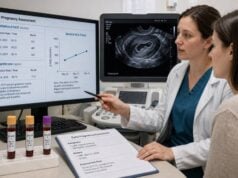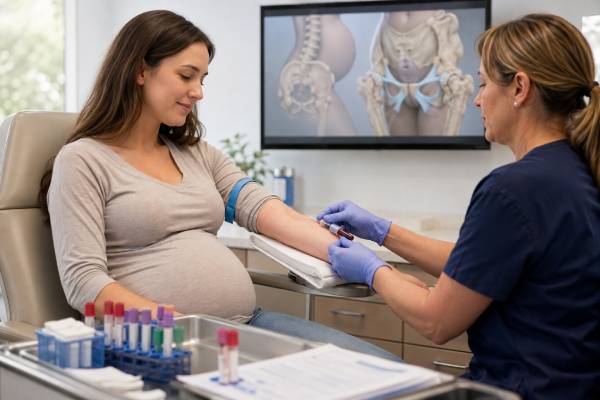
Relaxin is a peptide hormone produced mainly by the corpus luteum during human pregnancy, with additional local production reported in reproductive tissues. It participates in cardiovascular and renal adaptation, connective-tissue remodeling, and preparation of the cervix and birth canal. Despite its biologic importance, a relaxin blood test is not a standard prenatal test. Most hospitals and commercial laboratories do not use serum relaxin to confirm pregnancy, assess fetal well-being, diagnose pelvic girdle pain, predict labor, or determine whether pelvic joints are “too loose.” Research assays may measure relaxin-2, but methods and reference intervals are not standardized for routine care. Levels vary with gestational age, corpus-luteum number, assisted reproduction, and multiple pregnancy. Pelvic pain is multifactorial, and studies have not established a dependable blood cutoff that explains symptoms or guides treatment. When testing is available, results should be interpreted by a specialist within the exact research or clinical context rather than compared with general online ranges.
- Relaxin supports several maternal adaptations, especially early vascular and renal changes.
- Serum relaxin testing is uncommon and is not part of routine prenatal screening.
- There is no universal pregnancy reference range or diagnostic cutoff for pelvic girdle pain.
- IVF, ovarian stimulation, corpus-luteum number, and twin pregnancy can alter measured levels.
- Pelvic pain, instability, or walking difficulty should be assessed clinically, not diagnosed from relaxin alone.
Table of Contents
- What Relaxin Is and Where It Comes From
- What Relaxin Does During Pregnancy
- When a Relaxin Blood Test May Be Used
- Sample Timing, Methods, and Reference Ranges
- Relaxin and Pelvic Girdle Changes
- Interpreting Low, Normal, or High Results
- Fertility Treatment, Twins, and Special Situations
- Clinical Evaluation and Safe Next Steps
What Relaxin Is and Where It Comes From
Relaxin belongs to the insulin-like peptide family. Humans have several relaxin-family genes, but circulating relaxin-2 is the form most often discussed in pregnancy. It acts mainly through the RXFP1 receptor, which is present in blood vessels, connective tissue, reproductive organs, kidneys, and other tissues.
In spontaneous pregnancy, the corpus luteum is the major source of circulating relaxin. hCG stimulates the corpus luteum after implantation, supporting production of progesterone, estradiol, and relaxin. Relaxin has also been identified in the decidua, placenta, chorion, and other reproductive tissues, where local effects may occur even when circulating concentrations are low.
Maternal serum relaxin generally rises in the first trimester, when corpus-luteum activity is prominent, and then declines or plateaus later. This pattern differs from hormones such as progesterone and estrogen, which continue to be produced in large amounts by the placenta.
The source matters clinically. Pregnancies achieved with donor eggs in cycles without a functioning corpus luteum may have little or no circulating relaxin, yet successful pregnancy and birth can still occur. This observation shows that a detectable serum level is not required as a routine marker of pregnancy viability.
Relaxin is sometimes described simply as the hormone that “loosens joints.” That phrase is incomplete. Its effects include vascular dilation, kidney adaptation, extracellular-matrix remodeling, and changes in reproductive tissues. Human pelvic stability depends on muscles, ligaments, joint surfaces, posture, load, prior injury, pain processing, and movement patterns—not one hormone alone.
The hormone should not be confused with recombinant serelaxin, an investigational or therapeutic form studied mainly in cardiovascular medicine. A pregnancy relaxin assay measures endogenous hormone and is not a medication-monitoring test in ordinary prenatal care.
What Relaxin Does During Pregnancy
Early pregnancy requires major cardiovascular adaptation. Systemic vascular resistance falls, cardiac output rises, and renal plasma flow and glomerular filtration increase. Relaxin contributes to vasodilation through endothelial pathways that include nitric oxide and changes in arterial compliance. These effects help the maternal circulation accommodate pregnancy.
Relaxin also influences water balance and the renin-angiotensin system. Its actions interact with progesterone, estrogen, aldosterone, and other mediators. No single hormone independently controls the entire physiologic shift.
In connective tissue, relaxin can affect collagen turnover, matrix metalloproteinases, and tissue remodeling. Animal studies show pronounced cervical softening and pubic-symphysis changes. Human physiology is more complex, and the magnitude of circulating relaxin does not reliably predict the degree of pelvic joint motion.
Possible reproductive roles include:
- supporting uterine and placental vascular adaptation;
- influencing decidual and fetal-membrane biology;
- contributing to cervical remodeling near birth;
- modulating uterine contractility in some settings;
- affecting connective-tissue compliance.
These actions are mostly inferred from laboratory, animal, and observational human studies. They do not create a validated clinical indication for measuring serum relaxin in an uncomplicated pregnancy.
Relaxin’s role may also depend on timing and tissue receptor activity. A blood concentration does not show how strongly a particular ligament, artery, kidney, or cervix is responding. Receptor expression, local production, other hormones, and mechanical forces all influence the effect.
Because the hormone participates in normal adaptation, a result outside a research reference interval does not automatically indicate disease. Likewise, symptoms such as pelvic pain do not prove that relaxin is high. The relationship between systemic concentration and a local musculoskeletal symptom is indirect.
When a Relaxin Blood Test May Be Used
Relaxin measurement is used mainly in research. Studies may examine maternal cardiovascular adaptation, renal function, preeclampsia, fertility treatment, multiple gestation, preterm birth, connective-tissue biology, or the effects of having no corpus luteum after assisted reproduction.
A specialist laboratory may offer relaxin-2 testing as a laboratory-developed or research-use assay. Availability does not mean the test has an established prenatal indication. Before ordering, the clinician should define what decision the result would change and whether a validated reference population exists.
Relaxin is not ordinarily used to:
- confirm pregnancy;
- assess miscarriage or ectopic-pregnancy risk;
- determine gestational age;
- screen for fetal chromosome conditions;
- evaluate placental function;
- predict when labor will begin;
- diagnose pelvic girdle pain or pubic-symphysis separation;
- decide whether vaginal birth is safe.
Other tools answer these questions more directly. hCG confirms and tracks early pregnancy; ultrasound assesses location and development; prenatal serum or cell-free DNA tests estimate chromosome risk; blood pressure and ultrasound assess placental complications; physical examination and imaging evaluate severe pelvic disorders.
A patient may encounter a relaxin result through a research study or specialty reproductive-endocrinology program. In that setting, interpretation should come from the investigators or laboratory because assay calibration, sample handling, gestational windows, and study-specific units may differ.
Direct-to-consumer hormone panels sometimes include uncommon analytes without evidence that they improve pregnancy care. A numeric result can create concern but may have no validated clinical action. Ask whether the assay is approved or validated for pregnancy, what reference interval was used, and what medical decision follows from the answer.
Sample Timing, Methods, and Reference Ranges
When measured, relaxin is usually tested in serum or plasma collected from a vein. Fasting requirements depend on the laboratory or research protocol rather than on a broadly accepted clinical standard. Sample handling can matter because peptide hormones may require prompt processing, specific tubes, freezing, or batch analysis.
Research assays often use immunoassay techniques such as enzyme-linked immunosorbent assays. Different kits may recognize different molecular forms, use different calibrators, and report different units. Results from one method cannot be assumed equivalent to another.
There is no universal trimester-by-trimester reference range accepted for routine obstetric care. Published concentrations vary substantially among studies because of:
- assay design and detection limits;
- gestational age at collection;
- natural conception versus fertility treatment;
- number of corpora lutea;
- singleton versus multiple pregnancy;
- fresh versus frozen embryo-transfer protocol;
- sample storage and processing;
- population characteristics.
A report may use picograms per milliliter, nanograms per liter, or another unit. Unit conversion is possible only when the molecular form and scale are clear. An isolated online range should not be applied to a result from an unfamiliar assay.
Timing is especially important in early pregnancy. Relaxin tends to reflect corpus-luteum activity, so levels may be highest when one or more corpora lutea are actively stimulated by hCG. Later measurements may decline even in a healthy pregnancy. A falling result is therefore not interpreted like falling hCG.
Repeated testing has no standard target rise, doubling time, or minimum decline. Without a protocol, serial measurements can produce numbers that look dynamic but have no validated clinical meaning. If testing was ordered for research, the study protocol—not general prenatal advice—governs collection and interpretation.
Relaxin and Pelvic Girdle Changes
Pregnancy-related pelvic girdle pain can involve the sacroiliac joints, pubic symphysis, buttocks, groin, hips, or thighs. Symptoms may worsen with walking, stairs, turning in bed, standing on one leg, getting into a car, or separating the legs. The condition can range from mild discomfort to substantial mobility limitation.
Relaxin is biologically plausible as one contributor because it influences connective-tissue remodeling. However, systematic reviews have not shown a consistent, clinically useful relationship between serum relaxin concentration and pelvic girdle pain. Some studies find associations; others do not. Differences in timing, assay, pain definitions, and study size limit conclusions.
Mechanical and clinical factors are often more useful. Prior low-back or pelvic pain, previous pelvic trauma, altered movement patterns, muscle function, workload, joint irritation, and individual pain sensitivity may contribute. Pregnancy-related changes in body mass, posture, and center of gravity add load.
A blood test cannot determine whether the pubic symphysis is pathologically separated. Severe focal pubic pain, a waddling gait, clicking, inability to bear weight, or postpartum onset may require physical examination and imaging. Peripartum pubic-symphysis diastasis is uncommon and is diagnosed from symptoms plus measured separation, not from relaxin.
Management of ordinary pelvic girdle pain may include activity modification, pelvic-health physiotherapy, individualized exercise, support belts, sleep-position adjustments, and pregnancy-compatible pain relief recommended by a clinician. Prolonged bed rest is generally avoided because it can cause deconditioning and increase thrombosis risk.
The idea that all joints become dangerously loose is misleading. Pregnancy produces modest normal changes, while muscles and neuromuscular control continue to stabilize the pelvis. Symptoms deserve validation and care, but an unmeasured or presumed “high relaxin” should not be used as the sole explanation.
Interpreting Low, Normal, or High Results
Because routine reference intervals and outcome thresholds are lacking, labels such as low, normal, and high are assay-specific. The first task is to identify why the test was ordered and which comparison group the laboratory used.
A lower result can occur when there is no corpus luteum, such as some programmed donor-egg or frozen embryo-transfer cycles. It may also reflect later gestation, assay sensitivity, or ordinary biological variation. Low serum relaxin does not diagnose placental insufficiency, miscarriage risk, or inadequate pelvic preparation.
A higher result may reflect more than one corpus luteum after ovarian stimulation, a twin pregnancy, or timing during the first-trimester peak. It does not prove multiple gestation, predict preterm birth, or establish that pelvic ligaments are excessively lax.
Research has explored relaxin in preeclampsia, cardiovascular disease, and preterm birth, but no single cutoff has adequate validation for routine prediction or treatment. A result should not replace established monitoring such as blood pressure, urine or blood testing, fetal growth ultrasound, cervical assessment, or symptom review.
When reading a report, ask:
- Is this relaxin-2 or another relaxin-family analyte?
- Was the sample serum or plasma?
- Which assay and units were used?
- What gestational-age reference group was applied?
- Was conception spontaneous or assisted?
- How many corpora lutea and fetuses are present?
- Is the test for research only?
- What evidence links this result to a clinical action?
If the answer to the final question is unclear, the safest response is usually not to repeat the test or pursue unproven treatment. Clinical symptoms and established prenatal assessments should guide care.
Fertility Treatment, Twins, and Special Situations
Assisted reproduction creates distinct relaxin patterns. Ovarian stimulation may produce multiple corpora lutea, increasing circulating relaxin. A programmed frozen embryo-transfer cycle may use estrogen and progesterone without ovulation, leaving no corpus luteum and little endogenous circulating relaxin.
These differences have become a research focus because corpus-luteum absence may influence vascular adaptation. Studies are investigating whether relaxin contributes to differences in hypertensive-disorder risk among fertility protocols. This work has not established a routine relaxin test or a treatment target.
Twin gestations can have higher or different trajectories, particularly when ovarian stimulation creates more than one corpus luteum. A 2025 prospective cohort examined serum relaxin-2 across twin pregnancies and mode of conception, illustrating how reproductive method affects the biomarker. The findings should not be converted into a universal twin reference range without assay-specific validation.
The number of fetuses and the number of corpora lutea are not always the same. A single embryo can follow stimulation with multiple corpora lutea, while a programmed cycle can support pregnancy without one. This distinction helps explain why relaxin cannot diagnose twins.
Other special situations include corpus-luteum cysts, ovarian surgery, donor eggs, and medications that alter ovarian function. Progesterone supplementation does not necessarily restore relaxin because they are different hormones.
After birth, circulating relaxin falls as pregnancy-related sources and stimulation resolve. Persistent pelvic pain postpartum should not simply be attributed to residual hormone. Musculoskeletal injury, pubic-symphysis diastasis, pelvic-floor dysfunction, nerve irritation, and other causes may require assessment.
Research findings can be valuable without being ready for routine care. A specialist should explain whether a result is exploratory, whether it has been associated with outcomes, and whether any intervention has been proven to improve those outcomes.
Clinical Evaluation and Safe Next Steps
For most patients, no relaxin blood test is needed. Concerns should be matched to established assessments. Pregnancy confirmation and early progression use hCG and ultrasound. Pelvic pain uses history, physical examination, functional assessment, and imaging when indicated. Hypertensive disorders use blood pressure, symptoms, laboratory tests, and fetal surveillance.
Seek prompt obstetric or emergency assessment for vaginal bleeding with severe pain, faintness, chest pain, shortness of breath, new leg swelling, severe headache, visual changes, right-upper-abdominal pain, fluid leakage, contractions, or reduced fetal movement. These symptoms should never be attributed to relaxin without evaluation.
For pelvic symptoms, contact a clinician when pain limits walking, sleep, work, or daily activity; when there is numbness or weakness; when bladder or bowel control changes; or when fever, trauma, or inability to bear weight is present. Early pelvic-health physiotherapy can be helpful.
Avoid unproven supplements or hormone products marketed to “balance relaxin.” No routine treatment is designed to lower or raise maternal relaxin. Products that alter hormones may be unsafe in pregnancy and can distract from the actual cause of symptoms.
When an uncommon test has already been performed, bring the complete report to an obstetric clinician or reproductive endocrinologist. Include the assay name, reference interval, gestational age, conception method, medications, number of fetuses, and reason for testing. A specialist may conclude that no action is necessary.
Relaxin is physiologically important but clinically difficult to measure and interpret. Biological significance does not automatically create a useful screening test. Symptoms and established prenatal findings should guide care, while serum relaxin remains primarily a research biomarker.
The absence of a routine test does not mean pelvic symptoms should be dismissed. Pregnancy-related pelvic girdle pain can have major effects on sleep, mobility, work, caregiving, and mental health. Clinical assessment can identify movement triggers, gait changes, muscle weakness, joint tenderness, neurologic signs, and functional limitations. Treatment can then be individualized without needing a hormone cutoff.
Exercise advice should be symptom-responsive. General prenatal activity remains beneficial for most patients, but painful asymmetrical loading, wide leg separation, or repeated single-leg tasks may need modification. A pelvic-health physiotherapist can teach transfers, stair strategies, bed mobility, and strengthening that protects function. A support belt may help some patients but should be fitted and assessed rather than used as proof that the pelvis is unstable.
Imaging is not routinely required for typical pelvic girdle pain, yet it becomes important after trauma, inability to bear weight, severe focal pubic pain, fever, neurologic deficits, or suspected symphysis diastasis. Ultrasound, radiography, or MRI may be selected according to gestational or postpartum status and the suspected condition. The measured anatomy, not serum relaxin, determines whether pathologic separation is present.
Cardiovascular and renal research on relaxin should also be interpreted carefully. A biologic role in vasodilation does not mean that a low assay result diagnoses preeclampsia or that giving relaxin would prevent it. Clinical trials and validated thresholds would be required before such use. Current prenatal care relies on established risk assessment, blood pressure, symptoms, laboratory evaluation, and fetal surveillance.
Commercial claims may describe relaxin as a direct predictor of labor or flexibility. Human labor is coordinated by many endocrine, inflammatory, cervical, uterine, and fetal signals. Serum relaxin has not become a reliable clock for delivery. Joint flexibility also varies with anatomy, training, prior injury, and other hormones.
After delivery, persistent pain warrants reassessment rather than waiting for hormones to “leave the body.” Early rehabilitation, pain management, and evaluation for diastasis or other injury can improve recovery. Severe pain, urinary retention, a palpable gap, or inability to walk requires prompt care.
Research reference ranges are often created from small cohorts and may exclude patients with obesity, chronic disease, fertility treatment, or multiple pregnancy. A value outside such a range may reflect population mismatch rather than pathology. Before labeling it abnormal, the ordering specialist should compare the patient with the study population and confirm that the same assay was used. This is another reason routine clinical decisions should not be built around a research relaxin result.
Functional changes are more useful clinically. Tracking walking tolerance, sleep disruption, painful movements, and response to physiotherapy gives clinicians more actionable information than repeating an unstandardized relaxin concentration.
Pain that is attributed to pelvic girdle dysfunction can coexist with unrelated obstetric or medical conditions. New bleeding, contractions, urinary symptoms, fever, calf swelling, or neurologic deficits require separate assessment. A musculoskeletal label should not be used to explain every new symptom during pregnancy.
Because routine ranges are absent, a second opinion should come from maternal-fetal medicine, reproductive endocrinology, or the laboratory that performed the assay—not from comparison with consumer hormone charts. The specialist can decide whether the result has any clinical relevance at all.
References
- Endocrinology of Pregnancy 2021 (Review)
- Relationship between relaxin-2 levels in serum and mode of conception in twin gestations: A prospective cohort study 2025 (Prospective cohort study)
- Physiology, Pregnancy 2023 (Review)
- Mechanisms Underlying Lumbopelvic Pain During Pregnancy: A Proposed Model 2022 (Review)
- Postpartum Pubic Symphysis Diastasis 2025 (Review)
Disclaimer
This article provides general education and does not interpret an individual relaxin result or diagnose pelvic girdle pain, joint instability, pregnancy complications, or fetal well-being. Relaxin testing is not standardized for routine prenatal care and should be reviewed with the ordering specialist. Seek urgent medical attention for severe pain, inability to walk, bleeding, faintness, breathing difficulty, or other emergency symptoms.