The plant discussed here is Hypericum calycinum, not the better-known hibiscus that also carries the common name Rose of Sharon. That distinction matters, because Hypericum calycinum belongs to the St. John’s wort family and has a very different chemistry, history, and safety profile. It is best known as an ornamental ground cover with large yellow flowers, but it also has a quieter herbal story tied to antioxidant compounds, topical folk use, and a handful of laboratory and animal studies.
What makes this herb interesting is not strong human clinical evidence, because that is still thin, but its mix of flavonoids, phenolic acids, aromatic compounds, and other secondary metabolites that suggest real biological activity. In traditional settings it has been linked to spasms, minor skin concerns, and general folk remedies. In modern research, the most credible themes are antioxidant action, antimicrobial potential, and limited central nervous system activity in preclinical models. That means it deserves thoughtful attention, but not inflated claims. The smartest way to approach Hypericum calycinum is as a promising but under-studied herb that calls for care, modest expectations, and species-specific caution.
Essential Insights
- The most plausible benefits are antioxidant support and limited topical folk use for minor skin concerns.
- Preclinical studies suggest antimicrobial and nervous-system activity, but human evidence is still very limited.
- No standardized oral dose exists; if folk tea use is attempted, keep it very conservative at about 1–2 g dried aerial parts per 250 mL water.
- Avoid self-prescribed internal use if you are pregnant, breastfeeding, taking antidepressants or other sensitive medicines, or have a history of photosensitivity.
Table of Contents
- What this Rose of Sharon actually is
- Key ingredients and medicinal properties
- Hypericum calycinum health benefits and what the research really says
- Traditional uses and where modern use still makes sense
- Dosage, preparation, and practical use
- Common mistakes, species confusion, and quality issues
- Safety, side effects, and who should avoid it
What this Rose of Sharon actually is
One of the biggest problems with this herb begins before anyone even uses it: the name. “Rose of Sharon” is often used for more than one plant, and that creates genuine risk when readers borrow advice from the wrong species. In this article, Rose of Sharon means Hypericum calycinum, a low, spreading shrub in the Hypericaceae family. It is more commonly called Aaron’s beard, creeping St. John’s wort, or great St. John’s wort in horticultural writing. It is not the same as Hibiscus syriacus, and it is also not the same as Hypericum perforatum, the classic medicinal St. John’s wort used for mood-related products.
That confusion matters because Hypericum calycinum sits in an awkward middle ground. It is not just a decorative plant, since it does contain interesting phytochemicals and has a documented record of folk and experimental use. But it is also not a mainstream medicinal herb with well-established clinical dosing, commercial standardization, or broad regulatory guidance. It is better described as a lesser-known Hypericum species with promising compounds and limited evidence.
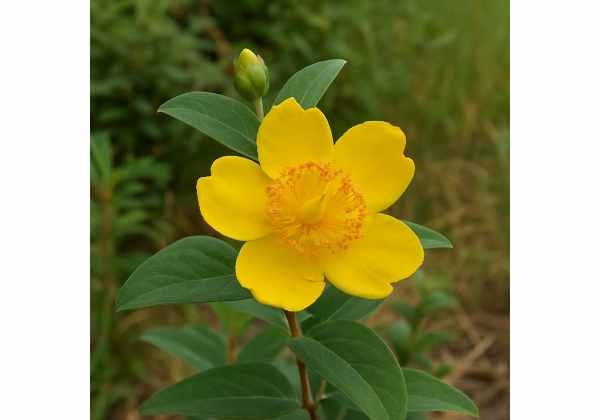
Botanically, it is a low-growing evergreen or semi-evergreen shrub with glossy leaves and large yellow flowers. Native to parts of southeastern Europe and Turkey, it has spread widely through cultivation. In gardens it is valued for erosion control and ground cover. In herbal discussion, its importance comes from the chemistry found in its aerial parts and stems, where researchers have identified flavonoids, phenolic compounds, phloroglucinol derivatives, and essential-oil constituents.
Its historical use appears to be narrower and more regional than that of Hypericum perforatum. In Turkish folk tradition, reports connect it with antispasmodic and anti-asthmatic use, while broader Hypericum traditions include applications for wounds, skin irritation, and inflammatory complaints. The species-specific record for H. calycinum is real, but it is not deep enough to justify confident statements that it should be used the same way as more established St. John’s wort species.
This is why framing matters so much. Hypericum calycinum should not be treated as a drop-in substitute for medicinal St. John’s wort, and it should not be confused with flowering landscape shrubs that share the same common name. The most useful mindset is to think of it as a botanically interesting, chemically active, but under-validated herb. Readers who like comparing lesser-used herbs with better-known antioxidant plants may notice a similar “promising but not definitive” profile in rosemary’s antioxidant tradition, though the chemistry and safety concerns are quite different here.
Key ingredients and medicinal properties
The strongest reason Hypericum calycinum attracts herbal interest is its chemistry. Studies on the plant have identified several groups of compounds that help explain why researchers keep revisiting it even though human trials remain scarce. The most relevant of these include phenolic acids, flavonoids, catechins, biflavonoids, phloroglucinol derivatives, and volatile compounds in the essential oil.
A 2009 phytochemical study isolated chlorogenic acid and another caffeoylquinic acid derivative alongside quercetin, quercitrin, hyperoside, isoquercitrin, rutin, biapigenin, catechin, and epicatechin. Even without turning that list into exaggerated claims, it tells us something important. This plant contains a recognizable antioxidant framework. Many of these compounds are associated with free-radical scavenging, membrane protection, or anti-inflammatory signaling in the broader plant chemistry literature.
The plant also produces more specialized constituents linked to the wider Hypericum genus. Research has noted hyperforin-related pathways and other phloroglucinol compounds in H. calycinum cell cultures and tissues. That does not mean it behaves exactly like Hypericum perforatum, but it does place the plant inside a chemically rich medicinal lineage rather than in the category of a purely decorative shrub.
Its volatile profile adds another layer. Essential-oil studies report constituents such as alpha-pinene, beta-pinene, and other terpenoid molecules that may help explain traditional interest in the plant’s external and aromatic uses. These compounds often matter most in topical or sensory contexts rather than in strong systemic effects. They can contribute to scent, antimicrobial testing outcomes, and irritation or sensitivity risk.
From this chemistry, several medicinal properties are plausible:
- Antioxidant activity, supported by phenolics and flavonoids
- Mild antimicrobial action, especially in extract testing
- Potential anti-inflammatory effects, though mainly inferred from compounds and preclinical work
- Possible nervous-system activity, suggested by older animal studies
- Possible topical usefulness, especially where antioxidant and antimicrobial qualities overlap
The most important caution is that chemistry is not the same as clinical proof. A plant can contain impressive constituents and still remain poorly supported as a medicine. That is especially true for Hypericum calycinum. Its compound profile is interesting, but much of the discussion still lives at the level of isolated compounds, extracts, and early biological assays.
Another useful point is that some of its chemistry may cut both ways. Hypericum species are known for photobiologically active compounds, and comparative work has raised legitimate questions about phototoxicity in certain species and extracts. So the same family traits that make the plant interesting also make it unsuitable for casual overuse.
In practical terms, the plant’s chemistry supports careful, limited interest in antioxidant and topical applications. It does not support marketing language that treats the herb as a proven antidepressant, wound-healing cure, or standardized daily tonic. That same difference appears with other gentle topical herbs such as calendula in skin-focused herbal use, where tradition and plausibility are meaningful, but proper boundaries still matter.
Hypericum calycinum health benefits and what the research really says
If you strip away wishful thinking and keep only what the evidence can support, the health benefits of Hypericum calycinum fall into a few cautious categories.
The first and most defensible is antioxidant potential. This is the clearest fit between chemistry and experimental data. The plant contains chlorogenic acid, quercetin-related compounds, catechins, and other flavonoids that are widely associated with antioxidant action. In laboratory terms, this matters because oxidative stress is involved in inflammation, tissue strain, and aging-related damage. In real-world terms, it means the herb has a credible biochemical profile, especially for topical or supportive formulations, even though it does not prove direct clinical benefit in humans.
The second likely area is mild topical usefulness. This should be stated carefully. There is a long tradition of turning to Hypericum species for minor wounds, irritated skin, and local discomfort, and broader Hypericum literature supports why that tradition developed. With H. calycinum specifically, the evidence is still largely preclinical or indirect, but its antioxidant and antimicrobial profile makes topical use more plausible than bold internal claims. That does not mean it should be used on serious wounds, infections, burns, or sun-exposed damaged skin without guidance.
The third possible benefit is antimicrobial support in extract studies. Species-specific work from Turkey found antibacterial activity in crude extracts of flowers, leaves, and stems against selected microorganisms. This is useful as early evidence, but it is not the same as showing the plant treats human infection. It is better interpreted as proof that the plant contains bioactive antimicrobial constituents worth studying further.
A fourth area, and the one most likely to be overstated online, is nervous-system and mood-related activity. An older mouse study found that H. calycinum extracts showed central nervous system effects in animal models alongside H. perforatum. That finding is interesting, but it is not a license to treat the plant as interchangeable with St. John’s wort supplements used for mood. No solid human evidence supports that leap, and borrowing dosing or safety assumptions from H. perforatum would be a mistake.
So what does the research actually justify?
- promising antioxidant relevance
- plausible external skin-support interest
- early antimicrobial activity
- preclinical nervous-system findings that need restraint
What it does not justify is strong language about depression treatment, asthma therapy, pain control, or routine internal self-medication. Those claims move faster than the evidence.
This is the pattern many under-studied herbs follow. The plant is not empty of value, but its strongest contributions remain exploratory and supportive rather than clinically settled. People looking for established calming herbs with a clearer self-care tradition often do better with options such as lemon balm for milder day-to-day nervous tension. Hypericum calycinum deserves interest, but it also deserves a more disciplined level of expectation than many herbal marketing pages allow.
Traditional uses and where modern use still makes sense
Traditional use can be informative when it is handled honestly. With Hypericum calycinum, the traditional record is narrower than it is for classic St. John’s wort, but it is still meaningful. Reports from Turkish folk medicine describe the species as being used to reduce spasms and as an anti-asthmatic plant. Broader Hypericum traditions also connect related species with wounds, swelling, minor inflammatory states, and local applications in oil or extract form.
That background helps modern readers in two ways. First, it tells us why researchers were interested in the plant’s chemistry and biological activity in the first place. Second, it reminds us that herbs were often used based on symptom patterns and local experience, not because they had been clinically standardized.
Still, folk tradition does not erase the need for caution. A traditional use for spasms or breathing discomfort is not enough to recommend this plant for asthma self-treatment today. Respiratory symptoms are too important, and the evidence for H. calycinum is too limited. The same goes for mood support. Just because the plant belongs to the same genus as medicinal St. John’s wort does not mean it should be approached in the same way.
So where does modern use still make sense?
The most sensible modern roles are relatively modest:
- Topical folk-style support for intact skin, especially in diluted herbal oil or salve form
- Exploratory phytotherapy under professional guidance, not self-dosing
- Academic or phytochemical interest, where the plant is studied rather than casually consumed
- Very cautious tea or infusion experimentation, only when the user fully understands that evidence is weak
In day-to-day practice, the herb is best thought of as a limited-support plant rather than a first-choice home remedy. For digestive or spasm-related self-care, more established herbs usually make better sense. For example, peppermint for digestive spasm and gut comfort has a much clearer self-care role than H. calycinum. That comparison is useful not because the plants are identical, but because it shows how evidence and tradition can guide herb choice more intelligently.
There is also a cultural lesson here. Garden plants sometimes carry old medicinal reputations that survive longer than the evidence behind them. That does not make the tradition false, but it does mean today’s reader has to separate “historically used” from “wisely self-prescribed.” With Hypericum calycinum, that boundary matters more than usual because of species confusion and the broader reputation of St. John’s wort as a mood herb.
The herb can still make sense in modern herbalism, but mostly as a cautious, species-specific plant with topical and exploratory value. It makes less sense as an internal daily herb, a mood supplement, or a substitute for conventional care. When modern use respects those limits, tradition becomes helpful context instead of an excuse for overreach.
Dosage, preparation, and practical use
The most responsible thing to say about dosage is that there is no clinically standardized oral dose for Hypericum calycinum. No major monograph or well-established human guideline gives a routine internal range for this species. That means any dosage advice has to be conservative, clearly labeled as provisional, and shaped by the fact that the evidence base is incomplete.
For that reason, the safest hierarchy of use looks like this:
- first choice: no internal self-dosing at all
- second choice: cautious external use only
- last resort: very conservative folk-style tea use, only with full awareness that evidence is thin
If someone still chooses to explore the herb in traditional tea form, a restrained range would be 1–2 g of dried aerial parts in 250 mL of hot water, steeped briefly and used once daily at most. That should be seen as a cautious ceiling for unsupervised experimentation, not as an established therapeutic dose. It also should not be continued indefinitely. A short trial with careful observation is more sensible than turning the plant into a routine beverage.
For topical folk use, a thin layer of a diluted infused oil or simple ointment may be applied once or twice daily to a small area of intact skin only. That approach respects the herb’s likely strongest modern niche while avoiding the false confidence that often comes with internal dosing. It also reduces, though does not remove, the risk of irritation or light sensitivity.
Preparation matters:
- Use correctly identified plant material only.
- Avoid concentrated essential oils for casual home use.
- Do not apply before sun exposure.
- Do not use on infected, deep, or heavily damaged skin.
- Stop immediately if irritation, redness, headache, nausea, or unusual sensitivity develops.
One practical truth is that this herb is not an ideal beginner plant for home medicine. Better-known herbs usually offer clearer margins. Someone wanting a gentle tea with a much better-established comfort tradition may prefer chamomile as a more practical daily infusion herb. Hypericum calycinum simply has too many unknowns to deserve casual, repeated internal use.
Duration also matters. Because the evidence is weak and the interaction profile is not well defined, prolonged self-treatment is a poor idea. A few days of cautious trial is one thing. Long-term daily use is harder to justify. If the goal is mood, chronic pain, respiratory support, or persistent skin healing, the plant should not be carrying that burden by itself.
So the dosage message is straightforward: use externally if used at all, keep oral experimentation small and brief, and do not mistake absence of a standard dose for freedom to improvise. With under-studied herbs, restraint is part of the dosage strategy.
Common mistakes, species confusion, and quality issues
Most errors with Hypericum calycinum happen long before side effects appear. They start with wrong identification, borrowed claims, and assumptions imported from other plants.
The first mistake is confusing common names. Rose of Sharon can refer to different species, and St. John’s wort can refer to many members of the Hypericum genus. If a person reads about Hibiscus syriacus or Hypericum perforatum and then applies that advice to H. calycinum, the result may be ineffective at best and unsafe at worst. Herbal accuracy starts with correct species, not with a familiar common name.
The second mistake is assuming genus-level reputation equals species-level evidence. Hypericum perforatum has a long modern research history. Hypericum calycinum does not. That means you cannot safely borrow its mood benefits, its dosing logic, its product forms, or its interaction discussions as though the two were identical. Related plants may share some constituents while still differing meaningfully in ratios, potency, and traditional fit.
The third mistake is overvaluing laboratory results. A plant can show antioxidant, antimicrobial, or enzyme-related effects in test systems and still fail to become a reliable home remedy. This is especially important with H. calycinum. The plant is chemically active enough to be interesting, but not validated enough to be casually promoted for internal health goals.
The fourth mistake is using homemade or concentrated preparations without thinking about light sensitivity. Hypericum species can contain compounds with photobiological effects. That does not mean every preparation will cause a dramatic reaction, but it does mean casual sun exposure after topical use is not a smart gamble.
The fifth mistake is treating ornamental plants as automatically safe medicine. Because H. calycinum is widely grown in landscapes, some people assume that if it is in the garden, it must be gentle enough for unrestricted herbal use. Gardening safety and medicinal suitability are not the same thing.
Product quality is another weak point. There are no common, well-standardized consumer products built specifically around H. calycinum. That means anyone using dried plant material, tinctures, oils, or extracts may be relying on inconsistent sourcing, weak botanical authentication, or homemade preparations with uneven concentration. In some situations, that matters more than the plant’s chemistry itself.
For readers who want topical support with clearer commercial standards, witch hazel for topical use is a good example of how much easier an herb is to use when preparations and expectations are better defined.
The larger lesson is that under-studied herbs demand more discipline, not less. With Hypericum calycinum, careful naming, modest expectations, and reluctance to over-prepare the plant are not signs of timidity. They are signs of competent herbal judgment.
Safety, side effects, and who should avoid it
Safety is where a careful article about Hypericum calycinum earns its value. The plant is not automatically dangerous, but it is also not well characterized enough to support relaxed self-medication.
The first safety issue is photosensitivity or phototoxic potential. Comparative work on Hypericum species has shown that this family can express phototoxic behavior, and H. calycinum is part of that conversation. This does not prove that every tea, oil, or topical preparation will cause a reaction in every person. It does mean that using the herb before strong sun exposure is not wise, especially in concentrated or topical forms.
The second issue is species-level uncertainty around internal use. While some Hypericum compounds are associated with mood or nervous-system activity, there is not enough human safety data for H. calycinum to justify routine oral use. Nausea, stomach upset, headache, restlessness, or skin sensitivity would all be reasonable signals to stop.
The third issue is possible drug interaction risk by family association. The strongest documented herb-drug interaction problems belong to Hypericum perforatum, not specifically to H. calycinum. Still, because the species belongs to the same chemically active genus, concentrated internal use alongside prescription medicines is a poor idea. Extra caution is warranted with:
- antidepressants
- anti-anxiety medicines
- oral contraceptives
- anticoagulants
- immunosuppressants
- seizure medicines
- medicines with narrow dosing margins
That does not mean H. calycinum is proven to interact the same way. It means there is too little certainty to make casual mixing sensible.
People who should avoid the herb altogether or avoid unsupervised use include:
- pregnant or breastfeeding people
- children
- anyone with a history of photosensitivity
- people taking psychiatric or interaction-sensitive medicines
- anyone with bipolar disorder or unstable mood symptoms
- people using the herb on damaged, infected, or sun-exposed skin
Possible side effects or warning signs include:
- redness or unusual skin sensitivity after topical use
- rash or contact irritation
- headache
- digestive upset
- feeling overstimulated or mentally “off” after internal use
Another subtle safety point is timing. If someone chooses external use, evening application with sun avoidance makes more sense than daytime application before outdoor exposure. If someone experiments with tea, that should never happen on the same day as important sun exposure, new medicines, or other unfamiliar herbs.
A useful contrast is that readers wanting gentle, low-drama nervous-system support usually do better with passionflower for stress and sleep support or other herbs with clearer self-care roles. Hypericum calycinum asks for more caution than that.
The bottom line is simple: this plant is interesting enough to respect, but not proven enough to use casually. The safest stance is topical restraint, careful species identification, strong sun awareness, and very limited tolerance for self-experimentation.
References
- Secondary metabolites of medicinal use in Hypericum spp.: a rich history and a promising future 2024 (Review)
- Hypericum Genus as a Natural Source for Biologically Active Compounds 2022 (Review)
- Essential Oil Composition of Seven Bulgarian Hypericum Species and Its Potential as a Biopesticide 2023 (Open Access Study)
- Phenolic compounds from Hypericum calycinum and their antioxidant activity 2009 (Phytochemical Study)
- Effects of Hypericum perforatum L. and Hypericum calycinum L. extracts on the central nervous system in mice 1996 (Animal Study)
Disclaimer
This article is for educational purposes only and does not replace medical advice, diagnosis, or treatment. Hypericum calycinum is an under-studied herb with limited human evidence, and it should not be used as a substitute for care of depression, asthma, skin infection, persistent pain, or any ongoing medical condition. Do not self-prescribe concentrated internal preparations if you are pregnant, breastfeeding, taking prescription medicines, managing a psychiatric condition, or prone to photosensitivity. When in doubt, consult a qualified healthcare professional before using this plant medicinally.
If this article helped you, please share it on Facebook, X, or any platform you prefer so more readers can find careful, evidence-aware herbal information.