Shavegrass, usually sold under the botanical name Equisetum arvense, is an old medicinal plant with a very modern appeal. People often reach for it when they want a mild herbal diuretic, gentle urinary-tract support, or a mineral-rich herb associated with skin, hair, nails, and connective tissue. The plant is better known in commerce as horsetail, and that naming detail matters because “shavegrass” is sometimes used loosely for other rough-stemmed Equisetum species. When choosing a product, the botanical name is the safest guide.
What makes shavegrass interesting is its mix of traditional use and selective modern evidence. It contains silica, flavonoids, phenolic compounds, mineral salts, and other plant constituents that help explain its reputation for fluid balance, antioxidant activity, and tissue support. At the same time, it is not a cure-all. The strongest mainstream use remains traditional support for minor urinary complaints and superficial wounds, with dosage and safety limits that deserve attention. A helpful article on shavegrass should therefore do two things at once: explain the real benefits clearly, and show where careful, sensible use matters most.
Quick Overview
- Shavegrass is traditionally used to increase urine flow for minor urinary complaints.
- Its silica, flavonoids, and phenolic compounds are linked with connective-tissue and antioxidant support.
- A common adult tea range is 1 to 4 g per cup, taken 3 to 4 times daily.
- It is not a good choice during pregnancy, breastfeeding, or when fluid restriction is medically required.
Table of Contents
- What shavegrass is and how it is identified
- Key compounds and medicinal properties
- Potential health benefits and what the evidence shows
- Shavegrass for urinary support and fluid balance
- Shavegrass for skin, connective tissue, and topical use
- Common uses and the best forms to choose
- Dosage, timing, and duration
- Safety, side effects, interactions, and who should avoid it
What shavegrass is and how it is identified
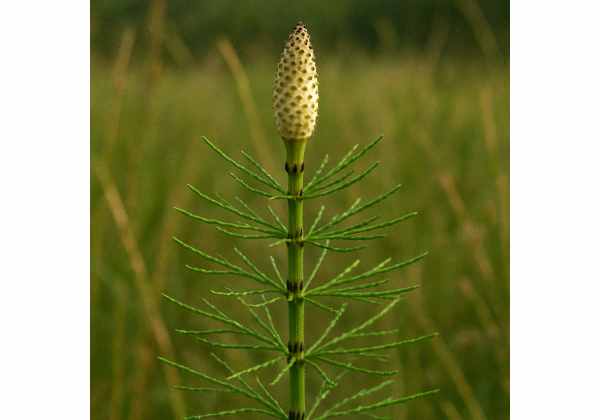
Shavegrass belongs to the ancient Equisetum genus, a group of primitive vascular plants that reproduce by spores rather than flowers. The medicinal species most commonly used is Equisetum arvense, often called field horsetail. It has two kinds of stems during the growing season: fertile spring shoots that carry spores, and later sterile green stems that are thin, jointed, and brush-like. Herbal products are generally made from those sterile aerial parts, not the early fertile shoots.
The plant’s rough texture explains the common name “shavegrass.” Like other Equisetum plants, its stems can feel slightly abrasive because they accumulate silica. Historically, that roughness made the herb useful for scouring and polishing, while internally it became known as a urinary and wound-support herb in European traditional medicine. That history still shapes how modern products are positioned today.
Identification matters more than many buyers realize. Several Equisetum species look related, and common names are not consistent from one label to another. A supplement may say shavegrass, horsetail, or Equisetum extract, yet the important detail is whether the label clearly states Equisetum arvense. That is the name most often connected with traditional medicinal use and regulatory monographs. A vague “horsetail herb” label with no botanical name should be treated cautiously.
Quality also depends on plant part, harvest timing, and preparation style. Some products use cut dried herb for tea, while others use water extracts, hydroalcoholic tinctures, capsules, or topical liquids. These differences matter because the chemistry shifts with processing. A tea made from the dried herb is not identical to a concentrated extract, and a topical wound wash is not interchangeable with a capsule.
From a practical standpoint, shavegrass is best understood as a traditional herbal tool rather than a general wellness trend ingredient. It occupies a middle ground: more purposeful than a simple pleasant tea, but less established than a drug with large modern clinical trials. That makes good labeling, realistic expectations, and proper dosing especially important from the start.
Key compounds and medicinal properties
Shavegrass is often described in one word: silica. That is part of the story, but not the whole story. The herb contains a broader mix of compounds, including flavonoids, phenolic acids, mineral salts, saponin-like substances, and small amounts of alkaloid-related constituents. Taken together, this blend helps explain why the plant is discussed for urinary support, tissue resilience, and mild antioxidant effects.
Silica is the headline constituent because it gives the plant much of its structural character and has long been associated with connective tissue. In practical terms, silica is one reason shavegrass is so often marketed for hair, nails, skin, and supportive bone health. Still, the science here needs a careful reading. The presence of silica does not automatically mean dramatic cosmetic or skeletal benefits, and the body’s handling of silica depends on the form present, the dose, and the rest of the diet. It is better to think of shavegrass as one plant source associated with broader conversations about silica and connective-tissue support, not as a miracle mineral delivery system.
The flavonoid fraction may be just as important for medicinal use. These compounds are commonly linked with antioxidant and mild inflammation-modulating activity. In shavegrass, they are often used to explain part of the herb’s traditional role in urinary flushing and its reputation for soothing irritated tissues. Phenolic compounds and related plant acids add to that picture, giving the herb a more complex pharmacological profile than its mineral content alone would suggest.
Mineral salts, including potassium salts, have also been discussed as part of the plant’s traditional diuretic action. That does not mean shavegrass works like a prescription diuretic in every setting, but it may help explain why the herb has long been used to promote urine output in minor complaints. Some modern studies and reviews support a modest fluid-balancing effect, although the degree varies by preparation.
Another important medicinal property is topical usefulness. Traditional herbal texts and modern monographs describe Equisetum arvense as a supportive external herb for superficial wounds. Here again, the likely effect is not from one isolated compound but from the combined action of the whole plant matrix.
A smart way to summarize shavegrass chemistry is this: silica helps define its identity, but the herb’s practical medicinal reputation comes from the interaction of minerals and polyphenol-rich plant compounds together. That is why product choice, extraction method, and dose can change the experience so noticeably.
Potential health benefits and what the evidence shows
Shavegrass has a respectable traditional profile, but the evidence base is uneven. Some uses are supported mainly by long-standing herbal practice and regulatory recognition of traditional use. Others have small human studies, laboratory work, or topical data that are promising but not definitive. The most honest way to describe the herb is not “proven for everything,” but “plausible and useful in selected situations when used appropriately.”
The best-supported traditional benefit is increased urine flow in minor urinary complaints. This is the area where shavegrass appears most at home. A small clinical study found that a standardized Equisetum arvense extract produced an acute diuretic effect in healthy volunteers without meaningful short-term electrolyte disruption. That is encouraging, but it does not mean shavegrass should replace prescription treatment for edema, hypertension, heart failure, or kidney disease.
A second benefit is supportive use in superficial wounds. European herbal guidance recognizes topical use for minor surface wounds based on long-standing practice. This does not turn shavegrass into an all-purpose wound treatment. It is better seen as a supportive herb for simple, shallow problems, not a substitute for proper care of infected, deep, or slow-healing wounds.
The third commonly discussed area is connective-tissue support. Because shavegrass contains silica and antioxidant compounds, it is frequently marketed for hair, skin, nails, and even bone-related wellness. This is where claims often outrun the evidence. The herb may fit well inside a broader tissue-support routine, but strong clinical proof for dramatic cosmetic change is limited. Readers should be skeptical of marketing that promises visibly thicker hair or rapid nail growth from shavegrass alone.
A fourth possible benefit is mild antioxidant and anti-inflammatory support. Review papers and experimental studies suggest that Equisetum species contain compounds capable of modulating oxidative stress and inflammation-related pathways. That may help explain some of the plant’s traditional uses, but it should still be viewed as supportive, not disease-specific.
In practice, the evidence supports a balanced conclusion:
- Most credible: minor urinary flushing support and traditional topical wound support.
- Reasonable but modest: mild diuretic activity and general antioxidant contribution.
- More speculative in everyday marketing: major cosmetic or bone-building effects.
That balance matters because shavegrass is the kind of herb people can benefit from when expectations are realistic. Used as a focused tool, it can make sense. Used as a cure-all, it becomes easy to misuse.
Shavegrass for urinary support and fluid balance
Urinary support is the clearest traditional niche for shavegrass. It is commonly used to increase urine volume and “flush” the urinary tract in minor complaints. That phrasing is important. Flushing support is not the same as treating a true infection, dissolving stones, or managing medically significant swelling. Shavegrass is best thought of as a mild adjuvant herb when the issue is minor, early, or functional rather than severe.
A practical example is someone who feels mildly irritated, wants more fluid turnover, and is otherwise well. In that setting, shavegrass tea or a standardized oral preparation may be used alongside generous fluid intake. The goal is gentle support, not aggressive intervention. Compared with more targeted herbs such as uva ursi for urinary support, shavegrass usually occupies the gentler, longer-tradition “flushing” role rather than a more direct antimicrobial niche.
This section is where safety judgment becomes essential. If symptoms include fever, burning urination, spasm, blood in the urine, flank pain, or symptoms that keep worsening, shavegrass is not enough. Those signs point toward a situation that deserves medical evaluation. The herb also should not be used as a home workaround for serious fluid retention caused by heart or kidney problems.
Modern research adds nuance. One human study suggests that oral Equisetum arvense extract may stimulate urinary factors relevant to defense against bacterial adhesion, alongside mild diuretic effects. That does not prove it prevents urinary infections in real-world clinical use, but it does help explain why the herb has stayed in traditional practice for so long.
Another useful point is hydration. Shavegrass is often used in tea, and the effect of the herb is partly intertwined with fluid intake itself. That means results can be shaped by the whole routine: how much water is taken in, how salty the diet is, and whether the person is already slightly dehydrated. Some people expect a dramatic change from the plant alone when the better explanation is a mix of herb plus fluid habits.
For readers who like traditional urinary herbs, shavegrass makes the most sense as a mild, structured option for short-term use. It should not be the hero of a serious urinary problem, and it should never delay evaluation when red-flag symptoms appear.
Shavegrass for skin, connective tissue, and topical use
The second major area of interest is tissue support. Shavegrass is frequently promoted for skin, hair, nails, joints, and bones, mainly because of its silica content and its long reputation as a strengthening herb. There is some logic behind that tradition, but it helps to separate realistic support from exaggerated marketing.
For skin and connective tissue, the herb is better understood as a supportive plant than a transformative one. Silica is important for structural tissues, and the plant’s polyphenols may also contribute to a healthier inflammatory balance. That combination makes shavegrass a reasonable herb to discuss when someone is building a broader wellness plan for tissue resilience. Still, no sensible reader should expect the plant by itself to reverse brittle nails, major hair loss, or age-related structural changes.
Topically, shavegrass has a more concrete traditional role. Decoctions, washes, and liquid preparations have been used on superficial wounds and irritated areas. Here the likely value is local support rather than dramatic pharmacological action. In everyday terms, it may help a simple, shallow skin problem along when used sensibly, but it does not replace cleansing, infection control, or wound assessment.
That distinction is why shavegrass should be compared with care-focused herbs rather than glamourized. It fits better beside practical topical botanicals than beauty promises. In that sense, it has a gentler profile than comfrey for skin repair, but it also deserves the same common-sense limit: do not use a soothing herb to avoid proper attention to a wound that is deep, dirty, infected, or not healing.
There is also a form question. Oral use for connective-tissue goals is common, but topical use is often overlooked. Someone interested in skin support may think only of capsules, when a properly prepared topical application is the more traditional option for surface issues. The best choice depends on the goal:
- For mild urinary-style herbal support, oral use makes more sense.
- For a superficial external concern, topical use is closer to traditional practice.
- For hair, skin, or nails, expectations should stay modest and long-term.
The biggest mistake in this area is assuming that “rich in silica” means “automatically powerful.” Shavegrass can be a thoughtful part of a supportive routine, but it works best when it is treated as one useful piece of a much larger picture that includes nutrition, protein intake, hydration, and medical evaluation when needed.
Common uses and the best forms to choose
Shavegrass appears in several forms, and the best one depends on the job you want it to do. The simplest form is the dried herb for tea or decoction. This is the most traditional option for mild urinary support and often the easiest way to keep the experience gentle. Tea also makes it easier to pair the herb with adequate fluid intake, which is part of the reason many people use it in the first place.
Capsules and tablets are more convenient when taste is the main barrier. They may also offer better dose consistency if they use a standardized extract. The trade-off is that they can make the herb feel stronger and more “supplement-like,” which increases the need to follow directions carefully rather than treating it casually.
Liquid extracts and tinctures are common too. These can be useful for flexible dosing, but they require more label reading. Extract strength varies widely, and some products are alcohol based. For some users, especially those taking multiple medicines or avoiding alcohol, that detail matters more than expected.
Topical forms include washes, liquid extracts diluted for dressings, and less commonly creams or gels. These make the most sense when shavegrass is being used in the traditional supportive role for superficial wounds or local tissue care. A topical product should be treated like a focused external remedy, not a skin-care trend item for daily all-over use.
Choosing the right product comes down to a few practical checks:
- Confirm the label says Equisetum arvense.
- Look for the plant part or extract ratio if available.
- Prefer brands that explain dosing clearly.
- Avoid products making oversized promises.
- Match the form to the goal rather than buying the strongest-looking option.
Some people also combine shavegrass with other mineral-rich or gentle herbal teas. That can be reasonable, but it is better done thoughtfully than randomly. For example, readers interested in nourishing herbal infusions often compare shavegrass with nettle leaf as a broader mineral-rich herb. The difference is that shavegrass is usually chosen for a more specific urinary or tissue-support purpose, while nettle is often used more broadly.
In short, the best shavegrass product is not always the most concentrated one. It is the one that fits the intended use, is labeled clearly, and can be used for a short, sensible period without confusion.
Dosage, timing, and duration
Dosage for shavegrass depends heavily on the preparation. That is why vague instructions like “take as needed” are not good enough. Tea, capsules, and extracts have different concentration profiles, and readers should not assume that one format can be swapped for another milligram for milligram.
For adults and adolescents over 12, one traditional tea method is 1 to 4 g of the cut herb in about 150 mL of boiling water, prepared as an infusion or short decoction, taken 3 to 4 times daily. That yields a daily total of roughly 3 to 12 g of the herb. This is a practical range because it reflects how the herb has been traditionally used for short-term urinary flushing support.
Standardized solid oral forms are often taken around 500 to 570 mg three times daily, though product-specific instructions should prevail. Extracts vary far more, which is why the label matters. Some liquid and dry extracts are intended for multiple daily doses, while others are concentrated enough that lower volumes are used. One clinical study on standardized dried extract used 900 mg per day for four days in healthy volunteers, but that should not be copied blindly to every product.
For topical use, a traditional preparation for superficial wounds is a decoction made from about 10 g of the herb in 1 liter of water, used for dressings or irrigation one to several times daily. Topical timing depends more on the condition and product format than on rigid scheduling.
Duration is just as important as dose. Shavegrass is usually treated as a short-course herb, not a perpetual daily supplement. Traditional oral use often falls in the 2- to 4-week range. If symptoms persist beyond about a week, worsen, or return repeatedly, continuing the herb without reassessment is not a smart plan.
A useful routine is this:
- Start with the lowest clearly effective dose on the label.
- Take it consistently rather than sporadically.
- Keep fluid intake appropriate unless a clinician has told you to restrict fluids.
- Reassess after several days, not several months.
People often compare urinary teas and assume they are interchangeable. They are not. Shavegrass has its own profile, and it should be used with the same care you would apply to corn silk for urinary comfort or other traditional flushing herbs. The best dose is the one that matches the product, the goal, and the time-limited nature of the herb.
Safety, side effects, interactions, and who should avoid it
Shavegrass is often marketed as gentle, but “gentle” does not mean risk-free. The main safety lesson is that the herb is appropriate for limited, specific uses, not unrestricted daily intake for everyone. Most problems arise when people ignore duration, use it for the wrong condition, or treat it as a replacement for medical care.
Common side effects appear to be uncommon and usually mild, but they can include stomach upset or allergic-type reactions such as rash or swelling. Any facial swelling, widespread rash, or breathing difficulty should be treated as urgent. With topical use, the same principle applies: stop if irritation increases rather than settles.
Several groups should avoid shavegrass or use it only with professional guidance:
- Children under 12, because established use and dosing are not well defined.
- Pregnant or breastfeeding people, because safety has not been established adequately.
- People who have been told to restrict fluid intake, especially those with severe heart or kidney disease.
- Anyone with persistent urinary symptoms, blood in the urine, fever, or worsening pain.
- People with complex medication regimens, especially if fluid balance changes could matter clinically.
Herb-drug interaction data are not especially robust, which means caution matters more, not less. Even when no formal interaction is well documented, a herb used for fluid balance can still complicate a plan that already involves diuretics, blood-pressure medicines, or conditions sensitive to hydration status. That does not automatically make shavegrass unsafe, but it does mean self-prescribing is not ideal for medically complicated users.
Another practical issue is product quality. Wild-harvested or poorly identified material is more concerning than a properly labeled commercial product. Since common names are inconsistent, mislabeled Equisetum material is a real quality concern. Readers should favor reputable brands and clear botanical labeling over romantic “foraged herb” appeal.
Finally, shavegrass should not be used to stretch out a problem that needs diagnosis. A person with ankle swelling from a heart condition, repeated urinary infections, or a chronic nonhealing wound should not rely on a traditional herb as a substitute for evaluation. Used wisely, shavegrass is a useful support herb. Used in place of diagnosis, it becomes a distraction.
References
- European Union herbal monograph on Equisetum arvense L., herba 2016 (Monograph)
- Genus Equisetum L: Taxonomy, toxicology, phytochemistry and pharmacology 2023 (Review)
- Therapeutic potential of Equisetum arvense L. for management of medical conditions 2023 (Review)
- Aqueous extract from Equisetum arvense stimulates the secretion of Tamm-Horsfall protein in human urine after oral intake 2022 (Human Study)
- Randomized, Double-Blind Clinical Trial to Assess the Acute Diuretic Effect of Equisetum arvense (Field Horsetail) in Healthy Volunteers 2014 (Clinical Trial)
Disclaimer
This article is for educational purposes only and is not medical advice, diagnosis, or treatment. Shavegrass may be appropriate for limited traditional use, but it is not a substitute for professional care when symptoms are severe, persistent, or medically complex. Seek prompt medical attention for fever, blood in the urine, severe swelling, worsening pain, signs of infection, allergic reactions, or any condition involving heart, kidney, or fluid-balance disorders. Use during pregnancy, breastfeeding, and in children should be approached cautiously and only with qualified guidance.
If this article was useful, please share it on Facebook, X (formerly Twitter), or any platform you prefer.