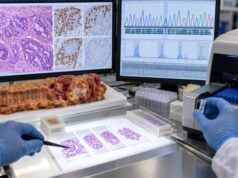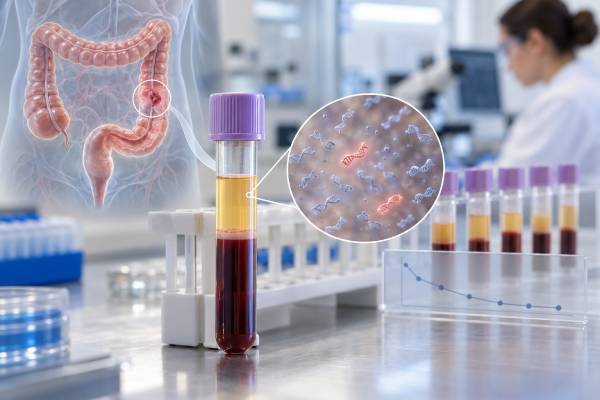
Signatera is a tumor-informed circulating tumor DNA (ctDNA) test used to look for molecular residual disease after treatment for colon cancer and to monitor for recurrence over time. The test begins by analyzing a patient’s tumor and normal DNA to identify a personalized set of tumor-specific variants. Later blood samples are then checked for those variants. A positive result means tumor-derived DNA was detected in the bloodstream; after curative-intent surgery, that finding is a strong marker of increased recurrence risk. A negative result means ctDNA was not detected at that blood draw, which is reassuring but does not prove that every cancer cell is gone. ctDNA can be below the assay’s detection limit, especially when disease volume is tiny or a tumor sheds little DNA. Signatera is best understood as a prognostic and monitoring biomarker, not a replacement for pathology, CT imaging, colonoscopy, or CEA. Studies in resected colorectal cancer show powerful risk stratification, and randomized ctDNA-guided trials support the broader strategy, but treatment changes based solely on ctDNA still depend on stage, clinical context, guidelines, and ongoing evidence.
- A positive postoperative Signatera result indicates detectable tumor-specific ctDNA and a substantially higher risk of colon cancer recurrence.
- A negative result lowers estimated recurrence risk but cannot guarantee cure; serial testing is more informative than one negative blood draw.
- Signatera is tumor-informed, meaning the assay is personalized using DNA from the patient’s own tumor before blood monitoring begins.
- ctDNA may become positive months before recurrence is visible on routine imaging in some patients, but imaging is still required to locate disease.
- A ctDNA result should not automatically trigger chemotherapy, surgery, or a treatment stop without oncology review because evidence for ctDNA-directed interventions is still evolving.
Table of Contents
- What Signatera Measures
- How a Tumor-Informed ctDNA Test Is Created
- What Positive and Negative Results Mean
- When Signatera May Be Used After Colon Cancer Treatment
- What Research Shows About Recurrence Risk
- Can ctDNA Guide Adjuvant Chemotherapy?
- Limitations, False Negatives, and Practical Next Steps
What Signatera Measures
Tumors release small fragments of DNA into the bloodstream as cancer cells die and turn over. This cancer-derived fraction is called circulating tumor DNA, or ctDNA. Most cell-free DNA in blood comes from normal cells, so detecting tiny amounts of ctDNA after surgery requires an assay that can separate true tumor signals from a large background of normal DNA.
Signatera uses a tumor-informed approach. Instead of applying only a fixed generic panel to every blood sample, the test first studies the individual patient’s tumor. It identifies a set of tumor-specific variants and builds a personalized assay designed to track those variants in plasma.
This personalization is important in the minimal residual disease setting because the amount of ctDNA may be extremely low. Looking only for mutations that are already known to belong to that patient’s cancer reduces the chance of mistaking unrelated age-associated blood-cell mutations for residual colon cancer.
The term molecular residual disease, or MRD, means cancer that remains after treatment at a level too small to be seen with standard imaging. In solid tumors, some experts also use “minimal residual disease.” A positive ctDNA test after curative-intent surgery is molecular evidence that tumor material remains somewhere in the body, even when a CT scan shows no measurable disease.
Signatera is not a germline genetic test. It does not determine whether a patient has Lynch syndrome. It is also not the same as a broad liquid biopsy used to search for treatment targets in metastatic cancer. A broad plasma NGS panel asks, “Which mutations are present in circulating tumor DNA?” A tumor-informed MRD assay asks, “Can we detect this person’s already identified tumor fingerprint in the blood now?”
The test is also different from CEA. CEA is a protein marker that can rise for cancerous and noncancerous reasons. ctDNA is a direct molecular signal from the tumor. Studies have found postoperative ctDNA to be a much stronger recurrence-risk marker than conventional clinicopathologic features alone, although CEA remains part of standard surveillance.
How a Tumor-Informed ctDNA Test Is Created
The process begins with tumor tissue, usually from the colon resection or a suitable biopsy. Normal DNA, commonly from blood, is also analyzed so inherited variants and non-tumor signals can be distinguished from tumor-specific changes.
The laboratory sequences the tumor and selects a personalized group of variants suitable for tracking. Once the assay is designed, future monitoring can usually be performed with blood draws rather than repeated tissue biopsies.
A typical workflow includes:
- Tumor tissue and a normal-DNA sample are submitted.
- The tumor is sequenced to identify patient-specific variants.
- A personalized ctDNA assay is designed.
- A postoperative blood sample is collected after enough time has passed for surgery-related cell-free DNA to settle.
- Additional blood samples may be collected during adjuvant therapy and surveillance.
The timing of the first postoperative sample matters. Drawing too soon after major surgery can increase background cell-free DNA and may reduce sensitivity. Many colorectal MRD studies use a landmark window around four weeks after surgery, although actual clinical schedules vary.
Serial testing is one of the main strengths of the approach. A single negative result is a snapshot. Repeated negative results over time provide stronger reassurance, while conversion from negative to positive can signal emerging recurrence risk.
During chemotherapy, serial ctDNA can also show molecular clearance. A patient who is positive after surgery but becomes persistently negative during treatment generally has a better prognosis than a patient whose ctDNA remains detectable. However, whether every change should trigger a specific treatment adjustment remains an active research question.
There is no special diet or fasting requirement for a routine ctDNA blood draw. Practical issues include correct timing, specimen handling, availability of adequate tumor tissue, insurance authorization, and whether the result will meaningfully affect care.
What Positive and Negative Results Mean
A positive Signatera result means the assay detected enough of the patient’s tumor-specific DNA variants in plasma to meet its positivity criteria. In a patient who has completed curative-intent surgery and has no visible disease, this is a high-risk finding.
Positive does not reveal where the cancer is located. ctDNA can come from microscopic disease in lymph nodes, liver, lungs, peritoneum, or another site. Imaging is needed to identify a structural recurrence.
The magnitude of a positive result may be reported quantitatively, but clinical interpretation focuses heavily on whether ctDNA is detectable and how the signal changes over time. Rising ctDNA can support increasing molecular disease burden; falling or clearing ctDNA during therapy can support response.
A negative result means the assay did not detect tumor-specific ctDNA above its threshold in that sample. This generally identifies a much lower-risk group after surgery, but it is not the same as “no cancer exists.” False-negative results can occur when:
- residual disease is extremely small;
- the tumor sheds little DNA into blood;
- disease is confined to sites that shed less ctDNA, such as some lung or peritoneal metastases;
- the blood sample was collected at a suboptimal time;
- treatment temporarily suppresses ctDNA below detection; or
- technical or specimen factors reduce sensitivity.
This is why serial testing improves sensitivity. A microscopic recurrence that was below detection in one sample may become detectable later.
An indeterminate or failed test should not be called negative. Failure can occur if tumor tissue is inadequate for assay design or if the blood specimen does not meet quality requirements. The report and laboratory can clarify whether another specimen is needed.
A common emotional trap is to interpret positive as certainty and negative as cure. Both are probabilistic results. Positive ctDNA after surgery is among the strongest known prognostic signals in resected colorectal cancer, but some positive patients clear ctDNA with treatment and remain disease-free. Negative patients have lower recurrence rates, but a minority still recur.
When Signatera May Be Used After Colon Cancer Treatment
The test can be used at several points in the colon cancer pathway, although the evidence strength and clinical purpose differ.
After curative-intent surgery
A postoperative or “landmark” sample can identify patients with molecular residual disease before recurrence is visible on imaging. This is the most studied setting.
For stage II colon cancer, ctDNA can add powerful information to conventional high-risk pathology. A patient with otherwise favorable pathology but positive ctDNA has a very different recurrence-risk profile from a ctDNA-negative patient.
For stage III disease, postoperative ctDNA can further stratify recurrence risk even though adjuvant chemotherapy is already standard for most medically fit patients.
After complete resection of stage IV metastatic disease, such as selected liver metastases, ctDNA can also identify a group at very high risk of recurrence. Management in this setting is especially individualized.
During adjuvant chemotherapy
Serial results can show whether ctDNA clears. Persistent positivity despite chemotherapy is concerning and may indicate resistant residual disease. At present, the best action after persistent positivity is not universally defined. Options can include closer imaging, clinical-trial enrollment, and multidisciplinary discussion rather than automatic off-protocol treatment escalation.
During surveillance
Serial ctDNA can detect molecular recurrence before conventional imaging in some patients. This lead time may create an opportunity for earlier imaging or clinical-trial intervention. Whether earlier molecular detection always improves overall survival remains under study.
The test does not replace colonoscopy, which detects new polyps and local mucosal lesions, nor does it replace guideline-based CT imaging for patients who need it.
What Research Shows About Recurrence Risk
Prospective colorectal studies have consistently found a large separation in recurrence risk between ctDNA-positive and ctDNA-negative patients after surgery.
The GALAXY observational arm of CIRCULATE-Japan used a tumor-informed ctDNA approach in a large cohort of resectable colorectal cancer. The 2023 analysis reported that postoperative ctDNA positivity around four weeks after surgery was associated with roughly a tenfold higher recurrence risk and was the strongest prognostic factor in stage II and III disease.
An expanded 2024 analysis of more than 2,000 patients reinforced that result. ctDNA positivity in the molecular residual disease window remained strongly associated with worse disease-free and overall survival. Patients whose ctDNA cleared and stayed cleared during adjuvant chemotherapy had markedly better outcomes than those with transient or persistent positivity.
Real-world experience also shows that tumor-informed ctDNA can correlate with recurrence and may outperform CEA in some patients. However, observational studies can demonstrate prognosis more easily than they can prove that changing treatment because of the result improves survival.
The distinction matters. Prognostic validity asks whether the test accurately separates higher- and lower-risk patients. ctDNA clearly does this. Clinical utility asks whether acting on the result with a defined intervention improves outcomes compared with standard management. That second question requires randomized trials.
Can ctDNA Guide Adjuvant Chemotherapy?
The randomized DYNAMIC trial in stage II colon cancer is the most influential evidence that a ctDNA-guided strategy can alter adjuvant chemotherapy use without compromising outcomes. The trial did not use Signatera, so its results support the ctDNA-guided concept rather than proving a brand-specific effect.
In DYNAMIC, patients were randomly assigned to ctDNA-guided management or standard clinicopathologic management. The ctDNA-guided group received less adjuvant chemotherapy—about 15% compared with 28%—while two-year recurrence-free survival was noninferior. Five-year follow-up published in 2025 continued to show similar recurrence-free and overall survival between strategies.
This is important evidence for de-escalation in stage II disease. It does not mean every ctDNA-negative patient in every stage should skip chemotherapy. Stage III colon cancer, high-risk stage II disease, and resected metastatic disease have different baseline risks and standards.
The harder question is escalation: if a patient is ctDNA-positive after surgery, does giving more chemotherapy, a different regimen, or longer treatment improve survival? Observational GALAXY data suggest ctDNA-positive patients can benefit from adjuvant chemotherapy and that molecular clearance is favorable, but definitive regimen-specific treatment rules remain under investigation.
Another unresolved scenario is molecular recurrence during surveillance when CT imaging is still negative. Starting systemic therapy immediately may expose a patient to toxicity without a visible target or proof that earlier treatment improves survival. Many oncologists use a new positive result to intensify diagnostic evaluation or consider a clinical trial rather than automatically treating an invisible recurrence.
Guideline positions continue to evolve as randomized trials mature. The safest interpretation is that ctDNA is a powerful prognostic tool with growing evidence for treatment guidance, but treatment should not be reduced to a one-number algorithm.
Limitations, False Negatives, and Practical Next Steps
Signatera and other tumor-informed MRD assays have important limitations.
Tissue dependence: Tumor-informed testing needs adequate tumor material. Very small specimens or exhausted blocks can prevent assay creation.
Biological shedding: Not all recurrences release ctDNA equally. Small lung metastases and peritoneal disease can be harder to detect than larger liver metastases.
Timing: Very early postoperative draws can have excess background cell-free DNA. Testing during treatment may temporarily suppress the signal.
No anatomic localization: A positive blood test cannot show where recurrence is located. Imaging remains necessary.
Uncertain actionability in some settings: Strong prognostic information does not automatically establish the best intervention.
Cost and coverage: Insurance policies vary by stage and indication. Patients should verify authorization and out-of-pocket responsibility.
Psychological burden: Serial molecular testing can create anxiety, especially when ctDNA becomes positive before imaging can identify disease. Patients should know in advance what the oncology team plans to do with each possible result.
Common mistakes include stopping standard imaging because ctDNA is negative, treating one positive result without confirmation or staging, comparing numbers from different ctDNA platforms as though they were identical, and assuming DYNAMIC was a Signatera-specific trial.
Useful questions include:
- Was my assay successfully personalized from my tumor tissue?
- When after surgery should the first blood sample be drawn?
- How often will serial testing be performed?
- What will we do if the result is positive but imaging is negative?
- Would a negative result change my adjuvant chemotherapy recommendation?
- Does my stage have randomized evidence for ctDNA-guided treatment?
- Will I still receive standard CT imaging, CEA testing, and colonoscopy?
- Could the site of my prior disease reduce ctDNA sensitivity?
- Is there a clinical trial for persistent or newly positive MRD?
The most useful way to view Signatera is as a high-resolution recurrence-risk signal. It can reveal molecular disease that conventional tools cannot yet see and can provide dynamic information across serial blood draws. Its value is greatest when the oncology team has a clear plan for integrating the result with stage, pathology, imaging, and evidence-based treatment rather than allowing the test to replace them.
Because negative predictive value depends on the population being tested, a negative result carries different weight in a low-risk stage II patient than in a patient who recently had multiple liver metastases resected. The residual pretest risk is different even when the blood result is identical. Serial ctDNA is therefore most informative when interpreted on top of the patient’s original stage and treatment history.
References
- Molecular residual disease and efficacy of adjuvant chemotherapy in patients with colorectal cancer 2023 (Prospective Study)
- ctDNA-based molecular residual disease and survival in resectable colorectal cancer 2024 (Prospective Study)
- Circulating Tumor DNA Analysis Guiding Adjuvant Therapy in Stage II Colon Cancer 2022 (RCT)
- Circulating tumor DNA analysis guiding adjuvant therapy in stage II colon cancer: 5-year outcomes of the randomized DYNAMIC trial 2025 (RCT Follow-Up)
- Minimal residual disease in colorectal cancer. Tumor-informed versus tumor-agnostic approaches: unraveling the optimal strategy 2025 (Review)
- Clinical performance of tumor-informed versus tumor-agnostic ctDNA assays for colorectal cancer recurrence: A systematic review and diagnostic accuracy meta-analysis 2026 (Systematic Review)
Disclaimer
This article is for general education and does not replace individualized oncology advice. Signatera and other ctDNA MRD results should be interpreted with cancer stage, timing, pathology, imaging, CEA, prior treatment, and the evidence for the specific clinical setting. Do not start, stop, intensify, or omit chemotherapy solely from a ctDNA result without review by the treating cancer team.