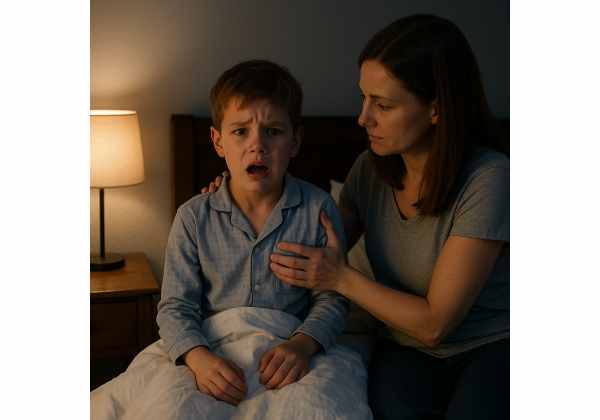
Sleep terror disorder is a sleep-wake condition in which a person has repeated episodes of intense fear during sleep, usually without becoming fully awake. The episode may look alarming: the person may scream, sit upright, sweat, breathe rapidly, stare, thrash, or seem terrified. Yet they are often confused, hard to comfort, and unable to recall much, if anything, the next morning.
Sleep terrors are most common in children, especially in the preschool and early school years, but they can also occur in adolescents and adults. In children, occasional sleep terrors are often brief and self-limited. In adults, new, frequent, injurious, or unusual episodes deserve more careful evaluation because they may overlap with other sleep disorders, seizures, substance use, trauma-related symptoms, medication effects, or other medical and psychiatric conditions.
Table of Contents
- What Sleep Terror Disorder Is
- Sleep Terror Symptoms and Signs
- Sleep Terrors vs Nightmares
- Causes and Brain-Sleep Mechanisms
- Risk Factors and Common Triggers
- Effects and Complications
- Diagnostic Context and Red Flags
What Sleep Terror Disorder Is
Sleep terror disorder is classified among non-rapid eye movement sleep arousal disorders, a group of parasomnias that arise from incomplete awakening out of deep non-REM sleep. In practical terms, the person is not simply having a frightening dream. Part of the brain appears to be asleep, while systems involved in movement, emotion, and body alarm responses partially activate.
Sleep terrors are also called night terrors, although “sleep terrors” is the more precise clinical term because episodes occur during sleep rather than because of nighttime fear while awake. They often happen during the first third of the night, when deep slow-wave sleep is more common. This timing is one reason they differ from typical nightmares, which more often occur during REM sleep later in the night.
A sleep terror episode usually begins suddenly. A child or adult may bolt upright, cry out, scream, appear panicked, or show strong physical signs of fear. Their eyes may be open, but they may not recognize people in the room or respond normally to reassurance. The episode may last seconds to several minutes, though some episodes are longer. Afterward, the person often settles back into sleep and may have little or no memory of the event.
Sleep terror disorder is not diagnosed from one dramatic night alone. Clinically, the pattern matters: recurrence, incomplete awakening, signs of intense fear, poor responsiveness during the episode, limited recall afterward, and distress, impairment, safety risk, or concern that another condition may be involved.
In children, sleep terrors are usually not a sign of severe emotional disturbance or a dangerous neurological disease. They can be frightening for parents or caregivers because the child appears awake but unreachable. However, the child often does not experience the event as a remembered trauma because recall is usually absent or fragmentary.
In adults, the meaning can be more complex. Adult sleep terrors may persist from childhood, return during periods of sleep disruption, or begin in association with other medical, sleep, psychiatric, or substance-related factors. Adult episodes are also more likely to raise concerns about injury, bed partner safety, legal issues, or confusion with seizures or REM sleep behavior disorder.
Sleep terror disorder sits at the intersection of sleep medicine, neurology, and mental health. It is a sleep-wake disorder, but stress, anxiety, trauma history, sleep deprivation, alcohol, medications, and other conditions can influence whether episodes occur. That overlap is why a careful description of the episode is often more useful than focusing only on the word “terror.”
Sleep Terror Symptoms and Signs
The core signs of sleep terror disorder are abrupt fear-like arousals from sleep, intense physical activation, poor responsiveness, and little or no memory afterward. The episode can look more dramatic than the person’s later recall would suggest.
Common symptoms and signs include:
- Sudden screaming, crying, shouting, gasping, or panicked vocal sounds
- Sitting up in bed, jumping up, thrashing, kicking, flailing, or trying to run
- A frightened, wide-eyed, or confused facial expression
- Rapid heartbeat, fast breathing, sweating, flushing, trembling, or dilated pupils
- Difficulty being awakened or comforted during the episode
- Confused speech, mumbling, staring, or not recognizing familiar people
- Little, vague, or absent memory of the event in the morning
- Possible overlap with sleepwalking or other complex movements
In children, a typical episode may involve a child suddenly sitting up and screaming while appearing terrified. A parent may try to soothe the child, but the child may push them away, stare through them, or seem unaware of where they are. After several minutes, the child may lie down and continue sleeping. The next morning, the child may remember nothing or may only know that a parent seemed worried.
In adolescents and adults, episodes can be more varied. Some people shout, run from the bed, strike out, open doors, or appear to defend themselves from a perceived threat. Adults may occasionally report fragments of mental content, such as a sense of danger, an intruder, a collapsing room, or the need to escape. Even then, recall is often incomplete and may not match how intense the behavior looked to others.
Sleep terrors are not the same as ordinary waking panic. During the episode, the person is usually not fully awake and may not be able to reason, answer questions, or make deliberate choices. The behavior is typically automatic, confused, and poorly responsive to the environment.
The pattern is also different from deliberate attention-seeking, tantrums, or acting out. Sleep terror episodes arise from sleep, commonly during deep non-REM sleep, and the person’s awareness is impaired. In children, this distinction matters because caregivers may mistakenly assume the child is choosing not to respond.
A single episode can occur during fever, travel, exhaustion, or a disrupted night. Sleep terror disorder becomes more clinically significant when episodes are frequent, prolonged, injurious, disruptive to the household, distressing to the person, or unclear in origin.
Sleep Terrors vs Nightmares
Sleep terrors and nightmares can both look frightening from the outside, but they come from different sleep states and have different patterns of awareness and recall. The clearest distinction is that nightmares usually involve a remembered frightening dream, while sleep terrors involve incomplete awakening with confusion and poor recall.
| Feature | Sleep terrors | Nightmares |
|---|---|---|
| Typical sleep stage | Deep non-REM sleep | REM sleep |
| Usual timing | First third of the night | Later in the night or early morning |
| Awareness during event | Partly awake, confused, hard to comfort | Wakes more fully and can often respond |
| Memory afterward | Little, vague, or no recall | Often remembers dream content |
| Behavior | Screaming, sitting up, thrashing, running, autonomic arousal | Fear after waking, crying, seeking comfort, less complex movement |
| Common age pattern | More common in children | Can occur at any age |
A child who wakes from a nightmare may seek a parent, describe a monster or frightening scene, and gradually calm with reassurance. A child having a sleep terror may appear more intensely distressed but may not recognize the parent or explain what is wrong. This can be confusing because the sleep terror looks more severe, while the child may remember less.
In adults, the distinction can be less tidy. Some adults with non-REM parasomnias report brief, vivid, or dream-like experiences during episodes. That does not automatically turn the event into a nightmare. The overall pattern still matters: timing, impaired responsiveness, confusion, motor behavior, autonomic activation, and incomplete recall.
Sleep terrors also need to be distinguished from stress-related nightmares, nocturnal panic attacks, seizures, REM sleep behavior disorder, and substance- or medication-related nocturnal behaviors. For example, nocturnal panic attacks involve sudden fear during the night, but the person usually wakes more fully and remembers the panic symptoms more clearly.
Another important distinction is that sleep terrors are not usually “bad dreams” that need interpretation. Trying to extract meaning from a child’s episode may not be useful if the child was never fully awake and has no remembered dream. In adults who do remember fragments, the content may reflect a threat-like state, but it still needs to be understood in the context of sleep-state instability.
Causes and Brain-Sleep Mechanisms
Sleep terror disorder is best understood as a problem of partial arousal from deep non-REM sleep rather than a simple fear disorder. The brain does not shift smoothly from sleep to wakefulness; instead, some systems activate while others remain in a sleep-like state.
Deep non-REM sleep is usually a period of reduced awareness and limited responsiveness. In sleep terrors, arousal appears incomplete. Motor systems may activate enough for movement, emotional alarm systems may trigger a fear response, and the autonomic nervous system may produce sweating, rapid pulse, and fast breathing. At the same time, the person may remain confused, poorly aware, and unable to form a clear memory.
This “mixed state” helps explain several features that otherwise seem contradictory:
- The person may have open eyes but not be fully awake.
- The behavior may look purposeful, yet the person may not respond normally.
- The fear may look intense, but the person may not remember being afraid.
- The episode may be brief, but the household impact can be large.
- The person may return to sleep quickly as if nothing happened.
The exact cause is not always identifiable. In many children, sleep terrors likely reflect developmental sleep patterns and a tendency for deep sleep to be unstable. As the nervous system matures, episodes often decrease. Family clustering also suggests a genetic predisposition in some cases, especially when relatives have sleepwalking, sleep terrors, or other non-REM parasomnias.
In adults, causes and contributors are more often mixed. Sleep deprivation, irregular sleep schedules, alcohol, stress, fever, sleep apnea, restless legs syndrome, medication effects, and other factors that fragment sleep can increase the chance of incomplete arousal. Mental health conditions do not “cause” every sleep terror, but anxiety, trauma-related symptoms, depression, and high stress can act as priming or precipitating factors for some people.
Sleep terrors may also overlap with sleepwalking. Both are non-REM arousal parasomnias, and a person may have both types of episodes. One night may involve screaming and fear; another may involve walking, opening doors, or confused activity without obvious terror.
A medical or neurological cause is not assumed in every case, especially in a child with a classic pattern. However, unusual timing, adult onset, frequent injuries, stereotyped movements, loss of bladder control with other seizure-like signs, daytime neurological symptoms, or events that occur many times a night may shift the concern toward other diagnoses.
The most useful way to think about causes is in layers. A person may have an underlying predisposition, a period of deeper or more unstable sleep, and then a trigger that fragments sleep on a particular night. That combination can make an episode more likely even if no single cause fully explains the disorder.
Risk Factors and Common Triggers
Sleep terrors are more likely when a person is predisposed to non-REM arousal instability and something increases sleep pressure or disrupts deep sleep. The most common risk pattern is childhood age plus family history, but triggers can vary across the lifespan.
Risk factors and triggers may include:
- Childhood age, especially preschool and early school years
- Family history of sleep terrors, sleepwalking, or other parasomnias
- Sleep deprivation or inconsistent sleep timing
- Fever, illness, pain, or physical discomfort
- Stress, anxiety, major life changes, or emotional strain
- Alcohol use, especially in adults
- Certain medications or medication changes
- Sleep-disordered breathing, including obstructive sleep apnea
- Restless legs syndrome or periodic limb movements
- Noisy sleep environments or sudden awakenings
- Travel, jet lag, shift work, or circadian rhythm disruption
Sleep deprivation is a particularly important trigger because it can increase deep sleep pressure. When the brain enters deeper sleep more intensely, partial arousals may become more likely in someone predisposed to them. This is one reason episodes may appear during busy school periods, travel, illness, or periods of inconsistent sleep.
Conditions that repeatedly disturb sleep can also matter. Obstructive sleep apnea, for example, can cause brief arousals throughout the night. In someone with sleep terrors or sleepwalking, those arousals may contribute to episodes. When snoring, witnessed breathing pauses, morning headaches, or daytime sleepiness are present, sleep apnea symptoms become relevant to the diagnostic picture.
Restless legs syndrome and periodic limb movements can also fragment sleep. A person who has uncomfortable leg sensations at night, repeated leg jerks, or strong urges to move the legs may need evaluation for restless legs syndrome as part of a broader sleep history.
Stress can influence sleep terrors, but it should be described carefully. In children, sleep terrors are not automatically evidence of trauma, family conflict, or a psychiatric disorder. In adults, stress and trauma-related conditions may be more relevant, especially if episodes began after a major event or occur alongside nightmares, hyperarousal, panic symptoms, dissociation, or daytime distress.
Alcohol and sedating substances can increase risk by altering sleep architecture and arousal thresholds. Some medications have also been associated with parasomnias or unusual sleep behaviors. The important point is not that any one medication always causes sleep terrors, but that medication timing, dose changes, and interactions are part of the clinical history when episodes are new or worsening.
Effects and Complications
The main complications of sleep terror disorder are injury risk, disrupted sleep, family distress, bed partner disruption, and confusion with other medical or psychiatric conditions. Even when episodes are benign in origin, their impact can be significant.
For children, the most common effect is caregiver alarm. Parents may lose sleep, feel helpless, or worry that the child is terrified or psychologically harmed. The child may not remember the episode, but repeated household disruption can still affect family sleep and stress levels. If episodes involve climbing, running, or leaving the bed, injury risk becomes more important.
For adults, complications may be broader. Sleep terrors can interfere with relationships, create fear for bed partners, and lead to embarrassment or avoidance of sleeping near others. If episodes involve striking, pushing, running, or leaving the bedroom, the safety concern is real even when the person has no conscious intent to harm.
Possible complications include:
- Falls, bruises, cuts, collisions, or other injuries during confused movement
- Injury to a bed partner or caregiver during flailing or defensive behavior
- Sleep disruption for the household
- Daytime sleepiness if episodes are frequent or part of broader poor sleep
- Anxiety about going to sleep, especially in adults who know episodes occur
- Misinterpretation as panic, psychosis, seizures, or intentional behavior
- Social, relationship, occupational, or legal consequences in rare severe cases
Sleep terrors can also complicate mental health assessment. A person may describe “waking up screaming” and be assumed to have panic attacks or trauma nightmares. Another person may be told the behavior is “just stress” when the pattern actually suggests a sleep disorder or seizure mimic. Accurate description matters because the visible fear is not the same as fully awake fear.
In adults, recurrent violent or complex behaviors during sleep need careful attention. Non-REM parasomnias can sometimes include defensive or escape-like actions, but other disorders can also cause dream enactment or nocturnal agitation. REM sleep behavior disorder, sleep-related hypermotor epilepsy, intoxication-related behaviors, dissociative episodes, and medication-related sleep behaviors can look similar.
The emotional burden can be substantial even when the episodes are not dangerous. Bed partners may become afraid to sleep in the same bed. Parents may stay awake listening for signs of another event. Adults may feel ashamed about behaviors they cannot remember. These effects are part of the condition’s real-world impact, even though they are not always captured by a simple symptom checklist.
A further complication is delayed recognition of related conditions. If sleep terrors are triggered by sleep apnea, restless legs syndrome, fever, substance use, or a neurological disorder, focusing only on the dramatic scream may miss the underlying contributor. That is why persistent, atypical, adult-onset, or injurious episodes deserve a broader clinical view.
Diagnostic Context and Red Flags
Sleep terror disorder is usually diagnosed from a careful history of the episodes, especially from someone who has witnessed them. Testing is not always needed, but it becomes more relevant when the pattern is atypical, dangerous, adult-onset, or difficult to distinguish from seizures or other sleep disorders.
A clinician may ask about:
- Age when episodes began
- Time of night the episodes usually occur
- What the person does during the episode
- Whether the person can respond or be awakened
- Whether there is memory of fear, dreams, or events afterward
- Frequency, duration, and pattern over time
- Injuries, leaving the bed, or risk to others
- Snoring, breathing pauses, restless legs, insomnia, or daytime sleepiness
- Fever, sleep deprivation, alcohol, substances, or medication changes
- Personal or family history of sleepwalking, seizures, trauma, panic, or neurological symptoms
A home video can sometimes help a clinician understand the pattern, although it does not replace professional evaluation when there are red flags. In some cases, overnight polysomnography may be considered, particularly if sleep apnea, periodic limb movements, unusual behaviors, or diagnostic uncertainty are present.
If seizures are a concern, clinicians may consider EEG testing or longer video EEG monitoring. Sleep-related hypermotor epilepsy can sometimes resemble non-REM parasomnias because both can involve abrupt movements from sleep. Clues that raise suspicion include highly stereotyped episodes, very frequent events in a single night, unusual posturing, brief repeated attacks, daytime spells, or neurological findings.
Professional evaluation is especially important when episodes:
- Begin for the first time in adulthood
- Become frequent, prolonged, violent, or injurious
- Include leaving the home, driving, or dangerous actions
- Occur many times per night or at unusual times in the sleep period
- Are associated with fainting, seizure-like movements, tongue biting, or unexplained injuries
- Occur with loud snoring, witnessed breathing pauses, or severe daytime sleepiness
- Follow a head injury or occur with new neurological symptoms
- Appear after a new medication, dose change, alcohol escalation, or substance use
- Are accompanied by severe depression, suicidal thoughts, psychosis, or major daytime impairment
Urgent evaluation may be needed if a person is injured, cannot be awakened after an event, has seizure-like symptoms, shows new confusion or weakness, has breathing difficulty, or presents a serious risk of harm to themselves or others. When mental health or neurological warning signs are present, guidance on urgent mental health or neurological symptoms may be relevant.
A diagnosis should also consider cultural and family interpretations of the event. Some families describe sleep terrors as “panic,” “possession,” “bad dreams,” “fits,” or “acting strange at night.” A respectful clinical approach focuses on the observable pattern: sleep timing, responsiveness, motor behavior, autonomic signs, recall, and safety.
Sleep terror disorder can be frightening to witness, but the label is most useful when it clarifies what is happening and what else needs to be ruled out. The goal of diagnostic context is not to overmedicalize every childhood episode; it is to identify when the pattern is typical and when the risks, age of onset, or features point to something more complex.
References
- Diagnosis and Management of NREM Sleep Parasomnias in Children and Adults 2023 (Review)
- Challenges in diagnosing NREM parasomnias: Implications for future diagnostic classifications 2024 (Review)
- Conscious experiences during non-rapid eye movement sleep parasomnias 2024 (Review)
- A Comprehensive Review of Non-Rapid Eye Movement (NREM) Parasomnias 2025 (Review)
- What are Sleep Disorders? 2024 (Official Organization Resource)
- Night Terrors(Archived) 2023 (Clinical Reference)
Disclaimer
This article is for general educational purposes only and is not a substitute for professional medical advice, diagnosis, or treatment. Sleep terror-like episodes that are new, injurious, frequent, adult-onset, seizure-like, or linked with severe mental health or neurological symptoms should be assessed by a qualified health professional.
Thank you for taking the time to read this guide; sharing it may help another family or adult recognize when sleep terrors are likely benign and when they deserve closer attention.