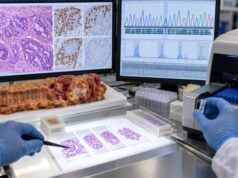
A SMAD4 test in pancreatic cancer looks for loss or alteration of a tumor suppressor that is central to transforming growth factor-beta (TGF-β) signaling. SMAD4 is inactivated in a large subset of pancreatic ductal adenocarcinomas, often through deletion, mutation, or other biallelic loss. Pathologists can evaluate SMAD4 protein expression by immunohistochemistry, while tumor next-generation sequencing can detect many SMAD4 genomic alterations. Loss of SMAD4 supports the molecular profile of pancreatic ductal adenocarcinoma in the right pathology context and has been associated in many studies with more aggressive disease and worse survival. However, SMAD4 is not currently a stand-alone treatment-selection biomarker with an approved drug matched directly to SMAD4 loss. A patient should not be told that SMAD4 loss makes treatment futile or that retained SMAD4 guarantees a favorable course. Stage, resectability, lymph-node status, margins, CA 19-9, performance status, response to therapy, and other genomic findings remain more directly actionable. SMAD4 is best viewed as a biologically important tumor suppressor and an evolving prognostic and research marker.
- SMAD4 loss is common in pancreatic ductal adenocarcinoma and usually reflects an acquired tumor change rather than an inherited cancer syndrome.
- Loss can be detected by immunohistochemistry or inferred from pathogenic genomic alterations on tumor sequencing.
- SMAD4 loss has been associated with worse overall prognosis in pooled studies, but it does not determine an individual patient’s survival.
- There is no standard FDA-approved pancreatic cancer therapy selected solely because SMAD4 is lost or mutated.
- A retained SMAD4 stain does not rule out pancreatic cancer, and a lost stain does not by itself prove a pancreatic primary.
Table of Contents
- What SMAD4 Does in Normal Cells
- How SMAD4 Is Altered in Pancreatic Cancer
- How SMAD4 Testing Is Performed
- What SMAD4 Loss or Retained Expression Means
- SMAD4 and Pancreatic Cancer Prognosis
- Does SMAD4 Change Treatment?
- Limitations and Questions to Ask
What SMAD4 Does in Normal Cells
SMAD4 is a transcriptional mediator in the TGF-β signaling pathway. In normal cells, TGF-β binds cell-surface receptors, activates receptor-regulated SMAD proteins, and uses SMAD4 as a common partner to carry signals into the nucleus. Those signals can regulate proliferation, differentiation, tissue repair, immune responses, and extracellular matrix biology.
Early in cancer development, intact TGF-β/SMAD signaling can act as a growth suppressor. Loss of SMAD4 removes part of this control. As pancreatic cancer evolves, however, TGF-β signaling also has complex pro-tumor roles involving fibrosis, immune suppression, invasion, and metastasis. The pathway is therefore not a simple on/off tumor brake.
SMAD4 was historically called DPC4, for “deleted in pancreatic carcinoma locus 4,” reflecting its discovery through frequent deletion in pancreatic cancer. The gene is located on chromosome 18q21.
Pancreatic ductal adenocarcinoma typically accumulates alterations in a small set of major driver genes. KRAS activation is present in the great majority of tumors, while TP53, CDKN2A, and SMAD4 are commonly inactivated during progression. These changes cooperate: KRAS stimulates growth pathways, while loss of tumor suppressors removes checkpoints and supports invasion.
SMAD4 loss is therefore part of the canonical molecular landscape of PDAC. Depending on study methods and definitions, loss or inactivation is commonly reported in roughly half of pancreatic ductal adenocarcinomas. Frequency varies because IHC loss, mutation, deletion, and complete biallelic inactivation are related but not identical measurements.
The presence of SMAD4 loss is biologically meaningful, but it is not unique to pancreatic cancer. Other gastrointestinal and non-GI cancers can alter SMAD4, so the marker must always be interpreted with morphology and a broader immunohistochemical panel.
How SMAD4 Is Altered in Pancreatic Cancer
Tumor suppressor genes usually need major loss of function before their protective effect disappears. In PDAC, SMAD4 can be inactivated by homozygous deletion, a pathogenic mutation in one allele with loss of the other allele, or other mechanisms that result in absent functional protein.
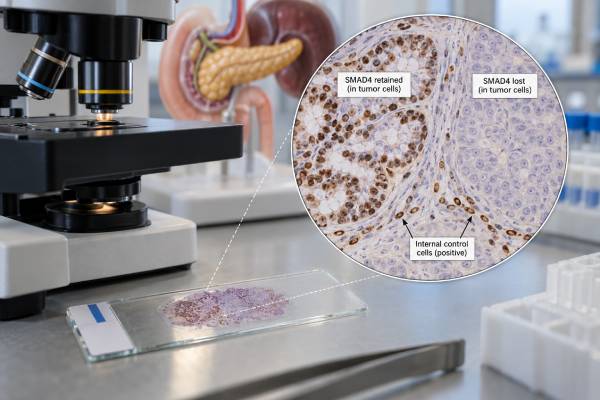
These genomic events often produce complete loss of nuclear and cytoplasmic SMAD4 staining in tumor cells on immunohistochemistry while normal stromal cells retain expression. The retained normal cells serve as an internal control.
Some pathogenic missense mutations can produce abnormal protein that remains detectable by IHC. Conversely, technical fixation or staining problems can create apparent loss. That is why IHC and sequencing do not always map perfectly onto one another.
SMAD4 alteration is usually somatic, meaning it arose in the tumor. A pancreatic tumor with SMAD4 loss does not generally imply that the patient or family has an inherited SMAD4 cancer syndrome.
Rare germline SMAD4 pathogenic variants are associated with juvenile polyposis syndrome, sometimes with hereditary hemorrhagic telangiectasia features. That is a distinct hereditary condition. Routine loss of SMAD4 in a pancreatic adenocarcinoma is far more commonly an acquired cancer event and should not automatically trigger family testing for SMAD4.
If tumor sequencing identifies a variant that is unexpectedly suggestive of germline origin, clinicians can evaluate the full personal and family history and obtain normal-DNA testing when appropriate. The decision should not be based on the gene name alone.
How SMAD4 Testing Is Performed
SMAD4 can be assessed through immunohistochemistry (IHC) or molecular sequencing.
SMAD4 immunohistochemistry
IHC stains tissue for the SMAD4 protein. In normal pancreas, stromal and epithelial cells generally show nuclear and cytoplasmic expression. A pancreatic cancer with true SMAD4 loss shows absent staining in malignant cells while surrounding non-neoplastic cells remain positive.
This pattern can be useful in pathology diagnosis. When a metastatic adenocarcinoma of uncertain origin is being evaluated, loss of SMAD4 may support a pancreaticobiliary source when combined with morphology and other markers. It is not specific enough to identify the primary site by itself.
IHC is relatively fast, inexpensive, and available on small biopsy samples. It directly answers whether protein expression is retained in the tested tissue.
Next-generation sequencing
Broad tumor NGS can identify SMAD4 substitutions, truncating mutations, deletions, and sometimes loss-of-heterozygosity patterns. Sequencing has the advantage of evaluating many genes simultaneously, including KRAS, TP53, CDKN2A, BRCA1/2, PALB2, and rare actionable targets.
A sequencing report may state that SMAD4 is “pathogenic,” “likely pathogenic,” “loss,” or “copy-number deletion.” The clinical meaning depends on whether the alteration is expected to abolish function. Not every rare missense variant is known to be damaging.
The two methods can complement each other. IHC may demonstrate functional protein loss even if a DNA panel does not capture the exact mechanism, while sequencing may identify a pathogenic variant despite retained staining.
No special patient preparation is required because testing is performed on existing tumor tissue. The main limitations are tissue quantity, tumor-cell percentage, fixation quality, and assay coverage.
What SMAD4 Loss or Retained Expression Means
A report stating SMAD4 loss usually means tumor cells lack detectable SMAD4 protein by IHC or have a genomic alteration expected to inactivate the gene.
In a known pancreatic ductal adenocarcinoma, this finding fits a common molecular progression pathway. It may also provide prognostic information, because loss has been linked across many studies with more aggressive behavior.
A report stating SMAD4 retained means the tumor cells continue to express detectable SMAD4 protein. It does not prove the SMAD4 gene is completely normal; some mutations can preserve protein expression. More importantly, retained SMAD4 does not rule out pancreatic adenocarcinoma. Roughly half of PDACs retain expression.
In pathology, SMAD4 can be especially helpful when a metastatic adenocarcinoma must be classified. For example, loss in a liver metastasis can support pancreaticobiliary origin if the patient has a pancreatic mass and the morphology fits. But colorectal, upper GI, and other cancers can also alter the pathway. A pathologist uses panels rather than a single stain.
The result should not be confused with stage. A small resectable tumor may have SMAD4 loss, and an advanced metastatic tumor may retain SMAD4. The biological association with aggressive disease emerges across populations, not as a perfect one-to-one relationship in individuals.
Similarly, SMAD4 does not measure response. Unlike CA 19-9 or ctDNA, it is generally a stable tumor characteristic rather than a serial marker that rises and falls with disease burden.
SMAD4 and Pancreatic Cancer Prognosis
The prognostic literature around SMAD4 has developed over decades and has not always been perfectly consistent. Differences in stage, treatment era, assay method, surgical selection, and whether studies measured mutation or protein loss contributed to variable results.
More recent synthesis strengthens the overall signal. A 2026 systematic review and meta-analysis of 24 studies involving more than 4,000 resected PDAC samples found that SMAD4 alteration was associated with worse overall survival, with a pooled hazard ratio around 1.43.
A hazard ratio is a population-level measure, not a personalized survival clock. It means that across the pooled studies, the group with SMAD4 alteration experienced death at a higher rate over time than the comparison group after the study-specific analyses. It cannot tell an individual patient, for example, that survival will be exactly 43% shorter.
SMAD4 loss has also been linked in some studies with patterns of distant metastatic spread and with treatment resistance, but these associations are more complex than the overall prognostic signal. The tumor microenvironment, KRAS subtype, TP53, transcriptional phenotype, stromal biology, and treatment all interact with SMAD4 status.
For a patient, the most established prognostic factors remain:
- resectable versus locally advanced or metastatic stage;
- lymph-node involvement;
- surgical margin status;
- tumor grade and size;
- baseline and postoperative CA 19-9;
- performance status;
- response to systemic therapy; and
- ability to complete effective multimodality treatment.
SMAD4 can refine biological understanding but should not overshadow these clinical variables.
A concerning molecular marker can also create unnecessary fatalism. Population associations never mean treatment cannot succeed. Patients with SMAD4-loss tumors can respond to chemotherapy, undergo successful surgery, and achieve long-term survival.
Does SMAD4 Change Treatment?
At present, SMAD4 status does not select a standard FDA-approved targeted therapy in pancreatic cancer. This is the single most important practical limitation of the test.
A patient with SMAD4 loss still receives treatment based on stage and overall clinical context. For resectable disease, this may include surgery with perioperative systemic therapy. For borderline-resectable or locally advanced disease, multiagent chemotherapy and selected radiation strategies may be used. For metastatic disease, standard systemic regimens remain the foundation.
SMAD4 research may eventually affect treatment in several ways.
First, investigators are studying whether SMAD4 deficiency changes sensitivity to chemotherapy, radiation, or specific pathway inhibitors. Results have not yet produced a routine treatment rule.
Second, SMAD4 sits within TGF-β biology, making the pathway a research target. Directly blocking TGF-β signaling is difficult because the pathway can suppress tumors in some contexts and promote them in others. Clinical development therefore requires careful patient selection.
Third, SMAD4 loss can interact with the immune microenvironment. Research is exploring whether combinations that alter stromal or immune suppression might be particularly useful in selected molecular subtypes.
Fourth, molecular profiling that reveals SMAD4 also reveals other genes that may be directly actionable. A report containing SMAD4 loss plus germline BRCA2, MSI-H, KRAS G12C, or an NTRK fusion should prioritize the alteration with established treatment implications.
This is why broad sequencing can be worthwhile even when SMAD4 itself is not directly targetable. It creates a comprehensive molecular map rather than a single-gene treatment decision.
Limitations and Questions to Ask
Several limitations can complicate SMAD4 interpretation.
IHC is not perfectly equivalent to genotype. Protein can be retained despite some pathogenic variants, and technical problems can mimic loss.
Sequencing panels differ. Some assays detect copy-number deletion well; others focus mainly on sequence variants. A “no SMAD4 mutation detected” result may not exclude every mechanism of loss.
Tumor heterogeneity exists. Most tumors show a dominant pattern, but different clones can evolve, especially after therapy.
Prognostic evidence is population-based. A molecular hazard ratio cannot replace individualized staging and clinical judgment.
SMAD4 is not pancreas-specific. Loss can occur in other cancers, so it should not be used alone to assign the site of origin of a metastasis.
Hereditary implications are usually absent. Somatic SMAD4 loss in PDAC should not be confused with a germline SMAD4 pathogenic variant causing juvenile polyposis syndrome.
Useful questions include:
- Was SMAD4 tested by IHC, sequencing, or both?
- Does “loss” refer to absent protein, a deletion, or a pathogenic sequence variant?
- Were normal cells on the IHC slide positive as an internal control?
- Does this result change my treatment today?
- What more actionable biomarkers were included on my tumor panel?
- Have I had germline testing for BRCA1, BRCA2, PALB2, and other pancreatic cancer susceptibility genes?
- How important is SMAD4 compared with my stage, CA 19-9, lymph nodes, and treatment response?
- Is there a clinical trial that uses SMAD4 or TGF-β pathway status for enrollment?
- Is there any reason to suspect the SMAD4 finding is germline rather than tumor-only?
For most patients, the answer to “What should I do differently because SMAD4 is lost?” is currently: use the result as additional biological and prognostic information, but base treatment on established pancreatic cancer standards and any truly actionable molecular findings. That framing preserves the value of the test without giving it more predictive power than current evidence supports.
SMAD4 also illustrates why pathology biomarkers should be interpreted with morphology rather than as binary organ labels. A metastatic adenocarcinoma in the liver can resemble pancreatic, biliary, upper gastrointestinal, or colorectal cancer. Loss of SMAD4 may support a pancreaticobiliary origin in the right clinical setting, but pathologists also consider cytokeratin patterns, CDX2, SATB2, mucin markers, clinical imaging, and prior pathology. The final diagnosis comes from the pattern as a whole.
For resected pancreatic cancer, SMAD4 status should likewise be separated from margin status and nodal stage. A tumor with retained SMAD4 but multiple positive lymph nodes and an involved margin can carry a high recurrence risk. A node-negative, margin-negative cancer with SMAD4 loss may still have a more favorable clinical course than a more advanced tumor. Molecular prognosis refines stage; it does not invert it.
Research studies are also examining whether SMAD4 influences patterns of failure, such as predominantly local progression versus distant metastasis. Results have varied, partly because radiation use, systemic therapy, imaging schedules, and definitions of recurrence differ between cohorts. That uncertainty is another reason not to use SMAD4 alone to decide whether a patient should receive radiation or a particular chemotherapy regimen.
If a report lists an unusual SMAD4 VUS rather than clear loss, clinicians should avoid converting uncertainty into a prognostic label. A VUS may later be reclassified, and functional protein staining can provide additional context. The actionable portions of a pancreatic NGS report should always be prioritized over uncertain alterations.
When SMAD4 is reported as retained, patients should not interpret that as a “good mutation test.” Retention simply means the common SMAD4-loss pathway was not demonstrated in that specimen. The tumor can still carry KRAS, TP53, CDKN2A, DNA-repair, or other alterations that shape its behavior. The molecular report should always be read as a whole rather than ranked by one familiar gene.
References
- Prognostic role and clinicopathological features of SMAD4 gene mutation in pancreatic cancer: a systematic review and meta-analysis. 2026 (Systematic Review)
- New insight into the role of SMAD4 mutation/deficiency in the prognosis and therapeutic resistance of pancreatic ductal adenocarcinomas. 2024 (Review)
- Genomic determinants of biological aggressiveness and poor prognosis of pancreatic cancers: KRAS and beyond. 2024 (Review)
- Pancreatic cancer: ESMO Clinical Practice Guideline for diagnosis, treatment and follow-up 2023 (Guideline)
Disclaimer
This article is for general education and does not replace individualized pathology or oncology advice. SMAD4 results should be interpreted with the test method, pancreatic cancer stage, pathology, CA 19-9, treatment response, and the rest of the molecular profile. Do not change treatment or assume a specific prognosis based on SMAD4 status alone.