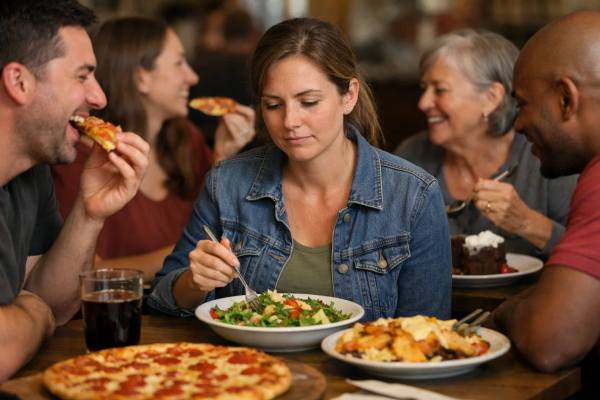
Weight loss habits rarely happen in a vacuum. Most eating decisions are made around other people, in response to other people, or in anticipation of what other people might say. That is why social pressure can quietly shape your food choices even when you are motivated, informed, and trying to stay consistent.
Sometimes the pressure is obvious, like a relative insisting you “just have one more.” Often it is subtler: matching everyone else’s order, eating to be polite, loosening your standards on weekends, or avoiding the awkwardness of being the only person not drinking or snacking. The good news is that social pressure is not just something to resist. It is something you can understand, plan for, and use more wisely.
Table of Contents
- Why social pressure changes food choices
- Where social pressure shows up most
- Signs other people are steering your eating
- How to respond without awkwardness
- Plan ahead for meals out and events
- Build support instead of sabotage
- Make your habits hold up anywhere
Why social pressure changes food choices
Social pressure affects eating because food is social, not just nutritional. People do not eat only to satisfy hunger. They also eat to connect, celebrate, avoid conflict, fit in, and signal that they are easygoing. In a practical sense, that means your body may need one thing while the moment pulls you toward something else.
One powerful mechanism is social modeling. People naturally adjust what, how much, and how fast they eat based on who is around them. If everyone orders appetizers, dessert, and drinks, that becomes the normal pattern for the table. If everyone keeps grazing, the meal feels unfinished even when you are already full. You are not weak for being influenced by that. You are responding to a cue that humans are built to notice.
Another factor is impression management. Some people eat more in groups because the atmosphere is permissive and the meal lasts longer. Others eat less in certain settings because they feel watched or judged. Either way, the social setting shifts behavior. This is one reason people can feel “good” all day alone, then lose control at dinner, during office celebrations, or over a weekend with friends.
There is also a politeness problem. Many people were taught that refusing food is rude, that finishing what is served is respectful, or that indulgence is part of being fun and relaxed. Those beliefs can create a hidden rule: if you are trying to lose weight, do it privately and do not make anyone else uncomfortable. That rule pushes people to abandon perfectly reasonable choices just to avoid social friction.
The key insight is this: social pressure does not only make you eat more junk food. It can also make you ignore your own cues. You may eat when you are not hungry, keep going after fullness, drink more than intended, skip your usual protein-rich meal before going out, or swing from “being good” in public to overeating later in private.
That is why the issue is bigger than willpower. The more useful question is not, “Why can’t I just be disciplined?” It is, “Which social situations change my decisions, and how can I reduce that effect?” Once you look at the problem that way, you can start building habits that survive real life instead of only working in ideal conditions.
Where social pressure shows up most
Social pressure around food is often strongest in repeated settings, not rare ones. A single birthday dinner does not usually derail progress. What matters more is the pattern you return to every week: the Friday takeout ritual, the coworker snack table, the family member who insists on second helpings, the date-night habit of treating every outing like a special occasion, or the friend group that bonds through drinks and dessert.
Some of the toughest moments are not aggressive at all. They are friendly, familiar, and easy to rationalize. That is why they are easy to underestimate. Many of the same patterns that show up in restaurant habit traps also appear at home, at work, and in social gatherings where the “default” is to keep eating because everyone else is.
| Situation | Hidden pressure | What often happens | Better default |
|---|---|---|---|
| Office treats and break-room snacks | You do not want to seem rigid or antisocial | You eat out of convenience, not hunger | Pause, decide once, and move away from the food |
| Family dinners | Love and hospitality get tied to portion size | You take more to avoid comments | Serve yourself once and compliment the meal without overeating |
| Restaurants and takeout nights | Everyone is “treating themselves” | You match the group’s pace and extras | Choose your main priority before ordering |
| Parties and holidays | The event feels special, so structure disappears | You graze for hours without noticing | Use one plate, one dessert, and planned pauses |
| Social media and group chats | Indulgence, cheat meals, and food hype feel normal | You crave foods you were not even thinking about | Notice the cue and choose intentionally, not reactively |
It also helps to distinguish between celebration and frequency. A holiday meal is one thing. Turning every stressful workday, weekend outing, sports event, and catch-up meal into an exception is something else. When exceptions happen three or four times a week, they stop being exceptions.
This is where planning matters. Social eating is not the problem by itself. Unplanned social eating is. A person who decides in advance, “At the party I will build one plate, have one dessert if I really want it, and skip the mindless chips near the kitchen,” is in a much better position than someone who tries to improvise while hungry, distracted, and surrounded by cues.
If holidays and celebrations are a major issue for you, it helps to treat them as skill-based situations rather than moral tests. A thoughtful holiday eating game plan is often more effective than telling yourself to “be good” and hoping motivation shows up at the right time.
Signs other people are steering your eating
Social pressure is often easiest to change once you can spot it early. Many people think they are making spontaneous choices when they are actually reacting to a pattern. The decision feels personal, but the cue came from outside.
Watch for signs like these:
- You eat foods you did not plan or want that much, mostly because everyone else is eating them.
- You keep eating after fullness because the table is still active.
- You order differently with different people, even when your hunger is the same.
- You feel more anxious about seeming rude than about ignoring your own goals.
- You say yes quickly, then feel resentful or defeated afterward.
- You are stricter when alone and looser when observed.
- You “save up” calories for events, arrive too hungry, and then overdo it.
- You feel that one person can throw off your entire evening just by offering food.
A useful self-check is to ask, “If I were eating this meal alone, would I choose the same thing, in the same amount, at the same speed?” If the answer is no, social influence is probably involved.
It is also worth noticing whether the issue is social pressure, emotional eating, or both. Some people overeat mainly because of direct encouragement from others. Others use social settings as permission to do what stress, boredom, or restriction already primed them to do. If that pattern sounds familiar, reviewing common emotional eating triggers can help you separate social cues from emotional ones.
Another sign is delayed overeating. You might stay controlled in front of others, then come home and eat everything you skipped because the restraint was driven by appearance, not real regulation. Social pressure can push behavior in both directions: outwardly “good,” then privately chaotic.
The most helpful mindset is to stop treating these moments as proof of failure. They are data. If you always overeat with one friend, always snack more at work, or always abandon your plan when food is being pushed on you, that is not random. It means the environment is predictable enough to prepare for.
A small notebook entry, notes app log, or end-of-day reflection can reveal a lot:
- Who were you with?
- What was offered?
- What did you feel pressured to do?
- What would you rather have done?
- What sentence or plan would have helped?
That kind of awareness is not obsessive. It is practical. The faster you identify the pattern, the less often you have to relearn the same lesson.
How to respond without awkwardness
Most people do not need a perfect speech. They need two or three calm responses they can use automatically. Social pressure gets stronger when you feel you must explain, justify, or defend yourself. In many cases, a short answer works better than a long one.
Use simple scripts
Try lines such as:
- “No thanks, I’m good.”
- “That looks great, but I’m full.”
- “I’m sticking with this.”
- “I’ll pass for now.”
- “I’m not that hungry, but thank you.”
- “I’m good on dessert tonight.”
These work because they are brief and do not invite debate. You are not asking permission. You are making a normal adult decision.
Do not over-explain
The more detailed your explanation, the more room you create for negotiation. “I am trying to avoid sugar because I had a heavy lunch and I need to be better this week” gives people several openings to persuade you. “No thanks, I’m good” is much harder to challenge.
Repeat instead of escalating
If someone keeps pushing, repeat your answer with the same tone. Repetition often works better than increasing intensity. For persistent situations, a direct version is fair: “I appreciate it, but I’m not having any.”
Shift from refusal to preference
Some people respond better when the choice sounds neutral rather than restrictive. For example: “I feel better when I keep dinner lighter,” or “I’m choosing something that sits better for me.” This reduces the social impression that you are rejecting the person instead of the food.
Have a default order
At restaurants, indecision increases social influence. Decide on a few go-to meals that fit your goals and order them without turning the table into a negotiation. This is one reason guides on saying no to food pushers are so useful: they remove the idea that every situation needs a fresh burst of confidence.
The deeper goal is not to win every interaction. It is to lower the number of moments where you are vulnerable to persuasion. When your response is already chosen, your energy can stay on the conversation instead of the food pressure.
Plan ahead for meals out and events
Social pressure gets much weaker when the key decisions are made before you are hungry, rushed, or surrounded by options. This is where planning has a bigger payoff than motivation.
A simple structure works well:
- Decide the meal’s purpose.
- Choose one or two priorities.
- Set one limit you can actually follow.
For example, if you are going out with friends, your purpose may be connection, not maximizing food. Your priorities might be ordering a satisfying main meal and enjoying one drink. Your limit might be skipping the shared appetizer basket or not treating dessert as automatic.
This kind of planning is most effective when it is concrete. “I’ll be careful” is vague. “I’ll order an entrée with protein, skip the bread basket, and stop when I’m pleasantly full” is usable. That is the strength of pre-commitment strategies: they reduce the influence of the moment by making the decision once, in advance.
Another overlooked tactic is not arriving overly hungry. People often under-eat all day to “save room,” then hit the event in a biologically and socially vulnerable state. A better approach is to eat a normal day with a decent protein and fiber base, or have a small structured snack before leaving if dinner will be late. Hunger plus social cues is a much tougher combination than social cues alone.
Regular eating patterns also matter. When meal timing is chaotic, social occasions do more damage because they become the day’s first real intake. Consistent structure tends to improve appetite control, which is why many people benefit from more predictable meal timing habits for appetite control even if they are not tracking calories closely.
For parties and buffets, choose a rule that is easy to remember:
- One plate first, then pause.
- Protein and produce first, extras second.
- Sit away from the snack table.
- Put drinks and appetizers on separate decisions.
- Decide whether dessert is a yes or no before you see all the options.
These are not rigid rules for life. They are friction-reducing tools for environments that are built to make you eat reactively. The more chaotic the event, the more useful a simple rule becomes.
Build support instead of sabotage
Not all social influence is negative. In fact, some of the strongest weight loss habits are easier when the people around you understand what helps and what does not. The problem is that many people ask for support in vague terms, then feel disappointed when they get criticism, teasing, food pushing, or “help” that feels controlling.
Real support is specific. It might mean your partner stops bringing home your trigger foods, your friend agrees to walk after dinner instead of meeting for pastries, or your family lets you serve your own portions without comment. It can also mean emotional support: less policing, less joking, less making your choices a topic of conversation.
If you want better support, ask for concrete behaviors:
- “Please do not offer me seconds after I say I’m done.”
- “Can we keep chips off the counter and put them away after dinner?”
- “If we go out, I’d rather pick the restaurant before I get too hungry.”
- “Encouragement helps me more than reminders.”
That tends to work better than broad requests like “Please support my weight loss,” which different people interpret very differently.
A stronger support system for weight loss also does not have to mean close family only. It can include a friend who checks in weekly, a partner who shares a grocery routine, a walking group, an online community with sane norms, or one person who respects your boundaries without turning your eating into a project.
At the same time, make the home environment do part of the work. Social pressure is harder to manage when the house itself keeps extending the invitation to overeat. A practical food environment reset can reduce the number of times your habits are challenged by visible snacks, oversized portions, or foods that invite grazing.
One of the most useful distinctions here is support versus surveillance. Support says, “How can I make this easier for you?” Surveillance says, “Are you really going to eat that?” The first builds consistency. The second usually creates defensiveness, secrecy, or rebellion.
You do not need everyone around you to understand your goals. You need a few people, and a few routines, that make the better choice feel normal more often.
Make your habits hold up anywhere
The long-term goal is not to become immune to social influence. That is unrealistic. The better goal is to become less dependent on other people’s habits when making your own decisions.
A good way to do that is to define a small set of non-negotiable behaviors that travel well. These are not extreme rules. They are anchor habits. For example:
- I stop when I am comfortably full, even if food remains.
- I make protein part of social meals when possible.
- I do not turn one off-plan choice into an off-plan day.
- I pause before taking food I was not planning to eat.
- I decide alcohol separately from dessert instead of letting both happen automatically.
These habits work because they are portable. You can use them at home, in restaurants, at family events, while traveling, or during stressful weeks. They do not require perfect conditions.
It also helps to tie choices to identity, not just outcomes. Someone practicing identity-based habits is more likely to think, “I am the kind of person who eats intentionally in social settings,” rather than, “I hope I stay strong tonight.” That subtle shift matters because it turns each interaction into a vote for the person you are becoming, not a test of temporary motivation.
Expect some misses. Social pressure is powerful because it taps into belonging, routine, and emotion. You will occasionally say yes when you meant no, or keep eating longer than planned. What matters most is the next choice. Do not make a social slip-up bigger by adding guilt, compensation, or all-or-nothing thinking.
A short review routine can help a lot. Weekly daily and weekly check-ins are useful here because they let you ask better questions than “Was I perfect?” Try:
- Which people or places helped me?
- Which ones made healthy choices harder?
- What sentence or boundary do I need next time?
- Which one social habit would make the biggest difference this week?
Social pressure becomes less disruptive when your habits stop depending on the room. The room still matters, but it stops deciding for you.
References
- Social Modeling and Eating Behavior—A Narrative Review 2021 (Review)
- Behavioral Approaches to Obesity Management 2022 (Review)
- The effectiveness of social-support-based weight-loss interventions—a systematic review and meta-analysis 2024 (Systematic Review)
- The Role of Household Social Support and Undermining in Dietary Change 2024 (Research Article)
- Weight loss journeys: Exploring social influences and determinants of health in an exploratory rural German intervention 2025 (Research Article)
Disclaimer
This article is for general education only and is not a substitute for medical, nutrition, or mental health advice. If social pressure around food is tied to binge eating, severe distress, a medical condition, or persistent trouble managing weight, speak with a qualified clinician or registered dietitian.
If this article helped, share it on Facebook, X, or your preferred platform so someone else can use it too.