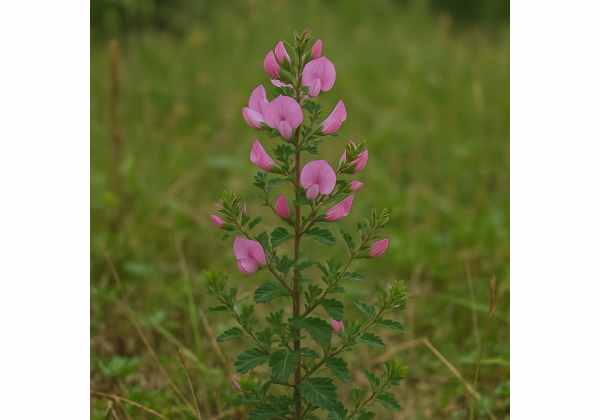
Spiny restharrow, or Ononis spinosa, is a thorny flowering plant in the legume family that has been used in European herbal medicine for centuries. Its root, known as restharrow root or Ononidis radix, is the part most often prepared for medicinal use. Traditional practice has valued it mainly for urinary support, especially when a gentle increase in urine flow is desired alongside adequate fluid intake. Over time, it has also been associated with minor urinary discomfort, gravel, and inflammatory complaints, although modern evidence is much stronger for traditional use than for broad therapeutic claims.
That distinction is important. Spiny restharrow is not a trendy all-purpose herb, and it is not backed by a large body of modern clinical trials. Its best-supported identity is narrower and more practical: a traditional urinary herb with mild diuretic and preclinical anti-inflammatory potential. Its chemistry, including isoflavonoids, flavonoids, and related phenolic compounds, helps explain why it still attracts scientific interest. Used thoughtfully, it may be a useful supportive herb. Used carelessly, especially in place of medical care for worsening urinary symptoms, it can be misunderstood.
Quick Summary
- Spiny restharrow may help support urinary flushing in minor urinary complaints when taken with enough fluid.
- Its root shows mild diuretic and preclinical anti-inflammatory activity rather than strong drug-like action.
- A common tea range is 2 to 4 g of comminuted root in 150 mL boiling water up to 3 to 4 times daily.
- People with reduced fluid allowance, kidney or heart-related edema, pregnancy, or worsening urinary symptoms should avoid self-treatment.
Table of Contents
- What Spiny Restharrow Is and How It Has Been Used
- Spiny Restharrow Key Ingredients and Medicinal Properties
- What Benefits Are Most Plausible
- How Spiny Restharrow Is Used in Herbal Practice
- Dosage Timing and Duration
- Common Mistakes When Using Restharrow Root
- Safety Side Effects Interactions and Who Should Avoid It
What Spiny Restharrow Is and How It Has Been Used
Spiny restharrow is a perennial shrub in the Fabaceae family, native to much of Europe, western Asia, and parts of North Africa. It grows close to the ground, often with woody stems, pink pea-like flowers, and the tough thorny branches that gave it the name “restharrow.” Traditionally, the idea was that its roots and stems could literally catch or “rest” a harrow in the field. That practical image has stayed with the plant, but in medicine the focus is not on the thorns or the flowers. It is the root that matters most.
The dried root, sold as Ononidis radix or restharrow root, has been part of European herbal medicine for generations. Historically, it has been used where mild urinary flushing was desired, especially for minor urinary complaints, urinary gravel, or a sense of sluggish elimination. That long-standing use is still the main reason the herb appears in modern herbal monographs.
One of the most important points for readers is that spiny restharrow is not primarily a general “kidney detox” herb in the modern wellness sense. That kind of language is too vague and often misleading. A more accurate description is that it is a traditional diuretic-support herb used to increase urine flow as part of conservative self-care for minor urinary discomfort, always together with adequate fluid intake.
Its traditional role often overlaps with herbs used in urinary blends, including:
- support for urinary flushing
- mild urinary tract discomfort
- adjuvant use in minor inflammatory urinary complaints
- folk use around gravel and urinary sediment
That does not mean it is appropriate for full urinary tract infections, severe pain, fever, or blood in the urine without medical care. It means it belongs to a narrower category of supportive herbs for mild, uncomplicated situations.
The herb is also sometimes mentioned in older folk practice for skin complaints, rheumatic discomfort, or inflammatory states, but these uses are much less central in modern herbal guidance than the urinary indication. In current herbal medicine, restharrow root’s identity is much more focused.
Readers who already know other urinary herbs may notice some overlap with uva ursi for urinary tract support, but the two are not interchangeable. Uva ursi is more often discussed for antiseptic urinary activity, while spiny restharrow is better understood as a gentle flushing herb with mild diuretic and supportive anti-inflammatory potential.
That focus is actually a strength. Spiny restharrow makes more sense when it is not forced into broad “detox” marketing. It is an old European root with a specific, modest, and still recognizable place in urinary herbal practice. That narrower role is what makes the plant credible.
Spiny Restharrow Key Ingredients and Medicinal Properties
The chemistry of spiny restharrow helps explain why the root has remained relevant in herbal medicine despite the lack of large clinical trials. Like many legume-family herbs, Ononis spinosa contains a mixture of flavonoids, isoflavonoids, phenolic compounds, and other secondary metabolites that give it a gentle but pharmacologically interesting profile.
The key groups of constituents most often discussed include:
- Isoflavonoids and isoflavonoid glycosides
These are especially important in restharrow chemistry. Studies on Ononis roots and hairy root cultures have identified several isoflavonoid compounds that may contribute to the plant’s diuretic and anti-inflammatory profile. - Flavonoids
These support antioxidant activity and likely contribute to some of the broader protective and anti-inflammatory effects seen in preclinical studies. - Saponins
Aqueous root extracts have been described as containing notable amounts of saponins, which may add to the herb’s biologic activity. - Other phenolic compounds and terpenoid-related constituents
These round out the plant’s chemistry and help explain why extracts of different polarity can behave somewhat differently in laboratory models.
From a medicinal standpoint, restharrow root is best described as having four broad properties:
- mild diuretic
- traditional urinary flushing support
- preclinical anti-inflammatory activity
- possible mild antimicrobial support in extracts
The first of these is still the most important. Spiny restharrow is not usually taken for a dramatic pharmacological effect. It is used to gently increase the amount of urine, which is why it is often paired with the recommendation to drink enough fluid. In this sense, the herb acts less like a forceful stimulant and more like a conservative urinary support measure.
Its anti-inflammatory reputation is also interesting, but it needs careful wording. Modern research suggests that root extracts can interact with inflammatory pathways, including Toll-like receptor 4 signaling, and may reduce inflammatory mediators in experimental settings. That helps support the traditional urinary use, since minor urinary complaints often involve irritation as well as reduced comfort. But it is still a leap too far to present the herb as a clinically proven anti-inflammatory treatment in humans.
The chemistry also explains why restharrow is often grouped with other classic urinary herbs. For example, readers interested in herbal urinary flushing traditions may also come across horsetail for urinary tract and fluid support. The two herbs share some practical territory, though restharrow root is much more strongly anchored in the traditional minor urinary-complaint indication.
The most useful takeaway is that spiny restharrow’s medicinal profile is modest but coherent. Its traditional use, phytochemistry, and laboratory findings point in the same direction: a urinary herb with mild diuretic action and supporting anti-inflammatory potential. That does not make it weak. It makes it specific, which is often more valuable than grander claims.
What Benefits Are Most Plausible
The most plausible benefits of spiny restharrow are the ones that stay closest to traditional use and official herbal monographs. That means the herb is best understood as a support for minor urinary complaints, especially when the goal is to increase urine flow and gently flush the urinary tract. Once claims move far beyond that, the evidence becomes much thinner.
The strongest and most credible benefit is this:
1. Urinary flushing support in minor urinary complaints
European herbal guidance recognizes restharrow root as a traditional herbal medicinal product used to relieve symptoms associated with minor urinary complaints while increasing the amount of urine, provided there is also sufficient fluid intake. This is the clearest use-case and the one most grounded in long-standing medicinal use.
This can be practically relevant for:
- a mild sense of urinary sluggishness
- support during minor urinary discomfort
- flushing support as an adjuvant, not a stand-alone treatment
- conservative short-term use when symptoms are mild and non-urgent
The second plausible area is narrower:
2. Preclinical anti-inflammatory support
Experimental studies on Ononis spinosa root extracts suggest that the plant may help reduce inflammatory signaling. This does not prove a clinical anti-inflammatory effect in people, but it helps explain why the herb has been linked with urinary comfort rather than urine flow alone.
A third area is possible but more tentative:
3. Mild antimicrobial or anti-adhesion effects in urinary settings
Some laboratory work suggests that aqueous root extract may influence bacterial behavior and host-cell interactions in urinary-tract-related models. This is promising as supportive science, but it is not proof that restharrow root will treat an active urinary tract infection by itself.
Benefits that are often overstated include:
- broad kidney detoxification
- strong stone-dissolving action
- reliable treatment for infections
- evidence-based therapy for edema of cardiac or renal origin
- general anti-inflammatory use for unrelated body systems
This is where good herbal comparisons are useful. If someone is looking for a broader herbal tradition around urinary flushing and irritation, golden rod for urinary support and diuretic use often comes up in the same conversation. Like restharrow, it is best used thoughtfully and not as a substitute for medical care when symptoms suggest infection or obstruction.
The evidence boundary matters here. Spiny restharrow has credible traditional use, official monograph support, and helpful preclinical research, but it does not have a rich clinical trial base proving that it outperforms placebo in modern urinary complaints. That means the herb is reasonable for mild, supportive use, especially in people who prefer traditional phytotherapy. It is not reasonable to present it as a clinically established treatment for urinary tract infection, kidney disease, or stone disease.
In short, the most plausible benefits are modest, urinary-focused, and best understood as supportive rather than curative. That may sound restrained, but with older traditional herbs, restraint is often the mark of accuracy.
How Spiny Restharrow Is Used in Herbal Practice
In herbal practice, spiny restharrow is used primarily as restharrow root, not as a culinary herb and not usually as a major stand-alone supplement in the way modern wellness products are sold. The most traditional and still most sensible preparation is a herbal tea or infusion made from the comminuted root.
This form matters because the official European monograph specifically refers to the comminuted herbal substance prepared as an herbal tea for oral use. In real practice, that means the herb is typically taken as a root infusion in warm water, several times per day, together with generous fluid intake.
Common herbal forms include:
- comminuted root for tea
- fluid extracts or tinctures
- capsules or tablets in mixed urinary formulas
- combination “diuretic species” teas with other urinary herbs
In traditional practice, spiny restharrow is rarely framed as a dramatic solo herb. It often works best in context, especially when urinary support is the main aim. Many urinary formulas combine several compatible herbs to balance flushing, soothing, and anti-inflammatory support.
That is why restharrow sometimes appears conceptually alongside herbs such as:
- nettle herb or leaf
- golden rod
- horsetail
- uva ursi in more specific urinary formulas
One practical comparison is nettle for urinary support and mineral-rich herbal use. Nettle and restharrow are not the same herb, but both can appear in urinary-support frameworks, especially where a gentler, food-adjacent herbal style is preferred.
There are a few good rules for how to use restharrow well:
- Use it for mild, not severe, urinary complaints.
- Make sure fluid intake is adequate.
- Prefer clearly labeled root preparations over vague whole-plant powders.
- Use it for a short, defined period, not indefinitely.
- Stop and seek medical care if symptoms worsen or if fever, burning, spasm, or blood in the urine appear.
That last point is particularly important. Restharrow is a support herb, not a delay tactic. The herb can make sense when symptoms are minor and short-lived. It makes much less sense when symptoms suggest infection, obstruction, kidney involvement, or another problem that needs diagnosis.
In practice, the best use of spiny restharrow is not glamorous. It is conservative, traditional, and specific. A warm root tea, enough water, and careful self-monitoring fit the herb’s real role much better than aggressive supplement marketing. That kind of use honors both the historical tradition and the limits of the evidence.
Dosage Timing and Duration
For spiny restharrow, the clearest dosing guidance comes from the European herbal monograph on Ononis spinosa root. That makes this herb easier to dose than many lesser-known plants, but only if you are using the right form. The monograph describes the comminuted root prepared as an herbal tea.
A practical traditional-use range is:
- 2 to 4 g of comminuted root
- infused in 150 mL of boiling water
- up to 3 to 4 times daily
- with a maximum daily dose of 12 g
This is the most grounded dosing range currently available for routine oral use. It applies to the comminuted root prepared as a tea, not automatically to extracts, capsules, or tinctures, which may vary considerably in concentration and quality.
Timing is simple. Because the herb is used to increase urine flow, it is often taken:
- during the day rather than late at night
- with enough fluid overall
- in divided doses rather than as one large serving
The herb is best treated as a short-term supportive measure. Official guidance indicates that if symptoms persist longer than one week during use, a doctor or qualified healthcare practitioner should be consulted. That is a very helpful boundary because it reminds users that restharrow is not meant for open-ended self-treatment.
A good practical routine might look like this:
- Prepare the tea with the correct root amount.
- Take it earlier in the day if nighttime urination is a concern.
- Make sure overall fluid intake is adequate.
- Monitor symptoms for change over several days.
- Stop and seek help if symptoms intensify or fail to improve.
There are also important cautions around duration and context. If urinary complaints worsen or if fever, painful urination, spasm, or blood in the urine develops, the herb should not be pushed further. Those are medical red flags, not reasons to simply drink more tea.
Another useful point is that dosing should not be extrapolated carelessly to blends. In combination urinary teas, each herb may be present at a lower amount than the single-herb monograph dose. That is fine if the formulation is designed well, but it means users should not compare a traditional root tea with a mixed tea bag as though they were equivalent.
Readers who are exploring traditional urinary herbs may also encounter golden rod in similar flushing formulas. The dosing logic is comparable in one important way: both herbs depend on adequate fluid intake and both make more sense as short-term, mild-support measures than as indefinite routines.
The best way to use restharrow dosing is as a framework, not a challenge. Stay within the traditional range, use the correct root form, and respect the one-week reassessment window.
Common Mistakes When Using Restharrow Root
Spiny restharrow is a modest herb, and that modesty makes it easy to misuse. The most common mistakes come from treating it either as too weak to matter or as strong enough to replace medical evaluation. In reality, it sits in the middle: useful in the right situation, unhelpful in the wrong one.
One frequent mistake is using it without enough fluid. Restharrow’s traditional use depends on increasing urine flow, and that only makes sense when the body actually has enough fluid to work with. Taking a urinary-flushing herb while drinking too little water defeats the whole idea.
Another mistake is using it for the wrong type of complaint. Restharrow fits mild, minor urinary complaints. It does not fit:
- fever
- strong burning pain
- severe back or flank pain
- visible blood in the urine
- symptoms lasting more than a week without improvement
A third mistake is assuming “urinary herb” means “kidney cleanser.” That kind of language sounds modern and appealing, but it is not precise. Restharrow is not a general solution for every urinary, bladder, or kidney concern.
Other common errors include:
- choosing vague “whole herb” powders instead of root-specific preparations
- using it late in the evening and then being surprised by nighttime urination
- combining it casually with several other diuretic herbs or supplements
- continuing it despite warning symptoms because it is a traditional remedy
- confusing minor urinary discomfort with a likely infection that needs medical care
There is also a subtler mistake: over-reading preclinical science. Laboratory studies showing anti-inflammatory or antimicrobial potential are interesting, but they do not make restharrow a clinically proven anti-inflammatory drug or infection treatment. With older herbs, mechanistic findings often sound much stronger than the real-world evidence.
A useful way to avoid most problems is to keep three questions in mind:
- Is this complaint truly mild?
- Am I drinking enough fluid for this herb to make sense?
- Would I still feel comfortable using this if symptoms lasted a week?
If the answer to the third question is no, then the plan should include reassessment from the beginning.
For readers comparing gentle urinary herbs, corn silk for urinary soothing traditions sometimes appeals because it is often framed as softer and more soothing. That contrast helps clarify what restharrow really is: not especially soothing, not especially antimicrobial, but a steady traditional flushing herb.
The best use of restharrow comes from respecting its scale. It is not a rescue herb, not a cure-all, and not a casual detox tea. It is a focused traditional root that works best when it is matched to the right level of complaint and used with clear stop rules.
Safety Side Effects Interactions and Who Should Avoid It
Spiny restharrow is generally considered a mild traditional herb, but it still has meaningful safety boundaries. The most important one is built into its main use: because it is taken to increase urine output, it is not appropriate for people who have been advised to reduce fluid intake. That includes some people with certain heart or kidney conditions where fluid loading is not safe.
The main official and practical cautions include:
- Do not use if reduced fluid intake has been advised
- Avoid self-treatment if symptoms worsen or persist
- Seek care if fever, painful urination, spasm, or blood in the urine occur
- Avoid use in children under 12 years unless appropriately guided
- Avoid use during pregnancy and lactation because safety has not been established
Possible side effects appear to be uncommon and not well documented, but that does not mean impossible. Mild gastrointestinal upset or hypersensitivity reactions are reasonable theoretical concerns with almost any herbal preparation. The monograph lists hypersensitivity to the active substance as a contraindication.
Interaction data are limited. No specific interactions are well established in the official monograph, but common sense still applies. A herb intended to increase urine flow deserves caution when combined with:
- prescription diuretics
- fluid-restriction plans
- complex kidney or heart medication regimens
- other strong urinary-flushing herbal combinations
One of the most important distinctions is the difference between minor urinary complaints and symptoms that suggest infection or more serious urinary disease. A mild sense of urinary sluggishness is one thing. Fever, significant pain, recurrent symptoms, or blood in the urine are different. In those cases, herbal self-care should not become a substitute for proper assessment.
The overall safety pattern is therefore straightforward:
- the herb is relatively gentle when used correctly
- it is not appropriate when fluid intake is medically restricted
- it should not be used to mask serious urinary symptoms
- long-term unsupervised use is not what the traditional framework supports
This is also where herbal style matters. Restharrow belongs more to the category of traditional conservative phytotherapy than to aggressive supplement use. That makes a careful, short-term tea trial more sensible than escalating into stronger and more numerous urinary products.
The most honest bottom line is this: spiny restharrow is a reasonable traditional herb for mild urinary support in the right person, but it should be avoided by anyone with reduced-fluid-intake advice, unresolved urinary red flags, or pregnancy-related safety concerns. Its modesty does not make it trivial. It simply makes correct use more important than hype.
References
- European Union herbal monograph on Ononis spinosa L., radix 2025 (Monograph)
- Review on phenolic constituents and pharmacological activities of genus Ononis 2025 (Review)
- Qualitative and Quantitative Phytochemical Analysis of Ononis Hairy Root Cultures 2021 (Research Article)
- Root Extracts From Ononis spinosa Inhibit IL-8 Release via Interactions With Toll-Like Receptor 4 and Lipopolysaccharide 2020 (Research Article)
- Ononis spinosa L., an edible and medicinal plant: UHPLC-LTQ-Orbitrap/MS chemical profiling and biological activities of the herbal extract 2020 (Research Article)
Disclaimer
This article is for educational purposes only and is not medical advice, diagnosis, or treatment. Spiny restharrow is a traditional herbal option for mild urinary support, but it should not replace medical evaluation for fever, blood in the urine, painful urination, severe pain, recurring urinary complaints, or any suspected urinary tract infection or kidney condition. Do not use this herb if you have been told to limit fluids, and speak with a qualified healthcare professional before using it during pregnancy, breastfeeding, or alongside prescription medicines.
If this article helped you, please share it on Facebook, X, or your preferred platform.