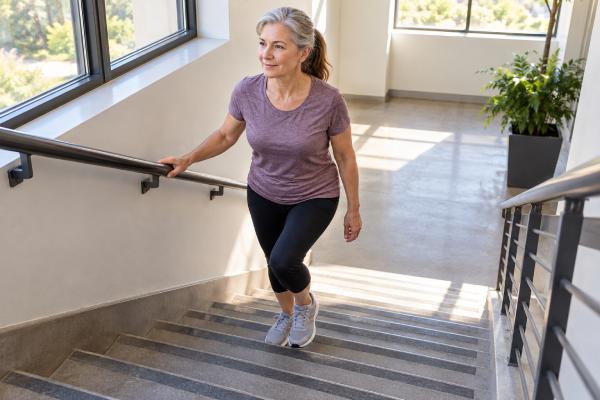
Stair climbing is one of the simplest ways to turn a normal part of the day into vigorous cardiovascular exercise. Going upstairs quickly raises heart rate, breathing, and oxygen demand because you are lifting your body against gravity. That makes stairs more demanding than level walking and potentially useful for improving cardiorespiratory fitness, blood sugar control, and overall activity in people who can do it safely. Large observational studies also link regular stair climbing with lower cardiovascular risk, although those studies cannot prove that stairs alone caused the benefit.
The key is to match the dose to your current fitness. A beginner does not need to sprint flights or chase exhaustion. Short, controlled bouts with the handrail nearby can provide a strong training stimulus. People with chest pain, unstable heart or lung disease, severe balance problems, or major joint limitations should get individualized advice first. For everyone else, stair climbing can be a practical “exercise snack” that complements walking, cycling, swimming, and strength training rather than replacing all other forms of movement.
Table of Contents
- Why Stair Climbing Works the Heart So Hard
- Heart-Health Benefits of Stair Climbing
- How Much Stair Climbing Is Enough?
- A Safe Beginner Stair-Climbing Plan
- How Hard Should It Feel?
- Who Should Be Careful or Get Medical Advice First?
- Common Mistakes and How to Progress
Why Stair Climbing Works the Heart So Hard
Stair climbing raises exercise intensity quickly because every step requires you to lift your body vertically. Compared with walking on flat ground at the same comfortable pace, climbing stairs recruits more muscle mass and demands more energy from the cardiovascular system.
Your heart responds by pumping faster and harder to deliver oxygen to working muscles. Breathing increases, leg muscles generate force repeatedly, and blood vessels adjust to move more blood where it is needed. This combination makes stairs an efficient way to challenge cardiorespiratory fitness without special equipment.
For many adults, climbing a few flights falls into moderate or vigorous intensity depending on speed, body size, age, fitness, and stair height. A fit person may climb several flights while still speaking comfortably. A sedentary person may become breathless after one flight. Both responses can be normal.
This is why stairs are useful but also why beginners should respect them. A task that looks ordinary can function like an interval workout. If you want to understand how heart rate relates to effort, a guide to target heart rate during cardio can provide context, although perceived effort is often more practical for everyday stair sessions.
Heart-Health Benefits of Stair Climbing
The strongest direct benefit is improved fitness. Short bouts of stair climbing can improve cardiorespiratory capacity, especially in people who start out inactive.
A 2023 pilot randomized study in young women with overweight or obesity used a brief stair protocol five days per week for four weeks. The sessions included three 20-second vigorous climbs separated by recovery. Peak oxygen uptake increased by about 10% in the stair group, showing that even very short, repeated bouts can create a meaningful training stimulus.
A 2024 randomized trial comparing stair-based “exercise snacks” with traditional moderate continuous exercise also found that short stair sessions can improve cardiorespiratory fitness in inactive adults. These studies are small and do not mean everyone should copy a high-intensity protocol, but they show why stairs can be time-efficient.
Cardiovascular risk and long-term health
Observational evidence is also encouraging. A 2023 prospective cohort study found that people who reported climbing more than five flights of stairs per day had a lower risk of atherosclerotic cardiovascular disease than people who rarely climbed stairs. Another 2024 population study found that more frequent stair use was associated with a healthier profile for several modifiable cardiovascular risk factors.
These findings do not prove that the stairs themselves caused the lower risk. People who use stairs may also be more active in other ways, have better mobility, or follow healthier routines. Still, the results fit with the broader evidence that regular physical activity reduces cardiovascular risk.
Blood sugar and metabolic health
Stair climbing uses large leg muscles and can improve glucose uptake after meals. A 2024 systematic review found that acute stair-climbing bouts often reduced post-meal glucose in people with prediabetes or type 2 diabetes. A 2025 randomized crossover trial also found that brief stair breaks during prolonged sitting reduced post-meal hyperglycemia.
That matters for heart health because diabetes and insulin resistance are major cardiovascular risk factors. A short stair session after a meal is not a substitute for diabetes treatment, but it may be a useful way to break up sitting and add activity.
Everyday activity without a gym
The practical advantage of stairs is accessibility. A staircase at home, work, a transit station, or an apartment building can become a repeatable workout. You do not need a machine, membership, or large block of free time.
For people who dislike formal exercise, this can reduce friction. A few flights spread through the day may be easier to maintain than a single long workout. It also pairs well with walking for heart health, which is lower impact and easier to sustain for longer durations.
How Much Stair Climbing Is Enough?
There is no medically established number of flights that everyone needs. Research uses very different definitions: flights per day, minutes per session, all-out intervals, self-paced climbs, or total vertical distance.
A large 2023 cohort reported lower cardiovascular risk in people climbing more than about five flights daily, but that should not be turned into a magic threshold. Five flights may be easy for one person and excessive for another. The study was observational, so it cannot tell us that exactly five flights causes a particular risk reduction.
A better approach is to use stairs as part of your weekly activity target. General exercise guidance for adults typically emphasizes at least 150 minutes of moderate-intensity aerobic activity per week, or 75 minutes of vigorous activity, plus muscle-strengthening activity on at least two days. Short bouts can contribute to that total.
If you already walk regularly, stairs can be the higher-intensity piece you are missing. For example, a 30-minute walk might include two or three short stair climbs separated by several minutes of level walking. That structure increases intensity without turning the entire workout into a hard session. For someone with a desk job, another option is one or two flights several times across the day. These brief interruptions may be easier to recover from than a single long stair workout while still reducing sedentary time.
Because stairs can be vigorous, even one to five minutes can feel substantial at first. The goal is to accumulate a dose you can repeat consistently without joint pain, dizziness, chest symptoms, or excessive fatigue.
Flights, steps, or minutes?
Use whichever measure is easiest:
- Flights: practical in an office or apartment building
- Minutes: useful when stair lengths vary
- Rounds: one climb plus a controlled recovery period
- Heart rate or effort: useful for managing intensity
Do not obsess over exact conversion. A “flight” is not standardized across buildings. Consistency matters more than precision.
A Safe Beginner Stair-Climbing Plan
If you have been sedentary, begin conservatively. The first goal is to learn how your body responds, not to test your maximum.
Week 1: Practice the movement
On two or three nonconsecutive days:
- Warm up with five minutes of easy walking.
- Climb one flight at a comfortable pace.
- Pause or walk slowly for one to two minutes.
- Repeat two to four times.
- Finish with several minutes of easy walking.
Use the handrail lightly for balance. Place your whole foot on the step when practical and keep your movement controlled.
Week 2: Add total work
If week one felt manageable, increase to four to six comfortable climbs. You can also shorten the recovery slightly, but change only one variable at a time.
Your breathing should increase, but you should recover noticeably within a couple of minutes. Mild leg fatigue is expected. Sharp knee, hip, ankle, or chest pain is not.
Weeks 3 and 4: Build a repeatable routine
Progress toward five to ten minutes of total stair work two or three days per week. That could mean several short bouts rather than continuous climbing.
If you want a stronger cardiovascular stimulus, climb at a brisk pace for 20 to 60 seconds, then recover for one to two minutes. You do not need an all-out sprint. For many adults, a brisk but controlled climb is enough to reach vigorous intensity.
On other days, continue easier aerobic activity. Combining stairs with lower-intensity Zone 2-style cardio can provide both brief intensity and longer aerobic volume.
A simple weekly example
| Day | Activity | Goal |
|---|---|---|
| Monday | Easy walk | 20–30 minutes |
| Tuesday | Stair session | 4–6 short climbs |
| Wednesday | Easy movement | Walking or rest |
| Thursday | Stair session | 5–8 short climbs |
| Friday | Strength training | Whole body |
| Weekend | Longer easy cardio | 30–45 minutes as tolerated |
This is an example, not a prescription. Shift days based on soreness, work, medical conditions, and other exercise.
How Hard Should It Feel?
A simple effort scale works well for stair climbing.
- Easy, 2–3 out of 10: breathing is comfortable and conversation is easy.
- Moderate, 4–5 out of 10: breathing is deeper, but you can still speak in full sentences.
- Vigorous, 6–8 out of 10: conversation is limited to short phrases, and you clearly need recovery afterward.
- Near-maximal, 9–10 out of 10: very hard effort that most beginners do not need.
For general heart health, you can benefit without reaching maximal intensity. Most beginners should spend their first sessions around moderate to moderately vigorous effort.
Heart rate can help, but it has limits
Heart rate often rises quickly on stairs, but formulas based on age are estimates. Beta blockers and several other medications lower heart-rate response, while dehydration, heat, stress, and caffeine can raise it. If you take medicines that affect pulse, rely more on perceived effort and clinician guidance.
A sudden fast heart rate during climbing is usually expected if it settles during recovery. A heart rate that feels irregular, is accompanied by faintness, or remains unusually high long after stopping deserves medical attention.
Breathing hard is not automatically dangerous
Stairs make many healthy people breathe heavily. The question is whether the response matches the effort and resolves with rest. Stop and seek medical advice for chest pressure, fainting, severe or unusual breathlessness, a new racing or irregular heartbeat with symptoms, or pain that radiates to the jaw, arm, shoulder, or back.
Who Should Be Careful or Get Medical Advice First?
Stair climbing is more demanding than ordinary walking, so some people should check with a healthcare professional before starting vigorous stair intervals.
That includes people with:
- Known coronary artery disease or recent heart attack
- Unstable angina or chest pain with light activity
- Decompensated heart failure
- Severe aortic stenosis or another significant valve problem
- Uncontrolled arrhythmias
- Severe uncontrolled blood pressure
- Significant lung disease with exertional symptoms
- Frequent fainting or unexplained dizziness
- Major balance problems or recent falls
- Severe knee, hip, ankle, or foot pain
- Recent surgery that limits weight-bearing activity
This does not always mean stairs are prohibited. It means the starting dose or supervision may need to change.
If you have high blood pressure
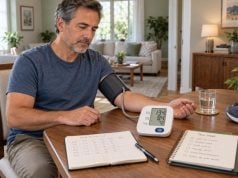
Regular exercise is generally beneficial for hypertension. However, repeated all-out stair sprints create a sharp temporary increase in blood pressure. Most people with controlled hypertension can perform moderate or vigorous aerobic exercise, but those with very high or poorly controlled readings should get guidance before intense intervals.
A broader overview of safe exercise for high blood pressure can help place stair climbing within a balanced program.
If you have joint pain
Ascending stairs often stresses the knees less than descending, but both can provoke symptoms. Use a handrail, slow the descent, and avoid deep, forceful steps if they hurt. An elevator down and stairs up can be a reasonable early strategy.
If pain persists or worsens after sessions, choose a lower-impact option such as cycling, swimming, or level walking while you address the underlying problem.
Common Mistakes and How to Progress
The most common mistake is doing too much too soon. Because stair sessions are short, people often underestimate their intensity.
Mistake 1: Sprinting from the first session
You do not need maximum speed to improve fitness. Start with controlled climbing. Add speed only after you can tolerate the volume comfortably.
Mistake 2: Increasing speed, flights, and frequency at once
Progress one variable at a time. Add one or two climbs, extend a work interval, or add a third weekly session—not all three in the same week.
Mistake 3: Ignoring recovery
Hard stair sessions need recovery just like running intervals. If your legs remain sore, your performance drops, or your resting fatigue builds, take an easier day.
Mistake 4: Rushing downstairs
Descending quickly adds fall risk and eccentric muscle loading. Walk down under control, use the rail, or use an elevator for recovery if needed. The cardiovascular benefit comes mainly from the climb.
Mistake 5: Making stairs your only exercise
Stair climbing is excellent for intensity, but it does not fully replace longer easy aerobic sessions, strength training, flexibility, or daily movement. A balanced program improves more components of fitness and reduces repetitive strain.
How to know you are ready to progress
Increase the challenge when your current session feels predictable for at least a week or two, you recover normally, and you have no new pain or warning symptoms. Small steps work: one extra flight, 10 more seconds per work interval, or slightly less recovery.
As fitness improves, the same staircase will produce a lower heart rate and less breathlessness. That is a positive adaptation. At that point, you can add speed, total climbs, or a weighted backpack only if there is a clear reason. For basic heart health, extra weight is unnecessary and increases joint and balance demands.
The best stair routine is not the hardest one you can survive. It is the one you can repeat safely for months. Short bouts done consistently can raise fitness, break up sedentary time, and add vigorous activity to an otherwise ordinary day.
What progress should look like after a month or two
Improvement is often more obvious in how the same staircase feels than in any single fitness number. You may notice that your breathing settles faster, your legs burn less, or you can climb an extra flight before needing a pause. Those are useful signs of adaptation. Resting blood pressure, glucose, body weight, or cholesterol may also improve over time, but stair climbing is only one influence on those measures.
Avoid judging progress by speed alone. A safer marker is being able to perform more total work at the same perceived effort while maintaining good balance and control. If you use a smartwatch, trends in heart-rate recovery can be interesting, but consumer devices are not diagnostic tools. Consistency, absence of symptoms, and gradual increases in capacity are more important than chasing a specific reading.
References
- Daily stair climbing, disease susceptibility, and risk of atherosclerotic cardiovascular disease: A prospective cohort study 2023 (Prospective Cohort)
- The association between stair climbing and modifiable cardiovascular disease risk factors: the Suita Study 2024 (Study)
- Effects of acute and chronic stair-climbing exercise on metabolic health: A systematic review 2024 (Systematic Review)
- Exercise snacks are a time-efficient alternative to moderate-intensity continuous training for improving cardiorespiratory fitness but not maximal fat oxidation in inactive adults: a randomized controlled trial 2024 (RCT)
- Effect of Short Bouts of Vigorous Stair Climbing on Cardiorespiratory Fitness in Women with Overweight and Obesity: A Pilot Feasibility Study. 2023 (RCT)
- Short-term effects of brief stair climbing interruptions on postprandial hyperglycemia during prolonged sitting: a randomized cross-over trial 2025 (RCT)
Disclaimer
This article provides general exercise information and is not a personal exercise prescription. If you have known heart or lung disease, uncontrolled blood pressure, chest pain, fainting, major balance problems, or significant joint pain, ask a healthcare professional what level of stair climbing is appropriate. Stop exercising and seek urgent care for chest pressure, fainting, stroke symptoms, or severe unusual shortness of breath.