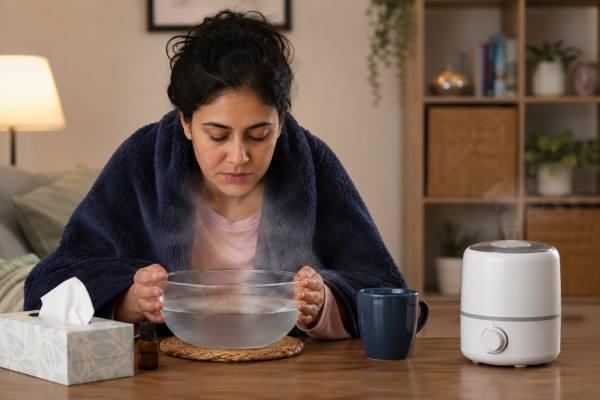
Steam inhalation has been passed down for generations as a simple cold remedy: boil water, lean over the bowl, breathe deeply, and hope the congestion breaks. It is easy to understand why people keep reaching for it. Warm, moist air can feel soothing when the nose is blocked, the throat is irritated, and the head feels heavy. But feeling better for a few minutes is not the same thing as meaningfully changing the course of a cold.
That distinction matters because steam inhalation sits in an awkward middle ground. It may offer brief comfort for some people, yet the evidence for reliable symptom relief is weak, and the risk of burns from spilled hot water is very real. This article looks at what steam actually does, what studies suggest it can and cannot help, why scald injuries keep happening, and what safer options make more sense for congestion, cough, and sore throats during a cold.
Quick Facts
- Steam inhalation may feel soothing for short-term congestion, but it does not clearly shorten a cold or reliably improve symptoms.
- The main danger is not the steam itself but the bowl, kettle, or mug of hot water that can spill and cause serious scalds.
- Children are at especially high risk, but adults also sustain steam-related burns that can require hospital care and skin grafting.
- A safer way to get warmth and humidity is a steamy bathroom or warm shower rather than leaning over a container of boiling water.
- If cold symptoms are severe, prolonged, or paired with breathing difficulty, high fever, or chest pain, symptom relief at home should give way to medical assessment.
Table of Contents
- Why Steam Feels Like It Helps
- What the Evidence Says for Colds
- Why Burns Happen So Often
- Safer Ways to Ease Cold Symptoms
- When Steam Is a Bad Idea
- Where Steam Fits in Real Cold Care
Why Steam Feels Like It Helps
Steam inhalation has always had one major advantage: it feels active. When you are stuffed up, tired, and frustrated, it can feel better to do something physical than to wait out a virus. Warm, moist air also has an immediate sensory effect. The nose may feel less dry, the throat may feel less scratchy, and thick mucus may seem easier to move for a short time. That is often enough for people to describe the remedy as helpful.
Part of this experience is mechanical rather than antiviral. A cold causes swelling in the nasal passages, changes in mucus consistency, irritation of the throat, and that familiar sense of heaviness in the head and face. Warm humidity can briefly soften secretions and make the lining of the nose feel less irritated. That may explain why people report temporary comfort even when the underlying infection is unchanged. The same general principle shows up in discussions of dry mucosal surfaces, where warmth and moisture can reduce irritation without necessarily changing the cause of the problem.
Steam can also create the impression of “opening” the nose, even when the effect is mostly subjective. During a cold, what people call congestion is often a mix of swollen nasal tissues, thicker mucus, mouth breathing, and irritation. A warm cloud of humidity can make breathing feel easier in the moment, much like sipping a warm drink can feel better than cold water on an irritated throat. That comfort is real, even if it is brief.
What steam does not do well is kill the cold virus inside the body. This is where the home-remedy logic runs ahead of the evidence. It is true that heat can affect some viruses under laboratory conditions. But that is very different from proving that steam from a bowl reaches infected tissues at a therapeutic temperature for long enough to change the course of a cold. Human noses, airways, and reflexes are built to protect deeper tissues from heat injury, which limits how much meaningful heat actually reaches the places people hope to treat.
This is why steam should be thought of as a comfort strategy, not as a treatment that reliably changes infection biology. It may help the experience of a cold feel more manageable for a short window. It may not do much beyond that. In immune-health terms, this fits better with support of mucosal comfort and defense than with any idea of “boosting” immunity or speeding viral clearance.
A useful way to frame it is this: steam may help some people feel less irritated, less dry, or less blocked for a little while. That is not nothing. But it is also not the same as strong evidence that steam inhalation improves a cold in a meaningful, consistent, and safe way.
What the Evidence Says for Colds
When people ask whether steam inhalation works, they usually mean one of three things: does it make congestion better, does it shorten the cold, or does it stop the illness from getting worse. The research does not give a strong yes to any of those questions.
The most important summary of the evidence is that results have been inconsistent and generally weak. Some small studies have found short-term symptom improvement. Others have found no meaningful benefit. The larger problem is that the evidence base is old, small, and mixed. Different studies used different devices, temperatures, timing, and ways of measuring results. That makes it hard to say with confidence that steam inhalation reliably helps typical cold symptoms in the real world.
One important detail is often missed: a good portion of the research has been on heated, humidified air delivered through devices rather than on the classic bowl-of-boiling-water method used at home. That matters because people often assume the evidence behind “steam” directly matches the home practice they know. It does not. And even in the more controlled device studies, the benefit has not been convincing enough to support routine use as a clearly effective treatment.
So what is the practical bottom line? Steam may provide temporary subjective relief, especially for a dry or irritated nose, but it does not clearly shorten a cold or consistently improve symptom severity. That is a very different conclusion from “steam cures congestion.” If someone says it made them feel better for 10 minutes, that may be true. If someone says it is a reliable cold treatment, the evidence does not support that claim.
This is where safer, better-supported symptom approaches usually deserve more attention. For nasal blockage, short-term use of a decongestant nasal spray can help some adults, though it has to be used carefully because overuse can backfire. For thick mucus or nasal irritation, saline nasal irrigation may be more useful and better supported than steam. These options are not perfect either, but they are easier to dose and easier to discuss clearly.
There is also a difference between symptom relief and disease modification. Most common cold care is about making the person more comfortable while the immune system does the work. Steam does not appear to change viral shedding or the overall course of illness in a dependable way. That matters because the idea that heat “kills the cold” remains surprisingly persistent.
The fairest conclusion is measured. Steam inhalation is not completely irrational. It can feel comforting, and short-lived relief is possible. But the evidence does not show a strong or consistent benefit for cold outcomes, and that weak benefit has to be weighed against the very real possibility of thermal injury when hot water is involved. Once that balance is considered honestly, steam starts to look much less like a smart first-line remedy and much more like a tradition that has outlived its evidence.
Why Burns Happen So Often
The danger of steam inhalation is usually not that someone breathes in a little warm mist. The danger is the setup. A bowl of boiling water on a lap, a mug near the edge of a table, a kettle poured in a hurry, or a child moving unexpectedly near a hot container can turn a home remedy into a scald injury in seconds.
That is why burns linked to steam inhalation are so common in burn centers. The pattern is often simple: the person leans too close, loses balance, reaches to adjust a towel, knocks the bowl, or startles and spills the water. In children, the risk is even higher because they move unpredictably, have less stable coordination, and may not understand how quickly a hot liquid can spread across the skin. But adults are not exempt. Adults also sustain serious steam-related burns, sometimes requiring hospital admission, surgery, or long-term scar management.
These injuries are not always tiny. Hot water spreads fast, holds heat well, and keeps burning after contact. Scalds can affect the face, chest, lap, thighs, genitals, and hands, depending on how the spill happens. One reason this matters so much is that the body positions used for steam inhalation make certain areas especially vulnerable. Leaning over a bowl places the face and upper body near the steam, while sitting with a bowl near the lap puts the legs and groin at risk if the container tips.
Burn severity also gets underestimated because people often think of steam inhalation as a mild home remedy, not as something involving a container of near-boiling water. But water does not care why it was heated. A spill is still a spill. When it lands on skin, especially thin skin or larger exposed areas, the result can be painful, medically significant, and sometimes disfiguring.
This is one reason warm-shower or steamy-bathroom approaches make more sense than the old bowl-and-towel method. They may still offer warmth and moisture, but they remove the most dangerous part of the setup: an unstable container of very hot water being held close to the body. That does not make all forms of heat therapy risk-free, but it does remove the main mechanism behind many steam-related scalds.
Children deserve especially strong caution. Steam inhalation with a bowl of hot water should not be treated as a child-friendly cold remedy. It is not. And if a child has significant congestion, parents are usually better served by simpler supportive measures such as fluids, age-appropriate symptom relief, and safe nasal care rather than a practice that can turn a minor respiratory illness into an emergency burn visit.
The most important practical point is blunt but useful: steam inhalation injuries do not happen because people are careless or foolish. They happen because hot water spills easily, especially when someone is tired, sick, distracted, or helping a child. That is exactly why the risk deserves more respect than the tradition usually gets.
Safer Ways to Ease Cold Symptoms
Once steam inhalation is viewed more critically, the natural next question is what to do instead. The good news is that most cold symptoms can be eased without balancing over a bowl of boiling water.
For nasal congestion, the safest starting point is often simple humidity and saline, not “steam therapy.” A warm shower or sitting in a steamy bathroom for a few minutes may feel soothing without requiring any hot-water container to be handled. Saline sprays or rinses can also loosen mucus and reduce irritation. If you are considering a rinse device, it is worth understanding safe neti pot use, especially the importance of proper water choice and cleaning.
For a sore throat or cough, warmth still has a place. The difference is that warm liquids are usually safer than inhaling steam from a bowl. Tea, broth, or simply warm water can feel soothing. For adults and for children old enough for it, honey for cough and sore throat can help reduce irritation and nighttime coughing. A salt water gargle is another low-risk option that many people find surprisingly effective.
If blockage is the main problem, it helps to match the tool to the symptom:
- Dry, irritated nose: saline spray or humidified air
- Thick mucus: saline rinse, fluids, warm shower
- Severe short-term nasal blockage: careful, limited decongestant use in adults
- Throat irritation: warm drinks, honey, gargles
- Mild cough: fluids, rest, symptom-targeted relief rather than steam
This approach matters because the common cold is mostly managed symptom by symptom. There is rarely one home remedy that fixes everything. The best results usually come from combining low-risk, modestly helpful measures rather than chasing one dramatic intervention.
Warmth can still play a role, but it should be framed correctly. A warm shower can relax the body, loosen mucus a little, and make breathing feel easier for a short period. A hot drink can soothe the throat. A humidifier may help some people in a dry room, though it needs good cleaning to avoid becoming its own source of irritation. These steps are not miracle cures. They are simply safer comfort measures.
It is also worth remembering that no home remedy needs to prove itself by feeling intense. One reason bowl-based steam inhalation remains popular is that it feels like a powerful treatment. But that intensity is exactly what makes it risky. Safer options tend to feel more ordinary, and that is part of their value. They do not ask a sick, tired person to manage boiling water at close range.
In short, you do not need to choose between “do nothing” and “inhale steam from a bowl.” There are better middle-ground options that respect both symptom relief and safety.
When Steam Is a Bad Idea
Even if an adult still wants to try steam for temporary comfort, there are situations where it becomes a poor choice quickly. Fever is one of them. If the body is already running hot, adding more heat can increase discomfort, fluid loss, dizziness, and overall stress. Someone who is feverish usually benefits more from rest, fluids, and appropriate fever care than from deliberate heat exposure. That is the same basic logic behind handling fever safely: the goal is to support the body, not to pile on another stressor.
Dehydration is another warning sign. People with colds may already be drinking less, sleeping poorly, and breathing more through the mouth, which can leave them feeling dry and lightheaded. Add sweating or hot exposure, and the problem can deepen. If someone feels weak, dizzy, has a very dry mouth, or is not urinating much, the first priority should be fluids and recovery, not a steam session. The same concern comes up in recognizing dehydration during illness.
Children are a special case. Bowl-based steam inhalation is a bad idea for children because the injury risk outweighs the uncertain symptom benefit. This is true even when the child is supervised. Sick children move suddenly, cough unexpectedly, reach for things, and can bump a container or a caregiver’s arm. The fact that something has “always been done at home” is not a safety argument.
Steam is also a poor idea when:
- The person has asthma or fragrance sensitivity and plans to add oils or menthol products that might irritate the airways
- They are sleepy, weak, or taking medicines that make them unsteady
- The setup requires balancing hot water on the lap or near bedding
- They are already feeling faint or nauseated
- They think steam is replacing needed medical attention
That last point matters. A cold can usually be managed at home, but not every respiratory symptom is “just a cold.” If someone has chest pain, shortness of breath, confusion, a very high fever, dehydration, worsening facial pain, or symptoms lasting longer than expected, the question shifts away from home comfort measures. At that point, the priority is assessment.
There is also a more subtle problem with steam inhalation: it can delay better decisions. Someone who spends a few days repeating a weak and risky home remedy may be slower to switch to safer symptom relief or slower to notice that the illness is becoming something more than an ordinary cold.
A useful rule is simple. If the main reason to use steam is that it feels intense or traditional, that is not enough. Steam should be avoided when heat, balance, or supervision make the setup risky, and it should be dropped immediately if it competes with safer care or makes the person feel worse rather than better.
Where Steam Fits in Real Cold Care
The fairest place for steam inhalation in cold care is small. It may offer brief comfort for some adults, but it should not sit at the center of a cold plan, and it should not be treated like a serious antiviral strategy. Once the evidence and injury risk are viewed side by side, steam looks less like a core treatment and more like an optional comfort habit that is easy to replace with safer methods.
That perspective matters in immune health because people often confuse “feels soothing” with “helps the body fight infection.” Most cold recovery still depends on time, sleep, fluids, symptom-targeted care, and not overloading a body that is already busy dealing with a virus. In other words, the basics matter more than the ritual. This fits the same broader pattern seen in what weakens immune resilience. When sleep is poor, stress is high, hydration is off, and recovery is rushed, small comfort practices do much less.
So where does steam fit? For adults only, a safer version of “steam” may be reasonable if it means a warm shower, a steamy bathroom, or simply warm fluids that help the nose and throat feel less irritated. That is a long way from leaning over a bowl of freshly boiled water. The soothing part can stay; the high-risk setup does not have to.
A sensible cold plan usually looks like this:
- Use simple symptom relief first, such as fluids, rest, saline, honey, or appropriate pain relief.
- Choose low-risk comfort measures before high-risk traditions.
- Watch for red flags that suggest the illness is more than a routine cold.
- Focus on prevention habits that matter more over time.
That last point is worth saying clearly. Steam inhalation does not lower future cold risk in any proven way. If someone wants to get sick less often, the better targets are the usual ones: sleep, hand hygiene, cleaner indoor air, vaccinations where appropriate, and the basic habits covered in practical illness-prevention strategies. Steam belongs nowhere near the top of that list.
The most honest conclusion is not dramatic. Steam inhalation may feel nice. It may briefly soothe a blocked or irritated nose. But its benefits are modest, uncertain, and temporary, while the burn risk from home steam setups is concrete and well documented. For that reason, steam should be treated as optional at best, avoided entirely for children, and replaced whenever possible with safer ways to get the same small comfort.
That kind of realism is useful. It protects people from unnecessary harm while still respecting why the remedy became popular in the first place: not because it is powerful, but because it feels comforting when a cold makes everything feel harder.
References
- Heated, humidified air for the common cold 2017 (Systematic Review)
- Steam inhalation and paediatric burns during the COVID-19 pandemic 2020 (Clinical Warning)
- Severe scalds sustained during steam inhalation therapy in an adult population: Analysis of patient outcomes and the financial burden to healthcare services 2022 (Retrospective Study)
- Common colds: Learn More – Relief for a stuffy nose, cough and sore throat 2023 (Evidence Summary)
- Sick Becomes Seriously Ill—Scald Injuries due to Domestic Medical Self‐Treatment: A Six‐Year Single Center Retrospective Study 2025 (Retrospective Study)
Disclaimer
This article is for general educational purposes only and is not medical advice. Steam inhalation can cause serious burns, especially in children, and should not be used as a substitute for medical assessment when symptoms are severe, prolonged, or unusual. Seek urgent care for breathing difficulty, chest pain, confusion, dehydration, facial swelling, severe burns, or burns involving the face, hands, genitals, major joints, or large areas of skin. If a burn occurs, cool it promptly with cool or lukewarm running water and seek professional medical advice when needed.
If this article helped you, consider sharing it on Facebook, X, or another platform so more people can avoid preventable steam burns and choose safer ways to manage cold symptoms.