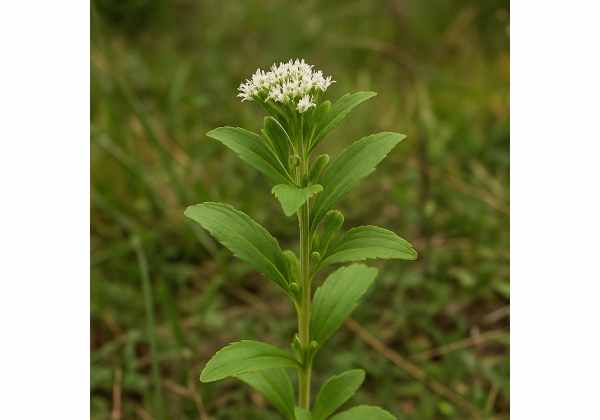
Stevia, or Stevia rebaudiana, is a South American plant best known for leaves that taste intensely sweet without behaving like sugar in the body. For many people, that alone makes it useful. It can sweeten drinks, yogurt, and prepared foods while adding little or no calories, and it usually has far less effect on blood glucose than ordinary table sugar. That practical role is the strongest reason stevia matters today.
Still, stevia is not just one thing. The whole leaf, crude extracts, and highly purified steviol glycosides are not equivalent in regulation, composition, taste, or safety interpretation. The compounds most responsible for sweetness are stevioside and several rebaudiosides, especially rebaudioside A and rebaudioside M. These molecules have also driven interest in stevia’s potential metabolic, antioxidant, and oral-health benefits.
The best way to understand stevia is as a modern sweetener with some promising medicinal features, not as a miracle herb. Its greatest health value often comes from what it replaces, especially added sugar, rather than from strong drug-like effects of its own.
Quick Overview
- Stevia can help reduce added sugar intake while keeping foods and drinks sweet.
- Purified steviol glycosides may modestly support blood glucose control, but the evidence is still limited.
- The accepted daily intake is 0 to 4 mg/kg body weight per day as steviol equivalents.
- Whole-leaf and crude stevia extracts are not the same as food-grade purified sweeteners.
- People using glucose-lowering or blood-pressure medicines should be cautious with concentrated use.
Table of Contents
- What stevia is and why the form matters
- Stevia health benefits and where evidence is strongest
- Key ingredients and medicinal properties of stevia
- How stevia is used in food, drinks, and supplement-style products
- Stevia dosage, sweetness equivalents, and how to stay within safe limits
- Common mistakes, product labels, and how to choose stevia well
- Safety, side effects, interactions, and who should avoid stevia
What stevia is and why the form matters
Stevia comes from the leaves of Stevia rebaudiana, a member of the Asteraceae family native to Paraguay and Brazil. The plant has a long local history of use as a sweetening herb, especially in teas and infusions. What made it globally important, though, was not simply its traditional use. It was the discovery that its leaves contain intensely sweet diterpene glycosides called steviol glycosides. These compounds can taste roughly 200 to 400 times sweeter than sugar, depending on the molecule and the preparation.
That sounds simple, but it is where most confusion begins. People often use the word “stevia” as if it means one uniform ingredient. In reality, stevia can refer to at least four very different things: the whole dried leaf, crude leaf extracts, high-purity steviol glycosides used as sweeteners, and consumer products that contain stevia plus bulking agents such as erythritol, dextrose, or maltodextrin. These are not interchangeable.
The difference matters because health claims and safety expectations change with the form. Food-approved sweeteners based on purified steviol glycosides are the most studied and the most tightly defined. Whole-leaf stevia and crude extracts are less standardized, may contain additional plant compounds, and are handled differently by regulators. In the United States, certain highly purified steviol glycosides are accepted for use as sweeteners, while whole-leaf and crude stevia extracts are not permitted for use as sweeteners in conventional foods. That one fact explains a great deal of the confusion people encounter when shopping.
Taste is another reason the form matters. Stevioside and rebaudioside A are sweet, but they can also carry bitterness or a licorice-like aftertaste in some foods. Rebaudiosides D and M are often valued because they taste cleaner and closer to sugar. This is why two products labeled “stevia” can behave very differently in coffee, yogurt, or baking.
From a practical standpoint, the best way to define stevia is this: it is a plant source of non-caloric sweet compounds, but the health and culinary experience depends heavily on how those compounds are processed and presented. That distinction is worth keeping in mind from the start, because many disappointments with stevia come not from the plant itself, but from choosing the wrong version of it.
Stevia health benefits and where evidence is strongest
The strongest health benefit of stevia is not mysterious. It helps people reduce added sugar while keeping sweetness in the diet. That may sound less exciting than claims about blood pressure, fat loss, or metabolic repair, but it is the most reliable and useful benefit by far. If someone replaces sugar-sweetened drinks or high-sugar foods with well-formulated stevia products, the likely gain is lower sugar exposure, fewer calories from sweetness, and often a smaller immediate glycemic load.
That replacement effect is important because it changes how stevia should be judged. Stevia does not have to act like a drug to be helpful. In many cases, its biggest benefit comes from making a better dietary choice easier to sustain. This is the same reason it often appears in broader conversations about lower-glycemic alternatives such as foods used for gentler glycemic control. The benefit is practical first and pharmacological second.
There is also some evidence for modest direct metabolic effects. A 2024 meta-analysis found low-certainty evidence that stevia consumption reduced blood glucose levels, especially in people with higher body mass index, diabetes, or hypertension. At the same time, stevia did not significantly improve insulin levels or HbA1c in a convincing way. That distinction matters. The findings are promising, but they do not justify presenting stevia as a stand-alone treatment for diabetes.
Blood pressure is another area where stevia is often overstated. Some earlier stevioside trials suggested that higher-dose stevioside might reduce blood pressure in people with hypertension. But those effects were seen in specific contexts and usually at doses higher than what many people consume simply by sweetening tea or yogurt. Purified steviol glycosides used at ordinary sweetening levels do not appear to have a strong hypotensive effect in people with normal blood pressure.
Stevia also has a useful oral-health reputation. Because it is non-fermentable and non-cariogenic in ordinary sweetener use, it is often viewed as a friendlier option for teeth than sugar. That does not turn it into a dental treatment, but it does support its role as a smarter sweetener.
A realistic hierarchy of benefits looks like this:
- Best supported: reducing added sugar intake and replacing caloric sweeteners.
- Reasonably supported: helping maintain lower glycemic impact than sugar in everyday eating.
- Promising but modest: small improvements in fasting blood glucose in some groups.
- Less settled: meaningful effects on weight, blood pressure, appetite regulation, or long-term metabolic disease outcomes.
That hierarchy protects against a common mistake: expecting stevia itself to solve the same problems that a high-sugar diet helped create. Stevia is most useful when it replaces sugar, not when it is layered on top of an already sweet, highly processed diet.
Key ingredients and medicinal properties of stevia
Stevia’s sweetness comes mainly from steviol glycosides, a group of diterpene compounds naturally present in the leaves. The best known are stevioside and rebaudioside A, but the full list is broader and includes rebaudiosides D and M, dulcoside A, and several others. These compounds are the main reason stevia has become globally important as a sweetener.
Stevioside and rebaudioside A are still the names people encounter most often, especially on older products and labels. Stevioside tends to be strongly sweet but more likely to bring bitterness or a lingering aftertaste. Rebaudioside A is usually cleaner in flavor and became one of the first widely commercialized stevia sweetener components. Rebaudiosides D and M are often prized for an even more sugar-like sensory profile, which is why they are increasingly used in newer formulations.
Beyond sweetness, stevia leaves also contain phenolic compounds, flavonoids, tannin-like constituents, chlorophylls, and minor volatile compounds. These do not drive the main sweetening function, but they are part of why whole-leaf stevia and crude extracts are chemically different from purified steviol glycosides. They also help explain why stevia leaf has attracted interest beyond the sweetener market.
From a medicinal standpoint, the most discussed properties of stevia are antioxidant, anti-inflammatory, glucose-related, and possibly antimicrobial. Much of this interest comes from in vitro work, animal studies, and broad phytochemical reviews. These signals are important, but they should not be confused with strong human therapeutic proof. Stevia’s compounds are biologically active, yet ordinary sweetening amounts may not produce the same effects seen in experimental models.
One particularly important property is how steviol glycosides are handled in the body. They are not broken down by enzymes in the upper digestive tract the way ordinary sugar is. Instead, they reach the lower gut, where microbiota help convert them to steviol, which can then be absorbed and further processed. This different metabolic route is one reason stevia does not behave like sucrose in terms of calories and immediate blood glucose response.
A practical summary of stevia’s key ingredients and medicinal properties looks like this:
- Stevioside and rebaudiosides: the main sweetening compounds.
- Phenolics and flavonoids: contributors to antioxidant and plant-defense activity.
- Non-caloric sweetening action: the most clinically useful everyday property.
- Potential metabolic and anti-inflammatory activity: promising, but still less established than the sweetener function.
This is also why stevia belongs in two different conversations at once. It is a food ingredient, but it is also a plant with meaningful phytochemistry. Its strongest real-world value still comes from sweetening without sugar, yet its chemistry suggests it may do more than that in the long run. The key is not to pretend those two roles are equally proven. They are not. Stevia’s sweetness is settled. Its broader medicinal impact is still being clarified.
How stevia is used in food, drinks, and supplement-style products
Stevia is used in several very different ways, and understanding those forms is one of the most practical things a reader can learn. In daily life, it appears most often in beverages, tabletop sweeteners, yogurt, protein powders, flavored waters, sugar-free desserts, and reduced-sugar packaged foods. These uses are straightforward because the goal is clear: sweetness without the same sugar load.
At home, stevia is commonly used in coffee, tea, smoothies, oatmeal, chia pudding, homemade dressings, and yogurt. In these settings, it works best when people use it sparingly. Because it is so sweet, a small amount goes a long way, and overuse quickly produces the bitter or metallic note that gives stevia a bad reputation. Many people who think they dislike stevia have simply used too much of the wrong form.
Cooking and baking are more complicated. Pure steviol glycosides provide sweetness, but they do not provide sugar’s bulk, browning, moisture retention, or texture. That means stevia can work very well in drinks and soft foods, but less predictably in cakes, cookies, and sauces unless the recipe has been specifically designed for it. This is one reason many retail products blend stevia with erythritol or other bulking sweeteners.
That blend issue is worth emphasizing. A packet labeled “stevia” is often not pure stevia. It may contain a small amount of steviol glycoside plus a much larger amount of erythritol, dextrose, inulin, or maltodextrin to make measuring easier. These extra ingredients can change taste, digestion, texture, and even the glycemic impact. In practical terms, the product experience often depends as much on the carrier as on the stevia itself.
Stevia also appears in herbal or supplement-style products. These may include whole-leaf powders, liquid extracts, tincture-like preparations, or “blood sugar support” formulas. Here, the line between sweetener and herb becomes less clear. The evidence is much stronger for food-grade sweetener use than for crude or concentrated leaf preparations used as medicinal products. For everyday wellness, a food-approved sweetener form is usually the cleaner choice.
People often use stevia in three main ways:
- Sugar replacement in drinks and foods.
- Reduced-sugar formulation in packaged products.
- Herbal-style use through leaves or crude extracts, which is much less standardized.
That distinction matters because the safest, most evidence-based use is still the first one. Stevia works best as a smart sweetener, not as a cure-all herb. Someone looking for digestive comfort, for example, would usually do better reaching for peppermint for digestive support than trying to turn stevia into a general medicinal extract.
The more stevia is used like food, the easier it is to understand and manage. The more it is used like a concentrated herbal medicine, the more uncertainty enters the picture.
Stevia dosage, sweetness equivalents, and how to stay within safe limits
Stevia dosage is confusing because people often measure the wrong thing. The official safety limit is not based on packet count, spoonfuls, or the total weight of a commercial sweetener blend. It is based on steviol equivalents, with an accepted daily intake of 0 to 4 mg per kg of body weight per day. This limit applies to steviol glycosides used as food additives, not to every possible whole-leaf or crude extract product.
That distinction matters immediately. A 70 kg adult has an accepted daily intake of about 280 mg steviol equivalents per day. But that does not mean 280 mg of every stevia product. Different glycosides have different conversion factors, and many consumer products contain fillers that make the label weight much larger than the actual steviol glycoside content.
For ordinary household use, the simplest advice is practical rather than mathematical: follow the product’s serving guidance, use the minimum amount needed for sweetness, and avoid assuming that “natural” means limitless. This is especially important with concentrated liquid drops and pure powders, where it is easy to overshoot both taste and intake.
A useful way to think about stevia dosing is by purpose.
For sweetening drinks, a very small amount is usually enough. One or two drops of a liquid extract or a fraction of a packet may fully sweeten a cup, depending on the product. For tabletop use, most people naturally self-limit because too much produces an obvious aftertaste. For packaged foods, the manufacturer has usually done the formulation math, but that does not guarantee the product is “pure stevia.”
For people specifically asking about medicinal dosage, the honest answer is narrower: there is no universally established therapeutic dose of stevia leaf for blood sugar, blood pressure, or any other disease outcome that should be copied casually. The strongest and safest dose framework remains the accepted daily intake for purified steviol glycosides.
A practical step-by-step approach looks like this:
- Check whether the product is a purified steviol glycoside or a blend.
- Use the smallest amount that gives acceptable sweetness.
- Watch how the product tastes and how your body responds.
- If using stevia heavily every day, pay attention to the accepted daily intake rather than just packet count.
- Avoid treating whole-leaf or crude extract products as though they were interchangeable with food-approved sweeteners.
It is also worth remembering that stevia is so sweet that its real dosage skill is restraint. Better results usually come from less, not more. This is different from nutritive sweeteners, where a larger amount is often needed for effect. With stevia, overdoing it worsens flavor before it meaningfully improves sweetness.
The best dosing mindset is therefore simple: think in terms of sweetness efficiency, label clarity, and steviol equivalents. That keeps stevia useful and keeps expectations realistic.
Common mistakes, product labels, and how to choose stevia well
One of the most common mistakes with stevia is assuming that every “stevia” product is basically the same. It is not. Some products contain mostly rebaudioside A. Others rely on rebaudioside M for a cleaner taste. Many contain erythritol or dextrose as the main bulk ingredient, with only a small amount of actual steviol glycoside. If you do not read the ingredient panel, you may not be evaluating stevia at all. You may be reacting to the blend.
Another mistake is using stevia as if it were sugar. Because stevia is so potent, adding it by habit rather than by careful tasting often leads to bitterness, lingering sweetness, or a medicinal note. This is especially common in coffee and baking. People then decide that “stevia tastes bad,” when the real problem is concentration, not the plant itself.
A third mistake is expecting stevia to create the same functional effects as sugar in recipes. Sugar adds browning, body, structure, viscosity, and preservation. Stevia mostly adds sweetness. When bakers replace all the sugar in a recipe with stevia and nothing else, the result is often dry, pale, oddly textured, or flat. That is a recipe problem, not necessarily a stevia problem.
Whole-leaf stevia causes another category of confusion. Some consumers assume that the least processed form must also be the healthiest. That is not always the case. For food sweetener use, high-purity steviol glycosides have clearer regulatory standing and more defined composition than crude leaf products. Whole-leaf material may feel more “herbal,” but it is also less standardized and less predictable.
When choosing a stevia product, look for:
- clear naming of the sweetening ingredient,
- information about whether the product is pure or blended,
- a realistic sweetness guide,
- simple ingredient lists,
- packaging that explains serving size,
- a taste profile that fits your intended use.
This is also where comparison becomes useful. Someone interested in overall blood-sugar-friendly eating may do more good by improving the broader diet, perhaps including better spice choices such as cinnamon in a balanced metabolic-support pattern, rather than obsessing over the exact sweetener alone. Stevia helps, but it does not replace sensible diet structure.
A final mistake is treating stevia like a medical shortcut. It can reduce the sugar burden of the diet, and that matters. But it does not erase the effects of ultra-processed eating, liquid calories from other sources, or a highly sweet palate. In fact, one of the best ways to use stevia is not simply to replace sugar one-for-one forever, but to use it as a bridge toward a less intensely sweet pattern overall.
Good stevia use starts with label literacy. Once you know what form you are buying, the rest becomes much easier.
Safety, side effects, interactions, and who should avoid stevia
At approved intake levels, purified steviol glycosides are generally considered safe. That is the central safety message, and it is important not to lose it in unnecessary alarm. Regulatory agencies and safety evaluations have repeatedly supported the accepted daily intake of 4 mg/kg body weight per day as steviol equivalents. For most people using stevia as a sweetener, this safety profile is reassuring.
Still, safe does not mean every form, every dose, and every situation are identical. The first safety distinction is between purified steviol glycosides and whole-leaf or crude stevia extracts. These are not treated the same way, especially in U.S. food regulation. A product made from high-purity glycosides has a much clearer safety frame than a loosely defined whole-leaf preparation.
The second safety issue is product composition. Many side effects blamed on “stevia” actually come from what it is blended with. Erythritol and other bulking agents can affect digestion or mouthfeel. Dextrose and maltodextrin can change the metabolic profile of the product. This is why reading the ingredient list matters so much. A person who says stevia causes bloating may be reacting more to the carrier than to the glycoside itself.
Possible side effects with stevia products include:
- bitter or metallic aftertaste,
- digestive discomfort with some blends,
- taste fatigue when overused,
- occasional individual sensitivity,
- mismatch between product expectations and actual ingredients.
Medication interaction concerns are more theoretical than dramatic, but they are worth noting. Because stevia may have modest glucose-lowering or blood-pressure-related effects in some settings, people who use medications for diabetes or hypertension should be a little more attentive when using concentrated products regularly. This does not mean stevia is dangerous for them. It means monitoring makes sense, especially if intake is high or the person is highly sensitive.
Pregnancy and breastfeeding deserve a nuanced answer. Ordinary amounts of approved food-grade steviol glycosides are generally treated more comfortably than crude herbal-style preparations. The more concentrated or less standardized the product becomes, the more caution is reasonable. The cleanest advice is to stay with ordinary food-grade sweetener use and avoid experimental medicinal-style use during pregnancy unless advised otherwise.
People who should be more careful include:
- those using glucose-lowering medicines,
- those using blood-pressure medicines,
- people with highly sensitive digestion,
- anyone relying on crude leaf or non-standardized extracts,
- pregnant or breastfeeding individuals considering concentrated products,
- people with known sensitivity to stevia products or specific additives.
The safest overall rule is straightforward: use well-defined food-grade stevia products in moderation, stay aware of the accepted daily intake, and do not assume all stevia products are equivalent. Stevia is one of the more useful non-caloric sweeteners available, but its safest form is also its most clearly defined one. Precision, not fear, is what keeps it in the safe category.
References
- Steviol Glycosides from Stevia rebaudiana: An Updated Overview of Their Sweetening Activity, Pharmacological Properties, and Safety Aspects – PMC 2023 (Review)
- Natural sweetener Stevia rebaudiana: Functionalities, health benefits and potential risks – PubMed 2021 (Review)
- Effect of stevia on blood glucose and HbA1C: A meta-analysis – PubMed 2024 (Systematic Review and Meta-Analysis)
- Safety evaluation of the food additive steviol glycosides, predominantly Rebaudioside M, produced by fermentation using Yarrowia lipolytica VRM – PMC 2023 (Safety Evaluation)
- Aspartame and Other Sweeteners in Food | FDA 2025 (Official Guidance)
Disclaimer
This article is for educational purposes only and is not a substitute for medical advice, diagnosis, or treatment. Stevia is best understood as a sweetener and food ingredient with some promising metabolic and oral-health relevance, not as a proven treatment for diabetes, obesity, or hypertension. If you have diabetes, kidney disease, unstable blood pressure, digestive sensitivity, or use prescription medicines that affect glucose or blood pressure, speak with a qualified healthcare professional before using concentrated stevia products regularly. Seek individualized advice if you are pregnant, breastfeeding, or using non-standardized whole-leaf or crude stevia preparations.
If you found this article helpful, please share it on Facebook, X, or another platform you prefer.