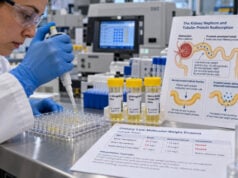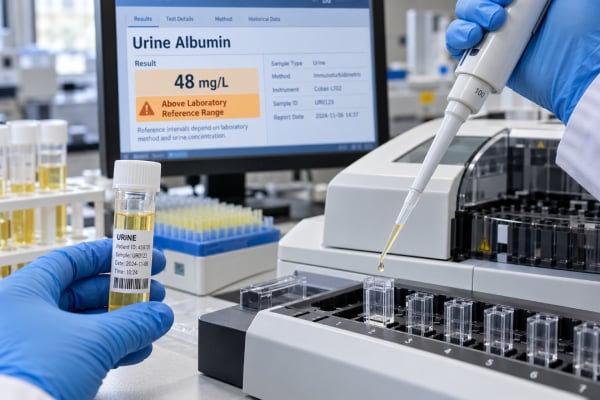
A urine albumin test measures albumin leaking from the blood into urine. Albumin is a large blood protein that healthy kidney filters largely retain, so persistent albuminuria can be an early and important sign of kidney damage. The preferred routine measurement is usually the urine albumin-to-creatinine ratio (uACR), which adjusts for how dilute or concentrated the urine is and can be measured from a single spot sample. A uACR below 30 mg/g is generally classified as normal to mildly increased, 30–300 mg/g as moderately increased, and above 300 mg/g as severely increased. Albuminuria can appear before the estimated glomerular filtration rate (eGFR) falls and is especially important in diabetes, hypertension, cardiovascular disease, and established chronic kidney disease. Because albumin excretion varies from day to day, an unexpected high result often needs repeat testing before it is considered persistent.
- uACR is the preferred routine urine albumin test because it corrects partly for urine concentration.
- uACR below 30 mg/g is A1, 30–300 mg/g is A2, and above 300 mg/g is A3 albuminuria.
- Albuminuria can reveal kidney damage even when serum creatinine and eGFR are still normal.
- Exercise, fever, infection, severe hyperglycemia, menstruation, heart failure, and marked hypertension can temporarily raise urine albumin.
- Persistent or rapidly increasing albuminuria should be evaluated with eGFR, blood pressure, urinalysis, and the person’s underlying kidney risks.
Table of Contents
- What Urine Albumin Testing Shows
- Types of Urine Albumin Tests
- Normal Range and Albuminuria Categories
- What Causes Albuminuria
- Temporary Increases and Test Preparation
- How Albuminuria Relates to CKD and Heart Risk
- Follow-Up, Monitoring, and When to Seek Care
What Urine Albumin Testing Shows
Albumin is made by the liver and is the most abundant protein in plasma. It helps keep fluid inside blood vessels and transports many substances through the circulation. Because albumin is relatively large and negatively charged, a healthy glomerular filtration barrier restricts most of it from entering urine.
When that barrier is damaged or under abnormal pressure, more albumin can pass into the filtrate. A rise in urinary albumin can therefore act as an early marker of glomerular stress or injury.
Albuminuria does not identify a single disease. It can occur with diabetes, hypertension, primary glomerular diseases, lupus, heart failure, obesity-related kidney stress, pregnancy-related disorders, infections, and other conditions. The amount, persistence, urine sediment, eGFR, and clinical history determine what the finding means.
A urine albumin test is more specific than a generic urine total protein measurement. Total protein includes albumin plus low-molecular-weight proteins, immunoglobulins, and other proteins. Albumin testing is especially valuable because albuminuria has a strong, well-established relationship with chronic kidney disease progression and cardiovascular risk.
The result is usually interpreted together with eGFR. These two measurements answer different questions: eGFR estimates filtration capacity, while albuminuria reflects kidney damage and glomerular barrier dysfunction. Neither should routinely replace the other.
Types of Urine Albumin Tests
Several test formats exist, but they are not equally useful in every setting.
Urine albumin-to-creatinine ratio
The uACR test measures albumin and creatinine in the same urine specimen. It is usually reported in mg/g in the United States or mg/mmol in many other countries.
Creatinine helps correct for urine concentration. A person who drinks a lot of fluid may produce a dilute sample with a low albumin concentration even though daily albumin excretion is abnormal. Someone who is dehydrated may produce a concentrated sample with a higher albumin concentration. The ratio reduces, though does not eliminate, this source of variation.
A random spot sample is convenient for screening. A first-morning void is often preferred when confirming an abnormal value or following borderline results because it minimizes variation from posture and daytime activity.
Albumin concentration alone
Some tests report urine albumin in mg/L or mg/dL without creatinine. This can be useful in specific laboratory contexts, but the result is more sensitive to hydration. It is generally less robust for routine CKD classification than uACR.
Timed urine albumin excretion
A timed or 24-hour collection can report the albumin excretion rate in mg/day. Historically, this was a standard approach. It can still be useful in selected situations, but timed collections are inconvenient and commonly affected by missed or extra voids. For routine screening, a spot uACR is usually preferred.
Albumin-specific dipstick or point-of-care testing
Some devices estimate albumin or uACR at the point of care. These can improve screening access, but an abnormal semiquantitative result may need confirmation with a quantitative laboratory assay.
Normal Range and Albuminuria Categories
Current kidney disease classification divides albuminuria into three main categories.
| Category | uACR | Albumin excretion rate | Meaning |
|---|---|---|---|
| A1 | <30 mg/g (<3 mg/mmol) | <30 mg/day | Normal to mildly increased |
| A2 | 30–300 mg/g (3–30 mg/mmol) | 30–300 mg/day | Moderately increased |
| A3 | >300 mg/g (>30 mg/mmol) | >300 mg/day | Severely increased |
The older terms “microalbuminuria” and “macroalbuminuria” correspond roughly to moderately and severely increased albuminuria, but current guidelines prefer A2 and A3 terminology. “Microalbumin” does not mean a smaller molecule of albumin; it means a relatively small but clinically important amount in urine.
Within A1, very low albumin excretion can be described more specifically. An albumin excretion rate below about 10 mg/day or uACR below about 10 mg/g is sometimes called normal, while 10–29 mg/g may be described as mildly increased. For CKD classification, however, both remain within A1.
The thresholds are useful, but risk is continuous. A uACR of 280 mg/g is not fundamentally different from 310 mg/g simply because one lies just below a category boundary. Clinicians therefore consider the actual number, the trend, and other risk factors.
A very high uACR can occur with severe glomerular disease. If total protein reaches the nephrotic range and serum albumin is low with edema, the evaluation shifts toward nephrotic syndrome and its causes.
What Causes Albuminuria
Diabetes is one of the most common causes. High glucose, glomerular hypertension, inflammation, and structural changes in the filtration barrier can lead to progressively higher albumin excretion. Current diabetes care therefore includes routine uACR testing in people at risk for diabetic kidney disease.
Hypertension can damage the kidney microvasculature and glomeruli. Albuminuria can also reflect increased intraglomerular pressure even before eGFR declines substantially.
Primary glomerular diseases can produce much higher albumin levels. Examples include focal segmental glomerulosclerosis, membranous nephropathy, minimal change disease, and IgA nephropathy.
Autoimmune and inflammatory kidney disease may cause albuminuria together with hematuria and abnormal urine sediment. Lupus nephritis is a major example. In this setting, albumin is interpreted with complements, antibodies, kidney function, and sometimes biopsy.
Heart failure can increase albumin excretion through hemodynamic changes, venous congestion, and systemic inflammation. Acute decompensation may temporarily worsen uACR.
Obesity and metabolic disease can increase glomerular workload and are associated with albuminuria, especially when hypertension, insulin resistance, or diabetes is present.
Albuminuria may also occur with infections, pregnancy complications such as preeclampsia, hereditary kidney disease, some medications, and acute kidney injury.
The cause cannot be inferred from the albumin number alone. A typical slowly rising uACR in long-standing diabetes is clinically different from abrupt severe albuminuria with blood in the urine and a rapidly falling eGFR.
Temporary Increases and Test Preparation
Albumin excretion has meaningful day-to-day variation. This is one reason repeat testing is important.
Temporary increases can occur with:
- Vigorous exercise, especially within the previous 24 hours
- Fever or acute systemic illness
- Urinary tract infection
- Marked hyperglycemia
- Severe uncontrolled hypertension
- Acute heart failure or volume overload
- Menstruation or sample contamination
- Some short-term hemodynamic stresses
If an abnormal result was measured during one of these situations, repeating the test after recovery may prevent a false diagnosis of persistent albuminuria.
A first-morning sample is often the best confirmatory specimen. Collect it before prolonged standing or exercise. Use the clean-catch method if instructed, and follow the laboratory’s storage and transport directions.
Normal hydration is preferable. Deliberately drinking large amounts of water before testing is unnecessary and may make urine unusually dilute. Deliberate dehydration is also unhelpful.
For people monitoring albuminuria over time, consistency improves trend interpretation. Similar timing, similar activity before collection, and the same laboratory method reduce avoidable variability.
How Albuminuria Relates to CKD and Heart Risk
Albuminuria is a core marker of chronic kidney disease because it provides prognostic information beyond eGFR. Persistent uACR of 30 mg/g or higher can qualify as evidence of kidney damage if it remains present for at least three months, even when eGFR is 60 mL/min/1.73 m² or higher.
Higher albuminuria categories are associated with greater risk of CKD progression, kidney failure, cardiovascular disease, and mortality. This relationship exists across eGFR categories, which is why modern CKD staging combines the G category for filtration and the A category for albuminuria.
A person with eGFR of 95 and uACR of 600 mg/g does not have “normal kidneys” simply because filtration is preserved. Conversely, a person with eGFR of 45 and uACR of 8 mg/g has reduced filtration but little albuminuria. Their kidney disease patterns and risk profiles are different.
Albuminuria is also useful for monitoring response to treatment. A meaningful sustained reduction can reflect lower intraglomerular pressure and reduced kidney risk. In people with diabetes and CKD, guideline-directed therapies may include renin-angiotensin system blockers, sodium-glucose cotransporter-2 inhibitors, and in selected cases nonsteroidal mineralocorticoid receptor antagonists. Treatment choices depend on blood pressure, potassium, eGFR, cardiovascular status, pregnancy considerations, and other factors.
A rising uACR despite treatment may prompt a review of blood pressure control, medication adherence, glucose management, sodium intake, acute illness, or a new superimposed kidney disease.
Follow-Up, Monitoring, and When to Seek Care
After an unexpected high result, clinicians often repeat uACR rather than diagnosing CKD from one specimen. In diabetes, two of three abnormal specimens collected over roughly three to six months are commonly used to confirm persistent A2 or A3 albuminuria when no acute confounder is present.
Typical follow-up includes:
- Serum creatinine and eGFR
- Blood pressure measurement
- Repeat uACR
- Urinalysis with microscopy
- HbA1c or glucose assessment when diabetes is relevant
- Serum electrolytes
- Additional immune, infectious, or hematologic tests when the pattern is atypical
If total protein appears disproportionately high compared with albumin, clinicians may investigate non-albumin protein. A UPCR measures total protein and can reveal a mismatch that suggests tubular or overflow proteinuria.
Monitoring frequency depends on risk. A person with no known CKD may be screened annually when clinically indicated, while someone with established CKD and high albuminuria may need testing several times per year, particularly after treatment changes.
Nephrology referral may be appropriate for rapidly increasing albuminuria, very high A3 results, active urine sediment, unexplained decline in eGFR, resistant hypertension, suspected systemic kidney disease, or uncertainty about the diagnosis.
Seek prompt or urgent medical care when albuminuria accompanies rapidly worsening edema, shortness of breath, very low urine output, visible blood in urine with systemic illness, severe symptomatic hypertension, or a sudden decline in kidney function. Albuminuria itself usually causes no pain, so symptoms often reflect the underlying disease or a complication rather than the protein leak alone.
A urine albumin test is most useful as part of a pattern: the actual uACR, whether it persists, how quickly it changes, the eGFR, the urine sediment, and the person’s clinical risks. That combination can detect kidney damage early and guide timely treatment long before symptoms appear.
Why albuminuria is treated as a continuous risk marker
The A1, A2, and A3 categories are useful for communication, but biology does not change abruptly at 30 or 300 mg/g. Cardiovascular and kidney risk generally rises across the spectrum. A uACR of 295 mg/g and one of 305 mg/g are clinically very similar despite falling on opposite sides of the A2/A3 boundary.
This is why trends and absolute changes are important. A patient whose uACR falls from 900 to 350 mg/g has had a substantial reduction in albuminuria even though the result remains A3. A rise from 40 to 200 mg/g within the same A2 category may be clinically significant and deserve investigation.
Who is commonly screened
Routine urine albumin testing is especially useful in people at increased kidney risk. This includes many people with diabetes, hypertension, known cardiovascular disease, established CKD, or a history that suggests glomerular disease. Screening intervals depend on the condition and current guidelines.
In diabetes, uACR and eGFR are commonly checked at least annually in adults who meet screening criteria, with more frequent monitoring once CKD is established. The exact schedule changes with eGFR category, albuminuria level, treatment changes, and clinical stability.
Screening people at meaningful risk is different from indiscriminate testing. A result is most useful when there is a clear plan for confirmation, risk assessment, and treatment if abnormal.
Common mistakes when reading an albumin result
Several interpretation errors are easy to avoid:
- Confusing urine albumin concentration with uACR. The numbers and units are not interchangeable.
- Assuming a single value above 30 mg/g proves chronic kidney disease.
- Ignoring temporary triggers such as strenuous exercise or infection.
- Assuming normal eGFR means albuminuria is harmless.
- Comparing results from different units without converting them correctly.
- Using a total protein cutoff to interpret an albumin-specific test.
- Treating “microalbumin” as a different molecule rather than a historical name for a range of albumin excretion.
How treatment changes the meaning of follow-up testing
Once therapy is started, urine albumin becomes both a risk marker and a response marker. A sustained reduction can indicate that intraglomerular pressure and kidney stress have improved. However, treatment decisions are not based on albumin alone. Blood pressure, potassium, eGFR, diabetes control, cardiovascular status, and medication tolerance all influence whether therapy is continued or adjusted.
A sudden large rise in uACR after a period of stability deserves a search for reversible explanations. Poor blood pressure control, acute infection, severe hyperglycemia, new heart failure, medication changes, or a superimposed glomerular disease can all alter albumin excretion. Confirming the increase with a properly collected sample is often the first step before launching a more extensive workup.
Age and body composition can influence uACR because the ratio uses urine creatinine. A frail older adult with low muscle mass may excrete less creatinine than a younger muscular adult, which can make the same albumin excretion produce a higher ratio. This is one reason borderline results are interpreted with clinical context and repeated rather than treated as exact measures of daily albumin loss.
Albuminuria can also be present without visible changes in urine. The urine may look completely normal, and a person may have no swelling or pain. Conversely, foamy urine is not specific for albumin and cannot replace testing. The absence of symptoms is therefore not reassuring enough to skip recommended screening in people with diabetes or other kidney risks.
When an abnormal result is confirmed, the goal is not simply to “normalize the urine test.” Clinicians use albuminuria to guide a broader risk-reduction strategy that may include blood pressure treatment, glucose management, smoking cessation, cardiovascular prevention, and medication choices that protect the kidney. The most meaningful outcome is lower long-term kidney and cardiovascular risk, with the uACR serving as one measurable marker of that response.
References
- KDIGO 2024 CKD Guideline 2024 (Guideline)
- Urine Albumin Measurements in Clinical Diagnostics 2024 (Review)
- Developments in albuminuria testing: A key biomarker for detection, prognosis and surveillance of kidney and cardiovascular disease-A practical update for clinicians 2025 (Review)
- Guidelines and Recommendations for Laboratory Analysis in the Diagnosis and Management of Diabetes Mellitus 2023 (Guideline)
- Recommendations for pre-analytical urine sample handling to allow optimal assessment of albuminuria and proteinuria. 2026 (Review)
- 11. Chronic Kidney Disease and Risk Management: Standards of Care in Diabetes—2026 2026 (Guideline)
Disclaimer
Urine albumin results should be interpreted using the laboratory’s units and together with eGFR, blood pressure, urinalysis, and medical history. One abnormal result may be temporary and often requires confirmation before chronic kidney disease is diagnosed. Seek urgent care for severe swelling, breathing difficulty, markedly reduced urine output, or other acute symptoms.