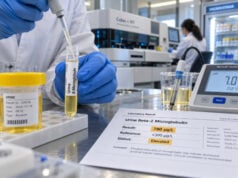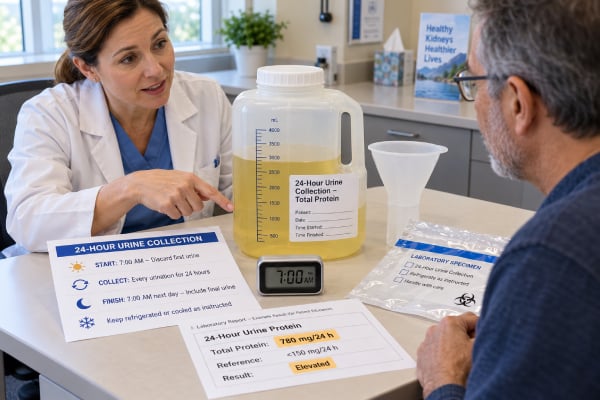
A 24-hour urine protein test measures the total amount of protein lost in urine during one complete day. Healthy kidneys keep most blood proteins in the circulation and reabsorb many small proteins that pass through the filters, so only a small amount normally reaches the urine. A persistently high result, called proteinuria, can reflect damage to the glomeruli, injury to the kidney tubules, or excess production of small proteins that overwhelm normal tubular reabsorption. The test can quantify protein loss more directly than a dipstick because the laboratory measures the protein in the entire timed collection. However, the result is only as reliable as the collection itself. Missing one or more voids can substantially underestimate protein loss. In many routine situations, a spot urine protein-to-creatinine ratio (UPCR) or albumin-to-creatinine ratio (uACR) is easier and preferred, while a 24-hour test is reserved for selected diagnostic or monitoring questions.
- Total urine protein is usually below about 150 mg/24 h in healthy adults, although laboratory reference limits vary.
- Nephrotic-range proteinuria in adults is commonly defined as about 3.5 g or more per 24 hours, but nephrotic syndrome also depends on clinical findings such as low serum albumin and edema.
- A urine dipstick mainly detects albumin and can miss important non-albumin proteins, including monoclonal free light chains.
- Missing urine makes a 24-hour result falsely low; collecting too long can make it falsely high.
- Temporary proteinuria can occur with strenuous exercise, fever, acute illness, dehydration, or other stress, so an unexpected result may need confirmation.
Table of Contents
- What the 24-Hour Urine Protein Test Measures
- When a 24-Hour Protein Test Is Useful
- How to Collect the Sample Correctly
- Protein Results and Common Ranges
- Causes of High Urine Protein
- What Can Distort the Result
- Follow-Up After an Abnormal Test
What the 24-Hour Urine Protein Test Measures
The test reports the total mass of protein excreted over 24 hours, usually in milligrams per day (mg/24 h) or grams per day (g/24 h). It does not identify one specific protein unless additional testing is ordered.
Urinary protein can come from several sources. In glomerular proteinuria, damage to the kidney’s filtering barrier allows larger plasma proteins—especially albumin—to cross into urine. In tubular proteinuria, low-molecular-weight proteins are filtered normally but are not reabsorbed efficiently by injured proximal tubules. In overflow proteinuria, the body produces so much of a small protein that the filtered load exceeds the tubules’ ability to reclaim it. Monoclonal free light chains in plasma-cell disorders are a classic example.
That distinction explains why total protein and albumin are related but not interchangeable. A urine albumin test focuses on albumin, while a total protein assay captures a broader mixture. For chronic kidney disease screening, albumin is usually the preferred marker because albuminuria has strong evidence for kidney and cardiovascular risk prediction. Total protein remains valuable when non-albumin protein is possible or when clinicians are following diseases traditionally monitored with protein excretion.
A routine urine dipstick is only a screening tool. It responds mainly to albumin and can be influenced by urine concentration and pH. A quantitative 24-hour measurement is more informative when the actual amount of total protein matters, but it still cannot show which proteins are present. Electrophoresis, immunofixation, or specific low-molecular-weight protein tests may be needed to characterize the pattern.
When a 24-Hour Protein Test Is Useful
Current kidney practice often favors spot ratios because they are convenient and avoid many timed-collection errors. A urine protein-creatinine ratio (UPCR) can estimate the severity of proteinuria from one sample, while uACR is generally preferred when albumin-specific risk classification is the goal.
A 24-hour urine protein test may be ordered when:
- the amount of daily protein loss needs direct quantification;
- a spot UPCR does not fit the clinical picture or varies unexpectedly;
- nephrotic-range proteinuria is suspected and precise measurement may affect management;
- the patient has a glomerular disease being followed with total protein excretion;
- urine electrophoresis or immunofixation is being performed on a timed specimen;
- multiple substances are being measured in the same 24-hour collection;
- a specialist wants to verify a surprising spot result in someone with unusual creatinine production.
A 24-hour test is not automatically the “gold standard” in practice if the collection is incomplete. Spot ratios remove much of the effect of urine concentration by indexing the analyte to creatinine. They are especially practical for serial monitoring because repeating a first-morning sample is far easier than repeating a full-day collection.
The choice between total protein and albumin also depends on the suspected disease. In diabetes and most routine CKD screening, uACR is favored. In known glomerulonephritis, nephrotic syndrome, or suspected monoclonal protein disease, total protein and more specialized urine studies may add important information.
How to Collect the Sample Correctly
A valid 24-hour result requires a complete, accurately timed collection. Follow the laboratory’s instructions because container type, storage, and preservatives can differ depending on the tests ordered.
A typical collection uses these steps:
- Pick a day when you can collect every urine sample. Avoid starting if travel, work conditions, or another event makes this unrealistic.
- At the chosen start time, empty your bladder into the toilet. Do not save this first urine. Record the exact time.
- Collect every void after that for the next 24 hours, including overnight urine.
- Store the container as instructed, often refrigerated or kept cool.
- At the exact stop time the next day, urinate one final time and add that urine to the container.
- Return the specimen promptly according to the laboratory’s directions.
The start and stop rule can seem counterintuitive. The first void is discarded because it contains urine produced before the collection period. The final void is saved because it contains urine produced during the last part of the 24 hours.
Do not change your diet, protein intake, salt intake, or fluid intake specifically to manipulate the test unless your clinician gives preparation instructions. If the goal is to measure your usual protein excretion, a typical day is more informative than an unusual one.
If you miss a sample, spill urine, contaminate the container, or realize the timing was wrong, contact the laboratory. Restarting may be necessary. The broader 24-hour urine collection error guide explains why missed voids and overcollection can change results so much.
Protein Results and Common Ranges
Reference intervals vary by laboratory and method, but total urinary protein below about 150 mg/24 h is commonly considered within the expected adult range. Values above the laboratory’s upper reference limit are proteinuria.
| 24-hour total protein | General interpretation | Important context |
|---|---|---|
| Below about 150 mg/24 h | Usually within the expected range | Use the laboratory’s own reference interval |
| Above about 150 mg/24 h | Proteinuria | Severity and protein type matter |
| Several hundred mg to a few g/24 h | Moderate to heavy proteinuria | May occur in glomerular, tubular, or mixed disease |
| About 3.5 g/24 h or more | Nephrotic-range proteinuria | Does not by itself establish nephrotic syndrome |
The 3.5 g/day threshold is a traditional adult definition of nephrotic-range total protein excretion. A person with this level may have edema, low serum albumin, and high blood lipids, but those features must be assessed separately. A dedicated nephrotic-range proteinuria test discussion can help distinguish a very high protein result from the full clinical syndrome.
Pregnancy uses different clinical thresholds in specific settings. For example, proteinuria at or above 300 mg/24 h has historically been used in evaluating preeclampsia, but diagnosis depends on the complete obstetric picture, and spot ratios are now commonly used. Pregnancy results should therefore be interpreted using obstetric guidance rather than general adult CKD thresholds.
A very low or unexpectedly normal 24-hour value can be misleading if the collection was incomplete. If the clinical picture suggests substantial protein loss but the measured total is low, collection quality should be reviewed before assuming the kidneys are normal.
Causes of High Urine Protein
High urine protein is a finding, not a single diagnosis. The likely cause depends on the amount, the dominant protein type, the urine sediment, kidney function, symptoms, and whether the abnormality persists.
Glomerular causes are common and often produce albumin-rich proteinuria. Examples include diabetic kidney disease, hypertensive kidney disease, membranous nephropathy, focal segmental glomerulosclerosis, minimal change disease, IgA nephropathy, lupus nephritis, and other glomerulonephritides. Heavy glomerular protein loss can reach the nephrotic range.
Tubular causes usually produce lower-molecular-weight proteins because damaged proximal tubules fail to reclaim proteins that were filtered normally. Tubulointerstitial nephritis, some medications and toxins, inherited tubular disorders, and certain infections can cause this pattern. If tubular proteinuria is suspected, markers such as alpha-1 microglobulin, beta-2 microglobulin, or retinol-binding protein may be considered.
Overflow causes occur when unusually high amounts of small proteins enter the filtrate. Monoclonal free light chains associated with plasma-cell disorders are clinically important because they may not produce a strongly positive standard dipstick. A discrepancy between a modest albumin dipstick result and substantial measured total protein can therefore prompt urine protein electrophoresis or immunofixation.
Proteinuria can also be temporary. Fever, strenuous exercise, seizures, acute illness, severe physiologic stress, and sometimes dehydration can increase protein excretion. Adolescents and young adults can have orthostatic proteinuria, in which protein rises while upright but is low in a first-morning specimen after lying down overnight.
Because so many conditions can produce proteinuria, repeating the measurement after a temporary trigger resolves is often more useful than assigning a chronic diagnosis from one result.
What Can Distort the Result
The most important source of error is a collection that does not truly represent 24 hours. A missed void, wrong start or stop time, spill, or accidental extra collection changes the total amount because the result is calculated from everything in the container.
Clinicians may use 24-hour urine creatinine as a rough check on completeness. Creatinine excretion tends to be fairly consistent within an individual, but it varies with muscle mass, age, sex, diet, and activity. A low creatinine total can suggest undercollection, yet it may also be appropriate for a person with low muscle mass. A high value can suggest overcollection or high muscle mass. It is a clue, not a pass-or-fail test.
Other issues include:
- Concentrated or dilute urine: less important for a true 24-hour total than for concentration-based tests, but may affect screening dipsticks.
- Recent intense exercise: can temporarily increase protein loss.
- Fever or infection: may cause transient proteinuria.
- Menstrual or other blood contamination: can add protein to the specimen.
- Method limitations: total protein assays differ in their sensitivity to different protein types.
- Known monoclonal proteins: some assays and dipsticks may underestimate or handle light chains differently.
This is one reason a single number should not be interpreted in isolation. If total protein, albumin, dipstick findings, and clinical features do not agree, the mismatch itself can be diagnostically useful.
Follow-Up After an Abnormal Test
After a high 24-hour urine protein result, clinicians usually determine whether the finding is persistent and what type of protein is being lost. Follow-up may include a first-morning uACR or UPCR, repeat urinalysis, serum creatinine and eGFR, blood pressure measurement, serum albumin, and review of medications and recent illness.
Urine microscopy matters when proteinuria occurs with blood, dysmorphic red blood cells, white blood cells, or cellular casts. Those findings can point toward inflammatory glomerular or tubulointerstitial disease. If protein loss is very high, clinicians may also check for edema, hyperlipidemia, thrombosis risk, and other features associated with nephrotic syndrome.
When non-albumin protein is suspected, additional studies may include urine and serum protein electrophoresis, immunofixation, and serum free light chains. When an autoimmune or systemic disorder is possible, targeted blood tests can help identify the cause. Kidney biopsy is reserved for situations where the diagnosis remains uncertain and tissue findings are likely to change management.
Persistent proteinuria is also a risk marker. In chronic kidney disease, larger amounts of protein or albumin are generally associated with a higher risk of kidney function decline. Treatment therefore focuses on the underlying disease and on kidney-protective measures such as appropriate blood pressure control, diabetes management when relevant, and medications shown to reduce kidney risk in eligible patients.
Seek timely medical care for heavy proteinuria accompanied by rapidly increasing swelling, shortness of breath, very low urine output, visible blood in urine, severe hypertension, or symptoms of acute systemic illness. These features can signal a more urgent kidney problem.
When Total Protein, Albumin, and the Dipstick Do Not Agree
A useful way to interpret a 24-hour urine protein result is to compare it with the albumin fraction and the routine urine dipstick. These tests overlap, but they do not measure exactly the same thing. A standard protein dipstick responds mainly to albumin. A laboratory total-protein assay measures albumin plus many other urinary proteins. uACR measures albumin specifically. This means a mismatch can provide a clue to the type of kidney problem.
If total protein is high and most of it is albumin, a glomerular source is more likely. Diseases that damage the glomerular filtration barrier allow albumin and other larger proteins to enter urine. In contrast, substantial total protein with a relatively low albumin fraction raises the possibility of tubular proteinuria or overflow proteinuria. Tubular disorders reduce reabsorption of normally filtered low-molecular-weight proteins. Plasma-cell disorders can produce large quantities of monoclonal free light chains that overflow into urine and may not register strongly on an albumin-focused dipstick.
This is why a negative or only mildly positive dipstick does not always rule out clinically important proteinuria. If the measured 24-hour total is unexpectedly high, clinicians may compare total protein with uACR and consider urine protein electrophoresis, immunofixation, serum free light chains, or tubular markers depending on the clinical context. Conversely, a strongly positive dipstick with a low measured 24-hour total should raise questions about specimen timing, contamination, collection completeness, and laboratory method.
The numerical result also needs a clinical frame. Persistent low-level proteinuria with stable eGFR has a different implication from rapidly increasing protein loss accompanied by hematuria, edema, low serum albumin, or declining kidney function. Very heavy protein loss can be associated with nephrotic syndrome, while proteinuria plus red-cell casts or rapidly worsening kidney function may suggest an inflammatory glomerular process that needs faster evaluation.
For monitoring, repeated measurements using the same method are easier to compare. A spot UPCR may be more practical than repeated 24-hour collections, while uACR is preferred when albumin-specific risk staging is the main goal. A 24-hour collection remains useful when the actual daily amount is important, but its extra precision is only meaningful if the collection itself is complete.
Why Trends Are More Useful Than Isolated Totals
Protein excretion can fluctuate with exercise, fever, blood pressure, glycemia, infection, and hemodynamic changes. A change from one collection to the next therefore needs to be large and persistent enough to exceed ordinary biological and collection variability before it is treated as true progression. Clinicians often compare the timed total with spot UPCR or uACR and with serum creatinine to see whether several markers are moving in the same direction.
When treatment is started, falling proteinuria can be a favorable sign, but the goal depends on the underlying disease. Glomerular diseases, diabetic kidney disease, and monoclonal protein disorders are not monitored in exactly the same way. A consistent method, similar collection conditions, and attention to kidney function make serial results much easier to interpret.
References
– Methods for Diagnosing Proteinuria-When to Use Which Test and Why: A Review 2025 (Review) – Executive summary of the KDIGO 2024 Clinical Practice Guideline for the Evaluation and Management of Chronic Kidney Disease: known knowns and known unknowns 2024 (Guideline) – Measuring albuminuria or proteinuria: does one answer fit all? 2023 (Review) – Proteinuria Assessment and Therapeutic Implementation in Chronic Kidney Disease Patients-A Clinical Audit on KDIGO (“Kidney Disease: Improving Global Outcomes”) Guidelines 2024 – Proteinuria, measured or estimated albuminuria for risk prediction in patients with chronic kidney disease? 2024
Disclaimer
This article provides general education about 24-hour urine protein testing and does not replace individualized medical care. Protein reference ranges, collection instructions, and interpretation can vary by laboratory and clinical situation. Discuss persistent, heavy, or unexpected proteinuria with a qualified healthcare professional.