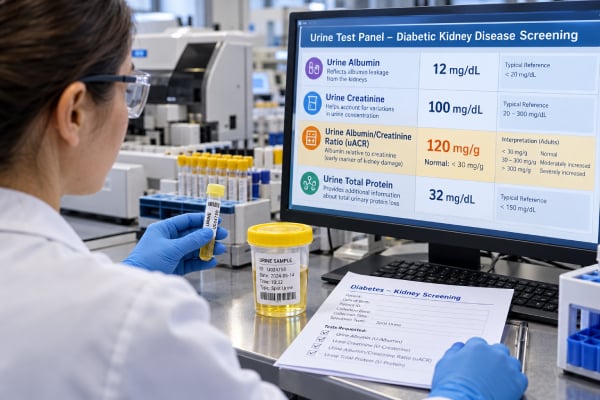
A diabetic kidney disease urine evaluation centers on the urine albumin-to-creatinine ratio (uACR), which detects albumin leakage and corrects the result for urine concentration. There is no single universal “diabetic kidney disease urine panel” with an identical set of tests in every laboratory. In routine care, uACR is the key urine marker, while urinalysis and total urine protein are added when the pattern is atypical or more detail is needed. Urine creatinine is mainly used as the denominator in uACR or protein-to-creatinine ratios; it is not the same as the serum creatinine test used to estimate glomerular filtration. Kidney screening in diabetes must therefore combine urine albumin testing with blood-based eGFR. Current diabetes guidance recommends at least annual uACR and eGFR testing for all people with type 2 diabetes and for people with type 1 diabetes after about 5 years of disease. Abnormal albumin results usually need confirmation because albumin excretion varies substantially from day to day.
- The core urine test for diabetic kidney disease is uACR: below 30 mg/g is A1, 30–299 mg/g is A2, and 300 mg/g or higher is A3 albuminuria.
- Urine creatinine in a uACR corrects for how dilute or concentrated the urine is; serum creatinine and eGFR are still needed to assess filtration.
- Two of three abnormal uACR specimens collected over about 3–6 months are commonly used to confirm persistent albuminuria.
- A normal uACR does not rule out diabetic kidney disease because some people develop reduced eGFR without increased albumin excretion.
- Blood or cellular casts, rapidly rising protein, nephrotic syndrome, or a rapid fall in eGFR can suggest a kidney disease other than—or in addition to—diabetes.
Table of Contents
- What Is in a Diabetic Kidney Urine Panel?
- uACR and Albuminuria: The Core Kidney Marker
- What Urine Creatinine Does—and Does Not—Show
- When Total Protein and Urinalysis Add Value
- Screening and Monitoring Schedule
- Temporary Causes of High Albumin
- When Results Do Not Fit Typical Diabetic Kidney Disease
- Using Results for Follow-Up and Treatment Decisions
What Is in a Diabetic Kidney Urine Panel?
For diabetes, the most important urine measurement is uACR, not a large fixed panel of unrelated urine markers. A uACR requires two measurements from the same sample: urine albumin and urine creatinine. The laboratory divides albumin by creatinine so the result is less affected by hydration and urine concentration.
A practical diabetic kidney evaluation may include:
- uACR;
- routine urinalysis, especially when symptoms or atypical kidney disease are possible;
- urine microscopy when blood, leukocytes, or casts need evaluation;
- total urine protein or a protein-to-creatinine ratio (UPCR) when protein loss is heavy or non-albumin protein is suspected;
- selected specialized urine tests when another kidney disorder is being considered.
The urine portion is only half of screening. Serum creatinine and eGFR are needed because diabetic kidney disease can present with albuminuria, reduced filtration, or both.
This combined approach matters because the old concept of diabetic kidney disease as a predictable march from “microalbuminuria” to heavy proteinuria and then declining GFR does not fit everyone. Some people lose filtration without developing substantial albuminuria. Others have persistent albuminuria for years while eGFR remains preserved. Looking at both markers avoids missing either pattern.
uACR and Albuminuria: The Core Kidney Marker
The urine albumin-creatinine ratio is the preferred screening test because it detects relatively small amounts of albumin and adjusts for urine concentration. A random spot specimen is acceptable for routine screening, while a first-morning sample is useful for confirmation and may reduce variability.
| Albuminuria category | uACR | Meaning |
|---|---|---|
| A1 | <30 mg/g | Normal to mildly increased |
| A2 | 30–299 mg/g | Moderately increased |
| A3 | ≥300 mg/g | Severely increased |
In mg/mmol, the approximate category boundaries are below 3, 3–30, and above 30 mg/mmol. Always use the units on the actual report.
Persistent A2 or A3 albuminuria is a marker of kidney damage and is associated with higher risks of CKD progression and cardiovascular disease. Risk does not suddenly begin at 30 mg/g, however. uACR is a continuous marker, and values within a category still carry different levels of risk.
The older term “microalbuminuria” roughly corresponds to A2 albuminuria. Current terminology favors moderately increased albuminuria. A urine microalbumin test is not measuring a smaller type of albumin; it is measuring small quantities of the same albumin protein.
Because of biological variation, one result should rarely be overinterpreted. Current diabetes guidance notes that two of three uACR specimens over roughly 3–6 months should be abnormal before labeling a person as having persistent moderately or severely increased albuminuria, unless the clinical context already establishes chronicity.
What Urine Creatinine Does—and Does Not—Show
The urine creatinine in uACR is mainly a concentration correction. If someone drinks a large amount of fluid, the urine albumin concentration in mg/L may fall simply because the sample is dilute. Urine creatinine also falls with dilution. Dividing albumin by creatinine gives a ratio that is generally more stable than albumin concentration alone.
This does not mean urine creatinine is a direct measure of filtration. The spot urine creatinine test is useful in ratios, but kidney filtration is estimated from serum creatinine, age, and other variables using a validated eGFR equation.
Creatinine correction has limitations. People with very low muscle mass tend to excrete less creatinine, which can make a ratio appear higher for the same albumin excretion. Very muscular people may excrete more creatinine, potentially lowering the ratio. This is one reason clinicians look at trends and, in unusual cases, may use timed urine measurements or other context.
Urine creatinine can also help assess a 24-hour collection. A daily creatinine amount that is implausibly low or high may suggest undercollection or overcollection, although muscle mass and diet create wide biological variation. It should not be treated as a perfect collection-quality test.
For routine diabetes screening, the practical message is simple: uACR is more useful than urine albumin concentration alone because the creatinine denominator partly corrects for hydration.
When Total Protein and Urinalysis Add Value
Albumin is the preferred urine marker for diabetic kidney disease, but total protein and urinalysis become important when the pattern is atypical.
A quantitative urine protein test measures albumin plus other proteins. It can help when proteinuria is heavy, when nephrotic syndrome is suspected, or when clinicians think non-albumin proteins may be present. A UPCR is a convenient spot estimate of total protein excretion.
Urinalysis adds different information. It can detect blood, glucose, ketones, leukocyte esterase, nitrites, specific gravity, and other chemical findings. Microscopy can identify red blood cells, white blood cells, tubular cells, and casts. A urinalysis for diabetes therefore complements uACR rather than replacing it.
In typical diabetic kidney disease, the urine sediment is often relatively bland. Persistent albuminuria may gradually increase, and eGFR may decline over time. Findings such as red blood cell casts, a large number of dysmorphic red cells, or other active sediment suggest that another glomerular disease may be present.
Total protein can also expose a mismatch. If UPCR is very high but uACR is much lower, a large fraction of urinary protein is non-albumin. That pattern can occur with tubular proteinuria or monoclonal free light chains and should not automatically be attributed to diabetes.
Screening and Monitoring Schedule
Current diabetes guidance recommends checking kidney function with uACR and eGFR at least once a year in all people with type 2 diabetes, regardless of treatment, and in people with type 1 diabetes once they have had diabetes for at least 5 years.
Why the difference? Type 2 diabetes may be present for years before diagnosis, so kidney involvement can already exist when diabetes is first recognized. In type 1 diabetes, clinically significant diabetic kidney disease is uncommon in the first several years.
Once CKD is present, monitoring becomes more frequent. Depending on eGFR, albuminuria category, progression risk, and whether a treatment change needs follow-up, uACR and eGFR may be checked one to four times per year. Very high-risk or unstable patients may require even closer clinical monitoring for specific issues such as potassium or acute kidney injury.
Screening should not be delayed until symptoms appear. Early diabetic kidney disease is usually silent. Foamy urine, edema, fatigue, or reduced urine output tend to occur later or with more severe disease and are not reliable early screening tools.
Testing also has value after treatment changes. A sustained reduction in uACR can indicate a favorable kidney response, while a substantial unexpected rise may prompt review of blood pressure, glucose control, adherence, acute illness, or another kidney process.
Temporary Causes of High Albumin
Urinary albumin has meaningful short-term variability. A high uACR does not always represent permanent diabetic kidney damage.
Factors that can temporarily raise uACR include:
- strenuous exercise in the previous 24 hours;
- fever or acute infection;
- marked hyperglycemia;
- markedly elevated blood pressure;
- decompensated heart failure;
- menstruation or blood contamination;
- acute kidney injury or major changes in circulation.
If one of these conditions is present, repeating uACR after it resolves can prevent a false chronic label. A first-morning specimen is often useful for confirmation because it reduces some variation from daytime activity and hydration.
Urinary tract infection can also complicate interpretation, particularly when there is blood or inflammation in the urine. Symptoms such as dysuria, urgency, fever, or flank pain may prompt infection testing before a borderline albumin result is treated as chronic diabetic kidney disease.
The same caution applies to abrupt changes. A sudden jump from a stable A1 result to very high A3 albuminuria deserves confirmation and clinical review rather than an assumption that ordinary diabetic kidney disease progressed overnight.
When Results Do Not Fit Typical Diabetic Kidney Disease
Diabetes is common, so people with diabetes can also develop unrelated kidney diseases. Clinicians look for features that make the kidney pattern atypical.
Examples include:
- active urine sediment with red or white blood cells or cellular casts;
- rapidly increasing albuminuria or total proteinuria;
- nephrotic syndrome or very heavy protein loss;
- rapidly declining eGFR;
- abrupt acute kidney injury without a clear explanation;
- proteinuria dominated by non-albumin proteins;
- systemic features suggesting autoimmune, infectious, or plasma-cell disease.
In type 1 diabetes, kidney disease arising very early in the course or without expected diabetic microvascular findings may also increase suspicion for another cause. In type 2 diabetes, the pattern is more variable, so the absence of retinopathy does not by itself exclude diabetic kidney disease.
When the findings are atypical, additional tests can include urine microscopy, serologic studies, serum and urine protein electrophoresis, kidney imaging, or kidney biopsy. The purpose is not to prove that diabetes is irrelevant; it is to identify a treatable second process that would change management.
Nonalbuminuric CKD is another important exception. A person can have uACR below 30 mg/g and still have persistent eGFR below 60 mL/min/1.73 m². That is why a urine-only “panel” cannot rule out diabetic kidney disease.
Using Results for Follow-Up and Treatment Decisions
The most useful interpretation combines uACR category, eGFR level, and trend over time. Together, these markers determine CKD stage, progression risk, monitoring frequency, and eligibility for kidney-protective therapies.
For people with albuminuric CKD, blood pressure control and renin-angiotensin system blockade are important when indicated. SGLT2 inhibitors reduce kidney and cardiovascular events in eligible people with type 2 diabetes and CKD, including many with albuminuria. Nonsteroidal mineralocorticoid receptor antagonists and GLP-1 receptor agonists also have roles in selected patients according to kidney function, potassium, albuminuria, and broader cardiovascular risk.
ADA guidance recommends aiming for a 30% or greater reduction in urinary albumin in people with CKD whose albuminuria is at least 300 mg/g, because reductions of that size are associated with slower progression. That target is a monitoring goal, not a reason to ignore eGFR or medication safety.
A rise or fall in uACR should be interpreted over repeated measurements. One isolated swing may reflect variability. More durable changes after treatment are more meaningful.
Seek prompt medical evaluation for rapid kidney function loss, very low urine output, severe swelling, shortness of breath, visible blood in urine, or severe blood pressure elevation. Stable A2 albuminuria usually requires timely outpatient follow-up rather than emergency care, but persistent abnormalities should not be ignored.
Common uACR and eGFR Combinations in Diabetes
The same uACR value can mean something different depending on eGFR and the trend over time. Consider four common patterns. First, normal eGFR with persistent A2 albuminuria can represent early diabetic kidney disease even when serum creatinine is still within the laboratory reference range. The urine abnormality may be the first routine sign that kidney risk has increased.
Second, reduced eGFR with A1 albuminuria can still be diabetic or vascular CKD. Not every person with diabetes develops marked albumin leakage. This nonalbuminuric pattern is one reason screening must include both uACR and eGFR rather than uACR alone.
Third, A3 albuminuria with preserved eGFR indicates substantial albumin leakage despite retained filtration capacity. The result usually warrants confirmation, treatment review, and closer monitoring because albuminuria itself predicts kidney and cardiovascular risk. If the protein loss is very high, rapidly increasing, or accompanied by hematuria or active sediment, clinicians should consider whether another glomerular disease is present in addition to diabetes.
Fourth, A3 albuminuria plus falling eGFR represents a higher-risk combination and often leads to more frequent monitoring and more intensive kidney-protective management. The exact interval depends on CKD stage, potassium, medication changes, blood pressure, and the speed of progression.
Temporary changes should not be mistaken for a new chronic stage. Marked hyperglycemia, infection, fever, recent strenuous exercise, heart failure exacerbation, menstruation, and severe blood pressure elevation can increase uACR. An unexpected result is often repeated after the temporary factor has resolved. Likewise, a new medication can change creatinine or albumin excretion, so the timing of treatment changes matters when interpreting trends.
The panel is most valuable when it is treated as a sequence rather than a snapshot: confirm the abnormality, establish chronicity, classify uACR and eGFR, look for atypical features, then follow the same markers after treatment. That approach separates true disease progression from ordinary biological and analytical variation.
Why the Urine Creatinine Number Is Not a Kidney Function Test
Patients sometimes see “urine creatinine” on the uACR report and assume it is another estimate of kidney filtration. In this panel, urine creatinine mainly serves as the denominator that adjusts albumin for urine concentration. A concentrated sample has more albumin and more creatinine per unit volume; a dilute sample has less of both. The ratio is therefore more stable than albumin concentration alone.
Urine creatinine still varies with muscle mass, age, diet, and timing. Very low muscle mass can raise a ratio for a given amount of albumin, while high muscle mass can lower it. This is one reason unexpected values may be repeated with a first-morning specimen. Kidney filtration itself is assessed with serum creatinine and eGFR, not the spot urine creatinine concentration.
What Counts as a Meaningful Change
Small shifts in uACR are common and should not be overinterpreted. A result that crosses from 28 to 32 mg/g, for example, may reflect ordinary variability rather than a sudden biological transition. Larger, sustained changes are more persuasive, particularly when they occur in the same direction as eGFR or blood-pressure changes.
When a kidney-protective treatment is started, clinicians often look for a durable reduction in albuminuria while monitoring eGFR, potassium, blood pressure, and tolerability. The treatment decision is based on the whole risk profile, not on achieving a single urine target at any cost.
References
– 11. Chronic Kidney Disease and Risk Management: Standards of Care in Diabetes-2026 2026 (Guideline) – Executive summary of the KDIGO 2024 Clinical Practice Guideline for the Evaluation and Management of Chronic Kidney Disease: known knowns and known unknowns 2024 (Guideline) – Diabetes management in chronic kidney disease: a consensus report by the American Diabetes Association (ADA) and Kidney Disease: Improving Global Outcomes (KDIGO) 2022 (Consensus Report) – Practicalities and importance of assessing urine albumin excretion in type 2 diabetes: A cutting-edge update 2024 (Review) – Diabetic Kidney Disease: An Update 2023 (Review)
Disclaimer
This article provides general information about urine testing in diabetic kidney disease and is not a personal screening or treatment plan. uACR and protein results can be altered by temporary illness and other factors, and kidney assessment also requires blood-based eGFR. Discuss persistent or rapidly changing kidney test results with a qualified healthcare professional.