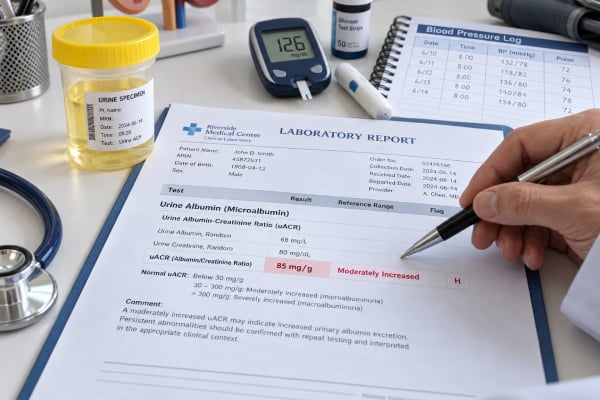
A urine microalbumin test looks for small increases in albumin leaking into the urine, often before standard urine protein dipsticks become strongly positive. Despite the name, it does not measure a smaller type of albumin. It measures ordinary albumin at relatively low concentrations. Today, laboratories and kidney guidelines increasingly use terms such as urine albumin, albuminuria, and urine albumin-creatinine ratio (uACR) instead of “microalbumin.” The most useful version is usually a spot uACR because it corrects urine albumin for urine concentration. Persistent albumin excretion of 30–299 mg/g creatinine is called moderately increased albuminuria and was historically called microalbuminuria. A high result can be an early sign of diabetic or hypertensive kidney damage, but one abnormal sample is not enough to diagnose chronic kidney disease. Exercise, fever, urinary infection, menstruation, uncontrolled blood sugar, and severe blood pressure elevation can cause temporary increases, so confirmation under stable conditions is often essential.
- “Microalbumin” usually refers to a small amount of ordinary albumin in urine, not a special small albumin molecule.
- A uACR of 30–299 mg/g is moderately increased albuminuria; 300 mg/g or more is severely increased.
- A spot urine albumin-creatinine ratio is generally more informative than albumin concentration alone because it corrects for urine dilution.
- People with diabetes commonly need periodic urine albumin testing because albumin leakage can appear before eGFR falls.
- Temporary illness, heavy exercise, infection, menstruation, high blood sugar, and uncontrolled blood pressure can raise the result and may justify repeat testing.
Table of Contents
- What a urine microalbumin test measures
- Normal and high urine microalbumin levels
- Diabetes, blood pressure, and kidney damage
- Test types, preparation, and collection
- Temporary versus persistent high results
- How abnormal results are confirmed
- Follow-up after a high microalbumin result
What a urine microalbumin test measures
A urine microalbumin test measures albumin that has crossed from the blood into the urine. Albumin is a major blood protein that helps maintain fluid balance and carries hormones, drugs, and other substances. Healthy kidney glomeruli act as selective filters and retain nearly all albumin in the circulation.
When the glomerular filtration barrier is stressed or damaged, albumin leakage can increase. Small increases matter because they can appear early in kidney disease. Traditional urine dipsticks are designed mainly to detect larger amounts of albumin, so low-level albuminuria may be missed. Sensitive laboratory assays can detect it earlier.
The term “microalbumin” is historical. It describes the amount of albumin in urine, not the size of the albumin protein. Modern reports may use “urine albumin,” “albumin/creatinine ratio,” “ACR,” or “uACR.” A dedicated urine albumin test can be reported as a concentration, but concentration changes with hydration. That is why uACR has become the preferred routine approach in many settings.
uACR divides urine albumin by urine creatinine. Creatinine helps account for whether the sample is dilute or concentrated. A single spot sample can therefore approximate daily albumin excretion without requiring a full 24-hour collection.
Normal and high urine microalbumin levels
The clearest way to interpret a microalbumin result is to know what unit and method the laboratory used. A concentration in mg/L cannot be interpreted with the same cutoffs as a ratio in mg/g.
For uACR, commonly used categories are:
| uACR | Albuminuria category | Meaning |
|---|---|---|
| <30 mg/g | Normal to mildly increased | Below the usual threshold for albuminuria. |
| 30–299 mg/g | Moderately increased | Historically called microalbuminuria; abnormal if persistent. |
| ≥300 mg/g | Severely increased | Historically called macroalbuminuria; associated with greater kidney and cardiovascular risk. |
A 24-hour urine albumin result may be reported in mg/day, with about 30 mg/day corresponding approximately to the lower threshold for abnormal albumin excretion. However, spot uACR is usually preferred for routine screening because collecting every urine void for 24 hours is cumbersome and easy to do incorrectly.
There is no sharp biological cliff at 30 mg/g. Risk rises along a continuum, so a person with uACR of 25 mg/g and many cardiovascular risk factors may still deserve careful follow-up, while a single result of 35 mg/g during fever may normalize. The threshold helps standardize clinical decisions, but context remains important.
If a report uses the older “microalbuminuria” label, it typically corresponds to the A2 range. For a broader explanation of the modern categories, see moderately and severely increased albuminuria.
Diabetes, blood pressure, and kidney damage
Diabetes is one of the most common reasons clinicians order urine albumin testing. Chronic high blood glucose can damage the glomerular filtration barrier and alter pressure within the kidney’s filtering units. Albumin may begin to leak before serum creatinine changes enough to lower eGFR.
Current diabetes standards recommend at least annual uACR and eGFR testing in all people with type 2 diabetes and in people with type 1 diabetes after about five years of disease. Once CKD is present, testing may occur more often according to eGFR, albuminuria category, treatment changes, and overall risk. A diabetic kidney disease urine test panel may combine uACR with urinalysis or other tests when the presentation is atypical.
High blood pressure is another major cause and amplifier of albuminuria. Elevated pressure can damage small renal blood vessels and increase glomerular pressure. Diabetes and hypertension often coexist, so both may contribute to a high result.
Albuminuria also predicts more than kidney outcomes. Persistent elevations are associated with higher cardiovascular risk. That makes urine albumin a useful risk marker even when kidney filtration remains near normal.
Not every high microalbumin result in a person with diabetes is automatically “diabetic kidney disease.” Blood in the urine, cellular casts, rapid loss of eGFR, a sudden large increase in protein, very short diabetes duration, or systemic symptoms can point toward another kidney disorder and may warrant nephrology evaluation.
Test types, preparation, and collection
There are three common ways to measure urine albumin:
- Spot uACR: measures albumin and creatinine in one urine sample and reports a ratio. This is generally the preferred routine test.
- Urine albumin concentration: measures albumin alone, often in mg/L or mg/dL. It is more sensitive to hydration because there is no creatinine correction.
- Timed or 24-hour urine albumin: measures the amount excreted over a defined collection period. It can be useful in selected cases but is inconvenient and prone to collection error.
A first-morning sample can reduce variation because it is less affected by daytime activity and fluid intake. A random clinic sample is still useful for screening. If an abnormal random value needs confirmation, a first-morning void is often a sensible next step. The uACR test explains why the ratio is less affected by dilution.
Fasting is usually unnecessary. Normal hydration is appropriate. Avoid trying to “prepare” by drinking excessive water because that can dilute urine albumin concentration and does not improve the validity of the sample. Strenuous exercise shortly before testing can temporarily raise albumin excretion, so many clinicians advise avoiding heavy exercise for about a day when practical.
If you have a urinary infection, fever, acute illness, or are menstruating, tell the clinician. Depending on the reason for testing, they may collect the sample anyway or wait until the temporary factor has resolved.
Temporary versus persistent high results
A high urine microalbumin result has two broad explanations: temporary albumin leakage or persistent kidney-related albuminuria.
Temporary increases can occur with:
- strenuous exercise;
- fever or acute infection;
- urinary tract infection;
- marked hyperglycemia;
- severe or poorly controlled hypertension;
- dehydration or acute hemodynamic stress;
- heart failure exacerbation;
- contamination with menstrual blood.
These situations are important because a single positive result obtained during one of them may not reflect a stable kidney condition. Repeating the test after recovery can prevent misclassification.
Persistent albuminuria can occur with diabetic kidney disease, hypertensive kidney disease, primary glomerular diseases, lupus nephritis, IgA nephropathy, obesity-related glomerulopathy, and several other kidney disorders. The pattern of other findings helps narrow the cause. A person with albuminuria plus red blood cells or casts on microscopy may have a different process than someone with long-standing diabetes, hypertension, stable urine sediment, and slowly increasing uACR.
The amount matters, too. Low-to-moderate albuminuria is common in early metabolic and vascular kidney disease. Very high albuminuria can reflect substantial glomerular injury and may contribute to low blood albumin and edema when total protein loss becomes severe. If urine protein is much higher than albumin alone suggests, clinicians may measure total protein or investigate non-albumin proteins.
How abnormal results are confirmed
Repeated measurement is the key difference between finding albumin once and diagnosing persistent albuminuria. Urinary albumin has significant within-person biological variation, even when no disease change has occurred.
In people with diabetes, two of three uACR specimens obtained over roughly three to six months are generally expected to be abnormal before classifying albuminuria as persistent, unless the overall clinical picture already establishes chronic kidney damage. A first-morning specimen is often preferred for confirmation.
The clinician also looks at eGFR and serum creatinine. These are complementary rather than interchangeable tests. uACR reflects kidney damage and glomerular leakage, while eGFR estimates filtration capacity. Someone can have significant albuminuria with a normal eGFR or reduced eGFR with little albuminuria.
Urinalysis adds further clues. Hematuria, casts, glucose, leukocytes, and urine concentration can change the differential diagnosis. If the first test was a semiquantitative albumin dipstick, a quantitative laboratory uACR is generally needed for confirmation.
Trends should be compared thoughtfully. A change from 40 to 55 mg/g may be ordinary biological variation. A sustained change from 40 to 400 mg/g is different and deserves faster evaluation, especially if kidney function also worsens.
Follow-up after a high microalbumin result
Follow-up depends on the level, persistence, and cause. For a modest first elevation, the next step may simply be a repeat uACR under stable conditions. For persistent albuminuria, care usually shifts toward reducing kidney and cardiovascular risk.
Blood pressure control is central. In many people with hypertension and albuminuria, an ACE inhibitor or angiotensin receptor blocker is used when appropriate because these medicines can lower intraglomerular pressure and albumin excretion. They require monitoring of serum creatinine and potassium after initiation or dose changes.
For people with diabetes or CKD, SGLT2 inhibitors can offer kidney and cardiovascular protection in many clinical situations. Other treatments, including nonsteroidal mineralocorticoid receptor antagonists and GLP-1-based therapies, may be considered for selected patients. The choice depends on kidney function, potassium, diabetes status, cardiovascular risk, blood pressure, and other medications.
Lifestyle measures support medical treatment: avoid smoking, keep dietary sodium within a healthful range, maintain an appropriate weight, exercise regularly when medically safe, and avoid unnecessary nephrotoxic drugs. Excessive protein restriction is not a do-it-yourself treatment; nutrition should be individualized, especially in advanced CKD.
Nephrology referral becomes more important with rapidly rising albuminuria, severe persistent albuminuria, declining eGFR, active urine sediment, resistant hypertension, uncertain cause, or advanced CKD. Urgent assessment is appropriate for severe swelling, shortness of breath, very low urine output, gross hematuria, or symptoms suggesting acute kidney injury.
The most useful interpretation of “high microalbumin” is therefore not simply “kidney damage yes or no.” It is a signal to confirm the result, pair it with kidney filtration and urine findings, identify the cause, and then reduce the risks that the result reveals.
Common questions about microalbumin results
A common question is whether a high microalbumin result can return to normal. It can. Albumin excretion may fall after better blood pressure or glucose control, recovery from acute illness, treatment of heart failure, or removal of another temporary trigger. Kidney-protective treatment can also reduce albuminuria. A lower value is generally encouraging, but the person still needs follow-up if there is established CKD because risk does not disappear after one improved result.
Another question is whether foamy urine means microalbuminuria. Usually, no. Small increases in albumin are not visible. Urine can foam from concentration, speed of urination, cleaning products in the toilet, or other harmless factors. Persistent marked foam accompanied by swelling may occur with heavy proteinuria, but only laboratory testing can quantify it.
People also ask whether drinking more water can lower microalbumin. Extra water may dilute a raw urine albumin concentration, but it does not treat the underlying leak. That is one reason uACR is preferred: the creatinine correction makes the result less sensitive to hydration. Deliberately overhydrating before a test can create a very dilute specimen and does not provide a better picture of kidney health.
In diabetes, the most useful comparison is often the uACR trend together with eGFR. A person whose uACR moves from 20 to 90 mg/g over repeated first-morning samples may be showing early progression even if eGFR remains normal. By contrast, a person with eGFR of 45 mL/min/1.73 m² may have significant CKD even if uACR is only 12 mg/g. The two markers describe different dimensions of kidney disease.
A high result can also occur without diabetes. Hypertension, glomerulonephritis, obesity-related kidney stress, heart failure, smoking, and several systemic diseases can increase albuminuria. That means a person without diabetes should not dismiss a repeated abnormal result as irrelevant. The clinician may evaluate blood pressure, urinalysis, kidney filtration, medication exposures, autoimmune symptoms, and other possible causes.
Finally, the old microalbumin terminology can create confusion when laboratory reports change. A report that once said “microalbumin 75 mg/g” may later say “uACR 75 mg/g, A2 albuminuria.” Those descriptions refer to the same general level of albumin leakage when the units and ratio are equivalent. The newer terminology simply emphasizes that albuminuria exists on a continuum and avoids implying that the molecule itself is unusually small.
A practical monitoring point is that treatment can lower albuminuria before it changes eGFR. If uACR falls substantially after blood pressure or diabetes therapy is optimized, that can indicate reduced kidney stress even though serum creatinine is unchanged. Clinicians usually look for a sustained change rather than reacting to one favorable sample.
Age and muscle mass also matter indirectly because the ratio uses urine creatinine. People with very low muscle mass may excrete less creatinine, which can make uACR somewhat higher for the same amount of albumin. This does not make the test invalid, but it is one reason repeat values and the full clinical picture are more reliable than a single borderline result.
For people testing regularly, consistency improves comparability. A first-morning sample collected under similar conditions, without a hard workout or active infection, reduces avoidable variation. Keeping track of the date, uACR, eGFR, blood pressure, and major medication changes can make the trend easier to interpret at follow-up visits.
Because albuminuria is also a cardiovascular risk marker, an abnormal result can influence more than kidney follow-up. Clinicians often use it as a reason to review blood pressure, lipid management, smoking, cardiovascular disease, and overall diabetes treatment. The benefit is not in labeling the urine result; it is in using an early signal to reduce preventable risk.
References
- KDIGO 2024 Clinical Practice Guideline for the Evaluation and Management of Chronic Kidney Disease 2024 (Guideline)
- 11. Chronic Kidney Disease and Risk Management: Standards of Care in Diabetes-2026 2026 (Guideline)
- Urine Albumin Measurements in Clinical Diagnostics 2024 (Review)
- Albuminuria in Cardiovascular, Kidney, and Metabolic Disorders: A State-of-the-Art Review 2025 (Review)
- Systematic review and meta-analysis of biological variation data of urine albumin, albumin to creatinine ratio and other markers in urine 2024 (Systematic Review)
Disclaimer
This information is educational and is not a diagnosis or treatment plan. A high urine albumin result should be interpreted with repeat testing, eGFR, blood pressure, diabetes status, medications, pregnancy status, and other urine findings. Seek prompt care for severe swelling, breathing difficulty, visible blood in urine, very low urine output, or acute illness.