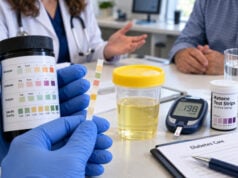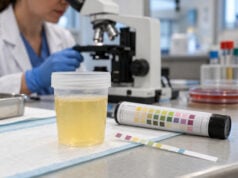
A urine bilirubin test checks for conjugated bilirubin, a water-soluble form of the yellow pigment produced when red blood cells are broken down. Normal urine is usually negative for bilirubin. A positive dipstick result therefore deserves attention because it can occur when the liver cannot properly process or excrete bile, or when bile flow is blocked. Causes range from hepatitis and medication-related liver injury to gallstones, bile duct narrowing, and other forms of cholestasis. The result is not a diagnosis by itself, and false-positive or false-negative dipstick reactions can occur. Interpretation is strongest when urine bilirubin is considered with symptoms, serum total and direct bilirubin, liver enzymes, alkaline phosphatase, and sometimes imaging. Dark urine, pale stools, itching, jaundice, abdominal pain, or fever can make a positive result more clinically important and may change how quickly follow-up is needed.
- A positive urine bilirubin result is abnormal and usually reflects conjugated bilirubin in the urine.
- Common concerns include liver injury, cholestasis, and obstruction of bile flow through the bile ducts.
- Urine bilirubin does not identify the exact cause; blood tests and sometimes ultrasound or other imaging are needed.
- A negative urine bilirubin result does not rule out all liver disease or all causes of jaundice.
- Fresh sample handling matters because light exposure, delay, vitamin C, and some medications can alter dipstick results.
Table of Contents
- What the Urine Bilirubin Test Measures
- What a Positive Urine Bilirubin Result Means
- Liver Disease and Positive Urine Bilirubin
- Bile Duct Obstruction and Cholestasis
- Bilirubin and Urobilinogen Patterns
- False-Positive and False-Negative Results
- Follow-Up After a Positive Urine Bilirubin Test
What the Urine Bilirubin Test Measures
The bilirubin pad on a urine dipstick is designed to detect conjugated bilirubin, also called direct bilirubin. Understanding why requires a short look at bilirubin metabolism.
Red blood cells are continuously removed from circulation as they age. Hemoglobin is broken down, and part of that process produces bilirubin. The first form is unconjugated bilirubin, which does not dissolve well in water. It travels through blood bound to albumin and normally cannot pass into urine in meaningful amounts.
The liver takes up unconjugated bilirubin and chemically conjugates it, making it water-soluble. Conjugated bilirubin is then secreted into bile, travels through the bile ducts, and reaches the intestine. If conjugated bilirubin builds up in the bloodstream because liver cells cannot excrete it normally or because bile flow is obstructed, the kidneys can filter it. That is when bilirubin may appear in urine.
This explains an important distinction: bilirubin in urine points toward conjugated hyperbilirubinemia rather than unconjugated hyperbilirubinemia. Conditions that mainly raise unconjugated bilirubin, such as many forms of hemolysis or Gilbert syndrome, generally do not produce a positive urine bilirubin test.
A standard urinalysis with dipstick and microscopy may report bilirubin simply as negative, trace, 1+, 2+, or a similar semiquantitative scale. The exact grading system depends on the strip manufacturer. The amount of color change is not a precise measurement of blood bilirubin and should not be used to estimate the severity of liver disease.
Urine bilirubin can sometimes become detectable before a person notices obvious yellowing of the skin or eyes. That makes an unexpected positive result potentially useful, but it still needs confirmation in clinical context. The next step is usually not to repeat the urine result indefinitely; it is to determine whether blood testing shows a corresponding hepatobiliary abnormality.
What a Positive Urine Bilirubin Result Means
A positive urine bilirubin result means conjugated bilirubin has reached the urine, which is not expected in healthy urine. The finding raises concern for a problem involving bilirubin handling by the liver or movement of bile through the biliary system.
The major possibilities can be grouped into two broad categories. The first is hepatocellular disease, in which injured liver cells have difficulty processing and transporting bilirubin. Examples include viral hepatitis, alcohol-associated liver injury, drug-induced liver injury, and advanced chronic liver disease. The second is cholestasis or biliary obstruction, in which bile cannot flow normally from the liver to the intestine.
A positive result does not distinguish these categories on its own. The pattern of blood tests often provides more direction. Alanine aminotransferase (ALT) and aspartate aminotransferase (AST) tend to be prominent when liver-cell injury is the dominant process. Alkaline phosphatase (ALP) and gamma-glutamyl transferase (GGT) may rise more noticeably when cholestasis or bile duct obstruction is prominent. Total and direct serum bilirubin show whether hyperbilirubinemia is present and how much is conjugated.
Symptoms matter as well. Dark brown or tea-colored urine can occur when conjugated bilirubin is excreted in larger amounts, although dark urine has many other causes. Jaundice, pale or clay-colored stools, generalized itching, nausea, reduced appetite, fatigue, or right upper abdominal discomfort can support a hepatobiliary explanation.
The result should also be read alongside the rest of the urine strip. A broader abnormal urinalysis pattern may contain findings unrelated to bilirubin, such as blood, protein, glucose, ketones, leukocyte esterase, or nitrite. These do not automatically share the same cause. For example, a patient can have bilirubinuria from liver disease and leukocytes from an unrelated urinary infection.
A single low-level positive result in a person without symptoms still deserves follow-up, especially if there is no known explanation. Urine bilirubin is not usually treated as a benign normal variant. At the same time, the dipstick is a screening tool, so a positive pad should not be equated with a specific diagnosis such as hepatitis, gallstones, or cancer without confirmatory evaluation.
Liver Disease and Positive Urine Bilirubin
Liver disease can produce bilirubinuria when hepatocytes cannot efficiently transfer conjugated bilirubin into bile or when inflammation causes intrahepatic cholestasis. The urine finding therefore can appear in both acute and chronic liver conditions.
Acute hepatitis is one example. Viral infections, immune-mediated hepatitis, ischemic injury, and toxic exposures can damage liver cells and disturb bilirubin transport. Depending on the cause and severity, serum ALT and AST may rise substantially. Urine bilirubin may accompany dark urine and jaundice when conjugated bilirubin accumulates in blood.
Medication, herbal product, and supplement-related liver injury is another possibility. Drug-induced liver injury can produce hepatocellular, mixed, or cholestatic biochemical patterns. A medication history should include prescription drugs, nonprescription products, herbal remedies, bodybuilding products, and dietary supplements, along with start dates and dose changes. A positive urine bilirubin result alone cannot identify a culprit, and medications should not be stopped without appropriate clinical advice unless urgent toxicity is suspected and emergency guidance directs otherwise.
Chronic liver disease can also be associated with bilirubinuria, particularly when disease is advanced enough to impair bilirubin excretion or when cholestasis develops. However, early fatty liver disease or other mild chronic liver disorders may have normal bilirubin, so a negative urine test cannot exclude them.
This is why bilirubin is different from markers used primarily for kidney disease. For instance, urine albumin on dipstick is interpreted mainly as a kidney filtration marker, whereas urine bilirubin points primarily toward hepatobiliary handling of conjugated bilirubin. The two may coexist but answer different clinical questions.
Blood tests help define the pattern. Clinicians commonly assess ALT, AST, ALP, total bilirubin, and direct bilirubin. GGT can help support a hepatobiliary source of an elevated ALP. Albumin and the international normalized ratio (INR) may be added when liver synthetic function or severity is a concern. Depending on the history, follow-up can include viral hepatitis testing, autoimmune markers, medication review, and other targeted studies.
The degree of urine dipstick positivity does not reliably grade liver damage. A 2+ result does not mean the liver is “twice as damaged” as with 1+. Hydration, urine concentration, timing, strip chemistry, and serum bilirubin all influence the urine reaction. Clinical severity is judged from the entire picture rather than the dipstick grade.
Bile Duct Obstruction and Cholestasis
A positive urine bilirubin test can also occur when bile flow is slowed or blocked, a process called cholestasis. Because conjugated bilirubin is normally secreted into bile, obstruction can force it back into the bloodstream, where the kidneys begin excreting it.
Extrahepatic obstruction may result from gallstones in the common bile duct, benign narrowing or strictures, inflammation, pancreatitis-related compression, or tumors involving the bile ducts, pancreas, gallbladder, or nearby structures. Intrahepatic cholestasis can occur within the liver itself from medications, infection, pregnancy-related disorders, or chronic cholestatic liver diseases.
The laboratory pattern can provide clues. Cholestatic disorders often produce a disproportionate rise in ALP relative to ALT and AST, frequently with increased GGT. Direct bilirubin may rise when obstruction is significant. These are patterns rather than absolute rules; mixed abnormalities are common.
Symptoms can help determine urgency. Jaundice with fever and right upper abdominal pain is particularly concerning because it can occur with acute cholangitis, an infected obstructed biliary system that may require urgent hospital treatment and biliary drainage. Severe or persistent abdominal pain, repeated vomiting, confusion, low blood pressure, or rapidly worsening illness also warrants urgent assessment.
In a stable patient with suspected obstruction, abdominal ultrasound is often an early imaging test because it can detect gallstones, gallbladder abnormalities, and dilation of larger bile ducts. Depending on the findings and clinical suspicion, clinicians may use magnetic resonance cholangiopancreatography, endoscopic ultrasound, computed tomography, or endoscopic retrograde cholangiopancreatography. The last is especially useful when intervention such as stone removal, stenting, or drainage is needed.
A positive urine bilirubin result does not prove that a duct is physically blocked. Hepatocellular injury can also impair bile transport, and some patients have mixed liver-cell injury and cholestasis. Conversely, very early or intermittent obstruction may not produce a strong urine result at every moment. The urine test is therefore a clue to the pathway, not an anatomical map of the biliary tree.
Bilirubin and Urobilinogen Patterns
Bilirubin and urobilinogen are related, but they are not interchangeable tests. Looking at both can sometimes clarify the physiology.
After conjugated bilirubin enters the intestine through bile, intestinal bacteria convert it into urobilinogen and related compounds. Some urobilinogen is reabsorbed and a small amount is normally excreted in urine. Changes in bile delivery, liver handling, or red blood cell breakdown can alter this pattern.
| General pattern | Urine bilirubin | Urine urobilinogen | Possible interpretation |
|---|---|---|---|
| Normal physiology | Negative | Low/normal amount | No evidence from these markers alone of conjugated bilirubin spilling into urine |
| Hepatocellular disease | May be positive | May be increased | Impaired liver handling can affect both bilirubin excretion and urobilinogen clearance |
| Complete or marked bile duct obstruction | Often positive | May be low or absent | Conjugated bilirubin reaches blood and urine while less bilirubin reaches the intestine |
| Predominantly unconjugated hemolysis | Usually negative | May be increased | More bilirubin is produced, but unconjugated bilirubin is not filtered into urine |
These are simplified patterns, not diagnostic formulas. Partial obstruction, mixed liver disease, antibiotics that change intestinal bacteria, specimen problems, and reagent-strip limitations can blur the expected combinations.
A useful practical point is that dark urine does not always mean urine bilirubin is positive. Blood, hemoglobin, myoglobin, dehydration, foods, and medications can also change urine color. Likewise, bilirubinuria can be present before a person notices dramatic color change. If color is the main concern, a urine color evaluation helps organize the broader differential rather than assuming every dark sample is caused by bilirubin.
Serum fractionation is more definitive when jaundice is present. Total bilirubin can be divided into direct and indirect components, helping distinguish predominantly conjugated from predominantly unconjugated hyperbilirubinemia. The urine dipstick is most useful as an accessible screening clue that prompts this more complete evaluation.
False-Positive and False-Negative Results
Urine bilirubin dipsticks are useful but vulnerable to preanalytical and chemical interference. A result that conflicts with the clinical picture should be confirmed rather than accepted in isolation.
False-negative results can occur when bilirubin in the sample degrades. Light exposure is important because bilirubin is light-sensitive. A specimen that sits in bright light or is tested long after collection may contain less detectable bilirubin than it did when freshly voided. Fresh collection and prompt testing improve reliability.
Vitamin C can suppress the reaction of some urine reagent strips. This is one reason a patient taking high-dose supplements can have an unexpectedly negative chemical result. An urine ascorbic acid interference result can be useful when the laboratory’s strip includes that pad. High nitrite concentrations and other method-specific factors may also reduce sensitivity on some systems.
False-positive reactions can occur when strongly colored medications or metabolites interfere with visual interpretation or reagent chemistry. Phenazopyridine, a urinary analgesic that turns urine orange, is a classic example of a substance that can complicate several dipstick pads. Some references also describe interference from chlorpromazine or other compounds depending on the assay.
The strip itself matters. Expired strips, moisture exposure, poor storage, incorrect timing, and manual reading outside the manufacturer’s specified interval can produce unreliable results. Automated readers reduce timing and color-perception variability but do not eliminate all chemical interference.
Urine concentration also affects how visually dramatic a result appears. A concentrated sample may look very dark, while a dilute sample may appear less impressive. Yet concentration alone does not create conjugated bilirubin from nothing. When the bilirubin pad is unexpectedly positive, the key question is whether the finding is reproducible and supported by blood tests.
If a result is surprising, a clinician may repeat urinalysis with a fresh protected sample and obtain serum bilirubin and liver chemistries. Repeating only the same dipstick without addressing collection, timing, or interference can reproduce the same uncertainty.
Follow-Up After a Positive Urine Bilirubin Test
The appropriate follow-up depends on symptoms, medical history, other urine findings, and whether blood tests are already abnormal. An unexplained positive urine bilirubin result generally warrants clinical review rather than watchful dismissal.
A typical evaluation starts with a history and examination. Important questions include recent illness, alcohol use, known liver or gallbladder disease, prior gallstones, abdominal pain, stool color, itching, weight loss, pregnancy when relevant, travel or infection risks, and all prescription medicines, over-the-counter products, and supplements.
Blood testing often includes total and direct bilirubin, ALT, AST, ALP, and sometimes GGT. Depending on the situation, clinicians may also check albumin, INR, complete blood count, kidney function, pancreatic enzymes, and targeted tests for viral, autoimmune, or metabolic liver disease.
The pattern of abnormalities guides the next step:
- **Predominantly hepatocellular pattern:** marked ALT/AST elevation may direct attention toward hepatitis, ischemic injury, toxins, medications, or other liver-cell disorders.
- **Predominantly cholestatic pattern:** prominent ALP/GGT elevation with direct hyperbilirubinemia raises concern for impaired bile flow and often leads to imaging.
- **Mixed pattern:** both liver-cell injury and cholestatic markers are substantially abnormal, so the differential remains broad.
- **Normal blood tests with an isolated urine positive:** repeating a properly handled sample and reviewing medications or assay interference may be reasonable, while persistent positivity deserves further evaluation.
Urgency changes when warning signs are present. Seek prompt medical care for new jaundice, significant right upper abdominal pain, repeated vomiting, or rapidly darkening urine with systemic illness. Fever or chills together with jaundice and abdominal pain requires urgent assessment because obstructed infected bile ducts can deteriorate quickly. Confusion, fainting, severe weakness, bleeding, or altered mental status are additional emergency features.
A negative repeat test can be reassuring when the initial result was likely analytical, but it should not override strong symptoms or abnormal serum testing. Likewise, a positive repeat result still does not specify the diagnosis. The value of urine bilirubin is that it identifies a pathway—conjugated bilirubin is reaching the urine—and directs attention to the liver and biliary system where the cause can be established with more specific testing.
References
- The EFLM European Urinalysis Guideline 2023 2024 (Guideline)
- Office-Based Urinalysis: A Comprehensive Review 2022 (Review)
- Measurement and clinical usefulness of bilirubin in liver disease 2021 (Review)
- ACG Clinical Guideline: Diagnosis and Management of Biliary Strictures 2023 (Guideline)
- AASLD practice guidance on drug, herbal, and dietary supplement–induced liver injury 2023 (Guideline)
- Bilirubinuria 2026 (Review)
Disclaimer
This article is for general education and does not diagnose the cause of a positive urine bilirubin test. Bilirubinuria can reflect liver or bile duct disease, and interpretation depends on symptoms, blood tests, medications, specimen handling, and sometimes imaging. Seek urgent medical care for jaundice with fever, chills, severe abdominal pain, confusion, fainting, or rapidly worsening illness.