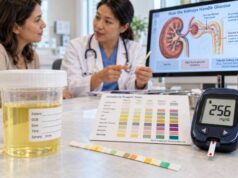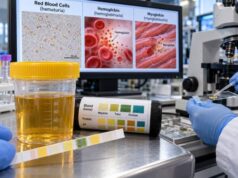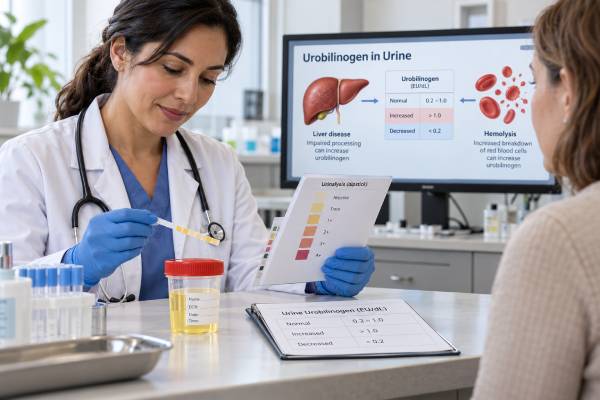
A urine urobilinogen test measures a breakdown product formed when intestinal bacteria process bilirubin from bile. Small amounts normally reach the urine, so a trace or low-level result is often expected. Higher urobilinogen can occur when red blood cells are being broken down faster than usual, as in hemolysis, or when the liver has trouble taking up and re-excreting urobilinogen, as in some forms of hepatitis or cirrhosis. Very low or absent urobilinogen can occur when little bilirubin reaches the intestine, including with significant bile duct obstruction, but medications, antibiotics, sample handling, and test-strip chemistry can also affect the result. Urobilinogen is therefore a clue rather than a stand-alone liver or blood test. Clinicians interpret it with urine bilirubin, symptoms, serum bilirubin, liver enzymes, blood counts, and hemolysis markers. One unexpected dipstick result usually needs context or confirmation before it is treated as evidence of disease.
- A small amount of urine urobilinogen is normal; many laboratories use a random-urine range around 0.1 to 1.0 mg/dL, but strip scales vary.
- High urobilinogen can occur with hemolysis or hepatocellular liver disease, including hepatitis and cirrhosis.
- Low or absent urobilinogen can occur with major bile duct obstruction or reduced intestinal bacterial conversion, including after some antibiotics.
- Urine bilirubin and urobilinogen are most useful when interpreted together because their patterns can help separate hemolysis, liver-cell injury, and cholestasis.
- Jaundice, pale stools, severe abdominal pain, fever, fainting, shortness of breath, or rapidly worsening weakness needs prompt medical assessment.
Table of Contents
- What Urobilinogen Measures
- Normal Urine Urobilinogen Range
- What High Urobilinogen Means
- What Low or Absent Urobilinogen Means
- Urobilinogen and Bilirubin Patterns
- False Results and Sample Quality
- Follow-Up Tests and When to Seek Care
What Urobilinogen Measures
Urobilinogen is part of the normal pathway the body uses to dispose of bilirubin. The urine test does not measure liver enzymes or red blood cells directly; it measures one downstream product of bilirubin metabolism.
The process starts when old red blood cells are broken down. Heme from hemoglobin is converted into bilirubin. This bilirubin initially circulates in an unconjugated, water-insoluble form and is carried to the liver. Liver cells conjugate it, making it water soluble, and secrete it into bile.
Bile carries conjugated bilirubin into the intestine. Gut bacteria then convert bilirubin into urobilinogen and related compounds. Most of these products leave the body in stool. Some urobilinogen is reabsorbed into the portal circulation and returns to the liver, where much of it is taken up and sent back into bile. A small fraction escapes hepatic uptake, reaches the bloodstream, is filtered by the kidneys, and appears in urine.
This pathway explains why urine urobilinogen can change in several different situations:
- More red blood cell breakdown can create more bilirubin and therefore more urobilinogen.
- Injured liver cells may clear reabsorbed urobilinogen less effectively.
- Blocked bile flow can reduce the amount of bilirubin reaching the intestine, so less urobilinogen is produced.
- Changes in intestinal bacteria can alter conversion of bilirubin to urobilinogen.
The dipstick urobilinogen pad is therefore best viewed as a metabolic clue. It may point toward a liver, biliary, or hemolytic process, but it cannot tell which specific disease is present.
Urobilinogen is also different from urine bilirubin. A urine bilirubin test detects water-soluble conjugated bilirubin that has entered the bloodstream and been filtered by the kidneys. Urobilinogen reflects what happened after bilirubin reached the intestine and was processed there.
Normal Urine Urobilinogen Range
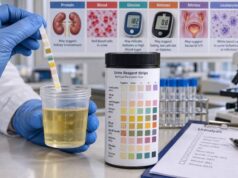
A small amount of urobilinogen is normally present in urine. One commonly cited random-urine range is about 0.1 to 1.0 mg/dL, and some test strips use a scale expressed in Ehrlich units or report categories such as normal, 1+, 2+, or higher.
Do not assume that every strip uses the same scale. The reference interval printed on the laboratory report or reagent-strip instructions is the correct one for that test.
A result may be displayed as:
- normal;
- 0.2 mg/dL;
- 1.0 mg/dL;
- 2.0 mg/dL or higher;
- semiquantitative grades rather than an exact concentration.
The result can also vary during the day. Urobilinogen excretion is not perfectly constant, and a single random sample provides only a snapshot.
A “normal” result does not rule out liver disease. Many liver conditions are better detected by serum alanine aminotransferase, aspartate aminotransferase, alkaline phosphatase, gamma-glutamyl transferase, total and direct bilirubin, albumin, and coagulation testing. Similarly, normal urine urobilinogen does not exclude hemolysis if other blood markers are abnormal.
A result at the low end of normal is not automatically a problem. The clinical concern is usually a clearly elevated result, an unexpectedly absent result in the right context, or a pattern that conflicts with urine bilirubin and symptoms.
The test can be useful because it is inexpensive and often already included on a standard dipstick. Its limitations are equally important: it is semiquantitative, vulnerable to interference, and not specific for one disease. For that reason, trends in serum bilirubin and liver or blood tests usually carry more clinical weight than small changes between two urine urobilinogen strip categories.
What High Urobilinogen Means
High urine urobilinogen most often suggests increased bilirubin production or reduced hepatic handling of urobilinogen. The two major clinical categories are hemolysis and hepatocellular liver disease.
Hemolysis
Hemolysis means red blood cells are being destroyed faster than normal. More heme is converted to bilirubin, more bilirubin reaches the intestine, and more urobilinogen can be produced and reabsorbed. This can raise urine urobilinogen.
Possible causes of hemolysis include autoimmune hemolytic anemia, certain inherited red blood cell disorders, transfusion reactions, mechanical destruction from some heart devices, infections, medications, and other conditions. The urine result alone cannot identify the cause.
When clinicians suspect hemolysis, they usually look for a broader pattern that may include:
- low hemoglobin or a falling blood count;
- increased reticulocytes as the bone marrow responds;
- increased lactate dehydrogenase;
- increased unconjugated bilirubin;
- low haptoglobin;
- characteristic findings on a peripheral blood smear;
- a direct antiglobulin test when immune hemolysis is suspected.
In intravascular hemolysis, free hemoglobin can also appear in urine. A urine hemoglobin test answers a different question from urobilinogen and can help when the dipstick is positive for blood without enough red blood cells on microscopy.
Hepatocellular liver disease
Hepatitis, cirrhosis, and other conditions that injure liver cells can also increase urinary urobilinogen. Damaged hepatocytes may not efficiently take up and re-excrete the urobilinogen that returns from the intestine through portal blood.
In liver disease, the pattern is not always simple. A person may have elevated urobilinogen, urine bilirubin, both, or neither depending on the type, timing, and severity of disease. Serum testing is much more informative than the urine urobilinogen value alone.
A comprehensive metabolic panel can provide several relevant blood measurements, although a full liver evaluation may also require direct bilirubin, gamma-glutamyl transferase, coagulation studies, viral testing, imaging, or other targeted tests.
High urobilinogen can occasionally occur without major disease, especially when the elevation is slight and isolated. The result should be repeated or confirmed when it conflicts with the rest of the clinical picture.
The degree of elevation does not reliably tell how severe the underlying problem is. A strongly positive strip is not a staging test for liver damage, and a modest increase does not prove that hemolysis is mild. Dipsticks use broad concentration steps, and the amount excreted in one urine sample depends on urine concentration as well as bilirubin metabolism.
Context can narrow the possibilities. For example, high urobilinogen with anemia, a high reticulocyte count, high LDH, low haptoglobin, and predominantly unconjugated hyperbilirubinemia fits a hemolytic pattern better than isolated liver injury. High urobilinogen with elevated AST and ALT, jaundice, medication or toxin exposure, or symptoms of acute hepatitis shifts attention toward the liver. These patterns still require a clinician to determine the cause.
Not every liver disorder raises urobilinogen. Conditions dominated by impaired bile flow may lower it instead, while mixed hepatocellular and cholestatic disease can produce less predictable results. The same person’s pattern can also change as an illness evolves. This is one reason a urine strip should not be used to monitor liver disease severity or treatment response by itself. Blood tests and, when indicated, imaging provide much stronger information.
What Low or Absent Urobilinogen Means
Low or absent urine urobilinogen can occur when too little bilirubin reaches the intestine to be converted by gut bacteria. Significant obstruction of bile flow is the classic example.
A blocked common bile duct from a gallstone, tumor, stricture, or severe cholestatic process can prevent conjugated bilirubin from entering the intestine. If less bilirubin reaches intestinal bacteria, less urobilinogen is formed. At the same time, conjugated bilirubin may back up into the bloodstream and appear in urine.
This is why the combination of positive urine bilirubin with very low or absent urobilinogen can support concern for substantial biliary obstruction. It does not prove obstruction, and partial or intermittent blockage may produce a different pattern.
Symptoms that make obstruction more concerning include:
- yellow skin or eyes;
- dark brown or tea-colored urine;
- pale or clay-colored stool;
- itching;
- right upper abdominal pain;
- nausea or vomiting;
- fever or chills, especially with jaundice.
Low urobilinogen can also occur when intestinal bacteria are reduced or altered. Some antibiotics can decrease bacterial conversion of bilirubin, so the urine result may fall without a blocked bile duct.
Sample problems are another common explanation for an unexpectedly low reading. Urobilinogen is not completely stable in stored urine, and delays or preservatives can lead to false-negative results. A fresh sample may be needed before a low value is considered clinically meaningful.
Because healthy people normally excrete only small amounts, the difference between “low-normal,” “not detected,” and “abnormally absent” depends heavily on the specific test method. A zero on a home strip should not be used to diagnose a bile duct blockage without medical evaluation.
Urobilinogen and Bilirubin Patterns
Urine urobilinogen becomes more useful when it is interpreted beside urine bilirubin. The two markers reflect different points in bilirubin metabolism, so their combination can suggest where the process may be disrupted.
| Clinical pattern | Urine bilirubin | Urine urobilinogen | Why the pattern may occur |
|---|---|---|---|
| Normal bilirubin handling | Negative | Small amount | Conjugated bilirubin enters bile, and a small fraction of intestinal urobilinogen reaches urine |
| Hemolysis | Usually negative | Often increased | More bilirubin is produced from red blood cell breakdown, but much of the excess bilirubin is unconjugated and not filtered into urine |
| Hepatocellular disease | May be positive | May be increased | Conjugated bilirubin may leak into blood while hepatic reuptake and processing of urobilinogen are impaired |
| Major bile duct obstruction | Often positive | Low or absent | Conjugated bilirubin backs up into blood while little reaches the intestine to form urobilinogen |
These are typical patterns, not diagnostic rules. Real patients may have mixed disease. For example, a person with chronic liver disease can also develop cholestasis, infection, bleeding, or hemolysis. Partial obstruction may still allow some bilirubin into the intestine. Early disease may not yet produce the textbook pattern.
The distinction between conjugated and unconjugated bilirubin is important. Unconjugated bilirubin is bound to albumin and is not water soluble, so it does not normally pass into urine. Conjugated bilirubin is water soluble and can be filtered by the kidney when blood levels rise.
This explains a common source of confusion: hemolysis can cause jaundice and high serum bilirubin while the urine bilirubin test stays negative. In that setting, increased urine urobilinogen may be a more compatible dipstick finding, but blood tests are still required to establish hemolysis.
False Results and Sample Quality
Urobilinogen dipsticks are convenient but vulnerable to chemical interference and sample handling. An isolated result that does not fit the symptoms or other tests should be questioned before it is acted on.
False-positive or misleadingly high readings can occur with substances that react with the strip chemistry or alter the urine color. Reported interferents include:
- phenazopyridine, a urinary pain-relief medication that turns urine orange;
- some sulfonamides;
- porphobilinogen on strips that use Ehrlich-type chemistry;
- aminosalicylic acid with some methods;
- high nitrite concentrations on certain reagent systems.
Porphobilinogen interference deserves attention because acute hepatic porphyrias can produce a falsely high “urobilinogen” result with some Ehrlich-reagent strips. This is uncommon, but it shows why a dipstick value should not substitute for the correct confirmatory test when the clinical picture points elsewhere.
False-low or false-negative results can occur when urine is stored too long, exposed to conditions that degrade the analyte, or mixed with certain preservatives. A fresh sample tested promptly is more reliable.
Other practical issues include:
- reading the strip too early or too late;
- using expired strips;
- storing strips in heat or humidity;
- comparing the pad with the wrong color scale;
- contamination of the specimen container;
- relying on a visual reading when urine is strongly pigmented.
If a result is important to a diagnosis, laboratory testing is preferable to repeated unsupervised home dipsticks. The laboratory can interpret the result alongside urine bilirubin, blood, protein, and other urinalysis markers and can order quantitative blood tests when needed.
Follow-Up Tests and When to Seek Care
Follow-up depends on whether the urobilinogen is high, low, isolated, or accompanied by symptoms. The next step is usually to evaluate the suspected liver, biliary, or blood process rather than to keep repeating urobilinogen alone.
For a high result, common follow-up may include:
- complete blood count;
- reticulocyte count;
- total and direct bilirubin;
- AST and ALT;
- alkaline phosphatase and gamma-glutamyl transferase;
- lactate dehydrogenase and haptoglobin when hemolysis is suspected;
- peripheral blood smear;
- direct antiglobulin testing when immune hemolysis is possible.
For low or absent urobilinogen with positive urine bilirubin or cholestatic symptoms, clinicians may focus on blood liver tests and imaging. Abdominal ultrasound is often an initial imaging study when gallstones or bile duct dilation are suspected, with additional imaging chosen according to the findings.
A mildly abnormal result in a person who feels well may simply be repeated with a fresh specimen and reviewed with medication use, recent antibiotics, and the rest of the urinalysis. This is especially reasonable when serum liver tests and blood counts are normal and there are no concerning symptoms.
Seek prompt medical assessment for new jaundice, dark urine with pale stools, persistent right upper abdominal pain, or unexplained fatigue and weakness. Fever, chills, jaundice, and significant abdominal pain can signal infection in an obstructed biliary system and require urgent evaluation.
Urgent care is also appropriate for possible severe anemia or hemolysis, including fainting, chest pain, shortness of breath at rest, rapid heartbeat, marked weakness, or rapidly worsening pallor or jaundice. These symptoms matter far more than the urine strip number itself.
The practical takeaway is simple: urine urobilinogen can help point toward the source of an abnormal bilirubin pathway, but it is a screening marker. The most useful interpretation comes from matching the result with urine bilirubin, the patient’s symptoms, and targeted blood testing.
References
- Office-Based Urinalysis: A Comprehensive Review 2022 (Review)
- Urinalysis 2023 (Review)
- Bilirubinuria 2023 (Review)
- BilR is a gut microbial enzyme that reduces bilirubin to urobilinogen 2024
- Bilirubin Hepatic and Intestinal Transport and Catabolism: Physiology, Pathophysiology, and Benefits 2025 (Review)
- Autoimmune Hemolytic Anemias: Challenges in Diagnosis and Therapy 2024 (Review)
Disclaimer
Urine urobilinogen is a screening marker and cannot diagnose liver disease, bile duct obstruction, or hemolysis on its own. Interpretation should include symptoms, urine bilirubin, medications, and appropriate blood tests. Seek prompt care for jaundice with fever or severe pain, fainting, shortness of breath, or other signs of serious illness.