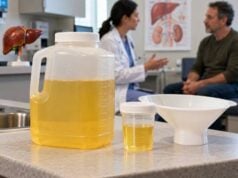
A 24-hour urine urea nitrogen test measures how much nitrogen from urea is excreted in urine over a full day. Urea is made in the liver when the body breaks down amino acids from dietary protein and from the body’s own tissues. Because a large share of nitrogen leaves the body as urea in urine, the test can help estimate recent protein intake, assess whether a prescribed protein diet is being followed, or contribute to calculations of nitrogen balance in selected patients. It is not a direct kidney filtration test, and a high or low result cannot be interpreted from the number alone. Protein intake, muscle breakdown, severe illness, hydration, kidney function, medications, and the completeness of the 24-hour collection can all change urinary urea nitrogen. In stable patients, the test is most useful when interpreted with diet history, body weight, blood urea nitrogen, creatinine, and the clinical reason for measuring protein metabolism.
- Urinary urea nitrogen, often abbreviated UUN, reflects nitrogen excreted as urea over 24 hours and is strongly influenced by protein intake and protein breakdown.
- Higher UUN can result from higher protein intake or increased tissue catabolism, while lower UUN can occur with low protein intake, reduced urea production, or incomplete collection.
- UUN can be used to estimate protein intake in metabolically stable people, but formulas are approximations and work less well during acute illness or rapidly changing nutrition.
- Nitrogen balance requires both nitrogen intake and nitrogen losses, so UUN alone is not the same as total nitrogen excretion.
- A missed urine sample makes UUN falsely low and can make estimated protein intake appear lower than it really is.
Table of Contents
- What Urine Urea Nitrogen Measures
- Why the Test Is Ordered
- How the Test Is Collected
- How Results Relate to Protein Intake
- High and Low UUN Results
- UUN, Kidney Function, and Nitrogen Balance
- Accuracy, Limitations, and Next Steps
What Urine Urea Nitrogen Measures
The test measures the nitrogen contained in urea that is excreted in urine over 24 hours, usually reported as grams of urea nitrogen per 24 hours (g/24 h). It does not report the total weight of urea itself. “Urea nitrogen” refers specifically to the nitrogen portion of the urea molecule.
Protein from food is broken into amino acids. The body uses those amino acids to build and repair tissues, make enzymes and hormones, and support many other functions. Amino acids that are not used for protein synthesis cannot be stored in a dedicated protein reserve. Their nitrogen-containing amino group is removed, and the liver converts much of that nitrogen to urea. The kidneys then excrete urea in urine.
For that reason, urinary urea nitrogen generally rises when protein intake rises, provided the person is in a relatively stable metabolic state and the kidneys can excrete urea. UUN can also rise when the body is breaking down its own protein, as may happen with infection, trauma, burns, surgery, corticosteroid exposure, or critical illness.
UUN is different from the blood urea nitrogen test. BUN measures urea nitrogen circulating in blood at one point in time. UUN measures how much urea nitrogen leaves through urine over an entire day. The two are related but answer different questions.
A 24-hour urine collection may also include creatinine, sodium, protein, or other analytes. When UUN is used to estimate nutrition, clinicians often review those results together rather than treating UUN as a stand-alone nutrition marker.
Why the Test Is Ordered
UUN testing is most often used when a clinician or dietitian needs an objective estimate of protein metabolism or protein intake.
Common uses include:
- Checking adherence to a prescribed low-protein diet in chronic kidney disease.
- Estimating dietary protein intake when food records may be incomplete or inaccurate.
- Assessing protein requirements in selected hospitalized or critically ill patients.
- Contributing to nitrogen-balance calculations in nutrition support.
- Evaluating whether protein intake is adequate after kidney transplantation or during recovery from illness.
- Supporting research on diet, kidney disease, and protein metabolism.
In routine outpatient care, many people never need UUN testing. A diet history, nutrition assessment, and standard kidney blood tests are often enough. The 24-hour test becomes more useful when the exact amount of protein consumed matters clinically or when reported intake does not match the patient’s laboratory results or nutrition status.
In chronic kidney disease, protein targets vary by CKD stage, diabetes status, nutritional risk, dialysis status, age, and treatment plan. UUN can help determine whether the actual intake is near the intended target, but it should not be used to prescribe protein restriction without broader assessment. Excessive restriction can contribute to inadequate calorie intake, loss of muscle, and protein-energy wasting.
Likewise, a high UUN does not automatically mean the diet contains “too much” protein. A physically active person, a patient recovering from surgery, and a patient with advanced CKD may have very different appropriate protein goals.
How the Test Is Collected
The test requires all urine produced during a defined 24-hour period. The laboratory usually provides a collection container and instructions for storage.
A typical collection works as follows:
- Choose a start time, often when you wake up. Urinate into the toilet and do not save this first sample. Record the time.
- Collect every urine sample after that, day and night, for the next 24 hours.
- Store the collection container as instructed, commonly refrigerated or in a cooler.
- At exactly the 24-hour stop time, urinate once more and add that final sample to the container.
- Return the collection promptly.
If you start at 8:00 a.m. on Monday, you discard the 8:00 a.m. Monday urine, collect everything after it, and save the final urine at 8:00 a.m. Tuesday.
Unless specifically instructed otherwise, eat your usual diet during the collection. If the purpose is to assess compliance with a prescribed protein intake, follow that prescribed diet consistently. A test done on an unusually low-protein or high-protein day may not represent the usual pattern.
Do not intentionally drink excessive water to increase urine volume. UUN is based on the total amount excreted, so concentration alone is not the main issue, but major changes in fluid intake can make the day unrepresentative and may complicate other measurements in the same collection.
If urine is missed or spilled, tell the laboratory or clinic. Restarting is often more accurate than submitting a knowingly incomplete specimen. The 24-hour urine collection errors guide explains how missed samples and incorrect timing affect timed urine tests.
How Results Relate to Protein Intake
In a metabolically stable person, UUN can be used to estimate how much protein is being consumed. The principle is that dietary protein contains nitrogen, and much of that nitrogen eventually appears in urine as urea.
A commonly used clinical approximation is:
Estimated nitrogen intake ≈ UUN + an allowance for non-urea nitrogen losses
Then:
Estimated protein intake ≈ total nitrogen intake × 6.25
The factor 6.25 is used because protein is roughly 16% nitrogen on average. One common simplified approach adds about 4 g of nitrogen per day to UUN to account for nitrogen lost in non-urea urine compounds, stool, skin, and other routes. With that method:
Estimated protein intake (g/day) ≈ [UUN (g/day) + 4] × 6.25
For example, if UUN is 8 g/day, the estimate would be:
(8 + 4) × 6.25 = about 75 g of protein/day.
This calculation is an approximation, not a direct measurement. Different clinical formulas use different correction terms, including body-weight-based adjustments. In CKD, the Maroni method and related protein-equivalent of nitrogen appearance calculations are often used under steady-state conditions.
The estimate becomes less reliable when the body is not in nitrogen equilibrium. A patient with sepsis may have high UUN because muscle protein is being broken down even if dietary protein intake is modest. Conversely, a patient with severe liver dysfunction may produce less urea from the same nitrogen load. Rapidly changing kidney function can also alter the relationship between urea production and urinary excretion.
For that reason, UUN works best as a physiologic cross-check on protein intake, not as a calorie-counter replacement.
High and Low UUN Results
Laboratory reference intervals differ, and there is no single UUN value that is ideal for everyone. Interpretation depends on protein intake, body size, kidney function, and metabolic state.
| Pattern | Possible explanations | What to check |
|---|---|---|
| High UUN | High protein intake | Diet history, supplements, protein shakes |
| High UUN | Increased protein breakdown | Fever, infection, surgery, trauma, burns, corticosteroids |
| Low UUN | Low protein intake or poor overall intake | Calories, appetite, weight trend, nutrition status |
| Low UUN | Incomplete urine collection | Urine creatinine, collection history, total volume |
| Low UUN | Reduced urea synthesis | Liver function and severe liver disease context |
| Variable UUN | Changing kidney function or diuretic/fluid status | Creatinine, eGFR, BUN, clinical course |
High UUN
A high result commonly means more nitrogen is being delivered to the liver for urea formation. That can come from dietary protein or from breakdown of body tissue. A high-protein diet, large servings of meat, protein powders, or intensive nutrition support can raise UUN. So can catabolic illness.
If UUN is being used to check a low-protein CKD diet, a high value may suggest intake above target, but the clinician should confirm that the collection is complete and that the patient is metabolically stable before concluding that diet adherence is poor.
Low UUN
Low UUN may fit with low protein intake, but it can also signal undernutrition if calorie intake is inadequate. The body may lose muscle even when UUN is not dramatically high, so nutrition status should be assessed with weight trend, appetite, muscle mass, and clinical context.
A falsely low result is common when part of the urine collection is missed. Comparing UUN with 24-hour urine creatinine can help identify a collection that appears implausibly incomplete.
UUN, Kidney Function, and Nitrogen Balance
UUN is related to kidney function, but it is not a direct measure of glomerular filtration. Tests such as serum creatinine and eGFR are used to estimate filtration. UUN instead reflects the intersection of urea production and urinary excretion.
When kidney function falls, urea can accumulate in blood, increasing BUN. Urinary urea excretion may no longer track dietary protein as cleanly if the patient is not in steady state. This is especially true during acute kidney injury, rapidly changing renal function, or dialysis.
In stable CKD, however, 24-hour UUN can still be useful for estimating protein intake. It can help clinicians distinguish a truly low protein intake from a dietary history that underestimates consumption. That can be valuable when trying to balance kidney-protective dietary goals against the need to preserve muscle and adequate nutrition.
UUN is also used in nitrogen balance calculations. Nitrogen balance compares nitrogen intake with nitrogen losses:
Nitrogen balance = nitrogen intake − nitrogen losses
A positive balance means more nitrogen is retained than lost, as may occur during growth or tissue rebuilding. A negative balance means nitrogen losses exceed intake, often reflecting inadequate intake or severe catabolism.
UUN does not equal total nitrogen loss. Urea is the major urinary nitrogen product, but nitrogen is also lost as urinary non-urea compounds, in stool, through skin, and from wounds or drains. Clinical formulas therefore add correction factors to UUN. In patients with major burns, open wounds, fistulas, or severe critical illness, routine correction factors can substantially underestimate true losses.
This is why nitrogen balance is most useful as one part of a nutrition assessment rather than a precise daily accounting system.
Accuracy, Limitations, and Next Steps
The most important limitation is the 24-hour collection itself. If urine is missing, UUN is falsely low; if collection extends beyond 24 hours, it may be falsely high. A test can be analytically perfect but clinically misleading because of collection error.
Other limitations include:
- Day-to-day changes in protein intake.
- Protein supplements that are forgotten during diet recall.
- Catabolic illness that raises UUN independent of food intake.
- Severe liver disease that changes urea synthesis.
- Rapidly changing kidney function.
- Dialysis, which removes urea by a route not captured in urine.
- Non-urinary nitrogen losses from diarrhea, wounds, drains, or burns.
If the goal is dietary protein assessment, repeat testing under stable conditions can be more useful than one isolated result. A clinician may compare UUN-derived protein estimates with a three-day food record or a dietitian’s assessment. Large disagreement may reveal either an inaccurate food record, a poor urine collection, or a metabolic condition that makes the equation unreliable.
The result should also be interpreted with blood markers. BUN can rise with high protein intake, dehydration, gastrointestinal bleeding, corticosteroid use, or reduced kidney function. Serum creatinine and eGFR help distinguish filtration issues from nutrition-related changes.
For people with CKD, the practical question is not whether UUN is “high” or “low” by itself. It is whether the estimated protein intake is appropriate for the individual’s kidney stage, nutritional status, treatment goals, and level of catabolism. A result that is appropriate for a healthy athlete may be excessive for one patient with nondialysis CKD and insufficient for another patient recovering from major surgery.
If a UUN result is unexpected, review the collection first, then review the diet and clinical state. That sequence prevents unnecessary dietary restriction based on a faulty sample and helps the test serve its real purpose: turning a full day of nitrogen excretion into useful nutrition information.
A repeated UUN measurement can be more informative than a single value when clinicians are trying to judge whether a nutrition plan is sustainable. For example, a patient with CKD may appear to meet a protein target on a food diary but show consistently higher UUN-derived intake. That mismatch may reveal uncounted snacks, protein supplements, large restaurant portions, or simply the limits of recall. The opposite pattern can identify patients whose intake is lower than they realize and who may be at risk for loss of muscle or inadequate energy intake.
The distinction between protein intake and catabolism is especially important in hospitalized patients. A high UUN during sepsis or after major surgery may reflect breakdown of body protein, so reducing dietary protein merely to lower the UUN could be harmful. In those settings, clinicians consider energy delivery, nitrogen balance trends, inflammatory state, renal replacement therapy, wound losses, and measured or estimated protein needs.
Because UUN is an excretion test, it also works best when urine output is adequate enough to collect reliably. Oliguria, dialysis, urinary obstruction, or rapidly changing renal function can make urinary nitrogen accounting incomplete. When those problems are present, nutrition assessment relies more heavily on the overall clinical picture rather than on a single formula.
References
- Correlation of the Dietary Protein Intake between Those Estimated from a Short Protein Food-Recall Questionnaire and from 24-Hour Urinary Urea-Nitrogen Excretion in Stages 3-4 Chronic Kidney Disease Patients. 2023
- Influence of protein intake on the changes in skeletal muscle mass after kidney transplantation. 2022
- Estimated protein intake and prognosis in hospitalised heart failure: A focus on patients with and without chronic kidney disease. 2025
- Higher daily protein intake was a protective factor for graft function of kidney transplant recipients in the early post-transplant period: a retrospective cohort study 2025
- Analysis of urinary urea nitrogen in critically ill surgical patients – Clinical variability and utility for caloric estimation. 2025
Disclaimer
This article is for general education and does not replace individualized medical or nutrition advice. UUN-based protein estimates are approximate and can be misleading during acute illness, changing kidney function, severe liver disease, dialysis, or incomplete urine collection. Do not change a prescribed protein target without guidance from your clinician or renal dietitian.