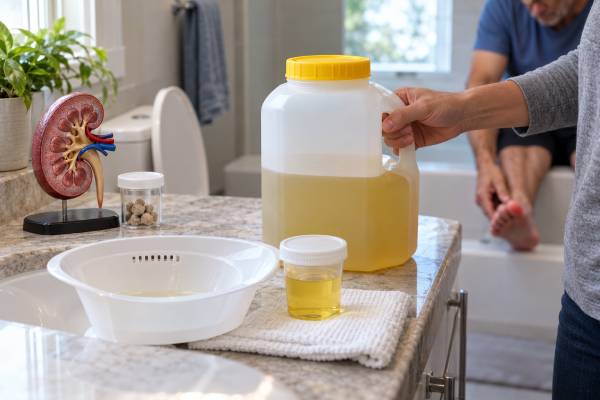
A 24-hour urine uric acid test measures how much uric acid your kidneys excrete during a full day. Uric acid forms when the body breaks down purines, substances found naturally in cells and in foods such as organ meats, some seafood, and meat. The test can help evaluate recurrent kidney stones, unusually high or low uric acid handling, and selected cases of gout. It is especially useful when clinicians need to know whether the kidneys are excreting a large uric acid load rather than simply measuring the uric acid level in blood. For kidney stones, the result must be interpreted with urine pH and urine volume because persistently acidic urine is often more important than the total uric acid amount in causing uric acid stones. Diet, medications, hydration, kidney function, and collection accuracy can all change the result, so one number rarely provides the whole answer.
- High 24-hour urine uric acid is called hyperuricosuria and can increase stone risk, but uric acid stones are strongly driven by low urine pH as well.
- Common adult hyperuricosuria cutoffs are roughly above 800 mg/day in men and 750 mg/day in women, although laboratories and guidelines may use different thresholds.
- Gout is diagnosed from the clinical picture and, when needed, joint-fluid crystal testing—not from a 24-hour urine uric acid test alone.
- Low urine volume and acidic urine can create uric acid stones even when uric acid excretion is not markedly high.
- Missing urine during collection makes uric acid excretion look falsely low, so timing and completeness matter.
Table of Contents
- What the 24-Hour Urine Uric Acid Test Measures
- Why the Test Is Ordered
- How to Collect the Sample
- What High and Low Results Mean
- Uric Acid Stones and Urine pH
- Gout and Uric Acid Excretion
- Follow-Up, Treatment, and Common Mistakes
What the 24-Hour Urine Uric Acid Test Measures
The test measures the total amount of uric acid excreted in urine over 24 hours, usually reported in milligrams per 24 hours (mg/24 h) or sometimes mmol/24 h. It is different from a serum uric acid test, which measures the concentration of uric acid circulating in the blood at one point in time.
Purines are broken down into uric acid. Most uric acid is handled by the kidneys, where it is filtered, reabsorbed, secreted, and reabsorbed again through kidney tubules before the final amount leaves in urine. That complex handling means blood uric acid and urine uric acid are related but not interchangeable.
A person can have high blood uric acid because the kidneys excrete too little uric acid, because the body produces too much, or because both processes are present. A 24-hour urine measurement can sometimes help clarify that physiology, although modern gout treatment decisions are usually based more heavily on the clinical history, serum urate, kidney function, and medication needs.
For kidney stones, a full-day measurement is particularly useful because it is often part of a broader 24-hour urine stone risk profile. Uric acid excretion is then interpreted with urine pH, volume, calcium, oxalate, citrate, sodium, and supersaturation.
Why the Test Is Ordered
The test is most useful when the clinical question is how much uric acid the kidneys are excreting over a day.
Common reasons include:
- Recurrent kidney stones, especially suspected uric acid stones.
- Calcium oxalate stones when hyperuricosuria may be contributing.
- Gout in selected patients when uric acid production and excretion patterns may affect management.
- Very high serum uric acid, especially when an unusual overproduction state is suspected.
- Myeloproliferative disorders, tumor lysis risk, chemotherapy, or other high-cell-turnover conditions.
- Rare inherited disorders of purine metabolism or renal urate handling.
- Monitoring response to dietary or medication changes in selected stone formers.
For many people with ordinary gout, a 24-hour urine test is not necessary. Serum urate, flare history, kidney function, tophi, stones, and medication tolerance usually guide treatment. The test is more likely to be ordered when the case is atypical, when stones are present, or when the clinician wants to distinguish high uric acid production from reduced renal excretion.
It is also important to separate gout from uric acid stones. Gout results from monosodium urate crystals depositing in joints and tissues, usually in the setting of sustained hyperuricemia. Uric acid stones form in urine, where acidity and concentration are critical. The conditions overlap, but one does not automatically imply the other.
How to Collect the Sample
The urine must represent a complete 24-hour period. The laboratory usually provides a large collection container and specific storage instructions.
A typical collection is done this way:
- On the start morning, urinate into the toilet and discard that first sample. Record the exact time.
- Collect every urine sample after that for the next 24 hours, including overnight urine.
- Keep the container refrigerated or stored as instructed.
- At the exact stop time the following morning, urinate one final time and add that urine to the container.
- Return the collection promptly.
If you begin at 7:15 a.m. Monday, the collection ends with a saved urine at 7:15 a.m. Tuesday.
Some laboratories use preservatives or provide special handling instructions for uric acid testing. Follow the container instructions rather than transferring urine into another bottle.
Unless your clinician tells you otherwise, maintain your usual diet and medication routine. A sudden low-purine diet during the collection may make the result unrepresentative if the goal is to measure usual uric acid excretion. On the other hand, if the test is specifically checking response to a prescribed diet or medication, follow that plan consistently.
Tell the ordering clinician about all medicines. Allopurinol, febuxostat, uricosuric drugs, diuretics, low-dose aspirin, and some other medications can affect uric acid handling. Do not stop prescription drugs just for the test unless instructed.
What High and Low Results Mean
Reference ranges vary by laboratory, sex, diet, and collection method. In stone medicine, hyperuricosuria is often defined as more than about 800 mg/day in men or 750 mg/day in women, but clinicians should use the laboratory’s range and the patient’s stone context.
High urine uric acid
High excretion can result from:
- A diet high in purines or large amounts of non-dairy animal protein.
- High cell turnover from some blood disorders, chemotherapy, or tumor lysis.
- Certain inherited purine metabolism disorders.
- Uricosuric medicines that intentionally increase uric acid excretion.
- Some kidney tubular urate-transport disorders.
- Increased overall uric acid production.
Hyperuricosuria can contribute to uric acid stones when urine is acidic and concentrated. It can also be associated with some calcium oxalate stones, although the relationship is more complex than a simple threshold.
Low urine uric acid
Low excretion may reflect low purine intake, reduced uric acid production, impaired kidney excretion, advanced kidney dysfunction, or the effect of urate-lowering medication that reduces production. An incomplete urine collection can also falsely lower the result.
A low 24-hour urine uric acid value does not mean gout is impossible. Many people with gout have hyperuricemia because the kidneys excrete too little uric acid relative to the body’s urate load. Their urinary amount may not be high.
| Pattern | Possible interpretation |
|---|---|
| High urine uric acid + low pH + low volume | Strong environment for uric acid crystallization |
| Normal urine uric acid + very low pH | Uric acid stone risk can still be substantial |
| High serum urate + low/normal urine uric acid | May fit reduced renal urate excretion, depending on kidney function and medications |
| High urine uric acid + normal serum urate | Can occur with high production or high dietary purine load |
Uric Acid Stones and Urine pH
For uric acid stones, urine pH is often more important than total uric acid excretion. Uric acid is much less soluble in acidic urine. As pH falls, more urate is converted to poorly soluble undissociated uric acid, which can crystallize.
A persistently low urine pH below about 5.5 is a major risk factor. Low urine volume makes the problem worse by concentrating uric acid. Hyperuricosuria adds more substrate, but a patient does not need all three abnormalities to form a stone.
People with obesity, insulin resistance, type 2 diabetes, metabolic syndrome, gout, and chronic diarrhea are more likely to have acidic urine. High intake of non-dairy animal protein can also increase dietary acid load.
This explains why treatment of uric acid stones often focuses on urine alkalinization, commonly with potassium citrate, rather than simply lowering uric acid production. Raising urine pH can prevent uric acid crystals and may even dissolve existing uric acid stones in appropriately selected patients who do not have an urgent obstruction or infection.
The target pH depends on whether the goal is prevention or stone dissolution and must avoid excessive alkalinization, which can favor calcium phosphate stones. Home urine pH monitoring may be used when clinicians are adjusting alkali therapy.
Increasing urine volume is another key strategy. Many stone-prevention guidelines aim for more than about 2.5 L of urine per day. The 24-hour urine volume test shows whether fluid intake is producing enough urine rather than simply estimating how much fluid was consumed.
Gout and Uric Acid Excretion
Gout develops when body urate levels remain high enough for monosodium urate crystals to form in joints or other tissues. The 24-hour urine test can provide information about uric acid handling, but it is not a diagnostic test for an acute gout attack.
During a typical flare, diagnosis is based on symptoms and examination, and the most definitive test is identification of monosodium urate crystals in joint fluid when aspiration is needed. Serum urate is helpful for long-term management, although it can occasionally be normal during an acute flare.
Historically, clinicians sometimes classified gout patients as “overproducers” or “underexcretors” using 24-hour urine uric acid. That distinction is less central to routine treatment today because most urate-lowering therapy is selected based on gout severity, kidney function, comorbidities, serum urate targets, and medication safety.
The urine test still matters when kidney stones complicate gout or when uricosuric treatment is being considered. Uricosuric drugs lower blood urate by increasing renal uric acid excretion, which can raise the uric acid load in urine and may be unsuitable for some people with a history of uric acid stones.
Diet can affect both gout and stones, but aggressive restriction is usually unnecessary. Limiting excessive alcohol, sugar-sweetened drinks, organ meats, and large amounts of certain animal proteins may help. Weight management and treatment of metabolic syndrome can also improve the broader urate and urine-pH environment.
Follow-Up, Treatment, and Common Mistakes
An abnormal result should lead to a cause-specific plan, not treatment of the laboratory number alone.
For a stone former, follow-up may include stone analysis, urine pH, 24-hour urine volume, calcium, oxalate, citrate, sodium, creatinine, and supersaturation. If uric acid stones are confirmed, alkalinization and higher fluid intake are often central. If hyperuricosuria is marked, dietary purine reduction or a xanthine oxidase inhibitor such as allopurinol may be considered, depending on the stone type and other findings.
For gout, treatment may include allopurinol, febuxostat, or other therapies selected according to the patient’s history and kidney function. The aim is usually to control serum urate and prevent crystal deposition rather than to force a particular 24-hour urine uric acid number.
Common interpretation errors include:
- Assuming high urine uric acid proves gout.
- Assuming normal urine uric acid excludes uric acid stones.
- Ignoring urine pH and volume.
- Comparing results collected on very different diets without context.
- Forgetting that allopurinol and other medicines change the result.
- Trusting a low value despite a clearly incomplete collection.
- Treating a laboratory cutoff as an absolute boundary between low and high stone risk.
A 24-hour urine creatinine measurement can help judge whether the collection is plausible. If the result is surprising, review the start and stop times, missed voids, recent diet, medication use, and acute illness before assuming the physiology truly changed.
Urgent care is needed for kidney stone symptoms accompanied by fever, chills, inability to urinate, severe persistent vomiting, one functioning kidney with obstruction, or uncontrolled pain. Those situations require evaluation for obstruction or infection rather than waiting for metabolic urine testing.
The most useful way to read a 24-hour urine uric acid result is to ask three questions: How much uric acid is being excreted? How acidic and concentrated is the urine? What clinical problem are we trying to prevent? Those questions connect the number to gout care or stone prevention far better than a high/low flag alone.
For stone prevention, trends can be more useful than one isolated measurement. Suppose a patient starts with urine pH 5.1, urine volume 1.5 L/day, and uric acid excretion of 850 mg/day. After treatment, volume rises to 2.6 L/day and pH to 6.1 while uric acid excretion remains 800 mg/day. Stone risk may still improve substantially because the urine is more dilute and uric acid is more soluble. By contrast, lowering uric acid excretion without correcting persistent pH 5.0 may leave a major driver untreated.
Dietary interpretation also requires context. Purines are concentrated in organ meats, some seafood, and large portions of red meat, but total dietary pattern matters more than memorizing a list. A very high animal-protein intake can increase uric acid generation and acid load, while sugar-sweetened beverages containing fructose may worsen hyperuricemia in susceptible people. For many patients, gradual changes in portion size, beverage choice, body weight, and overall dietary quality are easier to sustain than severe restriction.
Serum urate and urine uric acid can also move in opposite directions after medication changes. A uricosuric drug may lower serum urate by increasing urinary excretion, while a xanthine oxidase inhibitor lowers uric acid production and can lower both serum urate and urinary uric acid. This is one reason the medication list must be reviewed before interpreting a repeat collection.
If hyperuricosuria is extreme, especially when accompanied by very high serum urate or a history suggesting rapid cell turnover, clinicians may investigate causes beyond diet. Conversely, a mildly elevated 24-hour value in an otherwise stable stone former is usually interpreted as one modifiable factor among several rather than as evidence of a rare metabolic disease.
The timing of repeat testing should match the clinical question. A clinician may repeat the collection after a sustained diet change, after urine-alkalinizing treatment has been adjusted, or after a medicine that changes uric acid handling has reached a stable dose. Repeating too soon can capture a transition rather than the new usual state. When the goal is stone prevention, the repeat report is most informative when urine volume, pH, citrate, sodium, calcium, oxalate, and uric acid are reviewed together.
A high result also does not show where the uric acid came from. Urinary uric acid reflects both purines made inside the body and purines supplied by food. Fever, tissue breakdown, some blood disorders, cancer treatment, and rapid weight loss can increase production in certain settings. This is why a result that is far outside the expected range, especially when accompanied by other abnormal laboratory findings, deserves a broader clinical review rather than a diet-only explanation.
References
- Kidney Stone Pathophysiology, Evaluation and Management: Core Curriculum 2023 2023 (Review)
- 24-Hour Urinary Chemistries and Kidney Stone Risk 2024
- Kidney Stone Prevention 2023 (Review)
- Kidney stone disease: risk factors, pathophysiology and management 2025 (Review)
- Metabolic Evaluation and Recurrence Prevention – EAU Guidelines on Urolithiasis – Uroweb 2026 (Guideline)
Disclaimer
This article is for general education and does not replace medical diagnosis or treatment. Uric acid results must be interpreted with urine pH, urine volume, kidney function, diet, medications, and the reason for testing. Do not start or stop urate-lowering or alkalinizing medicine based on a 24-hour urine value without guidance from a healthcare professional.