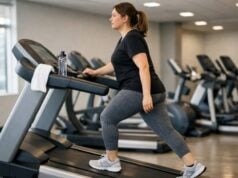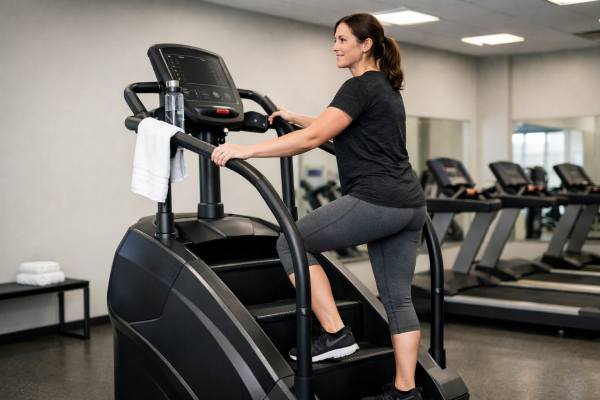
The 25-7-2 StairMaster workout is simple enough to go viral: climb on a StairMaster at level 7 for 25 minutes, twice a week. The appeal is obvious. It sounds structured, challenging, and easier to remember than a full training plan. The bigger question is whether it actually works for weight loss or whether it is just another catchy gym trend.
The honest answer is that it can help with weight loss, but not because there is anything magical about those numbers. It works when it helps you burn more energy, stay consistent, and fit cardio into a broader plan that also includes nutrition, recovery, and usually some strength training. The routine can be effective, but it is not automatically the best choice for every beginner, every body, or every goal.
Table of Contents
- What 25-7-2 actually means
- Can it help you lose weight?
- Why it feels so effective
- What level 7 really means
- A beginner progression that actually works
- Form and safety mistakes to avoid
- How to fit it into a full fat-loss plan
- Results, plateaus, and when to adjust
What 25-7-2 actually means
The usual version of the workout is straightforward:
- 25 minutes on the StairMaster
- 7 as the machine level or speed setting
- 2 sessions per week
That format is easy to remember, which is part of why people like it. You do not need to memorize intervals, heart-rate zones, or a complex split. You just show up and climb.
Still, there are two details that matter more than the trend usually admits.
First, level 7 is not a universal intensity. StairMaster settings are not perfectly comparable across every machine and gym brand. On one machine, level 7 may feel like solid moderate-to-hard work. On another, it may feel closer to a threshold effort if you are deconditioned or carrying more body weight. That means the workout is not truly standardized, even though it sounds precise.
Second, the workout is often promoted as a no-hands challenge. That advice is oversimplified. Light hand contact for balance is fine, especially if you are new, tired, or using a faster step rate. What matters is avoiding heavy leaning, hanging off the rails, or turning the session into a posture-compromised grind. Safe mechanics matter more than following the trend perfectly.
The 25-7-2 format also says nothing about your warm-up, your weekly training load, or your recovery. In real life, those details matter. A person who already lifts four days per week and adds two StairMaster sessions may respond very differently from someone who is mostly sedentary and jumps straight into 25 hard minutes.
So, treat 25-7-2 as a template, not a law. It is best understood as a memorable StairMaster routine, not a special fat-loss formula. If you need to start at 15 minutes, use level 4 or 5, or break the session into shorter blocks, you are not doing it wrong. You are just adjusting the template to your current fitness level.
If you are comparing it with other machine-based cardio options, a broader look at the best cardio machines for weight loss can help you decide whether the StairMaster is truly the best fit for your joints, fitness, and preferences.
Can it help you lose weight?
Yes, the 25-7-2 StairMaster workout can help with weight loss, but only in the same way any useful cardio plan can help: by increasing energy expenditure, improving fitness, and making it easier to maintain a calorie deficit over time.
That distinction matters. The workout itself does not create fat loss unless your overall weekly energy balance supports it. If your food intake rises enough to cancel out the extra activity, the scale may barely move. On the other hand, if the routine helps you stay active without burning you out, it can become a practical part of a sustainable fat-loss plan.
Here is where the workout genuinely earns some credit:
- It is time-efficient compared with lower-intensity cardio.
- It uses a large amount of lower-body muscle mass, which makes it feel demanding fast.
- It is low impact compared with running, so many people can tolerate it better.
- It is easy to repeat because the rules are simple.
But there are limits. The exact 25-7-2 formula has not been studied as a unique weight-loss protocol. The evidence is stronger for stair climbing in general and for aerobic exercise as part of a broader obesity-management strategy. That means the routine is supported indirectly, not because researchers proved that 25 minutes at level 7 twice weekly is the perfect setup.
For many people, two weekly sessions are a good start, not the whole answer. If those sessions are your only structured activity, your total weekly cardio volume may still be modest. That is why results depend heavily on what else you do across the week: walking, lifting, step count, food intake, sleep, and how active you are outside the gym.
The most realistic way to think about it is this: 25-7-2 can be a helpful tool, especially if it replaces sedentary time or less efficient exercise that you do not enjoy. It is less useful if it becomes your excuse to ignore food quality, protein intake, recovery, and total activity.
If your main goal is fat loss, make sure the workout sits inside a bigger structure that includes a calorie deficit and an appropriate amount of weekly cardio for weight loss. The StairMaster can support that process well. It just cannot do all the work on its own.
Why it feels so effective
One reason 25-7-2 gets so much attention is that the StairMaster makes people feel like they are working hard almost immediately. That perception is not imaginary.
Stair climbing combines continuous lower-body work with a fairly upright posture and repeated single-leg support. Your glutes, quads, calves, and cardiorespiratory system all have to keep contributing. Because each step is a small lift of body mass, the effort stacks up quickly, especially if you are moving continuously for 20 to 25 minutes.
That leads to several real-world advantages.
It packs intensity into a short session
For many people, steady climbing reaches a challenging effort level faster than flat treadmill walking. That can make a 25-minute session feel substantial without requiring a full hour of exercise.
It is lower impact than running
There is still loading through the legs, but there is no repeated pounding like jogging on a treadmill. For some people, that makes the StairMaster easier to recover from than higher-impact cardio.
It can improve work capacity
If you stick with it, the workout often improves your tolerance for hard continuous effort. That can show up as a lower heart rate at a given machine setting, better breathing control, or the ability to finish the session without staring at the clock.
It can feel more “athletic” than other machines
Some people simply find it more engaging than a bike or elliptical. Enjoyment matters more than people think. The best cardio routine is often the one you can repeat consistently for months.
That said, what makes the StairMaster effective can also make it easy to overrate. A workout feeling brutal does not automatically mean it is superior. A tough session can still be too hard to recover from, too hard to repeat, or too likely to drive extra hunger in some people.
This is why the smartest way to use the machine is not to chase the biggest sweat. It is to find a repeatable effort that challenges you without wrecking your legs, posture, or motivation. If you want more ideas beyond this specific trend, a more complete guide to StairMaster workouts for fat loss can help you see how intervals, steady-state work, and progression options compare.
The key takeaway is simple: the workout feels effective because stair climbing is a demanding form of cardio. That is a real strength. The mistake is assuming that demanding always means best.
What level 7 really means
“Level 7” sounds precise, but in practice it should be treated as a rough target, not a universal standard. The better question is not “Can you survive level 7?” but “What effort level does this create for you?”
For most people, the right effort for a 25-minute StairMaster session is somewhere between moderate and hard. You should be breathing noticeably harder, sweating by the middle of the session, and able to speak only in short phrases, not full relaxed conversation. But you should not feel out of control, panicked, or forced to grip the machine to stay upright.
A useful checkpoint is this:
- Too easy: You could comfortably hold a long conversation, your posture stays casual, and the session feels more like a warm-up than training.
- About right: You can maintain the pace, but the last third requires focus. Your breathing is elevated, and you feel your legs working without losing form.
- Too hard: You are leaning heavily on the rails, your steps become sloppy, or you need repeated mini-breaks to finish.
This is where many beginners go wrong. They assume that because the trend says level 7, starting lower means the workout “doesn’t count.” In reality, the best starting level is the one that allows good mechanics for the full session. For some people that may be 4 or 5 at first. For others, 7 may already feel manageable. A fitter person may need more than 7 to get the intended training effect.
You also need to account for your body weight, height, step rhythm, and training history. Someone with a strong walking or hiking background may adapt quickly. Someone with low cardio fitness or a history of knee irritation may need a slower ramp.
That is why perception and control matter more than trend loyalty. Your level should let you climb with:
- an upright torso
- full-foot contact rather than tiptoeing
- only light balance support if needed
- a steady rhythm you can keep without panic
If level 7 destroys your form, it is not your level yet. If level 7 feels easy, the number itself is not special enough to drive results. The workout only works when the setting matches your current capacity.
A beginner progression that actually works
The biggest reason people quit 25-7-2 is not that the StairMaster is ineffective. It is that they start too aggressively, get smoked, and decide they “hate cardio.” A better approach is to progress into the trend instead of forcing it on day one.
Here is a practical way to do that.
| Starting point | Session target | Frequency | Main goal |
|---|---|---|---|
| Brand new to cardio or returning after time off | 10 to 15 minutes at a comfortable level, often 3 to 5 | 2 times per week | Learn the machine and finish with good form |
| Basic gym fitness but little StairMaster experience | 15 to 20 minutes at level 5 to 6 | 2 times per week | Build tolerance without needing the rails |
| Comfortable with moderate cardio | 20 to 25 minutes at level 6 to 7 | 2 times per week | Reach a sustainable moderate-to-hard effort |
| Already adapted to the machine | 25 minutes at level 7 or higher as appropriate | 2 times per week | Use progression through pace, time, or recovery quality |
The simplest rule is to change only one variable at a time. Increase either:
- session length,
- machine level, or
- weekly frequency,
but not all three at once.
For example, you might start with 15 minutes at level 5 for two weeks. Then move to 18 to 20 minutes. Only after that feels controlled would you nudge the level upward. This reduces soreness, improves confidence, and gives your joints time to adapt.
A warm-up also makes the workout feel much better. Spend 3 to 5 minutes at an easier setting before you settle into your working pace. That short ramp can make the difference between a manageable session and a miserable one.
If your knees, hips, or low back get cranky, do not force the trend. You may do better with joint-friendly low-impact cardio or a more flexible beginner cardio workout plan that includes multiple options.
The goal is not to impress the machine. The goal is to build a routine you can repeat next week, then the week after that, without dreading it.
Form and safety mistakes to avoid
A StairMaster session can look simple from across the gym, but technique changes the training effect a lot. Small mistakes can turn a productive cardio session into something less safe, less efficient, and harder on your joints.
The most common mistake is hanging on the handrails. Heavy support takes work away from your legs and changes your posture. It often turns the session into a bent-over shuffle instead of an upright climbing pattern. Light touch for balance is fine. Pulling your body weight with your arms is not.
Another common mistake is tiptoeing. Many people stay on the front edge of the step and rush the motion. That can overload the calves, make balance worse, and reduce how naturally the hips and glutes contribute. Aim for a more stable foot placement and a controlled push through the step.
Also avoid starting too fast. A pace that feels exciting in minute three may feel awful in minute twelve. If you routinely blow up halfway through the workout, you are not training the intended quality. You are just overshooting your effort.
Watch for these issues:
- excessive forward lean
- white-knuckle gripping of the rails
- choppy, bouncing steps
- inability to maintain a steady rhythm
- pain that sharpens as the session continues
Some discomfort is normal. Burning legs and heavier breathing are part of the workout. Sharp knee pain, dizziness, chest symptoms, or feeling unstable are different. Those are reasons to stop and reassess.
Who should be especially cautious? People with poor balance, significant knee or hip pain, recent lower-body injury, severe deconditioning, or medical conditions that make hard exertion risky should scale carefully and consider professional guidance before using a challenging stair-climbing routine.
The safest approach is not the “hardcore” version of the trend. It is the version that lets you move smoothly, stay upright, and recover well enough to do another session later in the week. Safe consistency beats dramatic effort every time.
How to fit it into a full fat-loss plan
The best version of 25-7-2 is the one that complements the rest of your week instead of competing with it.
For many people, two StairMaster sessions work best when paired with two or three strength workouts and a solid daily movement baseline. That combination covers more of what actually drives long-term body-composition change: calorie expenditure, fitness, muscle retention, and routine consistency.
A simple weekly structure might look like this:
- 2 StairMaster sessions using the 25-7-2 format or a scaled version
- 2 to 3 strength sessions focused on full-body basics
- daily walking or step goals to keep total activity up
- 1 to 2 easier days for recovery, mobility, or light movement
That setup usually works better than hammering the StairMaster every day. More is not automatically better. Too much hard cardio can leave your legs flat, reduce lifting performance, and make you less active the rest of the day.
Nutrition matters just as much. If you want fat loss without feeling wrecked, prioritize:
- enough protein to support muscle retention and satiety
- meals that are filling enough to keep post-workout hunger manageable
- sensible meal timing if you train better with food in your system
- hydration, especially if you sweat heavily on the machine
If you need structure, pairing this routine with a 3-day strength training plan and practical pre-workout meal ideas can make the whole week feel more organized.
This is also where lifestyle factors show up. Poor sleep, high stress, and inconsistent eating can make a challenging cardio routine feel much harder than it should. So if the workout suddenly feels impossible, do not assume you need more willpower. Sometimes you need better recovery.
Used well, 25-7-2 is not your whole fat-loss plan. It is one efficient cardio block inside a bigger system that supports progress.
Results, plateaus, and when to adjust
If you do the workout consistently and your nutrition supports fat loss, what should you expect? Usually not a dramatic transformation from the routine alone. What you are more likely to notice first is better conditioning.
Within a few weeks, many people see signs like:
- lower perceived effort at the same machine setting
- less need to grip the rails
- better recovery between sessions
- improved confidence with longer or harder cardio
- gradual changes in body weight or waist size when diet is aligned
That is the right order. Fitness improvements often show up before obvious visual changes. If you are only judging the routine by whether the scale drops immediately, you may miss real progress.
At the same time, do not stay emotionally attached to the exact 25-7-2 numbers forever. If progress stalls, ask what actually needs adjusting.
Sometimes the answer is not more StairMaster. It may be:
- looser eating on weekends
- reduced daily movement outside workouts
- poor sleep that drives hunger and low energy
- an effort level that is too hard to recover from
- a routine you have outgrown and need to vary
If the workout feels easier but your results are flat, you can progress by raising the level slightly, adding a few minutes, or using one session as intervals and the other as steady climbing. If the workout feels punishing and your legs are always fried, the better move may be to scale back and improve overall consistency.
This is also why it helps to track more than scale weight. Waist measurements, workout quality, step count, photos, and how your clothes fit can all tell you whether the plan is working.
If your progress has clearly stalled, a guide to workout plateaus in fat loss can help you troubleshoot training issues, and a better daily weigh-in protocol can stop normal fluctuations from making you think the routine has failed.
The bottom line is simple: 25-7-2 works best as a repeatable cardio habit, not a miracle formula. If it helps you train hard enough, often enough, and long enough to stay consistent, it can absolutely support weight loss. If it beats up your joints, wrecks your recovery, or makes you dread exercise, it is not the right version of cardio for you, no matter how popular it is.
References
- WHO guidelines on physical activity and sedentary behaviour 2020 (Guideline)
- Exercise training in the management of overweight and obesity in adults: Synthesis of the evidence and recommendations from the European Association for the Study of Obesity Physical Activity Working Group 2021 (Review)
- Obesity Management in Adults: A Review 2023 (Review)
- Stair-climbing interventions on cardio-metabolic outcomes in adults: A scoping review 2024 (Review)
- Aerobic Exercise and Weight Loss in Adults: A Systematic Review and Dose-Response Meta-Analysis 2024 (Systematic Review)
Disclaimer
This article is for general educational purposes only. It is not medical advice and is not a substitute for personalized guidance from a doctor, registered dietitian, or qualified exercise professional, especially if you have heart symptoms, balance problems, joint pain, or other medical concerns that could affect exercise safety.
If this article helped, please share it on Facebook, X, or any other platform you prefer so more people can find it.