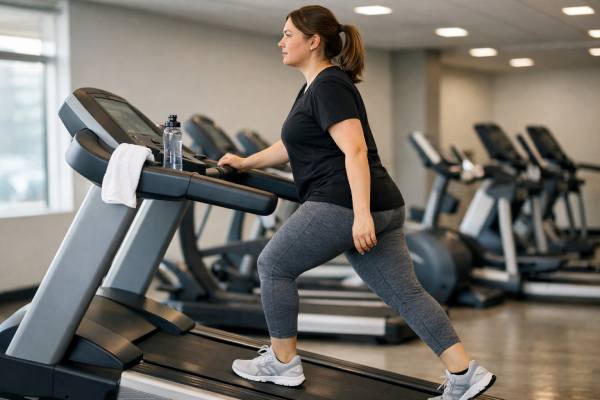
The 12-3-30 treadmill workout is simple to describe and much harder to do: set the treadmill to a 12% incline, walk at 3.0 mph, and keep going for 30 minutes. That combination has made it popular with people who want a clear cardio routine without running. For weight loss, it can be useful because it raises heart rate, increases calorie burn compared with flat walking, and gives you a repeatable workout you can track over time.
What it does not do is guarantee fat loss on its own. Results still depend on your overall calorie balance, weekly activity, recovery, and consistency. Below is a practical look at how the workout works, how many calories it may burn, what results are realistic, and how to use it safely.
Table of Contents
- What 12-3-30 actually is
- Why it can help with weight loss
- How many calories 12-3-30 burns
- What results you can expect
- How to start and progress safely
- How to fit it into a weekly plan
- Mistakes, modifications and cautions
What 12-3-30 actually is
The name is the workout prescription:
- 12 = 12% incline
- 3 = 3.0 miles per hour
- 30 = 30 minutes
On paper, that sounds straightforward. In practice, the 12% incline is what changes everything. A 3.0 mph walk on a flat treadmill feels moderate for many people. A 3.0 mph walk at 12% incline feels much more demanding because you are climbing continuously, even though the belt speed stays the same.
That is why the workout appeals to so many people. It creates a challenging session without the impact and coordination demands of running. It is also easy to remember, easy to repeat, and easy to compare from week to week.
Why the workout feels harder than expected
Incline changes the energy cost quickly. Your calves, glutes, hamstrings, and cardiovascular system all work harder. Many people notice that the limiting factor is not leg speed but breathing, calf fatigue, or the feeling of climbing without a break.
That said, the branded 12-3-30 format itself has limited direct research behind it. The stronger evidence comes from the broader research on moderate-intensity aerobic exercise, incline walking, and structured walking for weight management. In other words, the exact viral name is less important than the exercise principles behind it.
What counts as the “real” version
Most people do best with a short warm-up before the main 30 minutes. A practical session looks like this:
- Walk 3 to 5 minutes at 0% to 4% incline.
- Build to the target incline gradually.
- Complete up to 30 minutes of the main work.
- Cool down for 3 to 5 minutes.
If you cannot do the full prescription yet, that does not mean the workout is not for you. It usually means you need a progression. In fact, many people get better early results by starting below the full settings and building up instead of forcing the full version on day one.
For a broader look at incline-based treadmill training, see treadmill walking for weight loss.
Why it can help with weight loss
The 12-3-30 workout can support weight loss for one main reason: it increases energy expenditure in a format many people can repeat consistently. That matters more than hype.
Its biggest strength is efficiency without running
Walking uphill is an effective way to make a moderate-speed walk much harder. That can be useful for people who do not enjoy jogging, cannot tolerate running volume, or want a structured cardio option that feels productive.
Compared with flat treadmill walking, 12-3-30 typically:
- Raises heart rate more
- Increases calorie burn
- Challenges the glutes and calves more
- Feels more “workout-like,” which can improve adherence for some people
Compared with running, it usually creates less impact on the joints, but it is not automatically easier on the body. The steep incline can load the calves, Achilles tendon, plantar fascia, and lower back more than people expect.
If you are comparing cardio styles, incline walking vs running for fat loss is often less about which burns more in one session and more about which you can do well, recover from, and repeat for months.
It can improve more than the scale
Even before major weight changes happen, many people notice:
- Better walking endurance
- Lower heart rate at the same effort
- Easier daily movement and stairs
- Higher weekly activity levels
- Improved workout confidence
Those changes matter. Fat loss is rarely driven by a single workout. More often, one repeatable routine helps you move more overall, stay more consistent, and build momentum.
It is not a special “fat-burning” shortcut
The workout is effective because it is challenging and repeatable, not because the numbers 12, 3, and 30 are magic. You do not need to hit a mystical fat-burning setting for it to work. Total energy expenditure, consistency, diet quality, and recovery matter more than chasing a perfect zone.
That is why people sometimes get misled by heart-rate talk. The best cardio for fat loss is usually the type you can recover from and perform often enough to support a sustainable calorie deficit. If that topic interests you, fat-burning heart rate zone is worth understanding in a practical, non-mythical way.
How many calories 12-3-30 burns
This is the question most people care about, and the honest answer is: it depends, but usually enough to matter.
A 12% incline at 3.0 mph is a demanding walk. Using standard treadmill energy-cost estimates, the main 30-minute portion often lands in a range that is noticeably higher than flat walking at the same speed.
A practical calorie estimate
The table below gives rough estimates for the 30-minute main set only, not including warm-up or cool-down.
| Body weight | Estimated calories |
|---|---|
| 130 lb | About 255 to 260 |
| 160 lb | About 310 to 320 |
| 190 lb | About 370 to 380 |
| 220 lb | About 430 to 440 |
| 250 lb | About 490 to 495 |
These are estimates, not guarantees. Actual calorie burn can swing meaningfully based on:
- Body weight and body composition
- Fitness level
- Whether you hold the rails
- Treadmill calibration
- Stride length and walking mechanics
- Whether the 30 minutes is truly continuous
Why treadmill numbers are often off
Many treadmill displays overestimate calories, especially if they do not account for your actual body weight or if you lean on the handrails. Gripping the rails can make the workout much easier and cut the true energy cost.
If you want the estimate to be closer to reality:
- Enter your correct body weight if the machine allows it
- Keep posture tall instead of folding over the console
- Use handrails only briefly for balance
- Let your legs do the work
A useful way to think about 12-3-30 is not as a precise calorie equation but as a high-value walking workout. It usually burns a meaningful number of calories for 30 minutes, and that adds up when done consistently.
For perspective against other activities, calories burned by common exercises can help you compare treadmill incline walking with cycling, running, and other cardio options.
What results you can expect
Reasonable expectations are what keep people from quitting too early.
What can happen in the first few weeks
In the first 2 to 4 weeks, the most common results are fitness-related rather than dramatic scale changes:
- You finish the session with less stopping
- Your breathing settles faster after workouts
- Calves and glutes adapt
- The same settings feel less intimidating
- You start building a reliable exercise habit
That is progress, even if the scale is slow.
What it can do for fat loss
If you do 12-3-30 three times per week, many adults will create roughly 750 to 1,300 extra calories of weekly activity expenditure from those sessions alone. At five times per week, that may rise to roughly 1,250 to 2,100 or more, depending on body size and effort.
That is meaningful, but it still does not guarantee a specific amount of weight loss. Appetite changes, weekend eating, water retention, sleep, and lower movement later in the day can all shrink the real-world effect.
That is why 12-3-30 works best when it supports a broader plan that also includes food choices that keep you in a manageable deficit. If that piece is missing, the workout can improve fitness and still produce only modest fat loss.
A useful companion concept is simple calorie deficit steps. Exercise helps, but diet usually determines whether the deficit actually shows up on the scale.
What a realistic timeline looks like
Over 8 to 12 weeks, many people can expect some mix of:
- Better cardiovascular fitness
- Improved work capacity
- More confidence with cardio
- Gradual fat loss, especially if food intake is aligned
- Stronger lower-body endurance
The scale result may be modest even when the habit is working. That is normal. Weight loss is not linear, and treadmill workouts do not override biology. A better question than “How much will I lose from this one workout?” is “Can this become a routine I will still be doing in three months?”
If the answer is yes, that is where the payoff is. For a grounded timeline, how long it takes to lose weight is usually slower and steadier than social media makes it look.
How to start and progress safely
The biggest mistake beginners make is treating 12-3-30 like a pass-fail test. It is better to treat it like a training goal.
Start with control, not ego
If you are new to exercise, coming back after time off, carrying more body weight, or dealing with sore calves or knees, jump straight to a lower version first. The workout should feel challenging, but it should not force you to cling to the rails or stop every few minutes.
Use these technique cues:
- Stand tall and keep your chest open
- Take short, controlled steps
- Look forward, not down
- Lightly brush the rails only if needed for balance
- Keep the effort hard enough to notice, but not panicked
A proper warm-up matters here more than people think. A few minutes of easy walking before the incline ramps up can make the session feel better and reduce the shock to your calves and Achilles. For more on setup and recovery, see warm-up, mobility and recovery.
A simple beginner progression
| Week | Suggested setting | Main goal |
|---|---|---|
| 1 | 6% incline, 2.5 to 2.8 mph, 15 to 20 minutes | Learn posture and rhythm |
| 2 | 8% incline, 2.8 to 3.0 mph, 20 minutes | Build tolerance |
| 3 | 10% incline, 3.0 mph, 20 to 25 minutes | Increase climbing ability |
| 4 and beyond | 12% incline, 3.0 mph, up to 30 minutes | Reach full version gradually |
You can also progress one variable at a time:
- Increase time first
- Then increase incline
- Increase speed last if needed
When to back off
Modify or stop the workout if you notice sharp pain, limping, dizziness, chest discomfort, severe breathlessness, or worsening Achilles, foot, or knee symptoms. Some people do better with flatter walking, cycling, or other low-impact cardio for bad knees while they build fitness first.
How to fit it into a weekly plan
The best version of 12-3-30 is the one that fits into a complete routine, not the one that crowds everything else out.
How often should you do it?
For most people, 2 to 4 sessions per week is a strong starting range. That is often enough to improve fitness and help with fat loss without beating up your calves and feet.
Doing it daily is not automatically better. More sessions can help only if you recover well, keep your step count up outside the gym, and do not compensate by moving less later in the day.
A balanced weekly example
A simple week might look like this:
- Monday: 12-3-30
- Tuesday: Full-body strength training
- Wednesday: Easy walk or recovery day
- Thursday: 12-3-30
- Friday: Full-body strength training
- Saturday: Optional third 12-3-30 or longer easy walk
- Sunday: Rest or light movement
This kind of setup works well because the incline walking helps with calorie expenditure and conditioning, while strength training helps preserve muscle during weight loss. That combination is usually better than cardio-only plans.
If you want a larger framework, weekly workout schedule for weight loss can help you organize cardio and recovery. Pairing it with strength training for weight loss is often the smarter long-term strategy than adding more and more treadmill time.
Do not forget your non-workout movement
One overlooked point: hard cardio can make some people less active later in the day. If you crush a treadmill session and then sit far more afterward, the net calorie benefit may shrink. Try to keep your overall daily movement steady instead of treating the workout as permission to be inactive for the rest of the day.
Mistakes, modifications and cautions
The 12-3-30 workout is useful, but it is easy to do badly.
Common mistakes
The most common problems are:
- Starting too hard. A 12% incline is steep. Many people need a build-up.
- Holding the rails the whole time. That often turns the workout into an assisted climb and lowers the real workload.
- Turning it into punishment cardio. The goal is consistency, not exhaustion.
- Ignoring pain signals. Calf, foot, and Achilles problems can build quickly.
- Assuming it replaces nutrition. You can out-eat the calorie burn more easily than most people think.
- Skipping strength training. Fat loss is better supported when you also work to keep muscle.
Useful modifications
You do not have to force the full recipe. Good alternatives include:
- 10-3-20
- 8-3-25
- 6-2.5-30
- Interval style, such as 5 minutes hard incline and 2 minutes easier
These versions can still be very effective. A slightly easier plan that you repeat for months beats a perfect-looking plan you abandon after one sore week.
For people starting from a lower fitness base or carrying more weight, a workout plan for obese beginners may be a better first step than jumping straight into steep incline walking.
Who should be more cautious
Talk to a clinician before starting a hard incline-walking plan if you have:
- Known heart or lung disease
- Chest pain with exertion
- Significant balance problems or vertigo
- Achilles tendinopathy, plantar fasciitis, or recent ankle or foot injury
- Severe knee, hip, or back pain
- A recent surgery or major change in mobility
The best cardio machine for weight loss is not always the treadmill. For some people, a bike, elliptical, pool, or flatter walking plan is simply more sustainable and safer.
The bottom line is straightforward: 12-3-30 can be a very good weight-loss workout, but it is not mandatory, magical, or ideal for everyone. It works best when it is adjusted to your body, your recovery, and the rest of your routine.
References
- WHO guidelines on physical activity and sedentary behaviour 2020 (Guideline)
- Exercise training in the management of overweight and obesity in adults: Synthesis of the evidence and recommendations from the European Association for the Study of Obesity Physical Activity Working Group 2021 (Review)
- Physical activity in the management of obesity in adults: A position statement from Exercise and Sport Science Australia 2021 (Position Statement)
- 2024 Adult Compendium of Physical Activities: A third update of the energy costs of human activities 2024 (Review)
- Exercise Treatment of Obesity 2021 (Review)
Disclaimer
This article is for general educational purposes only and is not a substitute for medical advice, diagnosis, or treatment. If you have heart, joint, foot, balance, or mobility issues, or you are unsure whether steep incline walking is appropriate for you, speak with a qualified healthcare professional before starting.
If this article helped you, please share it on Facebook, X (formerly Twitter), or any other platform you use.